
Complete Guide to All Air Conditioner Types
Understand every AC type — from central systems to portable units — so you can choose the right one for your space, budget, and cooling needs
EXPLORE AC TYPESWhy This Guide Matters: Choosing the wrong AC type leads to wasted money, poor comfort, and high energy bills. This guide covers every major air conditioner category available in the US market, explaining how each works, who it's best for, and what it really costs — so you can buy with confidence.
Common Residential Air Conditioner Types
These are the six most widely used AC types in American homes. Each has distinct advantages depending on your home's layout, existing infrastructure, and cooling requirements.

Central Air Conditioning
Central AC uses a split system with an outdoor condenser and indoor evaporator coil connected to a network of ducts that distribute cooled air throughout your entire home. A thermostat controls the system, and the same ductwork can be shared with a furnace for year-round climate control. This is the most common cooling solution for larger American homes that already have ductwork installed.
Central systems are measured in tons (1 ton = 12,000 BTU) and typically range from 1.5 to 5 tons for residential applications. They offer the most even temperature distribution of any AC type and can be paired with advanced features like smart thermostats, zoning systems, and air purification.
Advantages
- Even cooling across all rooms
- Increases home resale value
- Works with existing ductwork
- Integrates with smart thermostats
Disadvantages
- High installation cost
- Requires existing ductwork
- Duct leaks reduce efficiency
- Single thermostat for all zones
Ductless Mini-Split AC
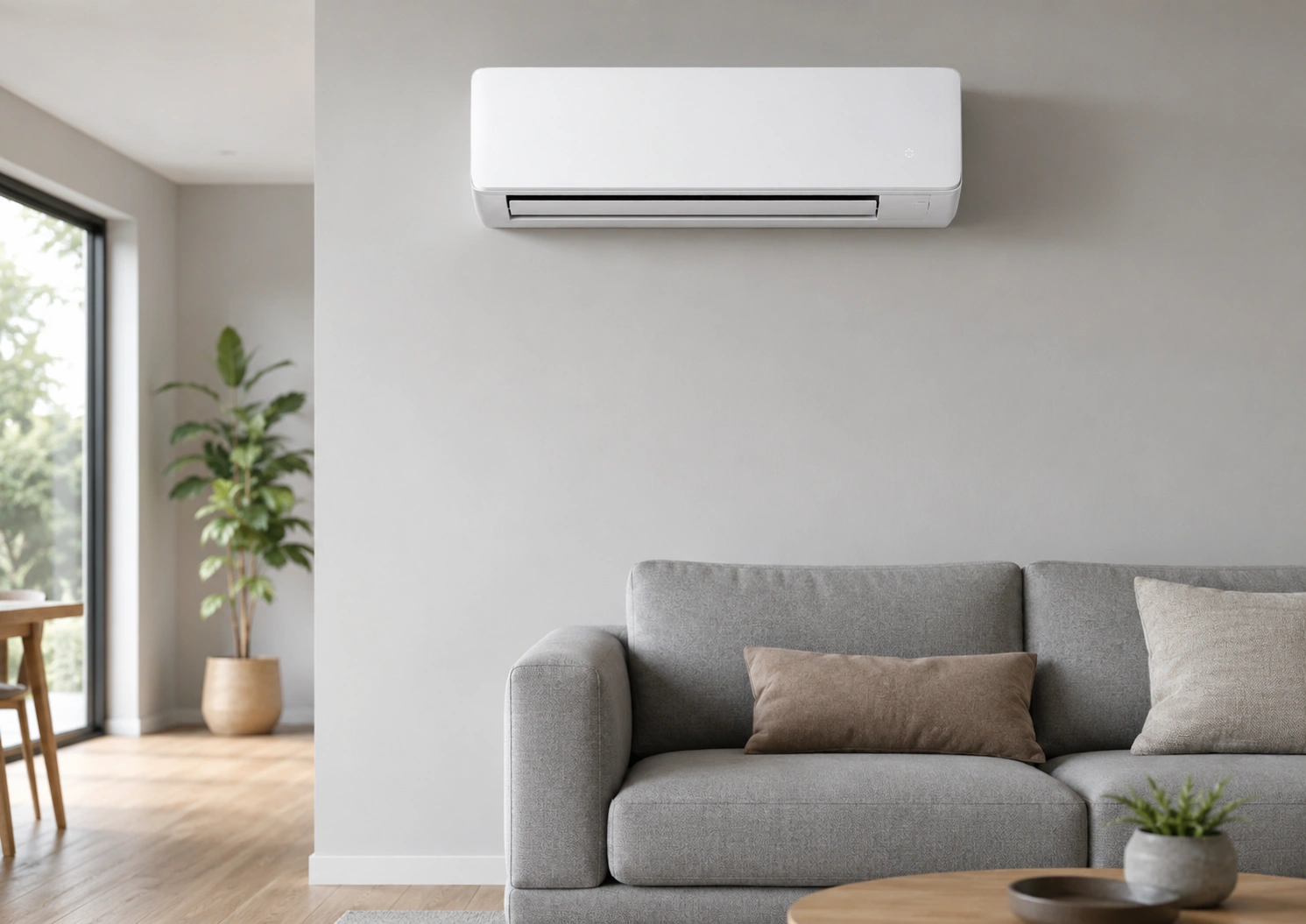
A ductless mini-split system consists of an outdoor compressor connected to one or more indoor air handlers via refrigerant lines — no ductwork required. Each indoor unit can be controlled independently, making it ideal for zone cooling. These systems are especially popular in homes without existing ducts, room additions, and spaces where preserving architectural integrity matters.
Multi-zone systems can connect up to 8 indoor units to a single outdoor compressor, providing customized temperature control for every room. Mini-splits are among the quietest AC types available, with indoor units operating as low as 19 decibels. They also tend to be highly efficient, with many models achieving SEER ratings above 20.
Advantages
- No ductwork needed
- Independent zone control
- Extremely quiet operation
- High energy efficiency
Disadvantages
- Higher cost per BTU than central
- Indoor units visible on walls
- Requires professional installation
- Multiple units for whole home
Window Air Conditioner
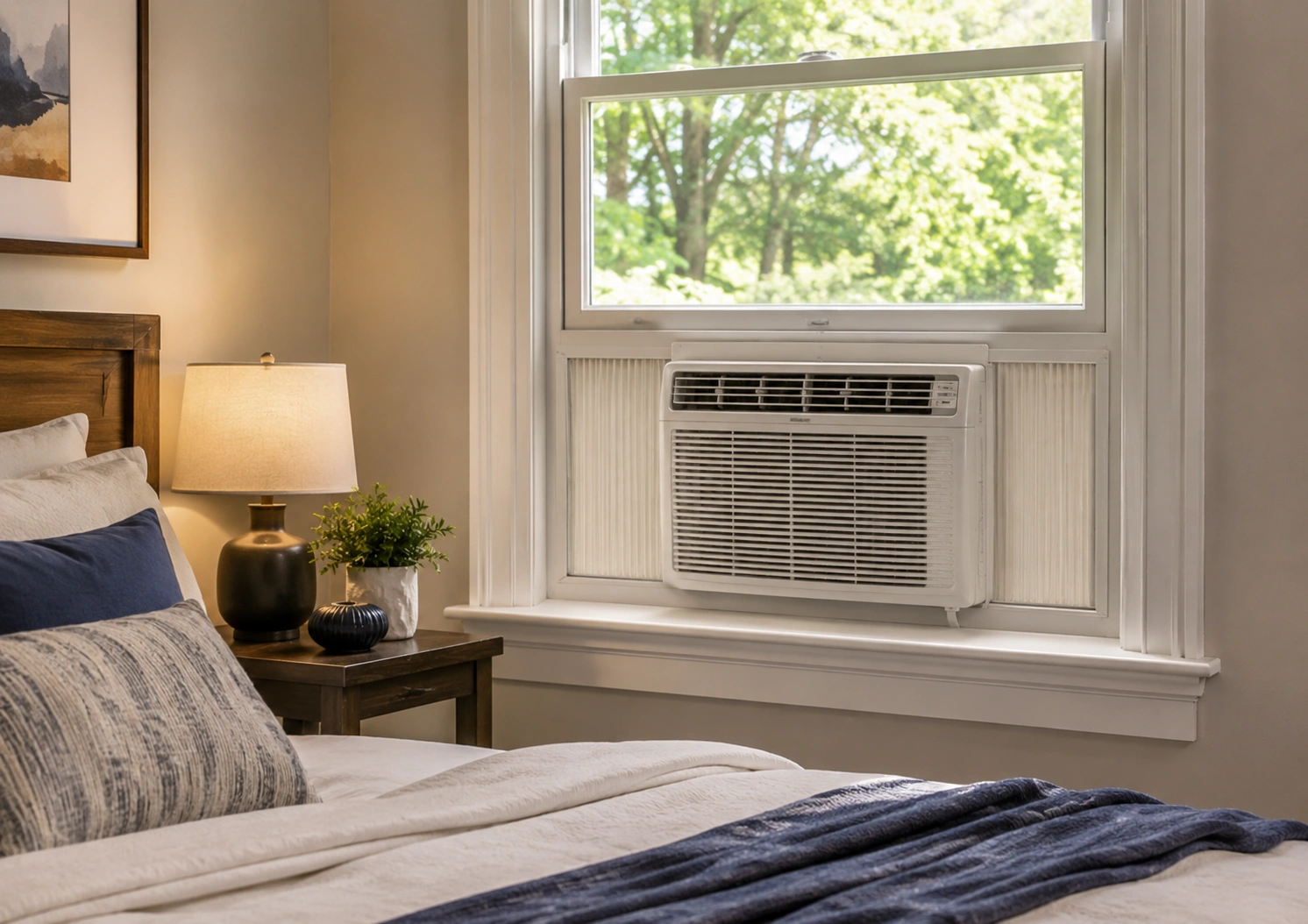
A window air conditioner is a self-contained, all-in-one unit that sits in a window opening and exhausts warm air outside. It's the most affordable and easiest-to-install cooling option for single rooms. Available in capacities from 5,000 to 24,000 BTU, window units can cool spaces ranging from small bedrooms to large living areas.
Window ACs are a practical choice for small apartments, renters, and anyone needing an affordable cooling solution without permanent modifications. Modern models include features like timers, remote controls, and energy-saving modes. Many quality units are available as budget-friendly options under $500.
Advantages
- Lowest purchase cost
- DIY installation
- No permanent modifications
- Easy to remove and store
Disadvantages
- Blocks window view and light
- Noisy compared to mini-splits
- Only cools one room
- May not fit all window types

Portable Air Conditioner
A portable air conditioner is a freestanding, wheeled unit that cools a room and exhausts warm air through a window hose. It requires no permanent installation — just plug it in, attach the exhaust hose to a window kit, and turn it on. This makes it the most flexible cooling option available.
Portable ACs are ideal for temporary situations, spaces where window units can't be installed, and people who move frequently. However, they are generally less efficient than other types because the exhaust hose creates negative pressure that pulls warm air from adjacent rooms. Dual-hose models perform significantly better than single-hose designs. If you need an affordable temporary solution, check out AC options under $500.
Advantages
- No installation required
- Movable between rooms
- Works in any room with a window
- Easy to store when not in use
Disadvantages
- Lowest cooling efficiency
- Loudest of all AC types
- Exhaust hose is bulky
- Limited cooling capacity
Through-the-Wall Air Conditioner
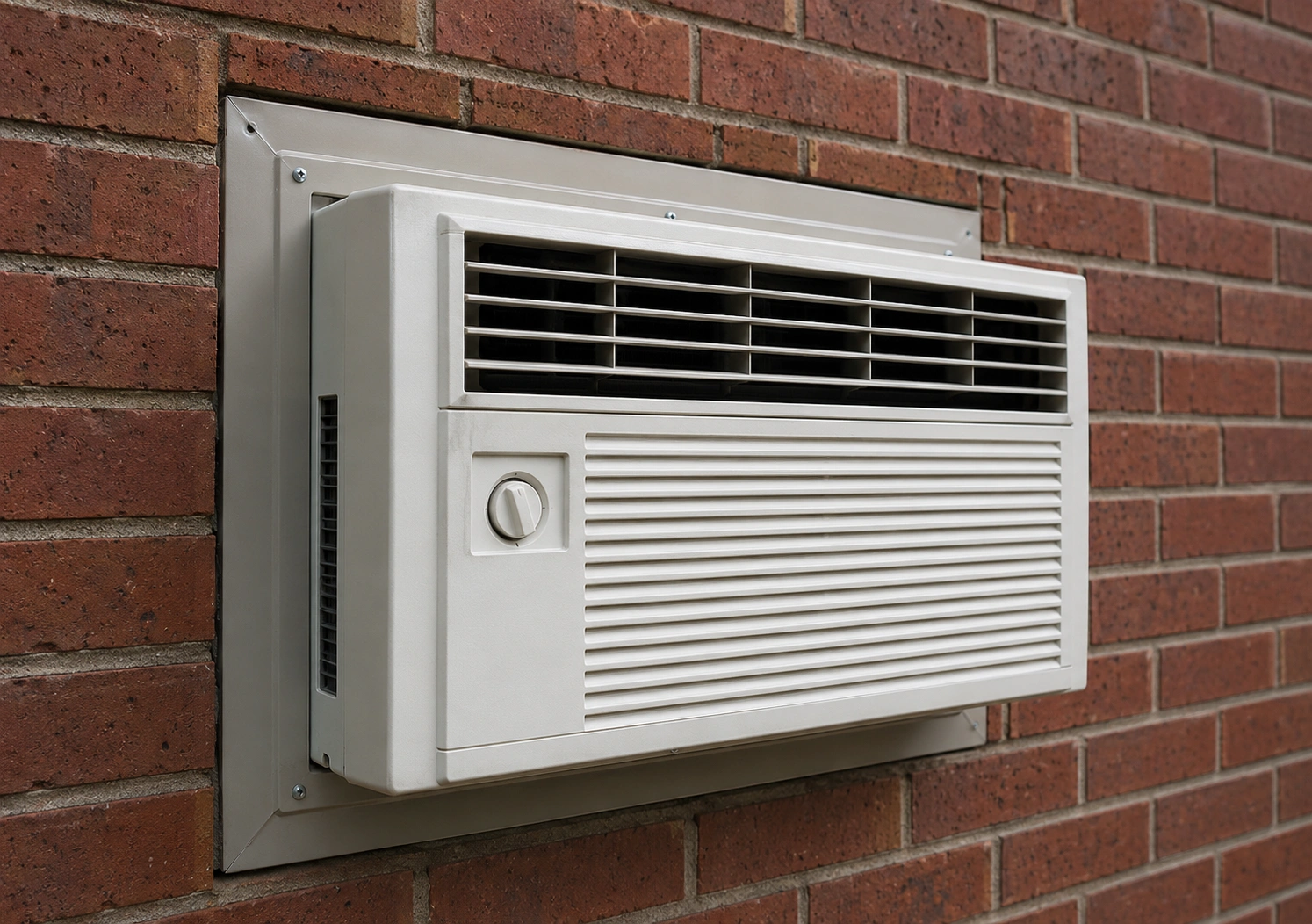
A through-the-wall AC is similar to a window unit but is permanently installed through an exterior wall using a metal sleeve. This provides a more secure and aesthetically pleasing installation that doesn't block your windows. The wall sleeve provides better insulation and a more stable mounting compared to window installations.
These units are commonly found in apartments, hotels, and older buildings where central AC wasn't originally installed. They offer better security than window units since they can't be easily removed from outside. Installation requires cutting a hole in an exterior wall, so they're best suited for situations where you want a permanent, dedicated room cooling solution without the cost of a full ducted system.
Advantages
- Doesn't block windows
- More secure than window units
- Better insulation and seal
- Permanent, clean installation
Disadvantages
- Requires wall modification
- Not easily reversible
- Professional install recommended
- Limited to single rooms
Floor Mounted Air Conditioner
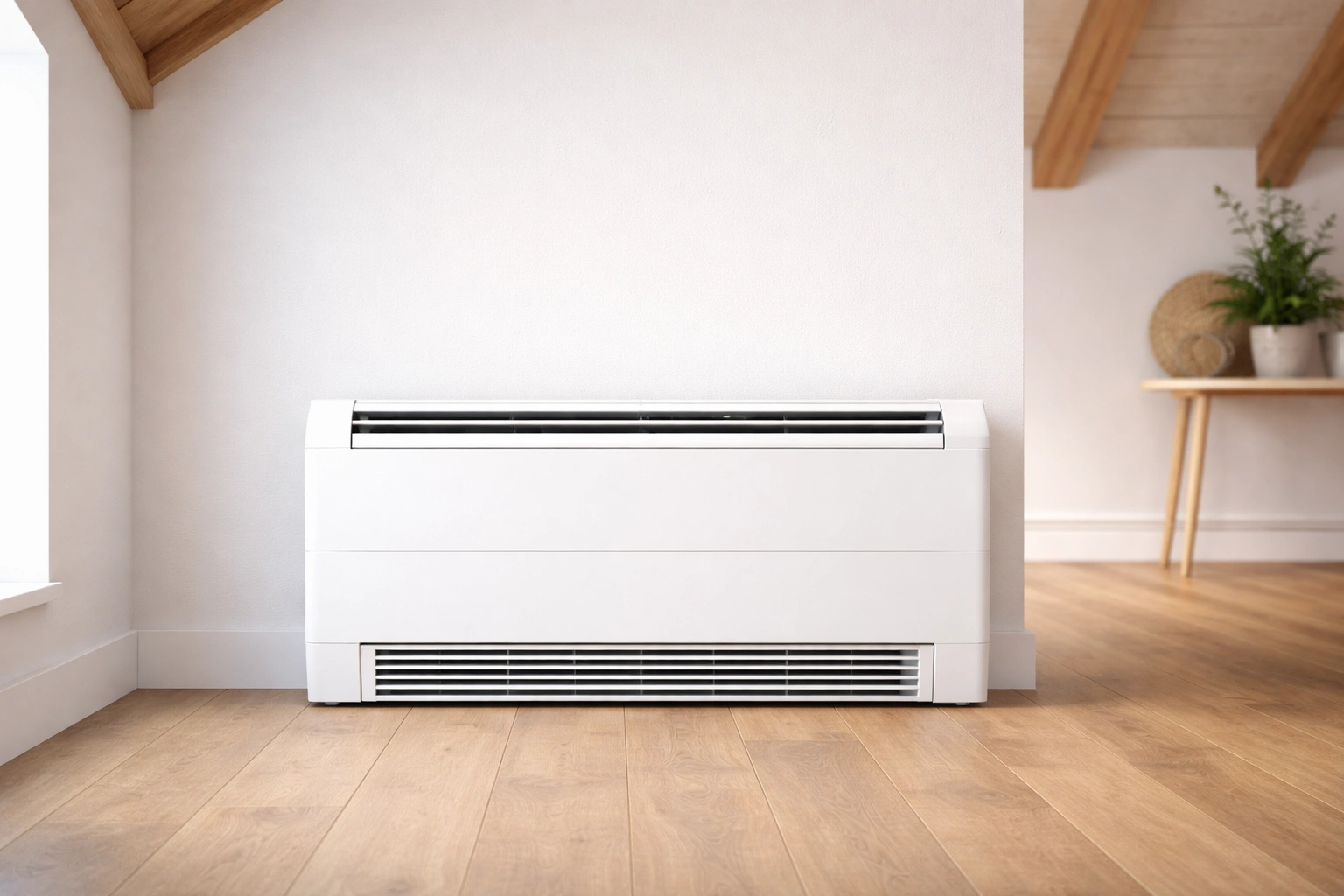
A floor mounted AC is a type of ductless mini-split where the indoor unit is installed at floor level rather than high on a wall. It operates on the same principle as a wall-mounted mini-split but offers unique advantages for certain spaces. The low mounting position provides floor-level airflow, which can feel more natural in rooms with high ceilings.
Floor mounted units are particularly well-suited for spaces where wall mounting isn't practical — such as rooms with slanted ceilings, large glass facades, or rooms with very limited wall space above eye level. They're also easier to access for maintenance compared to high wall units. Like other mini-splits, they connect to an outdoor compressor and offer heating capabilities when paired with a heat pump system.
Advantages
- Ideal for slanted ceilings
- Easy maintenance access
- Natural floor-level airflow
- Quiet mini-split operation
Disadvantages
- Takes up floor space
- More expensive than window AC
- Professional installation required
- Limited brand selection
Commercial & Specialty Air Conditioner Types
Beyond standard residential options, there are specialized AC types designed for commercial buildings, unique architectural requirements, and vehicles. These solutions address cooling challenges that standard units cannot handle effectively.

Packaged Air Conditioner
A packaged AC unit houses all components — compressor, condenser, evaporator, and blower — in a single outdoor cabinet. Unlike split systems, everything is contained in one box, typically installed on a rooftop or concrete pad next to the building. Ductwork runs from the packaged unit into the building to distribute conditioned air.
Packaged units are the standard choice for commercial buildings, warehouses, and retail spaces where indoor space is at a premium. They're also used in some residential applications, particularly in areas where rooftop installations are common. Package units can include both cooling and heating capabilities (gas/electric or heat pump configurations), making them a true all-in-one HVAC solution.
Advantages
- All components in one unit
- Saves indoor floor space
- Easier maintenance access
- Lower installation complexity
Disadvantages
- Exposes unit to weather
- Higher ductwork costs
- Noisy near the unit
- Not ideal for residential areas
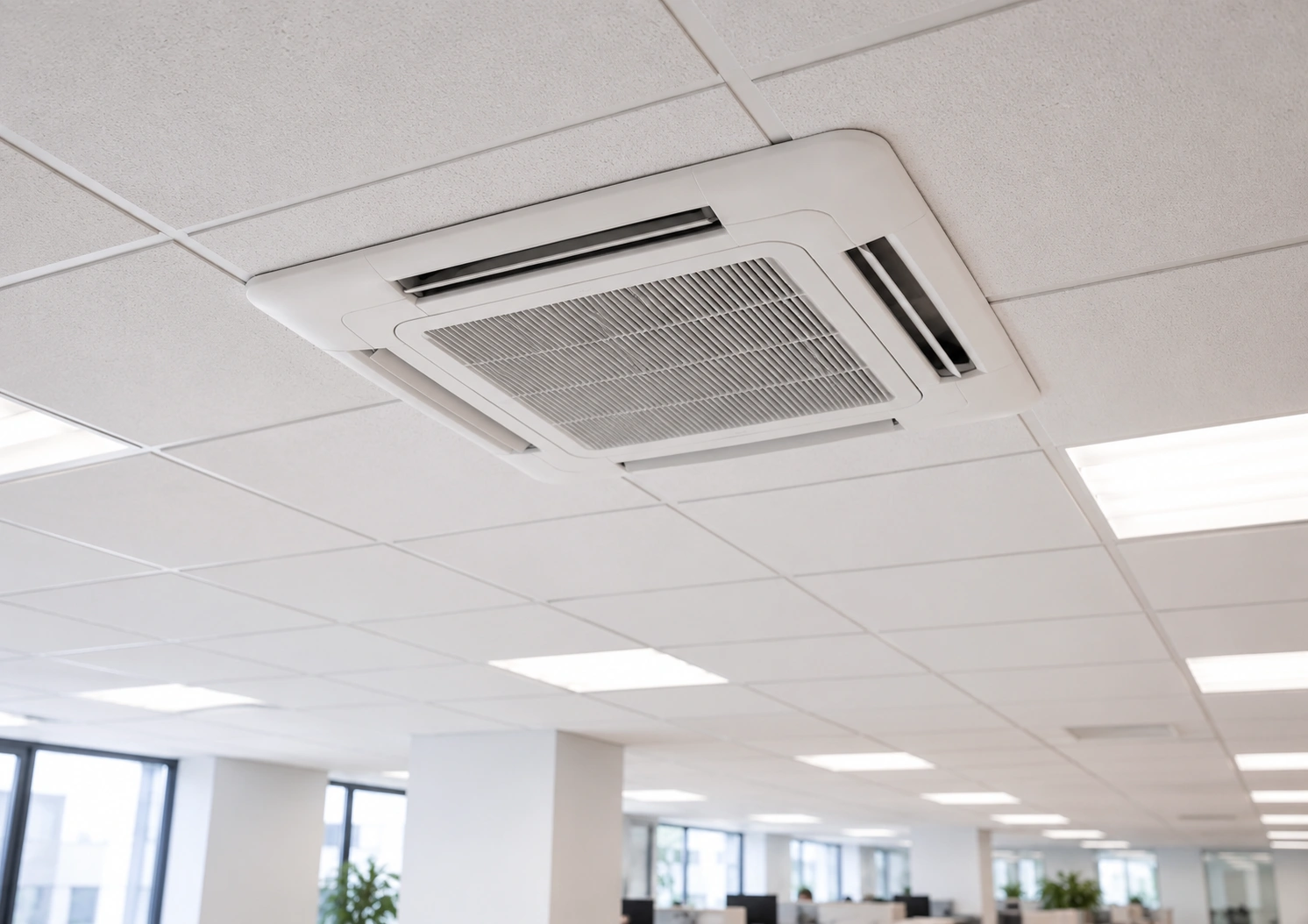
Ceiling Cassette Air Conditioner
A ceiling cassette AC is a ductless mini-split variant where the indoor unit is mounted in the ceiling with only a decorative panel visible from below. Air is distributed in four directions (or sometimes two or three), providing exceptionally even cooling without the visual impact of wall-mounted units. This makes them the preferred choice for office buildings, retail stores, and upscale residential spaces.
Ceiling cassettes require a drop ceiling or sufficient ceiling cavity for installation. They're excellent for open-plan spaces where wall mounting isn't practical or would look awkward. Despite their powerful airflow (typically 12,000–48,000 BTU), they operate very quietly and offer the same zone-control benefits as other ductless systems.
Advantages
- Four-way even airflow
- Hidden installation
- Powerful cooling capacity
- Professional, clean appearance
Disadvantages
- Requires drop ceiling or cavity
- More expensive than wall units
- Complex installation
- Difficult to access for maintenance
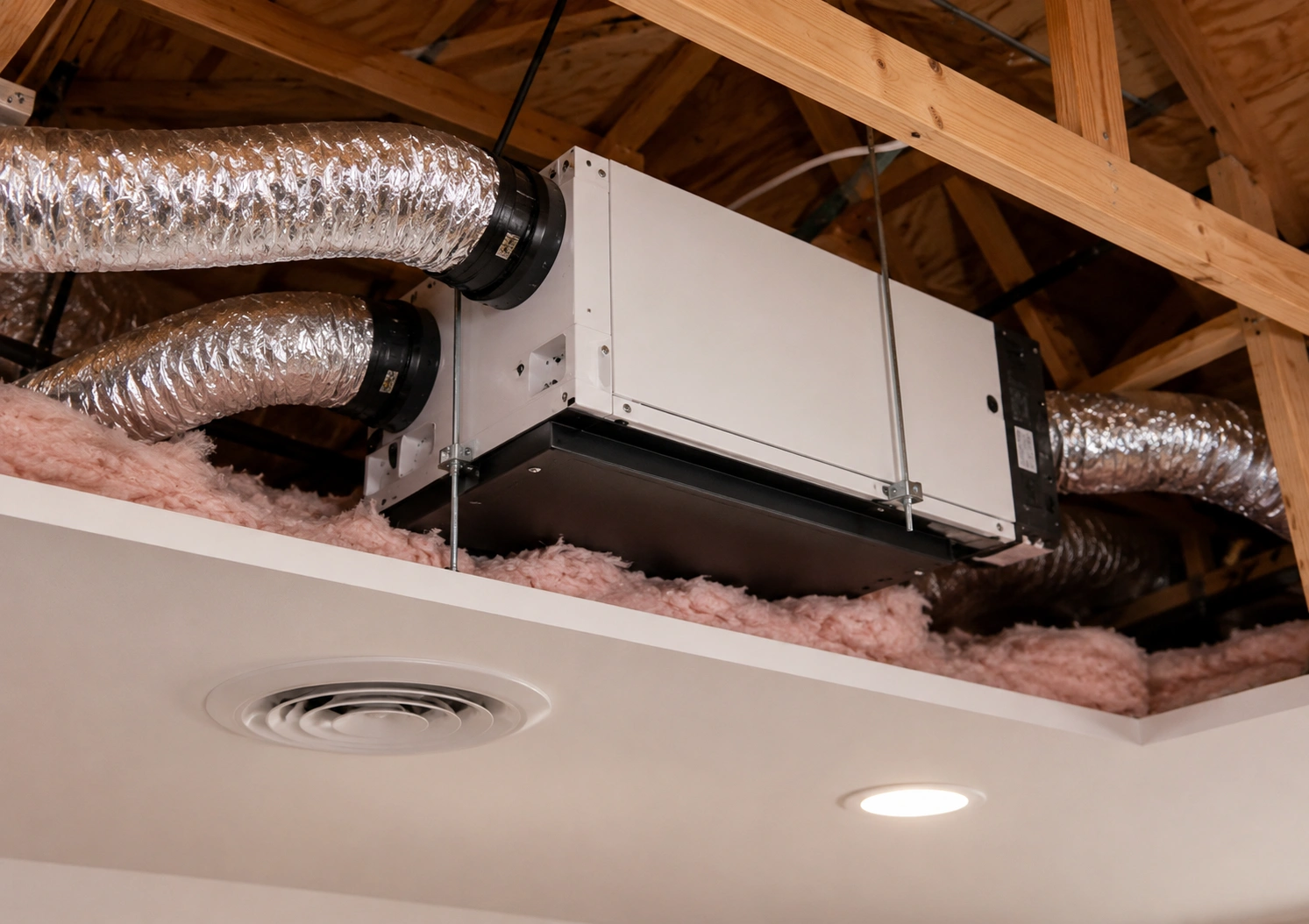
Ducted Mini-Split System
A ducted mini-split combines the efficiency of ductless technology with the clean, invisible appearance of a central air system. The indoor unit is concealed in the ceiling or attic, with short duct runs connecting to ceiling or wall vents throughout the space. This gives you the look of central AC without the extensive ductwork infrastructure.
These systems are excellent for new construction projects where full-size central ductwork isn't feasible, or for homeowners who want the aesthetics of central air in specific zones. They're particularly popular in home additions, converted attics, and open-concept living areas. The concealed design makes them ideal for spaces where visible indoor units would detract from the interior design.
Advantages
- Invisible indoor unit
- Short duct runs save space
- Multiple vents from one unit
- Higher efficiency than central AC
Disadvantages
- Requires ceiling or attic space
- More complex than wall mounts
- Higher cost than wall mini-split
- Limited to specific zones

RV Air Conditioner
An RV air conditioner is specifically designed for recreational vehicles, campers, and motorhomes. These low-profile rooftop units are built to withstand vibration, extreme temperatures, and limited power supply (typically running on 30-amp or 50-amp shore power). They're engineered to be lightweight yet powerful enough to cool the confined space of an RV quickly.
For RV and camper owners, choosing the right AC is critical because the cooling demand fluctuates dramatically based on sun exposure, outside temperature, and the number of occupants. Most RV ACs produce 13,500 BTU, with some models reaching 15,000 BTU for larger rigs. Dual-AC setups are common in motorhomes over 30 feet. Modern units now include features like heat pumps for year-round use and low-noise fan designs.
Advantages
- Designed for mobile use
- Low-profile roof mount
- Built-in heat pump options
- Operates on standard RV power
Disadvantages
- Limited to RV use
- Higher noise than home ACs
- Requires roof penetration
- Higher power consumption on batteries
Compressor Technology Types
Beyond the physical form factor, air conditioners are also categorized by how their compressors operate. This distinction has a major impact on energy efficiency, noise level, temperature consistency, and operating cost. Understanding compressor technology is essential for choosing an AC that performs well over its entire lifespan.
The compressor is the heart of any air conditioning system — it's the component that pressurizes and circulates refrigerant. The way it does this determines how efficiently the system cools your space. For a deeper comparison, read our detailed inverter vs non-inverter analysis.
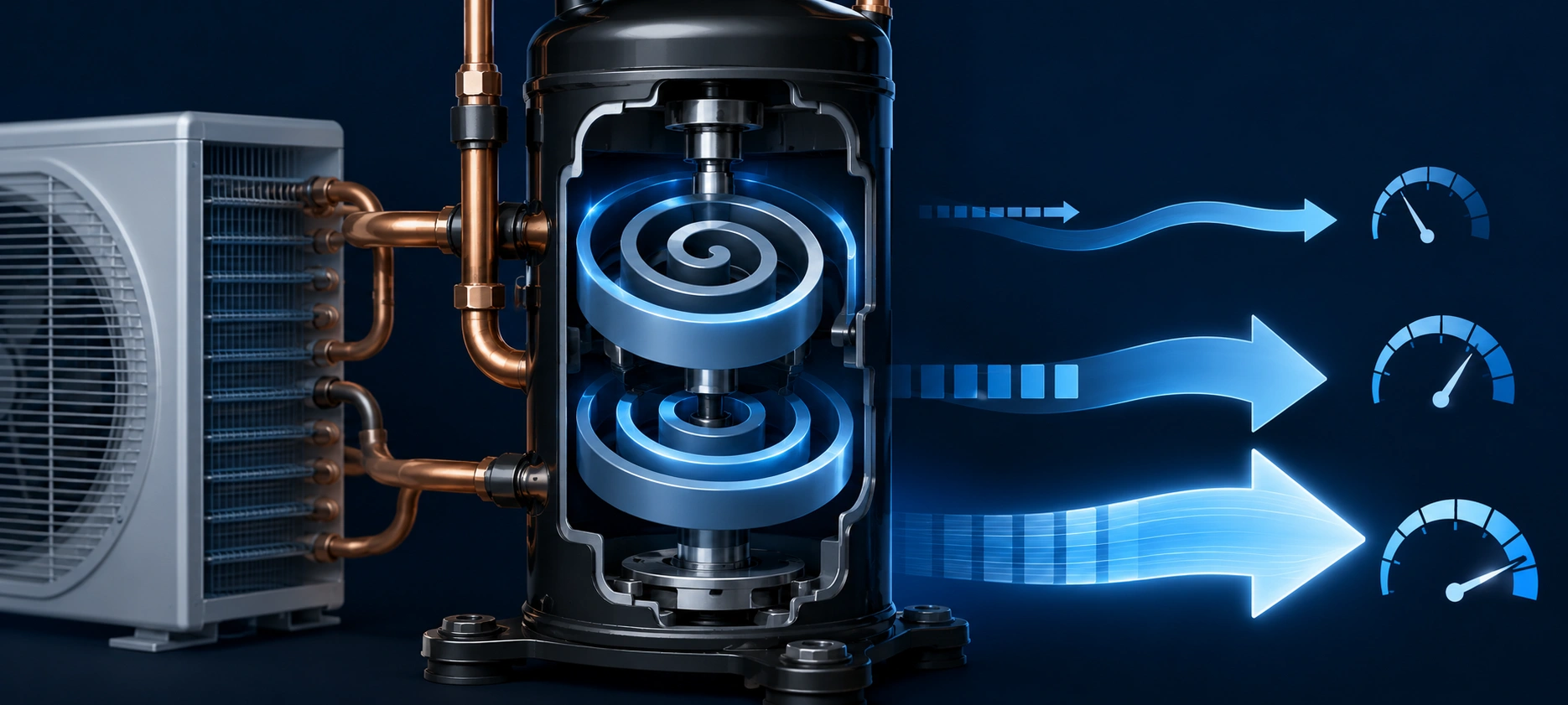
Inverter AC
An inverter AC uses a variable-speed compressor that continuously adjusts its speed to match the cooling demand. Instead of turning on at full power and shutting off repeatedly, the inverter compressor runs at lower speeds to maintain the set temperature. This eliminates the energy spikes caused by frequent start-stop cycles and reduces electricity consumption by 30-50% compared to non-inverter models.
Inverter technology is available across all AC types — central systems, mini-splits, window units, and portable ACs. It's particularly impactful in high-efficiency models where the compressor runs for extended periods. The trade-off is a higher upfront cost, but the energy savings typically pay for the difference within 2-3 years of regular use.

Non-Inverter AC
A non-inverter AC uses a fixed-speed compressor that operates at 100% capacity when running and completely shuts off when the target temperature is reached. This on-off cycling creates noticeable temperature fluctuations — the room alternates between slightly too warm and slightly too cool. Each startup also draws a surge of electricity, making non-inverter units less efficient overall.
Non-inverter ACs are significantly cheaper to purchase and are still widely available in budget AC categories. They can be a reasonable choice for spaces that are used infrequently — such as guest rooms or seasonal spaces — where the energy savings of an inverter wouldn't offset the higher purchase price over the unit's lifetime.

Variable Speed AC
A variable speed AC takes inverter technology further by allowing the compressor to operate at any speed within its range, typically from 40% to 100% capacity in increments as small as 1%. This provides the most precise temperature control available, maintaining the set point within fractions of a degree while optimizing energy use at every moment.
Variable speed systems are the top tier in terms of comfort and efficiency. They're most commonly found in high-end central AC systems and premium mini-splits. These units achieve the highest SEER ratings on the market — often 22 SEER and above — and provide superior dehumidification because they can run at low speeds for longer periods, removing more moisture from the air.
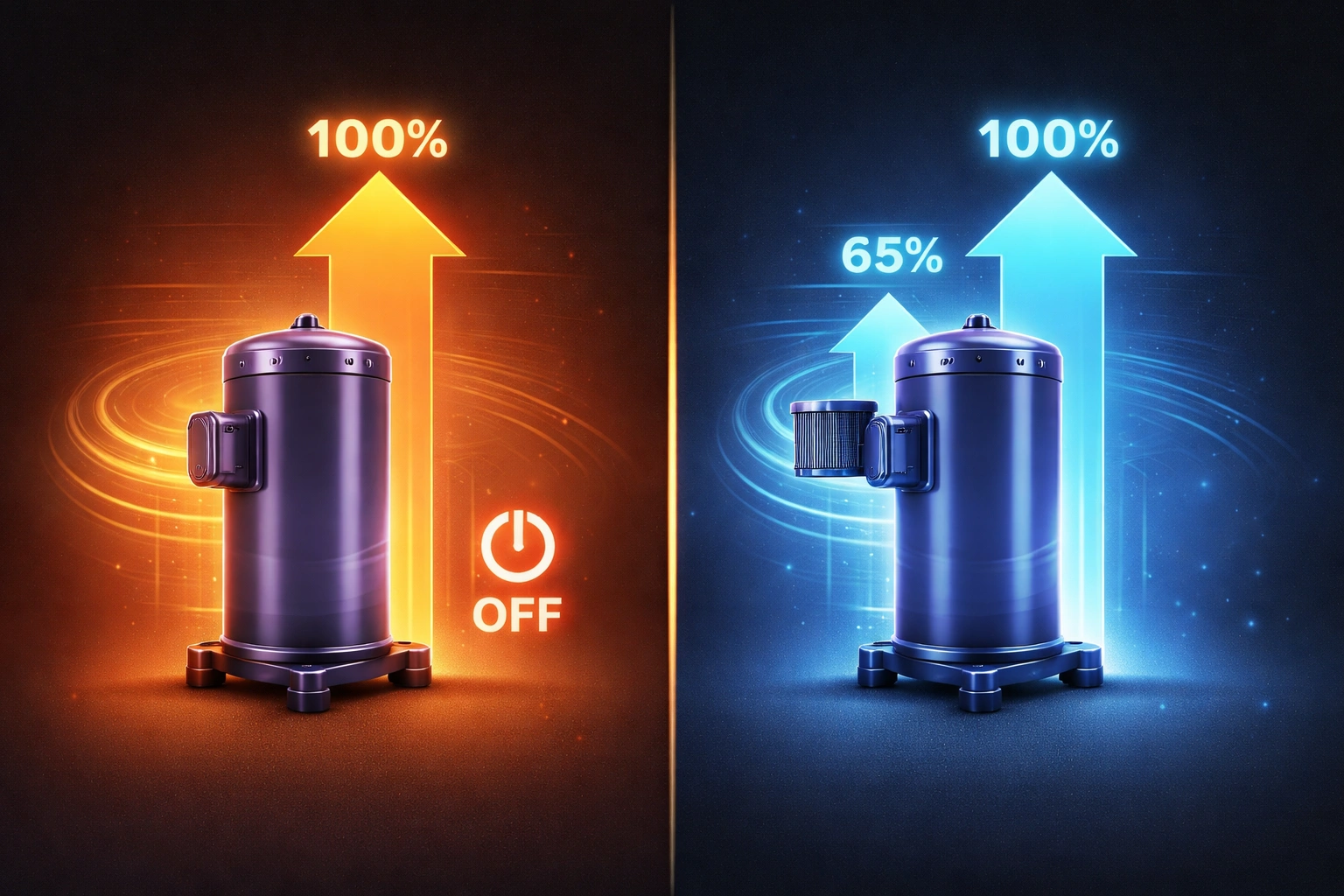
Single Stage vs Two Stage AC
A single stage AC operates like a non-inverter — it's either on at 100% or completely off. A two stage AC adds a middle option: it can run at approximately 60-70% capacity for milder cooling needs and switch to 100% only on the hottest days. Two-stage systems provide better humidity control and more even temperatures than single-stage models at a moderate price increase.
Two-stage technology bridges the gap between basic single-stage systems and full variable-speed/inverter models. It's a popular choice for homeowners who want improved comfort and efficiency over single-stage but aren't ready to invest in the highest-end variable speed systems. Two-stage compressors are commonly available in mid-to-high-range central AC units.
AC Types by BTU Capacity
BTU (British Thermal Unit) measures an air conditioner's cooling capacity — the higher the BTU, the larger the space it can cool. Choosing the correct BTU rating for your room size is critical: too small and the AC will struggle to cool, too large and it will cycle on and off frequently, wasting energy and failing to dehumidify properly.
Use our detailed BTU calculator by room size for precise sizing, or browse the categories below to find ACs matched to your space.
5,000–6,000 BTU
Small rooms up to 150 sq ft — bedrooms, home offices, nurseries
8,000–10,000 BTU
Medium rooms 150–250 sq ft — living rooms, master bedrooms
12,000–14,000 BTU
Large rooms 250–400 sq ft — open living areas, studios
18,000–24,000 BTU
Extra-large rooms 400–800 sq ft — large apartments, garages
30,000–36,000 BTU
Small whole-home 800–1,200 sq ft — small houses, townhomes
42,000–60,000+ BTU
Whole-home 1,200+ sq ft — large houses, multi-zone systems
Air Conditioner Types Comparison Table
The table below provides a quick side-by-side comparison of all major AC types across the factors that matter most when making a purchase decision. Use this as a reference alongside the detailed sections above.
| AC Type | Best For | Capacity Range | Price (Installed) | Efficiency | Noise Level | Installation |
|---|---|---|---|---|---|---|
| Central AC | Whole home with ducts | 18,000–60,000 BTU | $3,500–$7,500 | High (14–22 SEER) | 40–60 dB indoor | Professional required |
| Mini-Split | Rooms without ducts | 9,000–36,000 BTU | $1,500–$4,000/zone | Very High (16–30 SEER) | 19–42 dB indoor | Professional required |
| Window AC | Single rooms | 5,000–24,000 BTU | $150–$500 | Moderate (10–12 SEER) | 50–65 dB | DIY |
| Portable AC | Temporary cooling | 8,000–14,000 BTU | $300–$700 | Low (8–10 EER) | 55–70 dB | None (plug & play) |
| Through-the-Wall | Permanent room cooling | 8,000–18,000 BTU | $600–$1,300 | Moderate (10–12 SEER) | 50–60 dB | Semi-pro recommended |
| Floor Mounted | Rooms with slanted ceilings | 9,000–24,000 BTU | $1,200–$2,500 | High (16–24 SEER) | 22–38 dB | Professional required |
| Ceiling Cassette | Open commercial spaces | 12,000–48,000 BTU | $1,800–$3,500 | High (17–26 SEER) | 28–40 dB | Professional required |
| Ducted Mini-Split | Aesthetic whole-room | 12,000–36,000 BTU | $2,500–$5,000 | High (17–25 SEER) | 25–40 dB | Professional required |
| Packaged AC | Commercial buildings | 24,000–120,000+ BTU | $4,000–$8,500 | Moderate (10–16 SEER) | Varies by distance | Professional required |
| RV AC | RVs and campers | 11,000–15,000 BTU | $600–$1,500 | Low (8–10 EER) | 55–70 dB | RV professional or DIY |
How to Choose the Right AC Type for Your Situation
The "best" AC type doesn't exist in isolation — it depends entirely on your specific situation. Below are six common scenarios with our recommended AC type for each. Start by identifying which scenario matches yours most closely, then explore the detailed guide for that AC type.
Single Room, No Modifications
You need to cool one room and can't or don't want to make permanent changes to the space. Common for renters, dorm rooms, or temporary workspaces.
→ Window AC or Portable ACHome Without Ductwork
Your home was built without central air ducts, and you want effective cooling for multiple rooms without the cost and disruption of adding full-size ductwork.
→ Ductless Mini-SplitWhole House With Existing Ducts
Your home already has a furnace and ductwork from a previous heating system. You want the most effective and even whole-house cooling solution.
→ Central Air ConditioningMultiple Rooms, Individual Control
Family members have different temperature preferences, or rooms are used at different times. You want to avoid cooling empty rooms to save energy.
→ Multi-Zone Mini-SplitCommercial or Open-Plan Space
You need to cool a large, open area such as a retail store, office, or restaurant where aesthetics and even airflow distribution are priorities.
→ Ceiling Cassette or Packaged ACMaximum Comfort & Efficiency
Budget is not the primary concern. You want the quietest operation, most precise temperature control, and lowest long-term energy costs available.
→ Variable Speed Mini-SplitKey Takeaways Before You Buy
- The AC type you choose should match your home's infrastructure first — ducts vs. no ducts is the single biggest deciding factor
- Correct sizing matters more than the type itself — an improperly sized unit of any type will underperform. Use our AC sizing guide to calculate your needs
- Inverter and variable speed compressors cost more upfront but save 30-50% on electricity over the unit's lifetime — worth it if you use AC more than 3 months per year
- Always check the SEER rating and look for ENERGY STAR certification to ensure you're getting an efficient unit
- Installation quality is as important as the unit itself — a poorly installed premium AC will perform worse than a properly installed mid-range unit


