
AC Education Center
Understand how air conditioners work, decode efficiency ratings, learn about refrigerant standards, and make confident purchasing decisions
START LEARNINGWhy Understanding AC Technology Matters Before You Buy
An air conditioner is one of the most significant investments you will make for your home comfort. Yet most buyers focus solely on brand names and price tags, ignoring the technical fundamentals that determine real-world performance, energy consumption, and long-term costs.
This education center is designed to bridge that gap. Whether you are trying to understand the refrigeration cycle, decode what a SEER rating actually means for your electricity bill, or figure out why R410A is being phased out, you will find clear, jargon-free explanations here.
Our goal is simple: when you finish reading, you will know more than the average salesperson — and you will be equipped to choose a system that truly fits your home, climate, and budget.

How Air Conditioners Work
Compressor Technology
Efficiency Ratings Explained
Refrigerants & Environment
Standards & Regulations
Smart HVAC & Tax Credits
How Air Conditioners Work
At its core, an air conditioner does not "create" cold air. Instead, it removes heat from the indoor air and transfers it outside. This process relies on a physical principle called phase change — when a liquid evaporates into a gas, it absorbs heat, and when a gas condenses back into a liquid, it releases heat. Your AC exploits this cycle continuously using a chemical compound called refrigerant.

The Four Stages of the Refrigeration Cycle
- Evaporation (Indoor Unit): Warm indoor air is blown across the cold evaporator coil by a fan. The liquid refrigerant inside the coil absorbs heat from the air, causing it to evaporate into a low-pressure gas. The cooled air is then circulated back into your room. This is the stage that actually produces the cold air you feel.
- Compression (Outdoor Unit): The low-pressure refrigerant gas travels through copper tubing to the outdoor compressor. The compressor squeezes the gas, dramatically raising both its pressure and temperature. This step is critical because high-pressure gas can release its heat more efficiently at the condenser.
- Condensation (Outdoor Unit): The hot, high-pressure gas enters the condenser coil. A large fan blows outdoor air across the coil, causing the refrigerant to release its absorbed heat into the atmosphere. As it loses heat, the refrigerant condenses back into a high-pressure liquid.
- Expansion (Between Indoor and Outdoor): The high-pressure liquid refrigerant passes through an expansion valve (or metering device), which rapidly drops its pressure. This sudden pressure drop causes the refrigerant to cool significantly before it re-enters the evaporator coil, ready to absorb more heat. The cycle then repeats.
Key Takeaway: The refrigerant never leaves the system — it simply changes state (liquid ↔ gas) as it circulates, absorbing heat indoors and releasing it outdoors. Understanding this cycle helps you grasp why each AC type — whether a window unit, mini-split, or central system — relies on the same fundamental principle, just with different configurations.
Components That Affect Performance
Beyond the four main stages, several supporting components determine how well your system performs in real-world conditions:
- Blower motor: Moves air across the evaporator coil. A weak or failing blower reduces airflow, which lowers cooling capacity even if the refrigerant cycle works perfectly. Variable-speed blowers adjust airflow dynamically for better comfort and efficiency.
- Thermostat: Senses indoor temperature and signals the system to cycle on or off. Modern smart thermostats use algorithms to optimize run times and can be controlled remotely via smartphone apps.
- Air filter: Removes dust, pollen, and particles from the air before it reaches the coil. A clogged filter restricts airflow, forcing the system to work harder and consume more energy. Regular filter cleaning is essential — learn how to clean your AC filter properly.
- Copper line set: Connects the indoor and outdoor units, carrying refrigerant between them. The length and diameter of the line set affect system efficiency — longer runs require careful sizing to prevent pressure drops.

Heat Pumps: AC That Works in Reverse
A heat pump uses the exact same refrigeration cycle as a standard air conditioner, but with one crucial difference: it includes a reversing valve that allows the cycle to run in reverse. In heating mode, the outdoor coil becomes the evaporator (absorbing heat from cold outdoor air) and the indoor coil becomes the condenser (releasing heat indoors). This means a single system can provide both cooling and heating, making heat pumps an excellent option for moderate climates. Many modern AC units with heat pump functionality offer this dual capability.
For a deeper technical breakdown, read our dedicated guide on the AC refrigerant cycle explained.
Compressor Technology: The Heart of Your AC
The compressor is often called the "heart" of an air conditioning system because it is the component that drives the entire refrigeration cycle. The type of compressor technology your AC uses directly impacts energy consumption, temperature stability, noise levels, and upfront cost. There are three main categories you need to understand.
Single-Stage Compressors
A single-stage AC compressor operates at only one speed — 100% capacity. When the thermostat calls for cooling, the compressor turns on at full power and runs until the target temperature is reached, then shuts off completely. This on/off cycling creates noticeable temperature fluctuations (typically 2–4°F swings) and causes higher energy consumption because the system draws a surge of power every time it starts up.
Single-stage systems are the most affordable option, typically found in budget air conditioners and older installations. They are adequate for mild climates or occasional use, but not ideal for homes that need consistent, precise temperature control. Pricing generally ranges from $1,500 to $3,500 including installation.
Two-Stage Compressors
A two-stage AC compressor can operate at two capacity levels — usually 60–70% for mild cooling demands and 100% for peak conditions. This gives the system flexibility to match output to actual need. On most days, the unit runs at the lower stage, maintaining temperature with fewer on/off cycles. When temperatures spike, it ramps up to full capacity.
The benefits include more consistent indoor temperatures (1–2°F swings), lower energy bills compared to single-stage, reduced wear and tear from fewer start-up cycles, and quieter operation at the lower stage. Two-stage systems typically cost between $2,800 and $5,500 installed, making them a strong middle-ground choice for most homeowners.
Variable-Speed (Inverter) Compressors
An variable-speed AC compressor can modulate its output across a wide range — typically from about 25% to 100% capacity — in infinitely small increments. This technology, commonly referred to as inverter AC technology, allows the system to continuously adjust its output to match the exact cooling demand in real time.
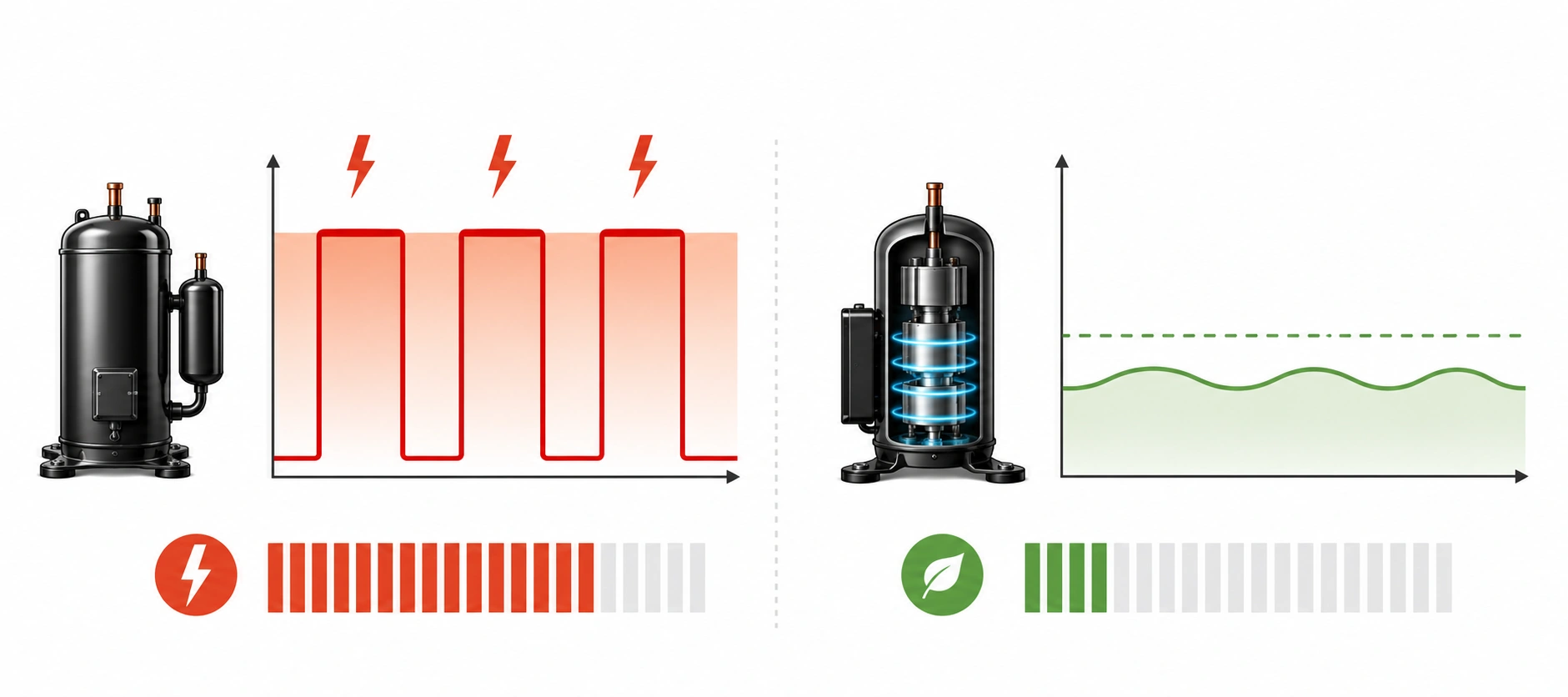
Instead of turning on and off, the compressor runs continuously at the precise speed needed. The result is exceptionally stable temperatures (less than 1°F variation), the lowest energy consumption of any compressor type, whisper-quiet operation at low speeds, and superior dehumidification because the coil stays cold longer. Understanding how inverter AC works reveals why these systems consistently earn the highest SEER ratings.
The trade-off is upfront cost. Variable-speed systems typically range from $3,500 to $7,500+ installed. However, the energy savings of 20–40% compared to single-stage often offset the premium within 3–7 years depending on your climate and usage patterns. If you are deciding between inverter and non-inverter AC, consider your annual cooling hours carefully — the longer your cooling season, the faster an inverter pays for itself.
| Feature | Single-Stage | Two-Stage | Variable-Speed (Inverter) |
|---|---|---|---|
| Capacity Levels | 1 (100%) | 2 (Low + High) | Infinite (25–100%) |
| Temperature Stability | ±2–4°F | ±1–2°F | <±1°F |
| Energy Efficiency | Lowest | Moderate | Highest |
| Typical SEER Range | 13–16 | 16–19 | 18–26+ |
| Noise Level (Low Stage) | N/A (on/off only) | Moderate | Very Quiet |
| Dehumidification | Basic | Good | Excellent |
| Installed Cost Range | $1,500–$3,500 | $2,800–$5,500 | $3,500–$7,500+ |
| Best For | Mild climates, tight budgets | Most homes, balanced value | Hot climates, long seasons |
Buying Advice: If you live in a region with more than 1,500 cooling hours per year (most of the southern and central U.S.), a variable-speed compressor will pay for itself in energy savings. In northern climates with shorter cooling seasons, a two-stage system often provides the best balance of comfort and value. Avoid single-stage for new installations unless budget is the absolute limiting factor — the long-term running costs will almost always exceed the upfront savings.
Understanding Efficiency Ratings: SEER, EER, and HSPF
Efficiency ratings are the single most important technical specification to understand when comparing air conditioners. They tell you exactly how much cooling (or heating) a system delivers per unit of energy consumed. Unfortunately, these ratings are frequently misunderstood or misused in marketing materials. Here is what each one actually measures and how to use it.

SEER — Seasonal Energy Efficiency Ratio
SEER measures the total cooling output (in BTUs) divided by the total electricity consumed (in watt-hours) over an entire cooling season. The test uses a range of outdoor temperatures from 65°F to 104°F to simulate real seasonal conditions. A higher SEER means the unit produces more cooling per kilowatt-hour of electricity.
Current federal minimum SEER requirements (under SEER2 testing, effective since January 2023) are 14 SEER2 for split systems in northern states and 15 SEER2 in southern states. The most efficient systems on the market achieve ratings of 24–26 SEER2. For context, upgrading from a 14 SEER to a 20 SEER unit can reduce cooling costs by approximately 30%.
What SEER Is Good For
- Comparing seasonal energy costs between models
- Estimating long-term savings over the system's lifespan
- Qualifying for ENERGY STAR certification (minimum 15.2 SEER2 for split systems)
- Meeting local building code requirements
What SEER Does Not Tell You
- Performance on the hottest days (use EER instead)
- Heating efficiency (use HSPF for heat pumps)
- Actual dollar savings without knowing your local electricity rate and cooling hours
- Real-world performance if the system is poorly installed or incorrectly sized
SEER vs SEER2: The New Testing Standard
The Department of Energy introduced SEER2 to address a significant gap in the original SEER test: it did not account for the static pressure caused by real ductwork. The SEER2 test adds external static pressure of 0.50 inches of water column (IWC) for split systems, making the test conditions more representative of actual installed performance.
Because the new test is more demanding, a unit that rated 20 SEER under the old method might rate 19 SEER2 under the new method. The unit has not become less efficient — the measurement has become more honest. When comparing units, always ensure you are looking at the same rating standard (SEER vs SEER2) to make an accurate comparison.
Important: As of January 1, 2023, all new residential central AC and heat pump systems manufactured must comply with SEER2 minimum standards. Retailers may still sell existing inventory rated under the old SEER standard, but understanding the difference ensures you are not misled by seemingly higher numbers.
EER — Energy Efficiency Ratio
While SEER measures seasonal average performance, EER measures efficiency at a single, specific condition: 95°F outdoor temperature, 80°F indoor temperature, and 50% relative humidity. It is calculated as cooling output (BTU/h) divided by power input (watts) at that exact operating point.
EER is particularly valuable if you live in a hot climate where your AC frequently runs at or near full capacity on peak-temperature days. A unit with a high SEER but low EER might perform well in mild weather but struggle efficiency-wise during heat waves. For homes in the southern U.S. or desert climates, EER can be a more relevant metric than SEER for predicting peak-day operating costs.
HSPF — Heating Seasonal Performance Factor
HSPF applies only to heat pumps and measures heating efficiency over an entire heating season. It is calculated similarly to SEER but for heating mode, using a range of outdoor temperatures. The current federal minimum is 8.5 HSPF2, and the most efficient heat pumps achieve 11–12 HSPF2.
If you are considering a heat pump vs a standard air conditioner, HSPF is the number that tells you how efficiently the system will heat your home during winter. A higher HSPF directly translates to lower heating bills. For every 1-point increase in HSPF, heating costs typically drop by about 8–10%.
| Rating | What It Measures | Test Conditions | When It Matters Most |
|---|---|---|---|
| SEER / SEER2 | Seasonal cooling efficiency | 65°F to 104°F range | Overall seasonal energy costs |
| EER | Peak cooling efficiency | 95°F outdoor, 80°F indoor | Hot climates, peak-day performance |
| HSPF / HSPF2 | Seasonal heating efficiency | Variable heating season temps | Heat pump heating costs |
Practical Tip: When evaluating AC units, look at both SEER2 and EER together. A unit with 20 SEER2 and 12.5 EER is generally a better choice for hot climates than one with 22 SEER2 but only 10.5 EER, because the latter sacrifices peak-day efficiency to boost its seasonal average. For guidance on which rating to prioritize for your specific situation, see our article on what SEER rating you should buy.
Refrigerants and Environmental Impact
Refrigerant is the working fluid that makes the entire cooling cycle possible. The type of refrigerant your system uses affects its efficiency, environmental impact, and in some cases, its long-term serviceability. Understanding refrigerant transitions is critical because the industry is undergoing a major shift that will affect every new AC purchase.

What Is GWP and Why Does It Matter?
GWP (Global Warming Potential) measures how much heat a greenhouse gas traps in the atmosphere relative to carbon dioxide (CO₂), which has a GWP of 1. The higher the GWP, the more the refrigerant contributes to global warming if released into the atmosphere. Current regulations are specifically targeting refrigerants with high GWP values.
| Refrigerant | GWP | Status | Used In |
|---|---|---|---|
| R22 (Freon) | 1,810 | Phased out (2020) | Legacy systems only |
| R410A | 2,088 | Being phased out | Most current ACs |
| R32 | 675 | Approved replacement | Mini-splits, some central |
| R454B | 466 | Approved replacement | Central AC and heat pumps |
The R410A Phase-Out
R410A has been the standard refrigerant for residential AC systems since the early 2000s. However, under the EPA's American Innovation and Manufacturing (AIM) Act, R410A is being phased down because of its high GWP of 2,088. The phase-down follows a stepped schedule that began in 2024, with production and import allowances reducing by 40% in year one and continuing to decrease through 2028.
This does not mean your existing R410A system will become illegal to operate. The phase-down affects manufacturing and importing of new refrigerant, not existing systems. However, it does mean that R410A will become increasingly expensive as supply shrinks, and servicing older systems will cost more over time. If your system needs an expensive refrigerant leak repair on an aging R410A system, replacement with a new system using next-generation refrigerant may be more economical.
The Next Generation: R32 and R454B
The two primary refrigerants replacing R410A are R32 and R454B. Both offer dramatically lower GWP values and comparable or slightly better efficiency:
- R32 (difluoromethane): Already widely used in ductless mini-split systems globally and increasingly in the U.S. market. It offers approximately 10% better energy efficiency than R410A and has a GWP of 675 — about one-third of R410A. R32 is classified as an A2L refrigerant (mildly flammable), which requires slightly different handling procedures but is considered safe for residential use with proper installation.
- R454B (Opteon XL41): A blend of R32 and R1234yf that is becoming the primary replacement for R410A in U.S. central air conditioning systems. It has a GWP of 466 and offers efficiency improvements of 5–10% over R410A. R454B is also classified as A2L and is backed by major manufacturers including Carrier, Bryant, and Trane.
What This Means for Buyers: Any new central AC or heat pump you purchase now will almost certainly use R454B or R32. This is not a drawback — these refrigerants offer better efficiency and lower environmental impact. However, be aware that A2L refrigerants require technicians with specific certification, so always verify that your HVAC contractor is properly trained for the refrigerant your system uses. The cost impact on new systems is minimal — most manufacturers have absorbed the transition costs into their standard pricing.
For a comprehensive overview of current rules, read our guide on EPA refrigerant regulations.
Government Standards and Building Codes
The air conditioning industry is heavily regulated at the federal, state, and local levels. These regulations exist to protect consumers from inefficient products, ensure environmental responsibility, and guarantee safe installation practices. Understanding the key standards helps you verify that the equipment and installation you are paying for actually meets legal requirements.

DOE Efficiency Standards
The U.S. Department of Energy sets mandatory minimum efficiency standards for all residential and commercial HVAC equipment sold in the United States. These standards are updated periodically to push the market toward greater efficiency. The most recent major update took effect on January 1, 2023, and introduced the SEER2 testing methodology along with higher minimum requirements.
Under the current standards, the minimum SEER2 ratings vary by region and equipment type:
- Northern states: 14 SEER2 for split AC systems, 14.3 SEER2 for heat pumps
- Southern and southwestern states: 15 SEER2 for split AC systems, 15 SEER2 for heat pumps
- Single-package units: 14 SEER2 nationwide
Additionally, new systems must meet minimum EER2 requirements (varies by equipment size) and, for heat pumps, minimum HSPF2 requirements. Any equipment that does not meet these standards cannot be legally manufactured or installed for new construction or replacement in residential applications.
EPA Regulations
The Environmental Protection Agency regulates refrigerants under the Clean Air Act and the AIM Act. Key regulations affecting consumers include:
- Refrigerant phase-down schedules: The AIM Act mandates a 40% reduction in HFC production and imports by 2024, stepping down to an 85% reduction by 2036. This directly affects R410A availability and pricing.
- Section 608 certification: Any technician who handles refrigerant must hold EPA 608 certification. This ensures proper handling, recovery, and recycling of refrigerants to prevent atmospheric release.
- Venting prohibition: It is illegal to knowingly vent refrigerant into the atmosphere. Technicians must use recovery equipment during service and disposal.
These regulations are why proper EPA refrigerant handling during installation and service is not just best practice — it is federal law. If a contractor offers to "top off" your system without checking for and repairing leaks first, they are violating EPA regulations.
ASHRAE Standards
ASHRAE (American Society of Heating, Refrigerating and Air-Conditioning Engineers) is not a government body but a professional organization that develops consensus standards widely adopted into building codes. The most relevant standards for consumers include:
- ASHRAE Standard 15: Safety standards for refrigeration systems, including requirements for A2L refrigerant classifications and maximum charge limits per room size.
- ASHRAE Standard 90.1: Energy efficiency requirements for commercial buildings, adopted by reference in most state building codes.
- ASHRAE Standard 62.1 / 62.2: Ventilation requirements for commercial and residential buildings, ensuring adequate fresh air intake.
State and Local Building Codes
HVAC building codes vary by state and sometimes by municipality. While most states adopt the federal DOE minimums as their baseline, some go further. For example, California's Title 24 energy code has historically required higher efficiencies than federal minimums. Before purchasing, check whether your state or city has requirements above the federal baseline — this could affect which models are legally available for installation in your area.
Permit Tip: Nearly all jurisdictions require a building permit for AC installation, especially for central systems, ducted mini-splits, or any work involving electrical modifications. If your contractor suggests skipping the permit to save money, find a different contractor. Unpermitted work can void your warranty, create insurance liability, and complicate future home sales. Learn about how to get an AC permit in your area.
Smart HVAC Technology and Financial Incentives
The air conditioning industry is experiencing a technological revolution that goes beyond compressor efficiency. Smart technology integration and government financial incentives are changing both how systems operate and how much they cost to own. Understanding these developments can save you thousands of dollars over the life of your system.
Smart HVAC Technology
Smart HVAC systems go beyond simple on/off control. Modern systems incorporate multiple layers of intelligence:

- Wi-Fi thermostats: AC units with Wi-Fi control let you monitor and adjust temperature, humidity, and system status from your smartphone. Many models learn your schedule and preferences over time, automatically optimizing setpoints to reduce energy waste without sacrificing comfort.
- Geofencing: Uses your phone's location to detect when you leave home or are returning, automatically adjusting the temperature so the system does not waste energy cooling an empty house but ensures comfort when you arrive.
- Diagnostics and alerts: Many modern systems can detect abnormal operation — such as restricted airflow, refrigerant pressure issues, or component degradation — and send alerts to your phone or your contractor before a minor issue becomes a major failure. This can prevent costly compressor replacements through early intervention.
- Zone control integration: Smart systems can integrate with HVAC zoning systems to independently control temperature in different areas of your home, directing cooling only where it is needed rather than conditioning the entire house to one setpoint.
- Voice assistant compatibility: Most smart thermostats work with Amazon Alexa, Google Assistant, and Apple HomeKit, allowing hands-free control.
Federal Tax Credits Under the Inflation Reduction Act
The Inflation Reduction Act (IRA) created the most significant federal incentives for HVAC upgrades in U.S. history. The key provisions for homeowners include:
| Incentive Type | Details | Requirements |
|---|---|---|
| 25C Tax Credit | 30% of installation costs, up to $2,000 per year | ENERGY STAR certified heat pump system meeting CEE Advanced Tier |
| 25C Tax Credit (Insulation/Sealing) | 30% of costs, up to $1,200 per year | Air sealing, insulation, duct sealing meeting energy code |
| 25D Tax Credit | 30% of costs, no annual cap | Geothermal heat pumps (Section 25D) |
| State HEEHRA Rebates | Up to $8,000 point-of-sale rebate | Income-eligible households replacing non-heat-pump systems |
Important Distinction: The 25C credit applies to ENERGY STAR certified heat pumps, not standard air conditioners. If you are choosing between a conventional AC and a heat pump system, the $2,000 tax credit can significantly reduce the effective price difference, making a heat pump the more economical choice even in areas with mild winters. Always consult a tax professional to verify eligibility, and keep all receipts, manufacturer certifications, and installation documentation. For the latest details, read our guide on HVAC tax credits and rebates.
Utility Rebates and State Programs
Beyond federal incentives, many electric utilities and state energy offices offer rebates for high-efficiency AC installations. These rebates can range from $100 to $1,500+ depending on the efficiency level and your utility provider. Some utilities also offer demand response programs that pay you a small amount each month for allowing them to briefly cycle your AC off during peak demand periods — a program that smart thermostats make seamless.
To find available rebates, check your utility company's website or search the DSIRE database (Database of State Incentives for Renewables & Efficiency) at dsireusa.org. Combine federal tax credits with utility rebates and the lifetime energy savings of a high-efficiency system, and the total financial benefit of choosing an efficient unit can easily exceed $5,000–$10,000 over 15 years.
Frequently Asked Questions
These are the most common questions homeowners have after learning about AC technology. If your question is not covered here, visit our full FAQ section or Help Center.


