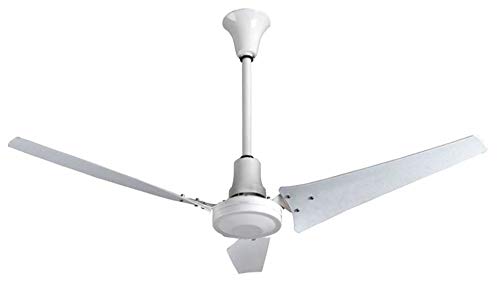
How to Use a Ceiling Fan With AC for Better Cooling
A ceiling fan does not replace your air conditioner, but when you run the two together correctly you can raise the thermostat a few degrees, feel cooler in every room, and reduce how hard your AC has to work. This guide explains the mechanics, the summer and winter settings, room-by-room placement, and the mistakes that cancel out the benefit.
See the Setup ChecklistWhy a Ceiling Fan and AC Work Well Together
An air conditioner removes heat and humidity from the air and delivers cooler air through the supply vents. A ceiling fan does not lower the temperature of the room. What it does is move air across your skin, which accelerates evaporation and makes the same room temperature feel cooler. Because the fan is doing part of the comfort work, you can set the thermostat slightly higher and still feel comfortable.
The important nuance is that the wind-chill effect applies to people, not to the room. Once you leave the room, the fan provides no cooling benefit, so it should be switched off. This is the single biggest difference between using a fan with an AC and treating a fan as a substitute for one.
Key idea: The fan cools you, the AC cools the air. Run them together while you are in the room, then turn the fan off when the room is empty.
There is also an airflow benefit. Many rooms have uneven temperatures because cool air settles near the floor or piles up in one corner. A properly sized ceiling fan on a low or medium speed gently mixes the air so the AC's output distributes more evenly. That reduces the number of times you walk into a room and feel a cold pocket near the vent and a warm pocket near the door.
Fan Direction: Clockwise vs Counterclockwise
Most ceiling fans have a small direction switch on the motor housing. The correct setting depends on the season and on what you want the fan to do.
| Season | Direction | Speed | Effect |
|---|---|---|---|
| Summer (with AC) | Counterclockwise | Low to medium | Pushes air down, creating the cooling breeze on your skin |
| Summer (empty room) | Off | Off | No benefit without people in the room |
| Winter (with heating) | Clockwise | Low | Gently pulls cool air up and pushes warm air along the ceiling and down the walls |
| Shoulder season | Counterclockwise | Low | Light air movement for mild days with the AC cycling |
To confirm direction, stand under the fan and look up. If the leading edge of the blade is higher than the trailing edge and air hits you from above, the fan is in summer mode. If you feel little downward airflow, it is likely in winter mode. Test the switch on a low speed before committing.
If your home uses a heat pump or a ducted system with a blower that runs continuously, the winter clockwise setting is especially useful because it evens out the temperature between the ceiling and the floor. That detail applies to most modern setups, whether you are running a standard split system or a variable-speed configuration such as a variable air volume HVAC system.
Thermostat Strategy When the Fan Is Running
The practical rule is a small adjustment, not a large one. Raising the thermostat by one to two degrees while the fan is on is usually enough to keep comfort steady and reduce how long the compressor runs. Larger jumps tend to make the room feel uneven and can invite a rebound where you drop the setpoint again a short time later.
There are three conditions to check before you adjust anything:
- Humidity. A fan does nothing to remove humidity. If the room feels clammy, keep the AC setpoint where it is and let the system dehumidify properly. Overshooting the thermostat in a humid climate leaves you with a fan blowing moist air around.
- Room occupancy. Only count the adjustment while someone is in the room. Programmable thermostats and smart schedules can drop the fan and the setpoint together when the room empties.
- Fan speed. Use the lowest speed that makes you feel comfortable. A high-speed fan under a low ceiling creates drafts and noise that are not worth the marginal gain.
If you are pairing a ceiling fan with a mini-split or a multi-zone setup such as a two-head mini-split, set the thermostat on the indoor head closest to where you spend time and let the fan mix the air in that zone. Do not try to use a ceiling fan to push conditioned air through a closed door into another room; that does not work well and it forces the system to run longer than necessary.
Quick reference: Counterclockwise fan at low or medium speed, thermostat one to two degrees higher than normal, fan off when the room is empty. That is the whole strategy in one line.
Room-by-Room Guidance
The best combination of fan and AC depends on the room and on the type of cooling equipment serving it. Below is a practical breakdown for the rooms where this pairing matters most.
Bedrooms
A bedroom is the best case for the pairing. You are stationary in bed, so a low fan speed delivers a steady breeze without drafts. A wall-mounted or window unit can handle the cooling while the fan distributes the air, and many households find that a small room unit plus a ceiling fan is enough for comfortable sleep. If the room is served by a compact unit rather than a full system, the same logic applies: see our notes on wall-mounted air conditioners for a small room for sizing context.
Living rooms
Living rooms are larger and often have taller ceilings, so a mid-speed fan works well. If the room is served by a through-the-wall unit, watch that the fan does not blow air directly into the supply vent, which can interfere with the unit's own discharge pattern. Our guide to through-the-wall AC covers placement considerations for that type of installation.
Home offices
Home offices tend to have one occupant and a lot of heat-generating equipment. A ceiling fan at low speed keeps air moving over you without disturbing papers, and it lets the AC cycle less often. If the office is cooled by a portable unit, route the exhaust properly first; the fan and the AC cannot compensate for hot air being dumped back into the room. Our article on using a portable air conditioner without a window explains the venting options.
Open-plan and multi-story spaces
In open-plan areas, fans should be set to a low, consistent speed so the air mixes without creating noticeable drafts at seating height. In multi-story homes, the goal is to even out the temperature between floors. A fan on the upper level in summer mode pushes cooler air down toward the stairs, which can reduce the load on the upper-floor zones of a central system. If you are evaluating how your system is laid out in the first place, the overview of types of HVAC systems is a useful starting point.
Rooms with heat pumps
Heat pumps in cooling mode behave like an air conditioner, so the same fan strategy applies. In heating mode, switch to the winter direction at low speed. Households with a combined system may find our guide to two-ton heat pumps helpful for understanding how the equipment cycles through the year.
Ceiling Fan Tiers and What Matters
Not every ceiling fan is equally suited to running alongside an AC. The differences that matter most are motor quality, blade balance, and control granularity. Below is a neutral tier breakdown of what to expect at each level.
| Tier | What It Typically Offers | Best For |
|---|---|---|
| Entry-level | Basic pull-chain control, acceptable balance, functional at low and medium speeds | Secondary rooms and short usage periods |
| Mid-range | Smoother motor, quieter at low speed, wall or remote control, better blade balance | Bedrooms and living rooms used daily |
| Premium | DC motor with fine speed control, very quiet, reversible without tools, refined blade design | Primary living spaces and rooms where noise matters |
| High-end tier | Architectural finishes, integrated smart control, long service life, precise low-speed control | Design-sensitive spaces and whole-home installations |
The most useful upgrade for AC pairing is fine speed control. The ability to run a fan at a genuinely low speed, rather than in off-low-high steps, is what lets you keep the thermostat adjustment modest without creating drafts. If you are also choosing a small cooling unit for the same room, the comparisons in our very small air conditioner window guide show how compact units interact with low-speed air movement.
A second useful upgrade is a DC motor. DC fans run more efficiently at low speeds, which matters if the fan is on for long stretches during cooling season. The gains are relative, not dramatic, but they add up over a full season of daily use.
Mistakes That Cancel the Benefit
Watch out: Running a ceiling fan in an empty room, or pointing a high-speed fan directly at the thermostat, can make the system behave in ways you did not intend.
- Leaving the fan on all day. A fan moves air, it does not cool it. In an empty room it only adds a small amount of heat from the motor and does no useful work.
- High speed under a low ceiling. This creates drafts, noise, and a sense of chill that pushes people to raise the thermostat more than intended, which then feels uncomfortable when they move out of the draft.
- Blocking the supply vent. A fan does not need to be aimed at the vent, and in some layouts the airflow can interfere with the AC's discharge. Keep the fan's downward column clear of obstructions.
- Using the fan to compensate for a poorly maintained AC. A clogged filter or a dirty coil reduces cooling regardless of how much air the fan moves. Clean the filter on schedule; our notes on cleaning the AC filter cover the basics.
- Ignoring humidity. Fans do not dehumidify. In a humid climate, the AC must run enough to remove moisture, so do not push the thermostat adjustment too far.
- Assuming the fan will fix an undersized or oversized system. If the AC is the wrong size for the room, air movement will not correct the underlying problem. The explanation of what happens when an AC is too big or too small is worth reading if the room never feels right.
Setup Checklist
Before You Run Both Together
- Set the fan to counterclockwise for cooling season and clockwise for heating season.
- Confirm the fan is balanced and does not wobble at low and medium speed.
- Clean the AC filter so the system is delivering full airflow before you rely on the fan to distribute it.
- Check that supply and return vents are unobstructed by furniture, curtains, or rugs.
- Choose a thermostat adjustment of one to two degrees, not more, for the first few days.
- Decide on an occupancy rule: fan off when the room is empty, or a smart schedule that handles it for you.
- For heat pumps and combined systems, note the changeover point between cooling and heating so you switch fan direction at the right time.
Once the checklist is in place, the routine is simple: fan on when you are in the room, thermostat a couple of degrees higher than you would otherwise set it, and the AC cycling less often than it did before. If you are still selecting equipment for a room, the overview of types of air conditioning systems can help you match the cooling unit to the space before you optimize airflow.
Frequently Asked Questions
Can a ceiling fan replace an air conditioner?
No. A ceiling fan does not lower the air temperature or remove humidity. It makes the air feel cooler on your skin, which is useful when the AC is running but not as a substitute for cooling equipment.
Should the fan blow down or up in summer?
Blow down. The counterclockwise setting pushes air toward the floor, creating the breeze that makes you feel cooler. The clockwise, low-speed setting is for heating season, when you want to circulate warm air without a draft.
How many degrees can I raise the thermostat with a fan running?
One to two degrees is the practical range for most rooms. Larger adjustments tend to make the space feel uneven and, in humid conditions, leave the AC running less than it needs to for moisture removal.
Should I leave the ceiling fan on all day to help the AC?
No. In an empty room the fan adds no comfort and only consumes a small amount of energy. Turn it off when you leave, or use a smart control that does it for you.
Does a ceiling fan help a mini-split or portable AC?
Yes, as long as the cooling unit is vented and maintained properly. The fan distributes the conditioned air more evenly and lets you keep the unit's setpoint slightly higher. For portable units, make sure the exhaust is routed correctly first.
Is a DC ceiling fan worth it for AC pairing?
A DC motor gives you finer control at low speeds, which is exactly the range you use when running the fan alongside an AC. It is a worthwhile upgrade for rooms used daily, though the difference is incremental rather than transformative.