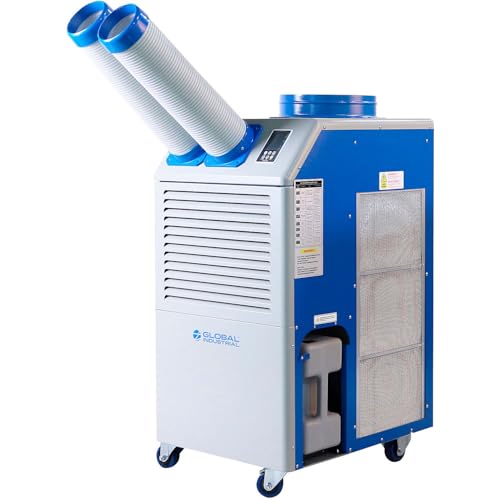
Warehouse Air Conditioner: Complete Commercial Cooling Guide
Expert advice on selecting, sizing, and installing AC systems for warehouses, distribution centers, and large industrial spaces. Reduce energy costs while maintaining optimal working conditions.
Shop Recommended Units →🏭 Why Warehouse Cooling Matters: Proper climate control in warehouses protects inventory, improves employee productivity, and reduces equipment heat stress. Unlike residential spaces, warehouses have unique challenges: high ceilings (20-40 ft), large open floor plans, significant heat gain from loading docks, and minimal interior partitions. This guide helps you navigate commercial AC solutions specifically designed for these demanding environments.
Understanding Warehouse AC Requirements
Cooling a warehouse is fundamentally different from cooling a home or small office. Commercial AC types for warehouses must handle high thermal loads, frequent door openings, and significant vertical temperature stratification. Most warehouses require systems between 5 tons (60,000 BTU) for small facilities up to 50+ tons for large distribution centers. Key factors include building insulation, lighting heat (especially LED vs. traditional), number of workers, forklift traffic, and sensitive goods storage requirements.
📐 Ceiling Height Impact
Warehouses with ceilings above 16 ft need high-velocity systems or destratification fans. Standard AC struggles to push cool air to ground level in tall spaces.
🚪 Door Activity
Loading docks and high-traffic doors cause massive heat infiltration. Consider air curtains and fast-acting doors alongside your AC system.
⚙️ Equipment Heat
Forklift chargers, conveyors, and servers generate significant BTUs. Calculate internal heat gain accurately for proper sizing.
Best AC Systems for Warehouses
Not all air conditioners can handle warehouse demands. Below are the most effective systems, ranging from economical options to high-efficiency commercial solutions. For smaller warehouse offices or break rooms, you might also consider ductless mini-split AC units as supplemental cooling.
| System Type | Best For | BTU Range | Typical Cost (Installed) |
|---|---|---|---|
| Packaged Rooftop Unit (RTU) | Large warehouses, big box retail, manufacturing | 60,000 – 500,000+ BTU (5–50 tons) | $8,000 – $30,000+ |
| Split System (Commercial Grade) | Medium warehouses, distribution centers | 36,000 – 240,000 BTU (3–20 tons) | $6,000 – $22,000 |
| VAV (Variable Air Volume) | Zoned warehouses with different cooling needs | 80,000 – 400,000+ BTU | $15,000 – $60,000 |
| Evaporative Coolers (Swamp Coolers) | Dry climate warehouses (low humidity) | Variable, high CFM output | $3,000 – $12,000 |
For smaller warehouse spaces like tool cribs or manager offices, packaged air conditioner units or high-capacity ceiling cassette AC systems can be effective. Many warehouse operators also use ducted air conditioning with multiple supply registers to distribute air evenly across large footprints.
Warehouse BTU Calculator & Sizing Guide
Proper sizing prevents short-cycling and high energy bills. For warehouses, use this professional formula: BTU = (Square Footage × Ceiling Height × Insulation Factor × Occupancy Factor) + Equipment Heat Load. A standard rule: warehouses need approximately 25-35 BTU per square foot for basic cooling, but this increases with poor insulation or high ceilings. Always perform a Manual J load calculation for accurate results.
🔧 Sizing Example: 10,000 sq.ft Warehouse
Ceiling height: 24 ft | Insulation: Average (R-13) | Windows/Docks: 2 loading docks + 4 personnel doors
Calculated load: 22 tons (264,000 BTU) for Texas climate zone. For reference, a typical home needs only 3-5 tons.
Recommended system: Two 10-ton packaged RTUs or one 25-ton VAV system with zoning capability.
See our detailed AC sizing for whole home guide for residential, or how to size an air conditioner for general principles.
Undersizing leads to insufficient cooling on hot days, while oversizing causes humidity problems and wasted energy. Understanding AC too big or too small issues is critical for warehouses where temperature-sensitive goods may be stored. Always consult a commercial HVAC engineer for systems above 10 tons.
Energy Efficiency: SEER, EER & IEER for Warehouse AC
For commercial warehouse systems, look beyond residential SEER ratings. The key metrics are EER (Energy Efficiency Ratio) and IEER (Integrated Energy Efficiency Ratio). High-efficiency warehouse units achieve EER of 11–14 and IEER above 15. Newer models using R-454B or R-32 refrigerants offer improved performance. The DOE efficiency standards for commercial units are stricter since 2023. ENERGY STAR certified AC units for commercial applications can save thousands annually.
⚡ EER vs IEER
EER measures peak performance at full load. IEER accounts for part-load operation – more realistic for warehouses with variable occupancy.
💰 Tax Benefits
Commercial HVAC upgrades may qualify for Section 179D tax deductions up to $1.80 per square foot. Check local utility rebates too.
🔄 VFD Technology
Variable Frequency Drives on compressors and fans (similar to inverter AC technology) reduce energy use by 30-50% in warehouse settings.
Warehouse AC Installation: Permits & Contractors
Commercial installations are complex. You'll need licensed HVAC contractors with commercial experience. Most municipalities require AC permits for systems above 5 tons. Key steps include structural analysis for rooftop units (roof load capacity), crane rental for equipment placement, and coordination with electrical upgrades. Many warehouses require 208V or 480V three-phase power – check your home electrical panel analogy but scaled for industrial.
✅ Warehouse AC Installation Checklist
- Conduct professional heat load calculation (Manual N for commercial)
- Verify roof structural integrity for RTU placement
- Obtain commercial mechanical permit from local building department
- Schedule crane and rigging for rooftop unit delivery
- Coordinate with licensed electrician for 3-phase power connection
- Plan for refrigerant line set routing if using split system
- Install programmable or BMS thermostat for scheduling
- Test airflow distribution and balance dampers
For the installation process itself, understanding refrigerant line set lengths and how to vacuum an AC system helps you evaluate contractor quality. Avoid common AC installation mistakes that plague commercial projects. After installation, follow how to test new AC procedures and register your AC warranty registration promptly.
Warehouse AC Maintenance & Common Problems
Commercial systems require rigorous maintenance. Dirty filters and condenser coils are the #1 cause of warehouse cooling failure. Establish a schedule for cleaning AC filters monthly (or more often in dusty warehouses). Annually clean condenser coils and clean evaporator coils. Watch for signs of trouble: inconsistent temperatures, unusual noises, or tripped breakers.
Common warehouse-specific issues include AC not cooling due to refrigerant leaks from vibration, frozen coils from low airflow, and water leakage from clogged condensate drains. For advanced repairs like compressor replacement or refrigerant leak repair, always hire certified commercial technicians. Annual service agreements ($800–$2,500/year) are cost-effective for systems over 10 tons – see typical annual service cost.
Warehouse AC Cost Breakdown (2025 Market Prices)
Equipment prices and installation vary significantly based on tonnage and complexity. Below are realistic price ranges for warehouse AC systems in the current market:
💰 Typical Investment by System Size
5-10 tons (60,000–120,000 BTU): $6,500 – $15,000 (equipment + basic install)
10-20 tons (120,000–240,000 BTU): $14,000 – $28,000
20-50 tons (240,000–600,000 BTU): $28,000 – $80,000+
Rooftop packaged unit replacement only: $5,000 – $18,000 per unit (DIY crane extra)
Annual operating cost (electricity): $3,500 – $25,000 depending on climate and efficiency
Note: These are estimates. Get 3-5 quotes from local HVAC vs big box store comparisons. Financing and HVAC tax credits may apply for energy-efficient commercial equipment.
Know When to Call a Commercial HVAC Pro
While you can handle basic filter changes, most warehouse AC service requires licensed professionals. Call a technician immediately if you notice refrigerant smells, ice forming on lines, electrical issues, or if the system fails to maintain temperature setpoint. For general guidance, see when to call an HVAC technician. Use find HVAC contractor near me tools to locate commercial specialists with experience in warehouse environments.
📚 Ready to Make a Decision? After reading this guide, you understand warehouse AC types, sizing calculations, efficiency metrics, and installation requirements. The next step is choosing the right commercial unit for your specific space. Browse the recommended products below – each has been selected based on real-world warehouse performance. Compare features, check current prices, and read verified buyer reviews before purchasing.