
Cold Air Return Vents: The Complete Guide to Selection & Placement
Understand how return air vents complete your HVAC airflow loop, how to size and place them correctly, and how the right return grille improves comfort, efficiency, and indoor air quality.
START LEARNINGWhy this matters: A cold air return vent is half of every forced-air system. Supply vents push conditioned air in, but return vents pull stale air out. When returns are undersized or poorly placed, the whole system struggles — rooms feel stuffy, the blower works harder, and efficiency drops. This guide walks you through sizing, placement, filter choices, and tier-based product selection so you can make an informed decision before you buy.
What Is a Cold Air Return Vent?
A cold air return vent — often called a return air grille or return air register — is the intake point of a forced-air HVAC system. It draws room-temperature air back into the air handler, where it passes through a filter, gets cooled or heated, and is then pushed back into your rooms through supply registers.
Despite the name, a return vent does not cool air on its own. The term "cold air return" comes from the fact that the air being pulled in is cooler than the heated supply air in winter, but in practice it simply describes the return side of the air loop. In cooling season, the return air is the warm room air being pulled back for reconditioning.
Returns are essential for three reasons:
- Airflow balance: Supply and return volumes must match. If a system pushes 1,200 CFM out but can only pull 800 CFM back, static pressure rises and airflow suffers.
- Filtration: The return grille is where most of the system's filtration happens, so it directly affects indoor air quality.
- Comfort distribution: Well-placed returns reduce hot spots and dead zones, especially in multi-story homes and rooms with closed doors.
If your system is struggling to cool the house even though air is flowing, the problem may be on the return side. Reviewing air blowing out of vents but not cooling the house alongside your return layout is a smart diagnostic step.
Return Air vs Supply Air: What's the Difference?
Supply vents and return vents do opposite jobs, and confusing them leads to poor system design. Supply registers are the visible vents that blow conditioned air into a room. Return grilles are the larger, often louvered intakes that pull air back.
| Feature | Supply Vent | Return Vent |
|---|---|---|
| Function | Delivers conditioned air | Draws stale air back to the air handler |
| Typical size | Smaller, often 6–12 inches wide | Larger, often 14–30 inches wide or more |
| Location | Near windows, exterior walls, ceilings | Central hallways, interior walls, low or high on wall |
| Filter location | Rarely filtered | Common filter location |
| Air velocity | Higher velocity, directed flow | Lower velocity, broad intake |
If you are troubleshooting airflow, it helps to know which side of the system is failing. Issues like AC fan on but not blowing cold air can sometimes trace back to restricted returns rather than a supply-side fault.
How to Size a Cold Air Return Vent
Sizing is the single most important decision when selecting a return vent. An undersized return chokes the system, while an oversized return is less harmful but can reduce filtration effectiveness if air bypasses the filter.
A common industry rule of thumb is:
- Return airflow: roughly 200 CFM of return air per ton of cooling capacity.
- Grille area: roughly 2 square feet of free grille area per 400 CFM, though this varies by grille design and free area percentage.
- Filter grille face velocity: keep face velocity around 300–500 feet per minute to protect the filter and reduce noise.
For a 3-ton system, that translates to roughly 600 CFM of return air and a return grille in the neighborhood of 14×20 to 16×25 inches depending on free area and filter depth. For larger systems, multiple returns are often better than one massive grille, because they distribute the intake load and reduce noise.
Pro Tip: Static Pressure Tells the Truth
Rules of thumb are a starting point, not a final answer. A technician measuring external static pressure across the air handler can confirm whether your return is actually adequate. High static pressure — often above 0.5 inches of water column — is a red flag that the return side is restrictive.
Return Vent Sizing Quick Reference
| System Capacity | Approx. Return CFM | Typical Return Grille Size | Best For |
|---|---|---|---|
| 1.5 ton | ~300 CFM | 14×14 in or 14×20 in | Small apartment, single room |
| 2 ton | ~400 CFM | 14×20 in to 16×20 in | Small home, 1–2 bedroom |
| 3 ton | ~600 CFM | 16×25 in or two 14×20 in | Mid-size home, 2–3 bedroom |
| 4 ton | ~800 CFM | 20×25 in or multiple returns | Larger home, 3–4 bedroom |
| 5 ton | ~1,000 CFM | Multiple returns totaling 24×24 in+ | Large home, multi-zone |
Where to Place Return Air Vents
Placement affects comfort as much as sizing. A return that is too close to a supply vent short-circuits the system, pulling in freshly conditioned air before it reaches the room. The following placement rules cover most residential installations:
- Central hallway or common area: A single central return works well in compact homes because it pulls air from the whole living space.
- Interior walls preferred: Interior walls reduce duct runs through unconditioned space and simplify routing.
- Opposite the supply vent: Placing returns across the room from supplies maximizes air mixing and prevents short-circuiting.
- 3–5 feet of separation: Keep at least 3 to 5 feet between supply and return grilles where possible.
- Low or high placement: Low returns work well in cooling-dominated climates; high returns help in heating-dominant homes because warm air stratifies near the ceiling.
- One return per closed room: Bedrooms and home offices with closing doors benefit from a dedicated return or a transfer grille to maintain pressure balance.
Avoid placing returns in bathrooms, kitchens, or garages, where moisture, grease, or fumes can be pulled into the system. Also avoid blocking returns with furniture, rugs, or curtains.
Filters and Return Grilles: The Air Quality Connection
The return vent is the most common location for HVAC filters. Filter grilles combine the intake and the filter frame in one unit, which makes filter changes easier and improves filtration consistency.
When choosing a filter for a return grille, match the filter's MERV rating to your system's capability. A MERV 8 to MERV 11 filter is a balanced choice for most residential systems, while MERV 13+ filters may be too restrictive for older systems with undersized returns. For broader guidance on filter selection, see air filters for AC vents.
Filter depth matters too. A 4-inch or 5-inch media filter has more surface area than a 1-inch filter, which means lower pressure drop and less frequent replacement. If your return grille has room for a deep filter, it is usually the better long-term investment.
Return Vent Tier Guide
The following tier descriptors are used throughout this guide to describe relative product positioning without referencing any numeric values.
| Tier | Best For | Typical Characteristics |
|---|---|---|
| Entry-Level | Basic replacements, rental units | Standard stamped steel, simple louver, screw-mount frame |
| Mid-Range | Most residential retrofits | Reinforced frame, better finish, filter grille options |
| Premium | High-end homes, visible locations | Architectural-grade aluminum, tight tolerances, low-noise design |
| Professional-Grade | Custom ductwork, commercial spaces | Heavy-duty construction, engineered free area, custom sizing |
Common Return Vent Problems and Fixes
Return vents are simple components, but they are involved in many airflow complaints. The most common issues include:
- Whistling or noisy returns: Usually caused by undersized grille or high face velocity. A larger grille or a second return resolves it.
- Weak airflow from supplies: Restricted returns can starve the blower. Check for blocked filters and furniture covering the grille.
- Dust around the grille: Often a sign of a loose filter or a leaky duct connection behind the grille.
- Stuffy rooms with closed doors: Add a return or a transfer grille so the room can exhale.
- Frozen coils: Low return airflow can cause the evaporator coil to ice over. See AC fan is spinning but no cold air for related diagnostics.
If your system keeps shutting off before reaching the set temperature, restricted return airflow is one possible cause. Reviewing AC short cycling helps you rule out other factors.
Cold Air Return Vents and Whole-Home Comfort
In multi-story homes, return placement becomes a balancing act. Warm air rises, so upper floors tend to run warmer in summer and cooler in winter. A return on the upper level can help pull warm air back to the system, while a central return on the main floor handles the bulk of the load. In some homes, adding a second return is a more effective comfort upgrade than replacing the equipment.
For homes without ductwork, ductless systems use a different circulation model, but the principle of balanced intake and output still applies. If you are comparing approaches, the buying guide covers ducted and ductless options side by side.
If you are adding a second unit or reworking your air distribution, the considerations in adding a second AC unit to house overlap with return design — both require a careful look at static pressure and room-by-room load.
Installation and Maintenance Checklist
Whether you are replacing a single grille or designing a new return layout, the following checklist keeps the job on track:
- Measure the existing duct opening and confirm the boot size before ordering a new grille.
- Check that the return path is sealed — gaps behind the grille pull attic or wall-cavity air into the system.
- Select a grille with sufficient free area for your system's CFM.
- Choose a filter grille if you want easy filter access without a separate filter rack.
- Verify that the grille is not blocked by furniture, doors, or rugs.
- Replace or clean filters on a schedule — typically every 1–3 months for 1-inch filters.
- Listen for whistling after installation; if present, the grille may be undersized.
- Have a technician measure static pressure if airflow problems persist.
Ready to Improve Your Airflow?
Browse our recommended return vents and filter grilles below, selected for balanced airflow, durable construction, and easy maintenance.
VIEW RECOMMENDED OPTIONSFrequently Asked Questions
What is a cold air return vent?
A cold air return vent is a grille that draws stale room air back into the HVAC system so it can be filtered, conditioned, and redistributed through supply vents. It completes the air circulation loop in a forced-air system.
How do I size a return air vent?
A common rule of thumb is about 200 CFM of return air per ton of cooling capacity, with roughly 2 square feet of grille area per 400 CFM. Professional sizing based on a load calculation and measured static pressure is always preferred.
Where should return vents be placed?
Place returns centrally in rooms or hallways, ideally on interior walls opposite supply registers, with at least 3 to 5 feet of separation. Avoid blocking with furniture and avoid returns inside bathrooms or kitchens.
Can I close a return air vent?
Closing a return vent is generally not recommended because it raises system static pressure, reduces airflow, and can stress the blower. Proper balancing or professional adjustment is the better approach.
Do I need a filter in every return vent?
Not necessarily. Many homes use a single central filter at the air handler or at one large return grille. However, filter grilles at each major return can improve filtration consistency and make filter changes more convenient.
How many return vents does a house need?
The number depends on system capacity and layout. A compact home may work well with one central return, while larger or multi-story homes typically need two or more returns to keep static pressure in check and comfort balanced.
Recommended Cold Air Return Vents & Grilles
⚠️ AFFILIATE DISCLOSURE: This website contains affiliate links. As an Amazon Associate, we earn from qualifying purchases. If you make a purchase through these links, we may receive a small commission at no additional cost to you. Read our full affiliate policy.

EZ-FLO 14 x 6 Inch (Duct Opening) Return Air Vent Cover for Wall or Ceiling, Solid Steel Return Air Grille, HVAC Vent Cover, White, 61628
Check price on Amazon
30x6 Baseboard Return Air Grille for 30"Wx6"H Duct Opening, 7/8" Depth | Steel Baseboard Return Air Vent Cover Grill,7/8" Thick Margin Turnback for Baseboard,Outer Dim 31.75"W X 7.75 "H X 7/8"
Check price on Amazon
Imperial RG0033 Louvered Steel Painted Baseboard Return Air Grille, 14 x 6-Inch, White, 1-Pack
Check price on Amazon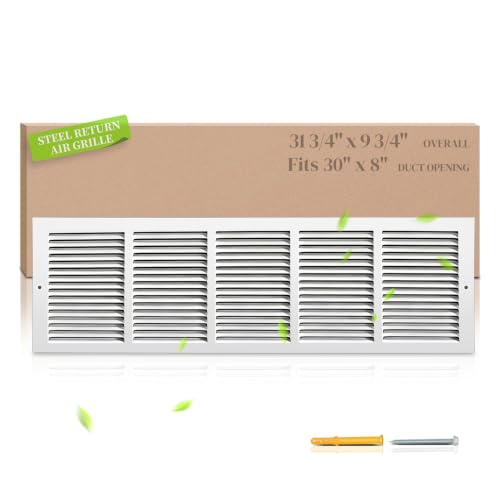
30x8 Steel Return Air Grille, HVAC Vent Cover Fits 30"W x 8"H Duct Opening | Steel Cold Air Return Vent Cover for Wall & Ceiling, No Filter, Outer Dim:31.75"W X 9.75"H
Check price on Amazon
Return Air Filter Grille 20x20,Air Return Vent Cover for 20x20 Duct Opening | Steel Return Air Grille HVAC Vent Cover for Wall Ceiling,Removable Door Hold 1"Thick AC Filter,Outer Size 22 5/8"x22 5/8"
Check price on Amazon
Fits 24x8 Duct Opening | Steel Baseboard Return Air Grille by Handua | Vent Cover Grill | 7/8" Margin Turnback [Depth] to Fit Baseboard | White | Outer Dimensions: 25.75"W X 9.75 "H
Check price on Amazon
Fits 14x6 Duct Opening | Steel Baseboard Return Air Grille by Handua | Vent Cover Grill | 7/8" Margin Turnback [Depth] to Fit Baseboard | White | Outer Dimensions: 15.75"W X 7.75 "H
Check price on AmazonDisclaimer
Some of the content on this site uses AI assistance. Information is provided for educational purposes only. We are not responsible for any losses resulting from the use of this information. By using this site, you waive any right to bring legal claims against us arising from your use of the information provided. If you do not agree, please do not use this site. Read the full disclaimer.