
Compact & Slim Window Air Conditioners
Your complete guide to finding the right compact or slim window AC for tight windows, small rooms, and space-conscious living areas — understand sizing, features, and installation before you buy.
Explore RecommendationsWhy compact and slim window ACs matter: Standard window air conditioners often struggle to fit narrow openings, shallow sills, or rooms where every inch counts. Compact and slim models solve this by reducing footprint without sacrificing essential cooling performance. This guide helps you match the right unit to your window and room.
What Are Compact & Slim Window Air Conditioners?
Compact window air conditioners are engineered with a reduced chassis — shorter in width, height, or depth — so they can fit into window openings that standard units cannot. Slim window ACs focus on a low-profile design that protrudes less into the room and works well with shallow window sills. Both categories prioritize space efficiency while delivering dependable cooling for small to medium rooms.
These units are especially relevant for apartments, older homes with non-standard windows, casement or slider windows (with proper kits), and rooms where furniture placement or walkway clearance is tight. If your window is narrower than 23 inches or your sill depth is limited, a compact or slim model is likely your best path forward.
Compact Footprint
Reduced width and height allow installation in narrow or short window openings where standard units simply will not fit.
Slim Profile
Low-profile designs protrude less into the room, preserving floor space and maintaining a cleaner interior look.
Lightweight Build
Smaller chassis typically means lower weight, making DIY installation and seasonal removal far more manageable.
Focused Cooling
Optimized for small to medium rooms where targeted cooling is more efficient than conditioning an entire home.
Who Should Choose a Compact or Slim Window AC?
These units are not for every situation, but they are an excellent match for specific scenarios. Consider a compact or slim model if any of the following apply to you:
- Your window opening is narrower or shorter than standard window AC dimensions.
- You live in an apartment or rental where modifications are restricted.
- You need to cool a bedroom, home office, studio, or small living area.
- Your window sill is shallow and a deep unit would protrude awkwardly.
- You want a unit that is easier to lift, install, and remove seasonally.
- You are dealing with a slider or casement window and plan to use a compatible installation kit.
If you need to cool a larger space, a standard window air conditioner or a ductless mini-split system may be a better fit. Compact units are purpose-built for targeted, space-constrained cooling.
Sizing and BTU: Getting the Cooling Capacity Right
The most common mistake buyers make is choosing a unit that is either too small to cool the room or too large, which causes short cycling and poor humidity control. Use the table below as a starting reference, then adjust for sun exposure, ceiling height, occupancy, and heat-generating appliances.
| Room Size | Recommended BTU | Typical Use Case |
|---|---|---|
| Up to 150 sq ft | 5,000 – 6,000 BTU | Bedroom, studio, small office |
| 150 – 250 sq ft | 8,000 – 10,000 BTU | Living room, larger bedroom, home office |
| 250 – 400 sq ft | 12,000 – 14,000 BTU | Open-plan living area, master bedroom |
For a deeper breakdown, see our guide on how to size an air conditioner and use the BTU calculator by room size to refine your estimate. If you are unsure whether a unit is too large or too small, our explainer on AC sizing mistakes covers the consequences of each.
Key Features to Evaluate
Beyond size, the feature set determines long-term satisfaction. Here are the most important factors to weigh when comparing compact and slim window AC models.
Energy Efficiency (CEER / EER)
Higher efficiency ratings translate to lower energy use over the cooling season. Look for ENERGY STAR certification when available for the unit's capacity class.
Noise Level
Compact chassis can sometimes amplify noise. Check decibel ratings and customer feedback, especially if the unit will be in a bedroom or office.
Installation Kit Compatibility
Confirm the unit ships with a window kit or that a kit is available for your window type — slider, casement, or double-hung.
Smart Controls
Wi-Fi connectivity, programmable timers, and remote app control add convenience for scheduling and energy management.
Filtration
Washable filters are standard, but some models add additional filtration stages for dust or allergens. Check filter accessibility for easy maintenance.
Drainage and Installation
Slim units may have specific drainage requirements. Review the manual to understand condensate management and whether a slight tilt is required.
How to Measure Your Window Before Buying
Accurate measurements prevent returns and installation headaches. Follow these steps before you commit to any compact or slim window AC.
- Measure the window opening width at the narrowest point, excluding any frame obstructions.
- Measure the window opening height from the sill to the bottom of the upper sash.
- Measure the sill depth to ensure the unit can rest securely without excessive overhang.
- Check for obstructions such as cranks, dividers, or storm window frames that could interfere.
- Confirm the manufacturer's minimum and maximum opening dimensions for the specific model.
- Verify the window type — double-hung, slider, or casement — and whether a special kit is required.
For units that will be installed in a wall rather than a window, see our guide to through-the-wall AC units. If you are evaluating ductless alternatives, the ductless mini-split guide covers options that do not require a window opening at all.
Installation Considerations for Compact & Slim Units
Most compact and slim window ACs are designed for straightforward installation, but there are important details to get right for safety and performance.
- Use the manufacturer-supplied bracket or support system — do not improvise with unsupported overhang.
- Follow the manual's guidance on slight backward tilt for proper condensate drainage.
- Ensure a dedicated circuit if the unit's amperage requires it; check the nameplate rating.
- Seal gaps around the installation with foam or weatherstripping to prevent air leaks and insect entry.
- For upper-floor installations, secure the unit properly and consider professional help for heavier models.
If your installation requires electrical work or you are unsure about your home's circuit capacity, consult a qualified technician. Our guide on 110V vs 240V AC units explains voltage considerations, and the amps and breaker size guide helps you verify circuit requirements.
Maintenance Tips for Long-Term Performance
Compact units work hard in small spaces, so routine maintenance is essential to preserve cooling performance and efficiency.
- Clean or replace the air filter every two to four weeks during peak cooling season.
- Inspect and gently clean the condenser coils at the start of each season.
- Check the drain path and clear any blockage to prevent water backup.
- Remove the unit or cover it during the off-season to protect components.
- Listen for unusual noises and address them early before they become major repairs.
For detailed steps, see our guides on cleaning AC filters and cleaning condenser coils. If you notice performance issues, our AC not cooling troubleshooting guide walks through common causes and fixes.
Compact & Slim Window AC Tiers Explained
Compact and slim window ACs generally fall into three market tiers. Use this framework to align your expectations with what each tier typically delivers.
| Tier | Typical Characteristics | Best For |
|---|---|---|
| Entry-Level | Mechanical controls, basic filtration, standard efficiency, simpler installation kit | Occasional use, guest rooms, tight budgets where core cooling is the priority |
| Mid-Range | Digital controls, programmable timer, improved efficiency, quieter operation, better filtration | Daily use in bedrooms and living areas where comfort and energy use matter |
| Premium | Wi-Fi and smart controls, high efficiency ratings, advanced filtration, quieter compressors, refined build quality | Primary living spaces, smart-home integration, and buyers prioritizing long-term efficiency |
Mid-range models typically offer the most balanced combination of features, efficiency, and build quality for most households. Premium units are worthwhile when smart controls, quieter operation, or top-tier efficiency are priorities. Entry-level models remain a solid choice for secondary rooms and seasonal use.
Recommended Compact & Slim Window Air Conditioners
⚠️ AFFILIATE DISCLOSURE: This website contains affiliate links. As an Amazon Associate, we earn from qualifying purchases. If you make a purchase through these links, we may receive a small commission at no additional cost to you. Read our full affiliate policy.

Midea 5,000 BTU EasyCool Small Window Air Conditioner - Cool up to 150 Sq. Ft. with Easy-to-Use Mechanical Controls and Reusable Filter, Perfect for Small Bedroom, Living Room, Home Office
Check price on Amazon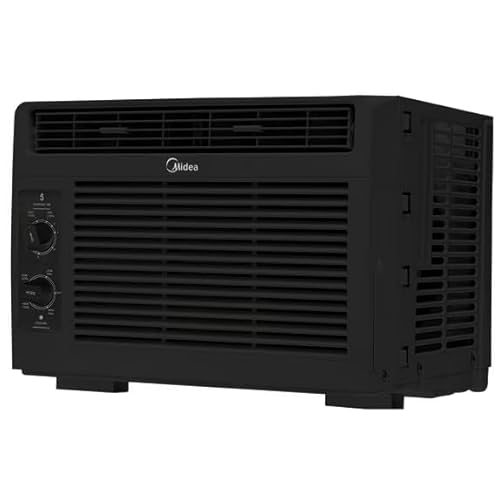
Midea 5,000 BTU 150 Sq ft Mechanical Window Air Conditioner, Black (Renewed)
Check price on Amazon
GE Window Air Conditioner 5,000 BTU AC Unit for Small Spaces up to 150 sq ft with Manual Controls & 2 Cooling Modes, Easy Install Kit, White
Check price on Amazon
Midea 6,000 BTU Window Air Conditioner, Electronic Control, 250 Sq Ft, New | 3-In-1 Cool/Fan/Dehumidifier Modes, Easy-To-Use Controls, Remote Control, And Cooling For Bedrooms, Studies and Home Offices
Check price on Amazon
Frigidaire 5,000 BTU Window-Mounted Air Conditioner, Cools Up to 150 Sq. Ft., Quiet Operation, Effortless Temperature Control, 2 Fan Speeds, Auto Restart, White
Check price on Amazon
Hisense 8,000 BTU Smart Inverter Window Air Conditioner Easy Install Bracket, Up to 350 Sq Ft, Ultra-Slim Profile, 3 Speed, 700W, 4‑Way Air Direction HLAW0825TW (Renewed)
Check price on Amazon
Midea 5,000 BTU Window Air Conditioner, Cools up to 150 Sq. Ft. with Easy-to-Use Reusable Filter, Remote, Perfect AC for Bedroom, Living Room, Home Office, Electronic Control
Check price on AmazonFrequently Asked Questions
What is a compact window air conditioner?
What is a slim window air conditioner?
How do I measure my window for a compact or slim AC?
What BTU size do I need for a small room?
Can I install a compact window AC myself?
Are compact window ACs as effective as standard units?
Final tip: Before purchasing, confirm the unit's dimensions against your actual window opening, verify the BTU rating matches your room size, and check whether a compatible installation kit is included. A few minutes of measuring and cross-referencing prevents the most common window AC return reasons.