HVAC Evaporator Coil: The Complete Guide
Understand how the evaporator coil works inside your air conditioner, recognize the warning signs of a failing coil, and learn how proper care keeps your system efficient year after year.
START LEARNINGWhy this component matters: The evaporator coil is the indoor heat-exchange surface of your air conditioning system. When it becomes dirty, blocked, or damaged, cooling capacity drops, humidity rises, and the compressor works harder than it should. Understanding this single component helps you protect the whole system.
What Is an HVAC Evaporator Coil?
The HVAC evaporator coil is a serpentine arrangement of copper or aluminum tubing fitted with thin fins, mounted inside the indoor air handler or above the furnace. Low-pressure refrigerant enters the coil as a cold mist, and as warm indoor air is pulled across the fins by the blower, the refrigerant absorbs heat and evaporates into a gas. That phase change is what removes heat and moisture from your living space.
Because the coil sits in the path of every cubic foot of air your system circulates, it is constantly exposed to dust, pet dander, and airborne debris. Over time, a film builds up on the fins and the coil loses its ability to transfer heat. This is the single most common reason a system that still runs stops cooling properly.
How the Evaporator Coil Fits Into the Cooling Cycle
The coil is one of four core components in the refrigeration loop, working alongside the compressor, condenser coil, and expansion valve. Here is the sequence:
- Compression: The outdoor compressor raises refrigerant pressure and temperature.
- Condensing: The hot gas releases heat outdoors through the condenser coil and becomes liquid.
- Expansion: The expansion valve drops pressure, turning the liquid into a cold mist.
- Evaporation: Inside the evaporator coil, the mist absorbs indoor heat and returns to gas — and the cycle repeats.
This is also why the evaporator coil is sometimes called the "indoor coil" or "cooling coil," while the condenser is the "outdoor coil." If you are comparing system architectures, the same heat-exchange principle appears in a heat pump vs air conditioner discussion, where the roles of the two coils can reverse in heating mode.
Types of Evaporator Coils
Evaporator coils are not one-size-fits-all. The geometry, cabinet, and refrigerant compatibility vary by system design and by the tier of equipment.
A-Shaped Coil
The most common residential design. Two angled slabs form an "A," fitting above a furnace or inside an air handler. Straightforward and widely serviced.
Slab Coil
A flat horizontal coil used in tight spaces such as closets and crawlspaces. Often seen in manufactured housing and compact air handlers.
N-Shaped Coil
A taller, folded configuration that packs more surface area into a smaller footprint. Common in higher-capacity residential systems.
Cased Coil
Factory-built coil inside a metal enclosure with matched airflow. Easier to seal and often better specified for efficiency than field-fabricated options.
Uncased Coil
Bare coil installed into a custom plenum or duct transition. Demands precise fabrication by the installer to avoid air bypass around the fins.
Microchannel Coil
Flat tubes with tiny internal channels. Strong heat transfer and compact size, increasingly used in modern equipment with new refrigerants.
Copper vs. Aluminum: Which Coil Material Holds Up?
The tubing material affects durability, corrosion behavior, and repairability. This table compares the two dominant constructions using tier-neutral descriptors:
| Attribute | Copper Tube Coil | Aluminum Tube Coil |
|---|---|---|
| Market position | Traditional, mid-range to premium | Modern, entry-level to high-end |
| Heat transfer | Excellent conduction | Good, with larger surface area |
| Corrosion behavior | Resistant; can fail in coastal salt air | Can form pitting in certain environments |
| Repairability | Easier to braze and seal | Harder to repair; microchannel often replaced |
| Best for | Mixed climates, long service life | Compact equipment, modern refrigerant systems |
Signs Your Evaporator Coil Is Failing
An evaporator coil rarely fails without warning. Watch for these symptoms, which usually appear together rather than in isolation:
- Weak airflow: The blower runs but registers feel weak across vents.
- Warm air from supply vents: The system runs continuously without cooling — a pattern also covered in our guide to an air conditioner that is not cooling the house.
- Ice on the indoor coil or refrigerant lines: Restricted airflow or low refrigerant charge freezes the coil.
- Water pooling near the air handler: A frozen coil melts and overflows the drain pan.
- Musty or "dirty sock" odor: Biological growth on a damp, dusty coil surface.
- Rising energy consumption: The compressor runs longer to compensate for reduced heat transfer.
- Hissing or bubbling near the coil: A refrigerant leak — see refrigerant leak repair for what technicians check.
Evaporator Coil Cleaning: DIY vs. Professional
Cleaning is the highest-value maintenance task you can perform for the indoor coil. The appropriate method depends on how deeply the contamination has set in.
What homeowners can do
- Replace the air filter on schedule — a clogged filter is the leading cause of a dirty coil.
- Inspect the coil surface visually each season for dust matting or biological growth.
- Use a soft brush or low-pressure nozzle to remove loose debris from accessible coil faces.
- Keep the drain pan and condensate line clear to prevent standing water.
What a technician does
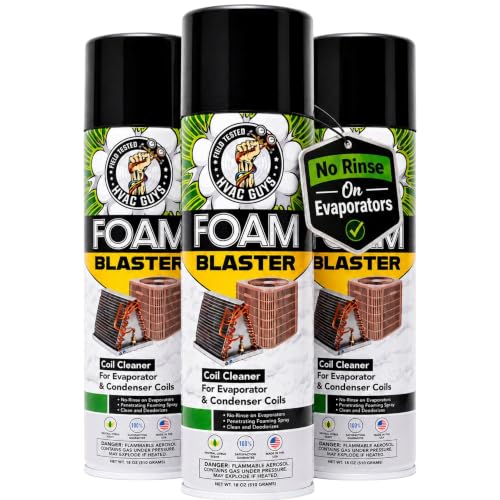
- Applies a coil-safe foaming cleaner that lifts embedded film from between the fins.
- Uses controlled rinsing with protective shielding so water does not reach electrical components.
- Straightens bent fins with a fin comb to restore airflow across the coil face.
- Verifies refrigerant charge and superheat/subcooling after cleaning.
- Checks for pinhole leaks, corrosion, and airflow bypass around the coil cabinet.
If the coil has not been cleaned professionally in several years, schedule a professional HVAC evaporator coil cleaning before peak season. Dirty coils are one of the most frequently cited causes of premature compressor failure, so this service is a long-term investment rather than a quick fix.
Recommended Maintenance Schedule
| Interval | Task | Who Does It |
|---|---|---|
| Every 1–3 months | Inspect and replace the air filter | Homeowner |
| Each season | Visual check of coil face and drain pan | Homeowner |
| Once per year | Deep coil cleaning and fin straightening | HVAC technician |
| Once per year | Refrigerant charge verification | HVAC technician |
| Every 3–5 years | Full system inspection including coil corrosion review | HVAC technician |
Bundling coil care into a broader seasonal visit is usually the most practical approach. Our HVAC preventative maintenance overview explains what a thorough tune-up typically includes, and a routine furnace and air conditioner tune-up keeps both halves of a split system in step.
When to Repair vs. Replace the Coil
Coil replacement decisions depend less on the coil alone and more on the age and condition of the whole system.
- Repair makes sense when: the system is relatively new, the leak is a single accessible pinhole, and the coil is otherwise clean and structurally sound.
- Replacement makes sense when: corrosion is widespread, multiple leaks have appeared, the coil is more than a decade old, or the refrigerant type is being phased out.
- Full system replacement makes sense when: the outdoor unit is nearing end of life, the coil mismatch would hurt efficiency, or repeated repairs exceed the value of the equipment.
A properly matched coil matters for efficiency ratings. When a coil is replaced, the new unit should match the outdoor condenser's capacity and refrigerant type — mismatched components can void efficiency claims and shorten compressor life. For context on how coil decisions interact with whole-system upgrades, see our notes on home air conditioner replacement and how a heat pump system handles the same indoor coil in both modes.
How Coil Condition Affects Efficiency Ratings
Published efficiency figures for air conditioners are measured with clean, matched components under laboratory conditions. In a real home, a fouled evaporator coil can measurably reduce effective capacity and raise run time. That means a high-SEER outdoor unit paired with a neglected indoor coil may perform well below its label. Keeping the coil clean is the simplest way to protect the efficiency you paid for.
Coil surface area also influences how well the system removes humidity. A coil that is undersized, dirty, or starved of airflow will cool the air but leave it clammy. If your home feels cool yet sticky, the coil and airflow are the first things to check — our high humidity troubleshooting guide walks through the sequence.
What to Look For When Selecting a Replacement Coil
Refrigerant Compatibility
The coil must be rated for the refrigerant in your system. Mixing R-410A and R-32/R-454B components is not permitted and will fail inspection.
Matched Capacity
Coil tonnage should align with the condenser. A larger coil on a smaller condenser can cause poor dehumidification and control issues.
Cabinet and Airflow Design
Factory-cased coils with tight cabinet sealing reduce air bypass, which is one of the most overlooked efficiency losses in retrofit work.
Corrosion Protection
Coils with enhanced fin coatings hold up better in coastal or high-humidity environments. Worth considering where salt air is present.
Installation quality matters as much as the coil itself. Refrigerant line sizing, brazing technique, evacuation, and airflow balancing all determine whether a new coil delivers its rated performance. Our guide on choosing an HVAC contractor covers what to verify before signing a work order, and our refrigerant line set overview explains the piping details technicians should confirm.
Quick Troubleshooting: Coil-Related Problems
| Symptom | Likely Coil-Related Cause | First Step |
|---|---|---|
| Ice on indoor unit | Restricted airflow or low refrigerant | Replace filter; if ice returns, call a technician |
| Water leaking near air handler | Frozen coil melt or clogged drain line | Shut system off, clear drain, check filter |
| Musty odor when AC runs | Biological growth on coil surface | Schedule coil cleaning |
| System runs but no cooling | Refrigerant leak at coil | Contact technician for leak detection |
| Hissing sound near indoor unit | Pressurized refrigerant escaping | Turn system off and call for service |
If your system exhibits several of these at once, avoid running it continuously. A frozen coil that keeps running can send liquid refrigerant back to the compressor and cause serious damage. Our guide to an AC with frozen coils explains the safe shutdown procedure.
Frequently Asked Questions
What does an HVAC evaporator coil actually do?
It absorbs heat and moisture from indoor air as refrigerant evaporates inside the coil. The cooled, dehumidified air is then pushed through the ductwork by the blower.
How often should the evaporator coil be cleaned?
A professional cleaning once a year as part of seasonal maintenance is the standard recommendation. Homeowners should visually inspect the coil and replace filters every one to three months.
Can a dirty evaporator coil cause health problems?
A damp, dusty coil can support mold and bacterial growth, which is then distributed through the ductwork. Persistent musty odors are a signal to schedule cleaning.
Is it normal for the evaporator coil to freeze?
No. Ice formation indicates restricted airflow or low refrigerant charge. Both conditions reduce cooling and strain the compressor, so they should be corrected promptly.
How long does an evaporator coil last?
With regular cleaning and correct refrigerant charge, a coil can last well over a decade. Coastal environments and poorly filtered systems tend to shorten that window.
Can a leaking evaporator coil be repaired?
Small isolated pinholes can sometimes be sealed. Widespread corrosion or multiple leak points usually justify replacement, since repeated repairs rarely hold on a compromised coil.
Does coil condition affect my energy bill?
Yes. A fouled coil reduces heat transfer, so the compressor runs longer to reach the thermostat setpoint. Clean coils are one of the most effective efficiency measures available.
Should I replace the coil and condenser at the same time?
When the outdoor unit is aging, replacing both as a matched set usually delivers better efficiency and reliability than pairing a new coil with an old condenser.
Ready to Protect Your Indoor Coil?
Start with a filter check and a visual inspection, then schedule professional cleaning before the cooling season begins. A well-maintained coil is the foundation of efficient, reliable cooling.
Explore the Getting Started Guide