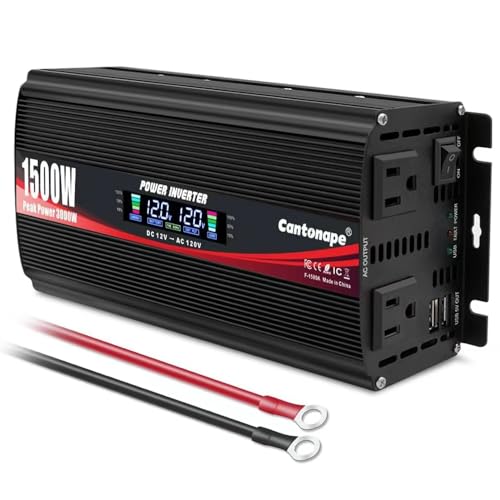
1500 Watt Car Inverter: Complete Guide for Roadside Power
Understand how a 1500 watt car inverter works, what it can power, how to install it safely, and which type fits your vehicle and electronics best.
START LEARNINGWhy this guide matters: A 1500 watt car inverter bridges the gap between your vehicle's 12V battery and the AC-powered devices you rely on every day. Whether you are a road-tripper, a mobile worker, or a camper, choosing the right inverter and installing it correctly protects both your equipment and your car's electrical system. This guide walks you through every decision point, from waveform type to cable sizing, so you can choose with confidence.
What Is a 1500 Watt Car Inverter?
A 1500 watt car inverter is a device that converts the 12V direct current (DC) from your vehicle's battery into 120V alternating current (AC), the same type of power that comes from household wall outlets. The "1500 watt" rating refers to the continuous output the inverter can sustain, with most models also offering a higher surge rating—typically between 3000 and 4500 watts—to handle the brief startup spikes of motor-driven appliances.
Unlike small plug-in inverters that draw power through the cigarette lighter socket, a 1500 watt unit is a serious piece of equipment. It requires a direct connection to the battery with heavy-gauge cables and an inline fuse, because the current draw at full load can exceed 120 amps. This class of inverter sits in the mid-range tier of the vehicle power market, offering a balanced combination of output capacity, portability, and safety features suitable for most consumer and light professional applications.
How It Works
Inside the inverter, a DC-to-DC converter first steps up the 12V input to a higher voltage, then a switching circuit chops that DC into an AC waveform. The output waveform is either a pure sine wave (smooth and identical to grid power) or a modified sine wave (a stepped approximation). The quality of this waveform determines which devices the inverter can safely power. A well-designed 1500 watt unit also includes protections against overload, overheating, reverse polarity, and low-voltage shutdown to prevent damaging the battery.
What Can a 1500 Watt Car Inverter Power?
The practical answer depends on continuous versus surge wattage. Most devices list a running wattage and a startup wattage. A 1500 watt inverter can comfortably run devices that draw up to about 1200 watts continuously, leaving headroom for efficiency losses and cable resistance. Here is a reference table of common devices:
| Device | Typical Running Wattage | Suitable for 1500W Inverter? |
|---|---|---|
| Laptop and monitor | 100 – 250 W | Yes, easily |
| CPAP machine | 100 – 300 W | Yes |
| LED TV (32–55 inch) | 80 – 200 W | Yes |
| Mini fridge | 200 – 400 W (surge higher) | Yes, with surge headroom |
| Blender | 300 – 800 W | Yes |
| Circular saw / power drill | 700 – 1200 W | Yes, check surge rating |
| Coffee maker | 600 – 1200 W | Yes, during brewing |
| Microwave oven | 1000 – 1500 W | Borderline — check continuous rating |
| Space heater | 1200 – 1500 W | Borderline — not ideal for long use |
| Hair dryer | 1200 – 1800 W | Often too demanding |
For a broader look at how inverters fit into vehicle electrical systems alongside other power accessories, you can explore related guides such as power inverter 4000 watts for higher-capacity needs.
Pure Sine Wave vs Modified Sine Wave
The waveform question is the single most important choice for most buyers. A pure sine wave inverter produces a smooth, sinusoidal output that matches or exceeds the quality of household power. It is the safe choice for sensitive electronics, medical devices, audio equipment, variable-speed motors, and any device with a microprocessor. A modified sine wave inverter produces a stepped waveform that is adequate for simple resistive loads like incandescent lights, basic power tools, and older appliances without digital controls, but it can cause humming, overheating, or malfunction in sensitive devices.
Within the 1500 watt class, pure sine wave models sit at the high-end tier and represent a long-term investment that protects your equipment. Modified sine wave models occupy the entry-level to mid-range tier and are a solid choice for buyers whose primary loads are basic and non-sensitive. If you are unsure, lean toward pure sine wave—the versatility is worth the step up in tier.
Key Factors When Choosing a 1500 Watt Car Inverter
1. Continuous vs Surge Rating
Always size based on continuous wattage. A 1500 watt continuous inverter with a 3000 watt surge rating can start a device that briefly draws double its running wattage, such as a fridge compressor or a power tool. If your load list includes any motor-driven device, prioritize a generous surge rating.
2. Efficiency
Inverter efficiency is typically expressed as a percentage of DC input converted to AC output. A well-specified 1500 watt unit should achieve 85–92% efficiency at moderate loads. Higher efficiency means less waste heat and more usable runtime from your battery. Efficiency curves often peak at around 50–70% load, so avoid running the inverter at its absolute maximum for extended periods.
3. Safety and Protection Features
Look for overload protection, over-temperature shutdown, low-voltage disconnect, reverse polarity protection, and a cooling fan with thermal control. These features are standard in the mid-range and high-end tiers and are essential for safe operation in a vehicle environment. A unit without low-voltage disconnect can permanently damage a lead-acid battery by over-discharging it.
4. Connection Method
A 1500 watt inverter should be hardwired or connected with ring terminals directly to the battery. Cigarette lighter sockets are typically rated for 150–180 watts and will overheat or blow a fuse if used at this power level. Many 1500 watt units include battery cables, but you should verify the gauge is adequate for your cable run length. For installation guidance that parallels other vehicle electrical work, see installation guide.
5. Physical Size and Cooling
Heat is the enemy of inverters. Choose a model with a metal housing and a fan that moves air through the unit, and mount it in a ventilated, dry location away from direct sunlight. Compact "flagship tier" models use advanced thermal design to pack 1500 watts into smaller housings, but they still require airflow.
Installation Basics for a 1500 Watt Car Inverter
Proper installation is what separates reliable performance from blown fuses and damaged electronics. The main steps are: mount the inverter securely, run positive and negative cables directly to the battery, install an inline fuse on the positive cable near the battery, keep cable runs as short as practical, and use a remote switch or the inverter's own on/off control for convenience. Ground the inverter chassis to the vehicle frame if the manufacturer requires it.
Cable sizing is critical. At 12V and 1500 watts, the inverter draws approximately 125 amps continuously. For a cable run under 6 feet, 2 AWG copper cable is a common minimum; longer runs require 1/0 AWG or larger. The inline fuse should be sized to protect the cable, typically 150–200 amps. Undersized cables cause voltage drop, overheating, and reduced output. If you are also planning other electrical upgrades, resources like transformer for furnace cost and how to get AC permit show how electrical planning is handled in adjacent home systems.
Battery Considerations
A 1500 watt inverter places a heavy demand on the vehicle's electrical system. At full load, it can pull over 120 amps, which will drain a typical 60–100 Ah starter battery in well under an hour. For occasional short use, running the engine while the inverter is active keeps the alternator supplying current. For extended use—such as camping or mobile work—a dedicated deep-cycle auxiliary battery charged by a DC-to-DC charger or isolator is the practical solution.
Keep in mind that lead-acid batteries should not be discharged below about 50% of capacity for longevity. If you routinely run high-wattage loads for long periods, plan your battery bank accordingly. The same principle of matching supply to demand appears in home cooling decisions, where how to size an air conditioner explains capacity matching for HVAC systems.
Common Applications and Use Cases
- Road trips and camping: Power a mini fridge, charge camera batteries, run a CPAP machine, or use a blender at a campsite. Pair the inverter with a deep-cycle battery for overnight use.
- Mobile work: Run power tools, laptops, and test equipment from a work van without a separate generator. Choose a pure sine wave model for sensitive instruments.
- Emergency backup: Keep communications equipment and medical devices running during a power outage when the vehicle is the only power source available.
- Tailgating and events: Power a small TV, speakers, and lighting from the vehicle while the engine idles or a auxiliary battery supplies the load.
For related power and comfort topics, see portable air conditioning unit for office and small air conditioning unit, which cover portable comfort solutions that sometimes pair with vehicle power setups.
Maintenance and Long-Term Care
An inverter has few moving parts, but a few habits keep it reliable. Keep the cooling vents and fan free of dust and debris. Inspect battery cables and terminals periodically for corrosion or looseness. Avoid dropping the unit or exposing it to moisture. Store it in a dry place when not in use. If the inverter shuts down repeatedly on overload or over-temperature, reduce the load rather than bypassing protections. Following a simple seasonal check—similar in spirit to an HVAC tune-up—helps catch loose connections before they become failures.