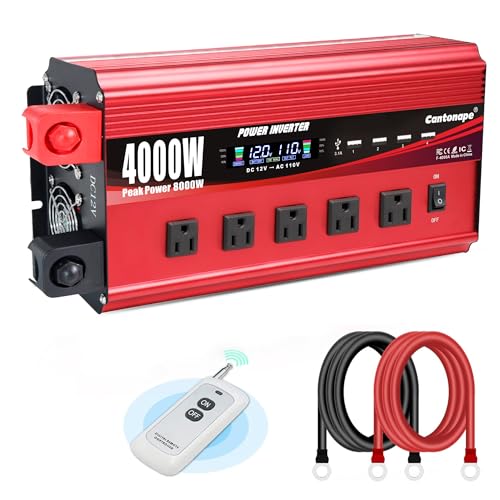
Power Inverter 4000 Watts: The Complete Buyer's Guide
Everything you need to know about 4000-watt power inverters — sine wave types, battery bank sizing, installation requirements, safety practices, and how to match one to your home, RV, or off-grid setup.
Explore Top PicksWhy this guide matters: A 4000-watt inverter sits in a sweet spot — powerful enough to run heavy household loads or a small off-grid cabin, yet manageable for a well-planned battery bank. Choosing the wrong type or under-sizing the wiring can waste energy, damage appliances, or create a safety hazard. This guide walks you through every decision so you can buy with confidence.
What Is a 4000-Watt Power Inverter?
A 4000-watt power inverter converts direct current (DC) from a battery bank into alternating current (AC) that standard appliances can use. At this capacity, the unit can supply up to 4,000 watts of continuous output — with many models offering a higher surge rating for brief motor-startup loads.
This class of inverter is typically used in:
- Off-grid and solar homes that need to run refrigerators, pumps, and power tools.
- RV and van conversions that power microwaves, coffee makers, and induction cooktops.
- Backup power systems for critical circuits during outages.
- Workshops and remote job sites running compressors, saws, and grinders.
Because a 4000W inverter draws a substantial amount of current from the battery bank, the quality of the wiring, fusing, and battery sizing matters as much as the inverter itself. A well-specified unit paired with a properly built battery system will deliver years of reliable service.
Pure Sine Wave vs Modified Sine Wave
The single most important decision when buying a 4000-watt inverter is the output waveform. It determines which appliances you can safely run and how efficiently they operate.
Pure Sine Wave Inverters
A pure sine wave inverter produces a smooth, clean AC waveform that closely matches grid power. This is the recommended choice for almost every modern application. It runs sensitive electronics, variable-speed motors, and medical devices without the buzzing, overheating, or premature failure associated with rougher waveforms.
- Ideal for refrigerators, freezers, and compressor-driven appliances.
- Safe for laptops, TVs, audio equipment, and battery chargers.
- Required for many modern appliances with digital controls.
- Typically more efficient when running inductive loads.
Modified Sine Wave Inverters
A modified sine wave inverter uses a stepped waveform that is simpler and generally more economical to produce. It can run basic resistive loads — incandescent lights, simple heaters, and some power tools — but it is not recommended for sensitive electronics or appliances with motors that rely on a smooth waveform.
- Acceptable for basic tools and resistive heating elements.
- May cause buzzing in audio equipment and flickering in some lights.
- Can reduce the lifespan of motors and compressors.
- Not recommended for modern refrigerators or medical devices.
Editorial Recommendation
For a 4000-watt unit, a pure sine wave model is almost always the better long-term investment. The cost difference within this tier is modest relative to the protection it provides for your appliances.
What Can a 4000-Watt Inverter Run?
Continuous wattage is only half the story — you also need to account for startup surge. Motors and compressors can draw two to three times their running wattage for a few seconds when they start. A 4000W inverter with a healthy surge rating can handle most household loads one at a time.
| Appliance / Load | Typical Running Watts | Startup Surge Consideration | Best For |
|---|---|---|---|
| Refrigerator (standard) | 150 – 400 W | High surge (2–3× running) | Essential tier off-grid |
| Microwave oven | 700 – 1,200 W | Moderate surge | Mid-tier RV / cabin |
| Coffee maker | 600 – 1,000 W | Low surge | Balanced tier |
| Circular saw | 1,200 – 1,800 W | High surge | Workshop / job site |
| Air compressor (small) | 1,000 – 1,500 W | Very high surge | Professional-grade |
| Space heater (resistive) | 1,000 – 1,500 W | Low surge | Essential tier |
| Laptop + monitor + router | 150 – 250 W | Low surge | Home office backup |
As a rule of thumb, keep your continuous load at or below roughly 80% of the inverter's rated capacity and check each appliance's startup surge before combining loads. Running several heavy loads simultaneously can push even a well-built 4000W unit past its limits.
Battery Bank Sizing for a 4000-Watt Inverter
A 4000-watt inverter at full load on a 12V battery bank draws roughly 333 amps — a very high current that stresses wiring and batteries. Many installers prefer a 24V or 48V battery bank for this capacity because higher voltage reduces current draw, cable size, and heat.
Quick Sizing Reference
- 12V bank: only for short-duration, lower-load use; requires very large cables.
- 24V bank: a balanced choice for many RV and small off-grid systems.
- 48V bank: preferred for continuous heavy loads and larger solar arrays.
- Battery capacity: plan for the number of hours you need at your average load, plus a depth-of-discharge margin.
For example, if your average load is 1,500 watts and you need four hours of runtime, you need roughly 6,000 watt-hours of usable energy. Accounting for inverter efficiency and battery depth of discharge, the nominal bank capacity will be higher. Lithium batteries tolerate deeper discharge and are often the better match for high-draw inverters, while flooded or AGM lead-acid banks require more conservative planning.
Installation, Wiring, and Safety Essentials
High-capacity inverters demand careful installation. Poor connections at these current levels can cause voltage drop, overheating, and fire risk. Key practices include:
- Use properly sized cables — short, thick runs between battery and inverter reduce losses.
- Install a DC fuse or breaker rated for the inverter's maximum draw, close to the battery positive terminal.
- Mount in a ventilated location — inverters generate heat and need airflow.
- Keep the inverter dry and away from flammable materials.
- Ground the chassis according to the manufacturer's instructions and local code.
- Use a transfer switch if the inverter will feed household wiring, to prevent backfeeding the grid.
If you plan to connect the inverter to your home's electrical panel, consult a licensed electrician. For related installation planning, see our guide on installation best practices and permits where applicable.
Features to Look For in a 4000-Watt Inverter
Beyond waveform and capacity, these features separate a good unit from a great one:
- Surge rating: look for at least double the continuous rating for a few seconds.
- Efficiency: higher efficiency means less wasted battery energy.
- Remote monitoring: displays, apps, or remote panels help you track load and battery state.
- Protection circuits: over-temperature, over-voltage, under-voltage, short-circuit, and overload protection are essential.
- Charger integration: some units combine inverter and charger functions, simplifying a backup system.
- Transfer switch: built-in automatic transfer makes grid-to-inverter switching seamless.
Related Guides on This Site
Common Use Cases for 4000W Inverters
Off-Grid Cabin and Tiny Home Power
A 4000-watt pure sine wave inverter can run a small off-grid cabin's essentials — lights, refrigerator, fans, TV, and small power tools — while leaving headroom for occasional larger loads. Pair it with a solar array and a lithium or lead-acid bank sized for your daily consumption.
RV and Van Conversions
RVers value the ability to run a microwave, induction cooktop, or coffee maker without a generator. A 4000W unit is generous for most van builds, so ensure your battery bank and alternator charging setup can support the draw. For portable setups, see our camping power guide.
Home Backup for Critical Circuits
With a transfer switch, a 4000W inverter can power a refrigerator, furnace blower, lights, and internet during an outage. This is a practical middle ground between a small portable unit and a whole-home generator.
Workshop and Job Site Power
Contractors use 4000W inverters to run saws, compressors, and chargers where grid power is unavailable. Look for durable construction, robust protection circuits, and a model rated for continuous industrial use.
Comparing Inverter Tiers: Entry-Level to Commercial-Grade
To help you match a model to your needs without relying on arbitrary figures, here is how 4000W inverters generally fall across quality tiers:
| Tier | Best For | Typical Characteristics |
|---|---|---|
| Entry-Level | Light backup, occasional use | Basic protection circuits, simpler displays, modified or entry pure sine wave |
| Mid-Range | RV, cabin, home backup | Pure sine wave, solid surge rating, remote display, good efficiency |
| High-End Tier | Full-time off-grid, workshops | High continuous rating, advanced monitoring, robust thermal design |
| Commercial-Grade | Job sites, continuous industrial loads | Heavy-duty construction, extensive protection, remote and network monitoring |
For most readers researching a 4000-watt inverter, the mid-range and high-end tier categories offer the best balance of reliability, efficiency, and features. Entry-level units can work for occasional backup, while commercial-grade models are best reserved for heavy daily use.
Maintenance Tips for Long-Term Reliability
- Keep it cool: ensure unobstructed airflow and clean dust from vents regularly.
- Inspect connections: check battery terminals and cable lugs periodically for tightness and corrosion.
- Monitor battery health: a healthy battery bank protects the inverter from low-voltage stress.
- Test under load: occasionally run a known load to confirm output and protection behavior.
- Follow the manual: each model has specific torque, clearance, and grounding requirements.
For broader maintenance planning on related equipment, see our maintenance plan guide and tune-up guide.
Frequently Asked Questions
Is a 4000-watt inverter enough to run a refrigerator?
Yes. A standard refrigerator draws roughly 150–400 watts running, with a startup surge that can be two to three times higher. A 4000W pure sine wave inverter with a healthy surge rating handles this comfortably, and leaves room for additional loads.
Should I choose a 12V, 24V, or 48V battery bank?
For a 4000-watt inverter, a 24V or 48V bank is generally recommended because it reduces current draw and cable size. A 12V bank can work for short-duration or lower-load use, but requires very large cables and is less efficient at high draw.
Can I install a 4000W inverter myself?
Many DIYers install inverters in vehicles and off-grid cabins, but household wiring connections require a licensed electrician. Always follow local code, use proper fusing, and consult a professional if you are unsure about any step.
Pure sine wave or modified sine wave — which is better?
Pure sine wave is the better choice for nearly all modern appliances, especially anything with a motor, compressor, or digital control. Modified sine wave units are limited to basic resistive loads and simple tools.
How long will a 4000W inverter run on a battery bank?
Runtime depends on your average load and usable battery capacity. Estimate by dividing usable watt-hours by your average load in watts. Higher-voltage banks and lithium batteries generally deliver more usable energy per rated capacity.
Final Thoughts
A 4000-watt power inverter is a capable, versatile solution for off-grid living, RV travel, home backup, and job-site power. Choose a pure sine wave model, size your battery bank for your real-world load profile, and invest in proper wiring and protection. Done right, it becomes a long-term investment in energy independence and reliability.
Ready to compare models? Browse our curated selection below and check availability for the unit that fits your setup.