
Air Conditioning Options for Homes Without Ductwork
Discover practical, energy-efficient cooling solutions for houses, apartments, and older homes that were built without central ductwork — from ductless mini-splits to portable and window units.
EXPLORE YOUR OPTIONSWhy this guide matters: Millions of homes were built before central air ductwork became standard — and retrofitting ducts can be a disruptive, structural project. The good news is that modern ductless cooling technology now makes it entirely possible to keep any home comfortable without a single duct. This guide walks you through every realistic option, so you can choose with confidence before you buy.
If your home has no ductwork, you are not locked out of comfortable indoor cooling. In fact, the market for ductless and duct-free air conditioning has matured dramatically, offering systems that range from a single-room air conditioner to whole-home multi-zone setups. The right choice depends on how many rooms you need to cool, whether you own or rent, how much wall or window space is available, and whether you plan to stay in the home long term.
This guide covers the four primary categories of ductless cooling — ductless mini-splits, portable air conditioners, window units, and through-the-wall or specialty systems — and explains who each one suits best. We also break down how to size a system for a room without ducts, how installation works, and what to check before committing. If you have ever wondered whether a home without ducts can still be cooled effectively, the answer is a confident yes — the rest is about matching the right system to your space.
The Four Main Ductless Cooling Options
Each ductless category solves a different problem. Use the quick comparison below to see how they stack up, then read the detailed breakdown further down the page.
| Option | Tier | Best For | Installation Effort | Zones |
|---|---|---|---|---|
| Ductless Mini-Split | Premium / Top-Tier | Whole-home or multi-room cooling | Professional installation (small wall hole) | 1–5+ |
| Portable Air Conditioner | Entry-Level / Starter | Renters, single rooms, temporary needs | Minimal (window or wall vent for hose) | 1 (movable) |
| Window Air Conditioner | Mid-Range | Single rooms with a suitable window | DIY-friendly (bracket or window kit) | 1 |
| Through-the-Wall / Specialty | Premium | Rooms without operable windows | Professional (wall cut-out required) | 1 |
Detailed Breakdown of Each Option
Which Option Is Right for Your Home?
There is no single answer for every home, but the decision usually comes down to three questions: how many rooms do you need to cool, do you own or rent, and what window or wall access do you have? Here is a practical decision path.
- You own the home and want whole-home comfort: A multi-zone ductless mini-split is the best long-term investment. It handles multiple rooms, runs quietly, and delivers premium efficiency compared with any single-room unit.
- You own the home but only need one or two rooms cooled: A single-zone mini-split is a strong mid-tier-to-premium upgrade over a window unit, while a window AC remains a practical mid-range choice for a single room.
- You rent or move frequently: A portable AC is the most flexible entry-level solution. If your window is compatible, a window unit is a solid step up in cooling performance.
- Your windows are casement or slide sideways: Window units need special kits or may not fit at all. In that case, a portable unit with a window kit or a ductless mini-split is the better path.
- You have no operable windows at all: A through-the-wall unit or a ductless wall-mounted system is the practical answer.
- You want heating and cooling together: A ductless mini-split with a heat pump delivers both, making it the most versatile high-end tier option.
How to Size a Ductless System for a Room
Sizing matters just as much for ductless systems as for central air. An undersized unit runs constantly and struggles; an oversized unit short-cycles and leaves the room humid. The starting point is room square footage, adjusted upward for sun exposure, ceiling height, occupancy, and kitchen heat gain.
As a general reference for residential cooling, use these capacity brackets as a starting point, then refine with a proper load calculation:
- Up to 150 sq ft: 5,000–6,000 BTU class — typical for bedrooms and small offices.
- 150–250 sq ft: 8,000–10,000 BTU class — typical for living rooms and medium bedrooms.
- 250–400 sq ft: 12,000–14,000 BTU class — large living areas and open-plan spaces.
- 400–700 sq ft: 18,000–24,000 BTU class — large rooms or open-plan zones.
- Beyond 700 sq ft or whole-home: Multi-zone mini-split with individually sized indoor heads per room.
Sizing tip: For ductless systems, each indoor head is sized to its own room rather than to the entire house. A multi-zone system lets you combine different capacities — for example, a small head for a bedroom and a larger head for a living room — while sharing one outdoor condenser.
What Installation Looks Like
One of the biggest advantages of ductless options is that installation is far less invasive than retrofitting ducts. Here is how each category compares.
- Portable AC: Place the unit near a window, connect the exhaust hose to the window kit, and plug it in. This is a true DIY setup with no structural changes.
- Window AC: Secure a mounting bracket or window kit, slide the unit into place, and seal the gaps. Basic tools are usually sufficient, and many units are designed for DIY installation.
- Through-the-Wall AC: A contractor cuts a sleeve opening in an exterior wall, installs the sleeve, and mounts the unit. This is a professional job but creates a permanent, clean result.
- Ductless Mini-Split: A licensed technician mounts the indoor head, drills a small hole through the exterior wall, runs the refrigerant line set and drain, mounts the outdoor condenser, and commissions the system. This is professional-grade work because refrigerant handling is regulated.
If your existing system is struggling rather than missing, it may be worth diagnosing it first. Common symptoms like an air conditioner running but not cooling or an air conditioner taking a long time to cool are often fixable and may be less disruptive than a full replacement. Similarly, if your unit is short cycling, that is usually a service issue rather than a reason to replace the whole system.
Maintenance and Efficiency Considerations
Ductless systems are generally efficient, but they still need routine care to stay that way. Filters should be cleaned or replaced regularly, coils should be kept free of dust, and the outdoor condenser needs clear airflow. Scheduling an air conditioner service and maintenance visit at the start of each cooling season keeps performance predictable and catches small issues early.
For mini-splits, one often-overlooked efficiency factor is drainage — a clogged condensate line is a common cause of air conditioning unit leaking water and can reduce performance. Portable units need their water tank emptied and their filters rinsed, while window units benefit from a seasonal coil cleaning. If your unit stops producing cold air altogether, review the common causes of an air conditioner stopped blowing cold air before assuming the unit is finished.
Energy efficiency also depends on the surrounding space. Keeping doors closed in cooled zones, shading windows during peak sun, and using a programmable schedule all reduce runtime. If your unit feels underpowered, it is worth ruling out a service problem before concluding that your home needs a larger system.
The Heat Pump Bonus: Cooling and Heating in One
Ductless mini-splits are available as heat pumps, which means they can reverse the refrigerant cycle to provide heating in cooler months as well as cooling in summer. For a home without ducts, this is a significant advantage: instead of buying a cooling-only system and relying on separate space heaters, a single ductless heat pump system can handle year-round comfort. Heat pump models are typically positioned in the premium and top-tier segment of the ductless market, and they are the most complete solution for a duct-free home.
Common Mistakes to Avoid
- Choosing a portable unit for a whole home: Portable ACs are single-room tools. Using several of them throughout a house costs more in energy and performs worse than one properly sized multi-zone mini-split.
- Ignoring window compatibility: Casement and sliding windows often cannot accept standard window units. Measure carefully and choose a kit or a different category before buying.
- Under-sizing the system: A unit that is too small runs continuously without reaching the set temperature. Use a load calculation rather than guessing from square footage alone.
- Skipping professional refrigerant work: Mini-split installation involves refrigerant lines. This is regulated work and should be handled by a licensed technician.
- Overlooking drainage: Condensate management is a common failure point. Make sure the drain path is set up correctly from day one.
- Ignoring the outdoor unit location: The condenser needs airflow and clearance. A cramped or shaded outdoor location can reduce efficiency and shorten equipment life.
Recommended Ductless Air Conditioners
⚠️ AFFILIATE DISCLOSURE: This website contains affiliate links. As an Amazon Associate, we earn from qualifying purchases. If you make a purchase through these links, we may receive a small commission at no additional cost to you. Read our full affiliate policy.

Midea 8,000 BTU Smart Inverter Air Conditioner Window Unit with Heat and Dehumidifier – Cools up to 350 Sq. Ft., Energy Star Rated, Quiet Operation, Electronic Controls, Remote Control, White
Check price on Amazon
Gree 30,000 BTU Multi21+ Tri-Zone Wall Mount Mini Split Air Conditioner Heat Pump 208/230V SEER 21 (9-9-12)
Check price on Amazon
KOMORE Portable Air Conditioner,14000 BTU up to 750 Sq.Ft 5-in-1Quiet WiFi | Auto Mode,Cooling,Dehumidifier,Sleep Mode,24H Timer,Remote Control for Room/Office/Dorms/Bedroom, Air Conditioning Unit
Check price on Amazon
KOMORE Portable Air Conditioner,10000 BTU up to 450 Sq.Ft 4-in-1 WiFi | Auto Mode,Cooling,Dehumidifier,Sleep Mode,24H Timer,Remote Control for Room/Office/Dorms/Bedroom, Air Conditioning Unit
Check price on Amazon
Arctic Air Pure Chill 2.0 Evaporative Air Cooler by Ontel - Powerful, Quiet, Lightweight and Portable Space Cooler with Hydro-Chill Technology For Bedroom, Office, Living Room & More,Blue
Check price on Amazon
Air Choice 10000 BTU Portable Air Conditioners, Air Conditioner Portable for Room Up to 450 Sq.Ft, Remote Control, Sleep Mode, 24H Timer, Dehumidifier & Fan, Portable AC Unit for Bedroom Apartment
Check price on Amazon
2026 Upgraded Portable Air Conditioners, Rechargeable Evaporative Air Cooler Humidifier, 2 Timer Mini Air Conditioner, 3 Powerful Wind, 7 Color Light, Air Cooler Desk Spray Fan for Home Office Camping
Check price on Amazon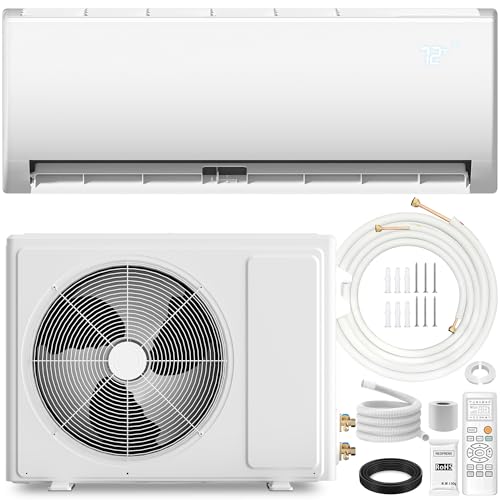
9000 BTU Mini Split Air Conditioner & Heat Pump - 110V/120V Wall Mount Ductless Inverter AC/Heating System - 19 SEER2, Ultra Quiet, Cools & Heats 500 Sq Ft
Check price on AmazonFrequently Asked Questions
What is the best air conditioning option for a home without ductwork?
Ductless mini-split systems are generally the strongest choice because they deliver efficient, quiet cooling across one or more rooms without any ductwork. They sit in the premium tier of ductless options. Portable and window units remain excellent practical choices for single rooms or starter-tier needs, especially for renters.
Can I cool an entire house without ducts?
Yes. A multi-zone ductless mini-split system lets you cool an entire house without ducts. You install a separate indoor air handler in each room or zone, and all of them connect to a single outdoor condenser. Most residential systems support between two and five indoor heads.
Are portable air conditioners good for homes without ductwork?
Portable air conditioners are a practical entry-level solution. They need only a window or wall vent for the exhaust hose, are easy to move between rooms, and suit renters or temporary cooling needs. They are best used to cool one room at a time rather than an entire home.
Do ductless mini-splits require a window?
No. Ductless mini-splits require only a small hole in an exterior wall for the refrigerant lines and wiring. This makes them ideal for rooms with casement windows, sliding windows, or no operable windows at all.
How many zones can a ductless mini-split system support?
Most residential multi-zone ductless mini-split systems support between two and five indoor air handlers connected to a single outdoor unit, allowing each room or zone to be cooled independently.
Can I install a ductless mini-split myself?
Mini-split installation involves refrigerant lines, vacuuming, and electrical work, which are regulated and safety-critical tasks. Licensed HVAC technicians should handle the installation, even though the system requires no ductwork. Portable and window units are the DIY-friendly categories.
Will a ductless system work in an older home with thick walls?
Yes. Ductless systems require only a small penetration through the wall, so thick walls are not a barrier. This makes them well-suited to older homes that were never designed for central ductwork.
Ready to Choose Your Ductless Cooling Solution?
Compare portable, window, and mini-split options side by side, check availability, and find the right fit for your home — all without needing a single duct.
COMPARE DUCTLESS OPTIONSFinal Thoughts
A home without ductwork does not mean a home without comfort. Whether you choose a portable unit for a rented studio, a window AC for a bedroom, or a multi-zone ductless mini-split for a whole house, modern duct-free technology delivers reliable cooling without the disruption of a duct retrofit.
The key is to match the category to your situation: starter-tier portability for flexibility, mid-range window units for single-room dependability, and premium ductless mini-splits for long-term, whole-home performance. Size each system correctly, plan the installation carefully, and keep up with routine maintenance — and your ductless setup will serve your home efficiently for years. Explore the recommended products above to take the next step with confidence.