
CRAC Unit Guide: Precision Cooling for Server Rooms and Data Centers
Understand how computer room air conditioners work, how to size them correctly, which types fit your facility, and how to keep your critical IT infrastructure protected with reliable precision cooling.
START LEARNINGWhy this guide matters: Standard comfort air conditioners are not designed for the continuous, high-sensible-load demands of a server room. A properly specified CRAC unit protects your equipment from heat and humidity damage, reduces downtime risk, and supports long-term operational efficiency. This guide gives you the knowledge you need before you specify or compare systems.
What Is a CRAC Unit?
A CRAC unit — short for computer room air conditioner — is a precision cooling system engineered specifically for spaces where IT equipment generates dense, continuous heat loads. Unlike residential or light commercial air conditioners that prioritize human comfort, CRAC units are built around three core priorities: tight temperature control, precise humidity management, and near-continuous operation.
Server rooms, edge data centers, telecom closets, and small enterprise IT facilities rely on CRAC units to maintain stable environmental conditions. These systems typically deliver high sensible cooling capacity — meaning they remove heat without excessive moisture removal — because IT equipment produces sensible heat rather than latent heat from people or infiltration. This design distinction separates a CRAC unit from a conventional comfort cooling system and is central to why precision cooling exists as a category.
For organizations comparing infrastructure options, understanding CRAC units is an essential part of planning server room cooling alongside broader industrial air conditioning system considerations. The right precision cooling decision protects hardware investment and supports business continuity.
How a CRAC Unit Works
A direct-expansion CRAC unit operates on a vapor-compression cycle similar in principle to a standard air conditioner, but with components and controls tuned for precision duty. The core process follows these stages:
1. Heat Absorption
Warm air from the server room is drawn across the evaporator coil. Refrigerant inside the coil absorbs heat and evaporates, cooling the air stream before it returns to the IT space.
2. Compression
The compressor raises the refrigerant pressure and temperature, moving heat energy to a higher temperature level so it can be rejected outdoors.
3. Heat Rejection
The condenser coil releases heat to the outside environment — through an air-cooled condenser, a water-cooled condenser, or a glycol dry cooler depending on the system configuration.
4. Expansion
The expansion valve drops refrigerant pressure and temperature, returning it to the evaporator to repeat the cycle under modulating control.
5. Humidity Control
Integrated humidifiers and dehumidification logic maintain relative humidity within a narrow band, preventing static discharge and condensation risks.
6. Continuous Modulation
Precision controls modulate cooling output to match real-time IT load changes, maintaining stable setpoints around the clock.
CRAC vs CRAH: Key Differences
The terms CRAC and CRAH are sometimes used interchangeably, but they describe distinct system architectures. Understanding the difference helps you match the system to your facility's infrastructure and scale.
| Feature | CRAC Unit | CRAH Unit |
|---|---|---|
| Cooling method | Direct expansion (DX) refrigerant cycle | Chilled water from central plant |
| Compressor | Built into the unit | None — relies on chiller plant |
| Best suited for | Small to mid-size server rooms, edge sites, facilities without chilled water | Large data centers with existing chilled water infrastructure |
| Installation complexity | Moderate — requires refrigerant lines and outdoor condenser | Higher — requires chilled water piping and pumping |
| Scalability | Modular, easier for incremental deployment | Highly scalable within a chilled water framework |
| Typical tier | Essential to mid-tier precision cooling | Mid-tier to professional-grade facility cooling |
For many smaller facilities and edge deployments, a DX-based CRAC unit offers a simpler path to precision cooling without the capital infrastructure of a chilled water plant. Larger mission-critical facilities often favor CRAH units for their integration with centralized cooling and higher efficiency at scale.
Types of CRAC Units
CRAC units are available in several configurations, each suited to different room layouts, heat densities, and building constraints. Selecting the right type is a foundational decision in your precision cooling strategy.
Air-Cooled CRAC Units
These units reject heat directly to outdoor air through a remote air-cooled condenser. They are the most common choice for small and mid-size server rooms because they avoid water usage and complex piping. Air-cooled CRAC units are well-suited to facilities where water availability or water treatment is a constraint, and they typically represent an essential-tier to mid-tier precision cooling option for edge and branch locations.
Water-Cooled CRAC Units
Water-cooled CRAC units use a water-cooled condenser connected to a cooling tower or building water loop. They generally offer higher efficiency in larger installations and can operate effectively in high-ambient outdoor conditions. These systems are often mid-tier to professional-grade and are common where a building already supports condenser water infrastructure.
Glycol-Cooled CRAC Units
Glycol systems circulate a glycol-water mixture to a dry cooler, allowing heat rejection without open water and with freeze protection in cold climates. They are a practical mid-tier choice for facilities that need water-free operation but want more efficiency flexibility than a purely air-cooled system.
Dual-Fluid CRAC Units
Dual-fluid units combine a DX refrigerant circuit with a chilled water coil, providing operational flexibility and redundancy within a single unit. They are typically high-end tier systems used where resilience and adaptability across cooling modes are priorities.
In-Row CRAC Units
In-row units are placed directly within server racks, cooling air at the point of heat generation. They are well-suited to high-density environments and represent a professional-grade approach to precision cooling, particularly in row-based or hot-aisle containment designs.
Perimeter CRAC Units
Perimeter units are installed along the walls of the server room and distribute cool air through the raised floor or ductwork. They are a traditional essential-tier to mid-tier configuration for small and medium rooms with moderate heat density.
How to Size a CRAC Unit
Correct sizing is the single most important factor in CRAC unit performance. An undersized unit cannot maintain setpoints during peak load, while an oversized unit cycles inefficiently and provides poor humidity control. Precision cooling sizing follows a structured process:
- Calculate total IT load: Sum the rated power draw of all servers, networking equipment, storage, and UPS losses. This is typically expressed in kilowatts and forms the dominant portion of the cooling requirement.
- Add building heat gain: Account for heat entering through walls, windows, ceilings, and floors, plus lighting and any personnel present in the room.
- Determine sensible and total capacity: Because IT equipment produces mostly sensible heat, the sensible cooling capacity of the CRAC unit must match the load closely. Confirm both sensible and total capacities during selection.
- Plan for growth: Size for current load plus a reasonable expansion margin, but avoid excessive oversizing that harms humidity control and efficiency.
- Apply redundancy: Determine the redundancy topology (for example N+1) and size individual units so that remaining units can carry the load if one fails.
For facilities planning larger infrastructure, understanding the broader HVAC system planning considerations helps contextualize how precision cooling fits into the overall mechanical strategy.
Key Selection Criteria
When comparing CRAC units, evaluate them across the dimensions that matter most for critical environments. Descriptors below use tier language rather than numeric figures, so comparisons remain meaningful over time and across markets.
Cooling Capacity and Sensible Ratio
Match capacity to your calculated load and verify the sensible heat ratio. A unit with strong sensible performance maintains room temperature efficiently without unnecessary dehumidification. Mid-range and premium units typically offer better modulation and tighter setpoint control.
Humidity Control
Precision environments require humidity within a defined band. Look for integrated humidification and reliable dehumidification logic. Higher-tier units often include more accurate sensors and finer control algorithms.
Redundancy and Modularity
Modular configurations support N+1 and concurrent maintenance. Professional-grade systems are designed for scalable deployment and serviceability without full shutdowns.
Airflow Configuration
Match the unit's airflow pattern — downflow, upflow, or in-row — to your room layout and containment strategy. Correct airflow prevents hot spots and improves efficiency.
Controls and Monitoring
Modern CRAC units offer BMS integration, remote monitoring, and alarm escalation. Top-tier systems provide granular telemetry that supports predictive maintenance and capacity planning.
Serviceability and Support
Consider filter access, coil cleaning clearance, and local service availability. A well-specified unit with strong support is a long-term investment in uptime.
Maintenance Best Practices
CRAC units run continuously, so a disciplined maintenance program is essential for reliability and efficiency. A quarterly service cadence is typical, with adjustments for dusty environments or high-load conditions. Key tasks include:
- Filter replacement: Clogged filters reduce airflow and force the unit to work harder. Replace according to differential pressure readings or a fixed schedule.
- Coil cleaning: Clean evaporator and condenser coils to maintain heat transfer efficiency and prevent capacity loss.
- Condensate management: Inspect drains, pans, and pumps for blockages or biological growth that can cause water damage.
- Refrigerant verification: Check charge and inspect for leaks. Low charge reduces cooling capacity and stresses the compressor.
- Fan and motor inspection: Verify belt tension, bearing condition, and airflow balance. Address vibration or unusual noise promptly.
- Control calibration: Confirm temperature and humidity sensors are accurate and alarm thresholds are correctly set.
- Electrical inspection: Check contactors, connections, and breaker condition to prevent failures under continuous load.
For facilities also maintaining conventional equipment, general air conditioning service practices can inform scheduling and documentation habits that translate well to precision cooling programs.
Redundancy and Reliability
Downtime in a server room is measured in business impact, not comfort. Redundancy planning ensures that cooling continues even when a unit is offline for maintenance or failure. Common topologies include:
N Configuration
Capacity exactly matches the load with no spare unit. Suitable only for non-critical spaces where short interruptions are tolerable.
N+1 Configuration
One additional unit beyond the minimum required. This is the most common topology for small and mid-size critical rooms, allowing maintenance without load loss.
2N Configuration
Full duplication of cooling capacity, often with separate power paths. This is a professional-grade approach for mission-critical facilities with stringent uptime requirements.
Redundancy should be paired with monitoring and clear escalation procedures. A redundant system that is not monitored can still fail silently. Align your CRAC strategy with broader HVAC system planning principles for consistency in documentation and lifecycle management.
Frequently Asked Questions
What is a CRAC unit?
A CRAC unit, or computer room air conditioner, is a precision cooling system engineered specifically for server rooms and data centers. Unlike comfort cooling, it maintains tight temperature and humidity control, operates continuously, and handles the high sensible heat loads generated by IT equipment.
What is the difference between a CRAC and a CRAH unit?
A CRAC unit uses a direct-expansion refrigerant cycle with its own compressor, while a CRAH unit uses chilled water from a central plant and has no compressor. CRAC units are common in smaller or edge facilities, whereas CRAH units are typical in large data centers with chilled water infrastructure.
How is a CRAC unit sized?
CRAC units are sized using the total IT load, typically measured in kilowatts, plus allowances for heat gain through the building envelope, lighting, and people. A professional heat load calculation determines the required sensible and total cooling capacity, and redundancy requirements such as N+1 are then applied.
How often should a CRAC unit be maintained?
Routine maintenance is recommended quarterly, with more frequent checks in dusty or high-load environments. Key tasks include filter replacement, coil cleaning, condensate drain inspection, refrigerant charge verification, and fan and compressor inspection.
Can a residential air conditioner be used in a server room?
It is not recommended. Residential units lack the sensible capacity, humidity control, continuous-duty components, and monitoring features required for server rooms. Using comfort cooling in a critical space risks overheating, condensation, and premature equipment failure.
Recommended Precision Cooling and Server Room AC Units
⚠️ AFFILIATE DISCLOSURE: This website contains affiliate links. As an Amazon Associate, we earn from qualifying purchases. If you make a purchase through these links, we may receive a small commission at no additional cost to you. Read our full affiliate policy.

Crac Unit Sign Kit, 6 Signs for One Crac Unit, 8x12 Premium Extra-Thick Rust-Resistant Aluminum, by CGAP Safety
Check price on Amazon
Crac Unit Sign Kit, 4 Signs for One Crac Unit, 8x12 Premium Extra-Thick Rust-Resistant Aluminum, by CGAP Safety
Check price on Amazon
Data Center Cooling & Environmental Systems: A Practical Guide to CRAC/CRAH Units, Airflow Containment, Chillers, Free Cooling, and Liquid Cooling for ... (N.V. Edema Data Center Career Series)
Check price on Amazon
CNC 1 Poles FLA 40 Amp Coil 24V AC Air Conditioner Condenser Compressor Contactor AC Definite Purpose Contactor
Check price on Amazon
Mastering CRAC units: Cooling infrastructure for modern data centres
Check price on Amazon
DANGER Crac Unit Qualified Only Sign, Qualified Personnel Only, for Labs Hospitals and Data Centers, 8x12 Premium Extra-Thick Rust-Resistant Aluminum Sign by CGAP Safety
Check price on Amazon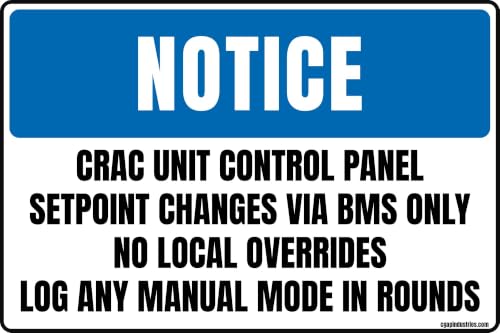
NOTICE CRAC Unit Control Panel Sign, Setpoints Changed Through BMS Only, for Data Centers, 8x12 Premium Extra-Thick Rust-Resistant UV-Resistant Aluminum Pre-Drilled Safety Sign by CGAP Safety
Check price on Amazon