Flush AC System: The Complete Guide to Clean Refrigerant Lines
Understand when, why, and how to flush an air conditioner system properly — including tools, safety requirements, and professional procedures
START LEARNINGWhy This Matters: Contaminated refrigerant lines can destroy a new compressor within months. Flushing an AC system is one of the most misunderstood procedures in HVAC work — done wrong, it causes more damage than it prevents. This guide explains the correct process so you can make informed decisions before hiring a technician or attempting any work yourself.
What Is an AC System Flush?
Flushing an AC system means circulating a cleaning agent through the refrigerant lines, evaporator coil, and condenser coil to remove contaminants that accumulate over time. These contaminants include:
- Acid and sludge left behind after a compressor burnout
- Old mineral or synthetic oil that is incompatible with a replacement compressor
- Moisture that entered the system during an open repair
- Metal particles and debris from failed components
- Residual refrigerant of a different type when switching systems
The goal is to restore the internal cleanliness of the sealed circuit so that new refrigerant and oil can circulate without carrying abrasive particles or chemical residue into the compressor. A properly flushed system protects the compressor — the single most valuable component in any air conditioner.
Flushing is distinct from routine maintenance such as coil cleaning or filter replacement. It targets the sealed refrigerant circuit itself, not the airflow path.
When Does an AC System Need Flushing?
Not every repair requires a flush. Technicians generally recommend the procedure in the following situations:
🔧 After Compressor Burnout
- Burned windings release acid and carbon deposits into the lines
- Failure to flush will contaminate the new compressor
- Usually combined with suction line filter-drier installation
🔄 Switching Refrigerant Type
- Old oil may be incompatible with the new refrigerant
- Residual charge must be fully removed
- Common during retrofits from older refrigerants
💧 Moisture Contamination
- System left open during a long repair
- Failed filter-drier allowed moisture through
- Ice formation or erratic pressure readings
🛠️ Major Component Replacement
- Evaporator or condenser coil replacement
- Line set replacement with reused sections
- Oil return issues in long line runs
If your system is simply not cooling, the cause is more often low refrigerant charge, a dirty filter, or a failing capacitor — not contamination. In those cases a flush is unnecessary. Consult a technician to diagnose the actual fault before authorizing a flush.
Tools and Equipment Required
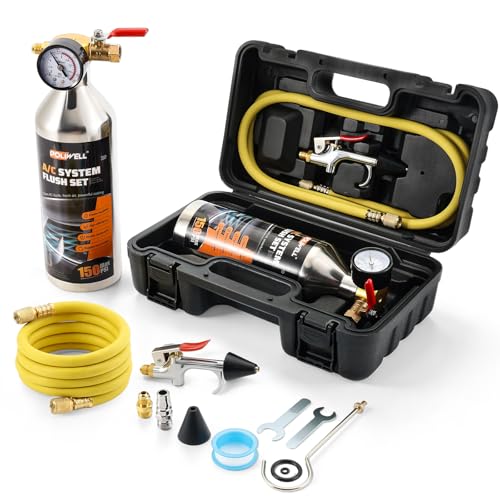
A proper AC system flush requires specialized equipment. The table below shows what is involved at each equipment tier so you can understand what a technician is using:
| Tier | Equipment Category | What It Includes | Best For |
|---|---|---|---|
| Essential | Basic flush kit | Flushing solvent, transfer pump, hoses, and adapters | Straightforward line set flushes on small systems |
| Balanced | Nitrogen + solvent combo | Nitrogen regulator, solvent, sight glass, gauge manifold | Most residential split-system flushes |
| Professional | Full recovery and evacuation set | Recovery machine, vacuum pump, micron gauge, digital manifold, flush solvent | Compressor burnout cleanup and commercial systems |
Core Items Every Flush Requires
- Recovery machine and cylinders — to remove all existing refrigerant before opening the circuit
- Approved flushing solvent — typically a specialized HVAC flush, not household chemicals
- Dry nitrogen tank with regulator — for purging solvent residue and pressure testing
- Vacuum pump and micron gauge — to evacuate moisture to below 500 microns after flushing
- Gauge manifold and hoses — for pressure monitoring throughout
- PPE — gloves, safety glasses, and adequate ventilation
Technicians who follow the refrigerant handling rules described in EPA refrigerant handling will always recover the charge before opening any part of the circuit.
Step-by-Step Flushing Process
The exact sequence varies by system, but a professional flush generally follows these stages:
- Recover the existing refrigerant All refrigerant is recovered into approved cylinders using a recovery machine. Federal law requires recovery — venting to the atmosphere is prohibited.
- Isolate and remove components The filter-drier, metering device, and any component that could trap solvent are removed or bypassed. Some technicians remove the compressor if it is being replaced.
- Connect the flush apparatus Flushing hoses are connected to create a circuit through the line set and coils. A capture container or recovery setup is placed at the outlet.
- Circulate the flushing solvent Solvent is pushed through the circuit until the discharge runs clear. On a burnout, the solvent color is monitored closely — dark discharge indicates continuing contamination.
- Purge with dry nitrogen Nitrogen blows remaining solvent and loosened debris out of the lines. This step also helps dry the interior surfaces.
- Replace filter-driers A new liquid-line filter-drier is installed, and on burnout jobs a suction-line filter-drier is added to catch residual particles.
- Triple evacuation The system is evacuated to below 500 microns, ideally using the triple evacuation method with nitrogen breaks, to remove all moisture and non-condensables.
- Pressure test and recharge Nitrogen pressure testing confirms the circuit is sealed, then the system is charged with the correct refrigerant by weight and performance is verified.
Never introduce flushing solvent into a system and leave it there. Residual solvent will damage the compressor lubricant and can cause acid formation. Complete nitrogen purging and evacuation are mandatory steps, not optional ones.
Safety and EPA Regulations
Flushing an AC system is regulated work. Section 608 of the Clean Air Act requires that anyone who handles refrigerant be EPA-certified. Key safety points:
- Refrigerant recovery is mandatory — releasing refrigerant into the atmosphere is illegal and harmful to the environment
- Flushing solvents are flammable or irritating — work in a ventilated area with proper PPE
- Nitrogen is stored under high pressure — always use a regulator; never connect a bare tank to the system
- Vacuum and pressure limits must be respected — line sets have maximum pressure ratings
- Documentation may be required — commercial systems are subject to recordkeeping rules
For a broader look at how refrigerant regulations affect AC work, see the guide on EPA refrigerant handling rules.
Can You Flush an AC System Yourself?
Short answer: no, not safely or legally for most homeowners. Here is why:
- Recovering refrigerant requires EPA Section 608 certification
- The equipment involved — recovery machines, vacuum pumps, micron gauges, nitrogen regulators — is professional-grade
- Improper flushing leaves solvent residue that destroys compressors
- Incorrect evacuation leaves moisture that freezes and blocks the metering device
- Mistakes can create refrigerant leaks or injury hazards
What homeowners can do is understand the process well enough to ask the right questions. When a technician recommends a flush, ask: what contamination was found, what flushing method will be used, and whether new filter-driers will be installed. A qualified contractor should answer all three clearly. If you are comparing repair options, the guidance on fixing an air conditioner and when to call an HVAC technician can help you decide whether a flush is the right step.
What Affects the Scope of the Job
The time and effort involved in a flush varies significantly by situation. Factors that make the job larger include:
- System size — a multi-zone mini-split takes longer than a single-room window unit's line set
- Line length and routing — long or concealed line runs require more solvent and longer purge times
- Contamination severity — a compressor burnout requires more than routine line cleaning
- Component access — coils or line sets that are hard to reach add labor
- Filter-drier replacement — burnout jobs typically add a suction-line filter-drier
- Certification and permits — some jurisdictions require permits for refrigerant work
For context on how repair and replacement decisions compare at a high level, see the overview on AC replacement estimates. If the system is older and the compressor has already failed, replacement may be the more sensible path than flushing and rebuilding. The guide on fixing a central air conditioner covers how to evaluate that decision.
Ready to Understand Your AC System Better?
Explore our full library of guides on AC maintenance, troubleshooting, and energy efficiency to make confident decisions about your system.
Explore Troubleshooting Guides →Frequently Asked Questions
What does flushing an AC system actually remove?
Flushing removes acid, sludge, metal particles, old oil, moisture, and residual refrigerant from the sealed refrigerant circuit. It is especially important after a compressor burnout, when burned oil and carbon deposits circulate through the lines.
How do I know if my AC system needs a flush?
Signs include a recent compressor burnout, a system that was left open during repairs, a refrigerant retrofit, or repeated filter-drier failures. A technician can confirm with acid tests, moisture indicators, and oil samples. Simply having weak cooling is not a sign that a flush is needed.
What solvent is used to flush AC lines?
Technicians use specialized HVAC flushing solvents designed to evaporate cleanly and carry away contaminants. Some older procedures used R-11, but modern practice favors dedicated flush products followed by dry nitrogen purging and triple evacuation.
Is flushing the same as cleaning the coils?
No. Coil cleaning removes dust and debris from the outside of the evaporator or condenser coil and is part of routine maintenance. Flushing cleans the inside of the refrigerant circuit. The two serve different purposes and use different tools.
Can I skip the flush after a compressor replacement?
Skipping the flush after a burnout almost guarantees premature failure of the new compressor. Acid and debris left in the lines will attack the new windings and lubricant. A suction-line filter-drier alone is not a substitute for proper flushing.
How long does a professional AC flush take?
Typically 2 to 4 hours for a residential split system, including recovery, flushing, nitrogen purge, and evacuation. Larger or heavily contaminated systems can take longer. The evacuation step alone may take an hour or more to reach the target micron level.
Does flushing an AC system improve efficiency?
A clean circuit allows refrigerant and oil to flow as designed, which supports efficient operation. However, a flush is a repair procedure, not an efficiency upgrade. For efficiency improvements, look at ENERGY STAR qualified air conditioners and routine maintenance such as filter changes.