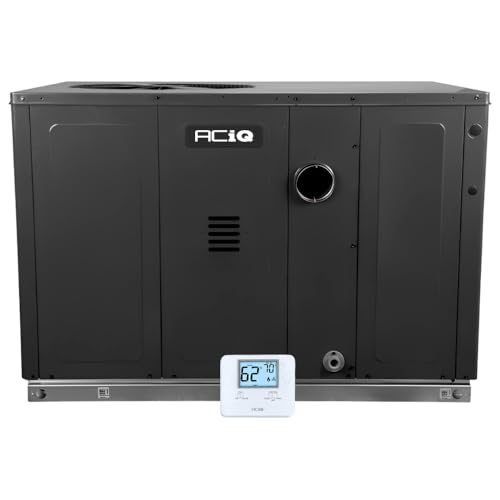
2 Ton AC Unit: The Complete Buyer's Guide
Everything you need to understand before you commit to a 2 ton system
Start ReadingWhy this guide exists: If you have been researching a 2 ton air conditioner, you already know it is one of the most common residential capacities in the United States. This page walks through what that capacity actually delivers, how different tiers perform, and how to match a unit to your home so you do not end up with an oversized or undersized system.
What Does a 2 Ton AC Unit Actually Mean?
In the HVAC industry, tonnage is a measure of cooling capacity, not weight. One ton of cooling equals 12,000 BTU per hour. A 2 ton AC unit therefore provides 24,000 BTU of cooling output. This is the amount of heat the system can remove from your indoor air in one hour under rated conditions.
To put that in perspective, a 1.5 ton system provides 18,000 BTU, and a 2.5 ton system provides 30,000 BTU. The jump from 1.5 to 2 ton is roughly a one-third increase in cooling power, which is why sizing is not a minor detail. A unit that is too small will run continuously on hot days and struggle to hold temperature, while a unit that is too large will short-cycle, leaving humidity high and indoor comfort uneven.
For a deeper explanation of how capacity is calculated from room dimensions and load factors, the guide on how to size an air conditioner breaks down the full process step by step.
How many square feet does a 2 ton unit cover?
As a rough rule, a 2 ton unit covers 1,000 to 1,500 square feet. The wide range exists because square footage alone is a poor sizing metric. A 1,200 square foot home in a mild coastal climate may need only 1.5 tons, while a 1,200 square foot home in a hot, poorly insulated region with large west-facing windows may need 2.5 tons. The table below gives practical context without relying on any numeric currency figures.
| Capacity | BTU Output | Typical Space | Best For |
|---|---|---|---|
| 1.5 Ton | 18,000 BTU | 700 – 1,000 sq ft | Small apartments and starter homes |
| 2 Ton | 24,000 BTU | 1,000 – 1,500 sq ft | Mid-sized homes and townhouses |
| 2.5 Ton | 30,000 BTU | 1,400 – 1,900 sq ft | Larger single-family homes |
| 3 Ton | 36,000 BTU | 1,800 – 2,400 sq ft | Spacious homes and open floor plans |
The 2 ton row is the sweet spot for a large share of American homes. It sits in the middle of the residential range, which means both entry-level and premium-tier options are widely available. If your space is closer to 1,500 square feet or exceeds it, you may want to review the comparison at 3 ton AC unit overview to see whether stepping up makes sense.
The Main Components of a 2 Ton System
A complete 2 ton air conditioning system is more than a single box. Understanding the parts helps you evaluate quotes and avoid paying for equipment you do not need.
- Condenser unit — the outdoor unit containing the compressor and condenser coil. It releases absorbed heat to the outside air.
- Evaporator coil — the indoor coil that absorbs heat and humidity from your return air.
- Air handler or furnace blower — circulates conditioned air through the ductwork.
- Ductwork — the distribution network. Existing ducts may need sealing or resizing for a new 2 ton unit.
- Thermostat and controls — modern units often pair with programmable or smart thermostats for scheduling.
- Refrigerant line set — connects the indoor and outdoor sections.
In a replacement scenario, you can sometimes reuse existing components, which changes the scope of the project considerably. A full system replacement is a different undertaking than swapping only the condenser. If you are weighing those two paths, the breakdown at replacing an air conditioning unit explains what each approach involves.
Tier Options: Entry-Level, Mid-Range, and Premium
Rather than comparing raw figures that shift with the market, it is more useful to think about 2 ton units in terms of tiers. Each tier describes the relative position of a model in the market and the kind of build quality and features you can expect.
| Tier | Build Quality | Typical Features | Best For |
|---|---|---|---|
| Entry-level | Standard materials, single-stage compressor | Basic thermostat compatibility, standard efficiency rating | Rentals, seasonal use, straightforward replacements |
| Mid-range | Improved coil protection, two-stage or variable-speed options | Better humidity control, quieter operation, smart thermostat ready | Primary residences with daily year-round use |
| Premium | Reinforced cabinet, high-grade components, advanced diagnostics | High efficiency rating, whisper-quiet fan, full variable-speed operation | Long-term homeowners prioritizing comfort and efficiency |
Mid-range models are the most common choice for a 2 ton installation because they balance capability with long-term durability. Entry-level units are a solid choice when the system sees moderate use, while premium units justify their position through quieter operation and smoother temperature control.
If quiet operation matters to you, the guide to quiet air conditioners covers the sound ratings and design features worth looking for. And if you are interested in the highest efficiency tiers, the overview of high SEER air conditioners explains how the rating scales work.
Efficiency Ratings That Matter for a 2 Ton Unit
Two units with identical 24,000 BTU output can consume very different amounts of electricity. The difference lies in efficiency ratings:
- SEER2 — the seasonal efficiency rating used under current DOE standards. Higher numbers mean less energy used per unit of cooling across a season.
- EER2 — a peak-load efficiency rating measured at a specific outdoor temperature. Useful for hot-climate households.
- HSPF2 — relevant if the unit is a heat pump rather than a cooling-only system.
Entry-level 2 ton units typically carry a baseline SEER2 rating, mid-range models move up a band, and premium units reach the top efficiency tiers. The practical difference shows up in summer electricity usage, not on the spec sheet alone. A full explanation of the rating system is available at what is a SEER rating.
Installation: What a 2 Ton Project Involves
Installation is often the larger variable in any AC project. A straightforward replacement of an existing 2 ton unit may take a single day, while a first-time installation in a home without ductwork is a multi-day project involving duct design and electrical work.
Key factors that shape the scope:
- Existing ductwork — condition, sizing, and sealing all affect performance.
- Electrical panel capacity — a 2 ton unit needs a dedicated circuit and breaker sized for its amperage draw.
- Outdoor placement — clearance, shading, and distance from the indoor unit.
- Refrigerant line length — longer runs may require adjustments.
- Permits — most jurisdictions require a permit for a new installation.
If ductwork is missing or inadequate, a ductless approach is a legitimate alternative. The guide to ductless mini-split AC covers how those systems compare for a home of this size, and the overview of installing central air without existing ductwork explains the added scope involved.
Replacement vs. new installation
Replacing an existing 2 ton unit is usually the more contained project: the outdoor pad, disconnect, and line set are already in place. A new installation in a home that has never had central air is broader and includes duct design. Both are valid paths, and the choice usually comes down to whether the home's structure already supports ducted distribution.
Maintenance and Longevity
A 2 ton unit is a long-term investment, and its service life depends heavily on upkeep. The essentials:
- Replace or clean the air filter every 1–3 months during cooling season.
- Schedule an annual professional tune-up before summer.
- Keep the outdoor condenser clear of debris and vegetation.
- Check and clean the condensate drain line to prevent clogs.
- Inspect ductwork for leaks every few years.
Well-maintained units from the mid-range tier and above regularly reach the upper end of the expected service life. The maintenance guidance at how to clean an AC filter is a good starting point for the most frequent task.
Common Mistakes to Avoid
- Buying by square footage alone. Load calculation accounts for insulation, windows, climate, and occupancy.
- Oversizing "just in case." An oversized 2 ton unit short-cycles, which raises humidity and wears components faster.
- Ignoring the duct system. A premium unit on leaky ducts underperforms an entry-level unit on well-sealed ducts.
- Skipping the load calculation. A proper Manual J calculation prevents both over- and undersizing.
- Choosing the lowest bid without checking licensing and insurance. Contractor quality determines whether the install performs as designed.
The comparison at what happens if an AC is too big or too small dives deeper into the consequences of mismatched sizing.
Bottom line: A 2 ton AC unit is the right capacity for a large share of mid-sized American homes. The decision that matters most is not raw capacity — it is matching tier, efficiency, and installation quality to your specific space and usage. Get a load calculation, compare tiers rather than headline specifications, and choose a licensed installer. That combination is what delivers comfortable, efficient cooling for the life of the system.
Frequently Asked Questions
What size space does a 2 ton AC unit cool?
A 2 ton unit provides 24,000 BTU and generally suits spaces of roughly 1,000 to 1,500 square feet. The exact fit depends on ceiling height, insulation, window area, local climate, and occupancy. A load calculation is the reliable way to confirm.
What is the difference between a 2 ton and 2.5 ton unit?
The 2 ton unit delivers 24,000 BTU, while the 2.5 ton unit delivers 30,000 BTU. The larger capacity suits bigger or more heat-exposed homes, while the 2 ton model fits medium spaces with average load conditions. Stepping up without need can cause short cycling.
Is a 2 ton AC unit energy efficient?
Efficiency is determined by the SEER2 and EER2 ratings, not tonnage. A high-efficiency 2 ton unit uses considerably less electricity over a cooling season than a baseline unit of the same capacity. Comparing ratings within the 2 ton class is the right way to evaluate efficiency.
How long does a 2 ton AC unit last?
With annual maintenance, most 2 ton units last 12 to 18 years. Premium-tier models with reinforced construction tend to reach the longer end of that range. Filter changes and professional tune-ups are the biggest factors in longevity.
Can I replace just the outdoor unit with another 2 ton model?
Sometimes, but the indoor coil and outdoor condenser must be matched for the system to perform correctly and honor the warranty. A matched system replacement is generally the safer path when the indoor components are aging.