
Portable Air Conditioner for Crank Windows: Complete Guide
Everything you need to know about cooling a room with a crank or casement window — from choosing the right venting kit and BTU capacity to installation, efficiency, and long-term maintenance.
Start LearningWhy this guide matters: Crank windows — also known as casement windows — open outward on a hinge rather than sliding up and down. That design makes them excellent for ventilation but incompatible with most window air conditioners. A portable AC paired with the correct casement venting kit is the practical solution. This guide explains exactly how to make that pairing work, what to look for, and how to avoid the most common mistakes buyers make.
Why Crank Windows Need a Different AC Approach
Most window air conditioners are engineered for double-hung or single-hung windows. The unit rests on the lower sash and the upper sash closes down onto it, creating a stable, sealed installation. A crank window does not offer that geometry. Its sash swings outward on a hinge, leaving an angled opening that cannot support the weight of a window unit and cannot be sealed with a standard accordion panel.
That is why a portable air conditioner for crank windows is the more realistic option. The portable unit sits on the floor, and only a flexible exhaust hose needs to reach the window. The hose is routed through a specialized casement sealing kit that bridges the gap between the open sash and the frame. The result is a workable, reversible installation that does not require permanent modification to your home.
Key takeaway
A standard sliding-window venting kit will not seal properly on a crank window. You need a casement or crank window kit — typically a fabric or rigid panel with a hose collar — to close the angled gap created by the open sash.
Venting Kit Options for Crank Windows
Venting is the single most important factor in whether a portable AC will perform well in a crank-window room. A poor seal allows hot outdoor air to re-enter, forcing the unit to work harder and reducing cooling effectiveness. There are two main approaches worth understanding.
Fabric casement sealing kits
These kits use a durable fabric panel that attaches to the window frame with adhesive strips or hook-and-loop fasteners. The exhaust hose connects through a collar in the panel. Fabric kits are flexible, fit a range of window sizes, and are the most common solution for crank windows. They are generally entry-level to mid-range in construction, with premium versions offering heavier fabric and better zipper placement.
Rigid panel kits
Rigid kits use a hard plastic or aluminum panel cut to the window opening. They provide a more stable seal and a cleaner appearance but require more precise measurement and are less forgiving on angled crank-window openings. Rigid kits tend to sit in the mid-tier to high-end tier of the accessory category and are often preferred by users who want a more permanent seasonal setup.
Universal adjustable sealing plates
Some manufacturers offer adjustable plates that extend to fit different window widths. These are convenient for renters and for windows that vary in size, but they can be less effective on crank windows unless they are specifically designed for casement openings. If you are unsure which kit your unit supports, check the manufacturer's compatibility list before purchasing.
| Kit Type | Best For | Tier | Seal Quality |
|---|---|---|---|
| Fabric casement kit | Most crank windows, renters, seasonal use | Essential to mid-tier | Good with proper installation |
| Rigid panel kit | Permanent or long-season setups | Mid-tier to high-end tier | Excellent when measured correctly |
| Adjustable universal plate | Varied window sizes, temporary use | Starter tier | Fair — depends on fit |
How to Size a Portable AC for Your Room
Correct sizing prevents the two most common portable AC problems: a unit that runs constantly without cooling the room, and a unit that cools too quickly and cycles on and off, leaving the space humid. Use the following baseline as a starting point, then adjust for your specific conditions.
| Room Size | Baseline BTU | Typical Use Case |
|---|---|---|
| Up to 150 sq ft | 5,000 – 6,000 BTU | Bedroom, small home office |
| 150 – 250 sq ft | 8,000 – 10,000 BTU | Living room, medium bedroom |
| 250 – 400 sq ft | 12,000 – 14,000 BTU | Open-plan living area, studio |
| 400 – 600 sq ft | 14,000 – 18,000 BTU | Large open space, basement |
Adjust upward if the room receives strong afternoon sun, has multiple occupants, contains heat-generating electronics, or adjoins a kitchen. Adjust downward if the space is well shaded and heavily insulated. For a more detailed breakdown, see our guide on how to size an air conditioner and the BTU calculator by room size.
Features That Matter in a Crank-Window Setup
Not every portable AC is equally suited to a crank-window installation. The following features directly affect performance, convenience, and longevity in this specific use case.
Single-hose vs dual-hose design
Single-hose units draw room air through the unit and exhaust it outside, which creates negative pressure and can pull warm air in through gaps. Dual-hose units separate intake and exhaust, maintaining better pressure balance and generally delivering more consistent cooling. Dual-hose models sit in the mid-range to premium tier and are the stronger choice for rooms where the crank window seal is not perfect.
Inverter vs fixed-speed compressor
Inverter compressors modulate speed rather than cycling fully on and off. That translates to steadier temperatures, quieter operation, and better energy efficiency over long run times. For a room cooled through a crank window — where some seal imperfection is common — the steadier output of an inverter model is a meaningful advantage. See our comparison of inverter vs non-inverter AC for a deeper breakdown.
Condensate handling
Portable AC units produce condensate. Some drain continuously via a hose, some use a self-evaporative system that recycles moisture through the exhaust, and some require manual tank emptying. Self-evaporative designs reduce maintenance and are preferable for bedrooms and offices where the unit runs for long stretches. Models with self-cleaning features add another layer of convenience.
Noise level and placement
Portable units are typically louder than window or mini-split systems because the compressor is inside the room. If the room is a bedroom or home office, prioritize models with lower published decibel ratings and place the unit on a stable, level surface away from soft furnishings that can muffle airflow. Our guide to quiet air conditioners covers this in more detail.
Smart controls and scheduling
Wi-Fi control and programmable scheduling let you pre-cool a room before you arrive and avoid running the unit when it is not needed. This is especially useful in a crank-window setup where the unit may need to run longer to compensate for minor seal gaps. Pair smart control with a programmable thermostat strategy to reduce runtime.
Step-by-Step Installation with a Crank Window
Installing a portable AC in a crank window is straightforward if you follow a consistent sequence. The goal is a stable unit position, a short and straight exhaust path, and a seal that minimizes air exchange.
- Measure the window opening. Record the height and width of the open sash gap. Confirm that your casement kit covers that range. Most kits list a supported size range on the packaging.
- Position the unit. Place the portable AC on a level surface within reach of the window. Keep the exhaust hose as short and straight as possible — avoid loops and sharp bends, which restrict airflow.
- Install the sealing kit. Attach the fabric or rigid panel to the window frame according to the manufacturer's instructions. Ensure the panel sits flush and that the hose collar is accessible.
- Connect the exhaust hose. Attach one end to the unit and the other to the collar in the sealing panel. Twist or lock the connectors fully to prevent leakage.
- Close and secure the sash. Crank the window closed against the sealing kit so the panel is held firmly in place. Check that no gaps remain along the edges.
- Test airflow. Power on the unit and confirm that warm air is exiting outside and that the room is cooling steadily. If the unit runs continuously without cooling, recheck the seal and hose connections.
Installation tip
If your crank window opens outward at a steep angle, a fabric kit with a flexible zippered opening often seals better than a rigid panel. The fabric conforms to the angle, while a rigid panel may leave a triangular gap at the hinge side.
Efficiency and Maintenance for Long-Term Performance
A portable AC in a crank-window setup is only as efficient as its seal and its maintenance routine. Small habits compound into noticeably better cooling and longer equipment life.
- Inspect the seal seasonally. Fabric kits can stretch or loosen over time. Re-tension or replace the kit if you notice warm air entering around the panel.
- Clean or replace the air filter regularly. A clogged filter reduces airflow and forces the compressor to work harder. Follow our guide on how to clean an AC filter for a safe, simple routine.
- Keep the exhaust path clear. Do not place furniture or curtains in front of the hose or the outdoor vent. Restricted exhaust is the most common cause of reduced cooling.
- Shade the window when possible. Reducing solar gain lowers the load on the unit and improves comfort without any change to the equipment.
- Schedule seasonal checks. A brief inspection at the start of cooling season catches loose seals, worn hoses, and dirty coils before they become performance problems. See our seasonal AC checklist for a printable routine.
Portable AC vs Other Options for Crank Windows
It helps to understand why a portable unit is usually the right answer for a crank window — and when another option might make more sense.
| Option | Crank Window Compatibility | Best For | Tier |
|---|---|---|---|
| Portable AC + casement kit | Excellent — designed for this use | Renters, bedrooms, rooms without ductwork | Essential to premium tier |
| Window AC unit | Poor — requires a double-hung or sliding sash | Double-hung windows only | Entry-level to mid-range |
| Ductless mini-split | Not dependent on window type | Permanent installations, whole-room cooling | Premium to luxury tier |
| Through-the-wall AC | Not dependent on window type | Spaces where wall modification is permitted | Mid-tier to high-end tier |
If you own the home and plan to stay for several years, a ductless mini-split is the more efficient long-term investment, though it requires professional installation. For renters or anyone who needs a reversible solution, the portable AC plus casement kit remains the most practical path. If you are comparing broader options, our portable air conditioner guide and the casement window installation guide cover adjacent scenarios in more depth.
Common Mistakes to Avoid
- Using a sliding-window kit on a crank window. The panel will not seal against the angled sash, and cooling performance will suffer noticeably.
- Oversizing the unit. A portable AC that is too powerful for the room cools the air quickly but leaves humidity behind, which feels clammy. Match BTU to room size, then adjust for heat load.
- Ignoring hose length. Longer hoses lose cooling capacity. Keep the hose as short as the setup allows and avoid kinks.
- Skipping the drain plan. If your unit is not self-evaporative, plan for regular tank emptying or a continuous drain hose before the cooling season starts.
- Placing the unit in direct sun. A unit in direct sunlight works harder. A shaded position improves efficiency and comfort.
Frequently Asked Questions
Can a portable air conditioner work with a crank window?
Yes. A portable AC can work with a crank window when paired with a casement-style sealing kit. The unit sits on the floor and only the exhaust hose reaches the window, so the window does not need to support any weight.
What is the difference between a crank window and a casement window?
A crank window is operated by a hand crank and swings outward on a hinge — the same principle as a casement window. In the context of portable AC venting, the terms are used interchangeably and both require the same type of sealing kit.
Do I need a special venting kit for a crank window?
Yes. Standard sliding-window kits do not fit the angled opening of an outward-swinging sash. A casement or crank window sealing kit — fabric or rigid — is required to close the gap and hold the exhaust hose securely.
How many BTU do I need for a room cooled by a portable AC?
Allow roughly 20 BTU per square foot as a baseline: 5,000–6,000 BTU for up to 150 sq ft, 8,000–10,000 BTU for 150–250 sq ft, and 12,000–14,000 BTU for 250–400 sq ft. Adjust upward for sun exposure, occupancy, and nearby heat sources.
Is a portable AC or a window AC better for a crank window?
A window AC is rarely compatible with a crank window because it needs a double-hung or sliding sash to rest on. A portable AC with a casement venting kit is the more practical and reversible choice for this window type.
Related Guides on AC Units Guide
- Portable Air Conditioner Guide
- Window AC for Casement Window Installation
- How to Size an Air Conditioner
- BTU Calculator by Room Size
- Inverter vs Non-Inverter AC
- Quiet Air Conditioner Guide
- AC with Self-Cleaning
- How to Clean an AC Filter
- Seasonal AC Checklist
- Ductless Mini-Split AC
- How to Use a Programmable Thermostat
- Portable AC for Office
Recommended Portable Air Conditioners for Crank Windows
⚠️ AFFILIATE DISCLOSURE: This website contains affiliate links. As an Amazon Associate, we earn from qualifying purchases. If you make a purchase through these links, we may receive a small commission at no additional cost to you. Read our full affiliate policy.

IKSTAR Portable AC Window Seal Kit 400CM/157 for Casement, Crank-Out & Skylight Windows, No-Drill Window Vent Kit with Adjustable Zipper, Fits Single & Dual Hose Portable Air Conditioners
Check price on Amazon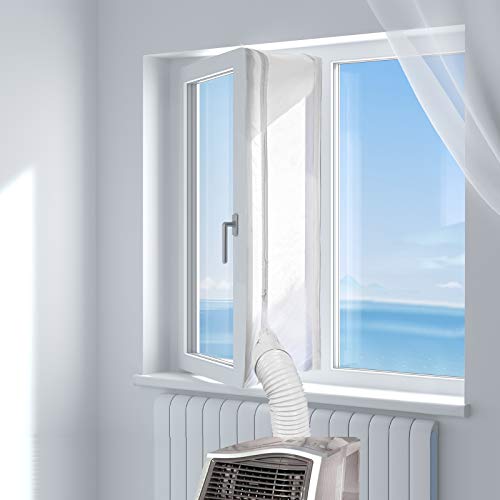
HOOMEE 157”(400CM) Universal Window Seal for Mobile Air Conditioner and Tumble Dryer – Window Kit Works with Portable AC, Easy to Install - Air Exchange Guards with Zip and Adhesive Fastener
Check price on Amazon
VOSE-FLO AC Window Seal Kit 157" for Casement Crank Out Windows, No-Drill | Portable AC Window Vent Kit, Adjustable, for Crank Casement, Push-Out Casement & Crank Skylight Windows, Waterproof
Check price on Amazon
HOOMEE 118”(300CM) Universal Window Seal for Mobile Air Conditioner and Tumble Dryer – Window Kit Works with Portable AC, Easy to Install - Air Exchange Guards with Zip and Adhesive Fastener
Check price on Amazon
SPONDWILD 157"/400CM Portable AC Window Seal Kit for Casement Windows | No-Drill Window Vent Kit, Fit 5" and 6" Single Hose Portable Air Conditioners, Waterproof Window Seal Kit, Easy Install
Check price on Amazon