
5,000 BTU Portable Air Conditioner Guide
Compact cooling for small rooms, bedrooms, home offices, and studio apartments — learn how to choose, install, and maintain a 5,000 BTU portable AC.
START LEARNINGWhy a 5,000 BTU portable air conditioner? A 5,000 BTU portable AC delivers targeted cooling for spaces up to roughly 150 square feet. Unlike window units, it can be rolled between rooms, making it a practical solution for renters, home offices, and rooms without permanent window infrastructure. This guide explains everything you need to know before choosing the right model for your space.
What Is a 5,000 BTU Portable Air Conditioner?
A 5,000 BTU portable air conditioner is a freestanding cooling appliance that produces 5,000 British Thermal Units of cooling output per hour. It sits on caster wheels, draws indoor air, cools it through a refrigerant cycle, and exhausts hot air through a flexible hose vented to a window or wall opening. Unlike a 5000 BTU air conditioner designed as a window unit, a portable model does not need permanent window mounting and can be relocated between rooms.
Units in this capacity class are typically classified as entry-level or essential tier portable cooling solutions. They are engineered for single-room use rather than whole-home cooling. For a broader understanding of how portable units compare with other configurations, see our guide to small room portable air conditioner reviews.
How Much Room Can 5,000 BTU Cool?
As a general rule of thumb, 5,000 BTU covers approximately 100 to 150 square feet under average conditions. Actual cooling performance depends on ceiling height, insulation quality, window area, sun exposure, and the number of occupants and heat-generating devices in the room.
| Room Type | Approx. Area | Suitability |
|---|---|---|
| Bedroom (single) | 100 – 150 sq ft | Excellent match |
| Home office | 100 – 150 sq ft | Excellent match |
| Studio apartment (partial) | Up to 150 sq ft zone | Good if doors isolate the zone |
| Dorm room | 100 – 130 sq ft | Excellent match |
| Living room (open plan) | Over 200 sq ft | Insufficient — consider larger capacity |
| Kitchen (with appliances) | 100 – 130 sq ft | Marginal — heat gain reduces effectiveness |
If your room exceeds 150 square feet or has strong heat gain from west-facing windows, consider stepping up to a higher capacity model. Our 5,000–6,000 BTU AC guide explains how the next tier compares, and our 8,000–10,000 BTU AC guide covers medium rooms. For a full sizing framework, read how to size an air conditioner.
Key Features to Evaluate
Portable AC units in the 5,000 BTU class vary significantly in build quality and feature set. The most useful differentiators fall into several categories:
Single-Hose vs Dual-Hose Design
Most 5,000 BTU portables use a single-hose exhaust system. Single-hose designs draw replacement air from the room, which creates slight negative pressure and can pull in warm outdoor air through gaps. Dual-hose designs separate intake and exhaust, improving efficiency but usually appearing in higher-capacity models. For compact 5,000 BTU units, single-hose is the norm — just ensure the window kit seals tightly.
Cooling Modes and Fan Speeds
Look for at least three modes: cool, fan-only, and dehumidify. Two or three fan speeds give you flexibility between rapid cooling and quiet nighttime operation. A dedicated dehumidify mode is valuable in humid climates, where moisture removal matters as much as temperature reduction.
Noise Level
Portable units are generally louder than window units because the compressor and fan sit inside the room. Decibel ratings in the 5,000 BTU class typically range from the low 50s to high 50s dB(A). If quiet operation is a priority, read our guide to the quiet air conditioner options before deciding.
Smart Controls and Remote Operation
Many current models include a remote control, programmable timer, and sleep mode. Some add Wi-Fi connectivity and app control. If app-based scheduling and voice assistant integration matter to you, see our overview of AC with Wi-Fi and smart control.
Air Filtration and Purification
Washable mesh filters are standard. Some models add activated carbon or HEPA-type filtration. If you want enhanced filtration alongside cooling, review AC with air purifier features.
Advantages and Limitations
Advantages
- No permanent installation — ideal for renters
- Rolls between rooms on casters
- Works with sliding, casement, and hung windows via vent kit
- Compact footprint for small spaces
- Built-in dehumidification in most models
- Lower cooling output means lower electrical draw
Limitations
- Single-room cooling only
- Generally louder than window or mini-split units
- Requires manual condensate drainage or bucket emptying
- Window vent kit must be installed and sealed
- Less efficient than dual-hose or inverter systems
- Not suitable for rooms above ~150 sq ft
Installation and Placement
Setting up a 5,000 BTU portable air conditioner is straightforward and typically takes 15 to 30 minutes. Follow these steps for reliable performance:
- Choose the right window. A double-hung or sliding window works best. Casement windows may need a specialized vent kit. Ensure the window is within hose reach of the unit's intended location.
- Assemble the window kit. Extend the adjustable panel to fit the window opening, then seal gaps with the included foam or weather stripping. Poor sealing lets hot air back in and undermines cooling.
- Connect the exhaust hose. Keep the hose as short and straight as possible. Bends and loops trap heat and reduce exhaust efficiency.
- Position the unit. Place it on a level surface near the window, leaving clearance around the intake and exhaust as specified by the manufacturer. Do not block airflow with furniture or curtains.
- Manage condensate. Many units evaporate most condensate automatically, but humid conditions may require draining via the bottom plug or continuous drain hose.
Placement tip: Avoid positioning the unit in direct sunlight or near heat sources such as ovens, lamps, or electronics. Keep the exhaust hose run as direct as possible, and verify the window seal after installation — a loose seal is the most common cause of disappointing cooling performance.
Efficiency and Energy Considerations
Portable air conditioners are rated using the same efficiency framework as other AC types. Understanding the ratings helps you compare models meaningfully. Our guides to efficiency of an air conditioner and energy efficiency ratings (SEER, EER, HSPF) explain the metrics in depth.
For 5,000 BTU portables, look at the EER (Energy Efficiency Ratio) or the newer CEER rating. A higher EER means more cooling output per unit of electricity. Because 5,000 BTU units draw relatively little power, the difference between an average and a high-efficiency model is modest in absolute terms — but a more efficient unit also tends to have better build quality and quieter operation.
Practical efficiency habits matter as much as the rating label:
- Seal window gaps thoroughly with the vent kit and weather stripping
- Use the timer and sleep mode to avoid running the unit unnecessarily
- Close doors to isolate the cooled zone
- Clean the filter every two weeks during peak season
- Pair the unit with a ceiling fan to distribute cool air
- Shade windows during the hottest hours to reduce heat gain
Maintenance Checklist
Regular maintenance keeps a 5,000 BTU portable AC running efficiently and extends its service life. Most tasks are simple enough to handle without professional help.
| Task | Frequency | Why It Matters |
|---|---|---|
| Clean or rinse the air filter | Every 2 weeks (peak season) | Maintains airflow and cooling output |
| Empty or drain condensate | As needed / weekly in humid climates | Prevents water overflow and odors |
| Wipe exterior and check vents | Monthly | Keeps dust from entering the unit |
| Inspect exhaust hose and window seal | Monthly | Prevents hot air leakage |
| Clean evaporator coil area (accessible models) | Seasonally | Improves heat exchange efficiency |
| Store properly in off-season | Annually | Prevents dust buildup and component wear |
If you notice reduced cooling, unusual noise, or water leakage, consult troubleshooting guidance before assuming the unit has failed. Many issues trace back to a clogged filter, blocked exhaust, or a loose window seal.
Who Is a 5,000 BTU Portable AC Best For?
This capacity class suits specific use cases particularly well:
- Renters who cannot install window units or modify the property
- Home office users who need targeted cooling during work hours
- Bedroom occupants who prefer a cool sleeping environment without cooling the whole home
- Dorm residents with limited window options and small floor space
- Supplemental cooling for rooms that central air struggles to reach
If your room is larger, has heavy heat gain, or you want quieter operation, compare alternatives. A 5,000 BTU window air conditioner with remote control is typically quieter and more efficient for permanent window installations. For spaces without suitable windows, a small room window air conditioner review may point to a better-fitting option. And if you need cooling for a room over 150 square feet, our 8,000–10,000 BTU guide is the next step.
Portable vs Window vs Mini-Split: Quick Comparison
| Category | 5,000 BTU Portable | 5,000 BTU Window | Mini-Split |
|---|---|---|---|
| Installation | No permanent install; vent kit required | Window mounting required | Professional installation |
| Portability | High — rolls between rooms | None | None |
| Noise | Moderate to high | Moderate | Very low |
| Efficiency | Moderate | Good | Excellent |
| Best For | Renters, flexible placement | Permanent single-room cooling | Long-term whole-room comfort |
Best 5,000 BTU Portable Air Conditioners to Consider
⚠️ AFFILIATE DISCLOSURE: This website contains affiliate links. As an Amazon Associate, we earn from qualifying purchases. If you make a purchase through these links, we may receive a small commission at no additional cost to you. Read our full affiliate policy.

Keystone 8,500 BTU ASHRAE/5,000 BTU DOE 115V Portable Air Conditioner with Dehumidifier and Remote Control, AC for Apartment, Bedroom, Small Rooms up to 200 Square Feet in White
Check price on Amazon
GarveeLife Portable Air Conditioner,8,000 BTU for Rooms up to 350 Sq.Ft., Smart Compact AC Unit with Cooling, Dehumidifier, Fan, Remote Control and Window Kit, White
Check price on Amazon
SereneLife 8,000 BTU Portable Air Conditioner | AC, Dehumidifier & Fan | 8000 BTU portable AC with 300 sq. ft. coverage, 3 modes, remote, window kit, washable filter & 24-hour timer
Check price on Amazon
Frigidaire 5,000 BTU Window-Mounted Air Conditioner, Cools Up to 150 Sq. Ft., Quiet Operation, Effortless Temperature Control, 2 Fan Speeds, Auto Restart, White
Check price on Amazon
Electactic 11,000/7,000 BTU ASHRAE/SACC Portable Air Conditioner | 5-in-1 Dual-Motor Portable AC for Bedrooms, as Low as 50 dB, Auto-Evaporation, Dehumidifier, 3 Speeds, 24H Timer, Remote
Check price on Amazon
Midea 10,000 BTU ASHRAE Portable Air Conditioner, Cools up to 300 Sq. Ft. | 7,100 BTU SACC Portable AC, Smart APP & Remote Control, with Dehumidifier & Fan mode, Window Kit, Easy-to-use and Install
Check price on Amazon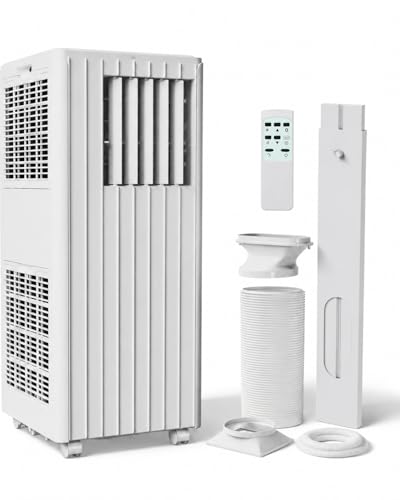
IDEALHOUSE 8000 BTU Portable Air Conditioner, 4-in-1 Portable AC Unit with Cooling, Dehumidifier, Fan & Sleep Mode, Cools up to 350 Sq. Ft, 24H Timer, Remote Control & Window Kit, White
Check price on AmazonA Practical Buyer's Framework
When comparing 5,000 BTU portable AC models, organize your evaluation around these priorities:
- Room size first. Confirm your space is within the 100–150 sq ft range. Oversizing wastes energy; undersizing disappoints.
- Noise tolerance. Check decibel ratings. If the unit will run in a bedroom, prioritize lower-noise models or a window alternative.
- Window compatibility. Verify the vent kit works with your window type. Casement windows often need an extra kit.
- Drainage approach. Decide between manual bucket emptying and continuous drain hose. Humid climates benefit from continuous drainage.
- Controls. A remote and timer are baseline conveniences; Wi-Fi and app control are optional upgrades.
- Tier positioning. Entry-level models cover basic cooling; mid-range models add quieter operation, better sealing kits, and improved filtration.
Frequently Asked Questions
Is 5,000 BTU enough for a bedroom?
How many watts does a 5,000 BTU portable AC use?
Do portable air conditioners need to be vented out a window?
Why is my 5,000 BTU portable AC not cooling well?
Can a 5,000 BTU portable AC cool two rooms?
How often should I drain the water tank?
Is a portable AC better than a window AC for a small room?
What tier of portable AC should I choose for daily use?
Ready to Choose Your 5,000 BTU Portable AC?
Review the recommended models above, confirm your room size, and select the tier that matches your noise tolerance and window setup. You now have the framework to choose confidently.
VIEW RECOMMENDED MODELSRelated Guides
Deepen your research with these related resources:
- Small Room Portable Air Conditioner Reviews — comparative perspectives on compact portable units.
- 5,000–6,000 BTU AC Guide — how the next capacity step compares.
- 5,000 BTU Window Air Conditioner with Remote Control — the window-mounted alternative for permanent installations.
- How to Size an Air Conditioner — the complete sizing framework.
- Quiet Air Conditioner Guide — if low noise is a top priority.
- AC with Wi-Fi and Smart Control — smart features explained.
- AC with Air Purifier — filtration features to look for.
- Efficiency of an Air Conditioner — understanding efficiency metrics.
- Energy Efficiency Ratings (SEER, EER, HSPF) — how ratings are calculated.
- Through-the-Wall AC Guide — another permanent-installation option for small rooms.