Air Filters for House: The Complete Buyer's Guide
Everything you need to know about home air filters — MERV ratings, filter types, sizing, replacement schedules, and how to match the right filter to your HVAC system and indoor air quality goals.
START THE GUIDEWhy this guide matters: The air filter is the simplest, most overlooked component in your HVAC system — and one of the most consequential. The right filter protects your equipment, improves indoor air quality, and keeps airflow balanced. The wrong one can strain your blower motor and quietly reduce comfort throughout the house. This guide helps you choose with confidence before you buy.
What Air Filters Actually Do in a House
A residential air filter serves two equally important jobs. First, it protects the HVAC equipment — the blower motor, evaporator coil, and ductwork — from dust, lint, and debris that would otherwise accumulate and reduce efficiency. Second, it improves the air your household breathes by capturing particles as air cycles through the return side of the system.
Contrary to a common assumption, a standard HVAC filter is not a whole-home air purifier. It captures a meaningful share of airborne particles over repeated cycles, but its primary design intent is equipment protection and baseline filtration. Homeowners who want deeper purification often pair a mid-range filter with a standalone room purifier or a dedicated air filtration system for the home.
Airflow is the constraint that governs every filter decision. A filter that captures more particles but restricts airflow too much will force the blower motor to work harder, raise static pressure, and can lead to frozen coils or reduced cooling. The goal is a filter that balances capture efficiency with the airflow your system was designed to move.
Understanding MERV Ratings
MERV — Minimum Efficiency Reporting Value — is the standard scale used to compare filter capture efficiency. Ratings run from MERV 1 to MERV 20. Higher numbers capture smaller particles but also tend to restrict airflow more, which is why the right choice is rarely the highest rating available.
| MERV Range | Typical Capture | Best For | Airflow Impact |
|---|---|---|---|
| MERV 1–4 | Larger dust, lint, pollen | Basic equipment protection | Minimal |
| MERV 5–8 | Dust mites, mold spores, pet dander | Most households | Low to moderate |
| MERV 9–12 | Fine dust, auto emissions, lead dust | Allergy-aware homes | Moderate |
| MERV 13–16 | Bacteria, smoke, virus carriers, fine particles | Sensitive households, smoke-prone areas | Moderate to high |
| MERV 17–20 | HEPA-level capture | Specialty and clinical environments | Very high |
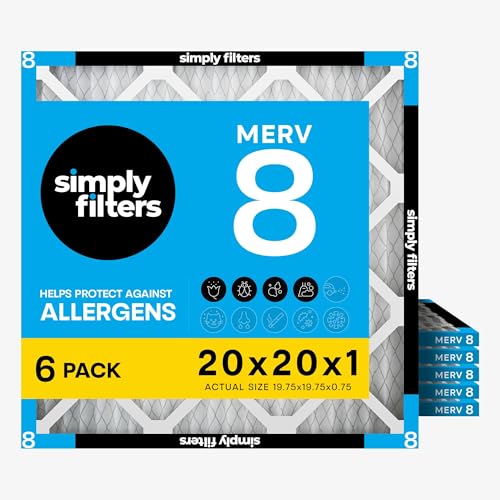
For most residential systems, the practical sweet spot is MERV 8 to MERV 13. MERV 8 is a solid baseline for everyday dust and pollen. MERV 11 is a meaningful step up for households with mild allergies. MERV 13 offers strong fine-particle capture and is the highest rating most residential blower motors can handle without modification. Before upgrading to MERV 14 or above, check your system's static pressure specifications or speak with an HVAC professional.
Types of Air Filters for Homes
Residential filters fall into a handful of distinct categories, each with a different balance of capture efficiency, airflow behavior, and maintenance requirements.
Fiberglass Panel Filters
The most basic option. These thin, spun-glass filters capture large debris and protect equipment, but have minimal impact on fine particles. Best suited to systems where airflow is already tight.
Pleated Disposable Filters
The most common residential choice. Pleated media offers significantly more surface area than flat fiberglass, delivering MERV 8–13 performance with reasonable airflow. Available in 1-inch, 2-inch, 4-inch, and 5-inch depths.
Washable / Reusable Filters
Reusable media that can be rinsed and reinstalled. Reduces waste and is convenient for entry-level maintenance, though most capture fewer fine particles than pleated disposables of similar thickness.
Electrostatic Filters
Use self-charging media or an active charge to attract particles. Capture efficiency improves as the filter loads. Some are washable, some disposable. Good middle-ground for allergy-aware homes.
Media Cabinet Filters (4–5 inch)
Thick pleated media installed in a dedicated cabinet. The extra depth lowers airflow resistance while delivering MERV 11–16 performance. A long-term investment for households prioritizing filtration.
HEPA Bypass Systems
True HEPA filtration integrated through a bypass duct so the main blower is not restricted. The most thorough residential option, typically installed by a professional as part of a broader air filtration system.
If you are weighing a reusable filter against disposables, it helps to think about maintenance rhythm rather than sticker features. Reusable filters need consistent rinsing to stay effective; a neglected washable filter can perform worse than a fresh entry-level pleated filter. Pleated disposables are predictable: swap on a schedule, and performance stays consistent.
Filter Thickness and Airflow
Filter thickness is often misunderstood. A 4-inch or 5-inch filter is not automatically "more restrictive" than a 1-inch filter — it typically has more pleated surface area, which actually lowers resistance while allowing a higher MERV rating. This is why media cabinet filters can deliver MERV 13–16 capture with less strain than a thin 1-inch MERV 13 filter.
- 1-inch filters: The most common residential size. Convenient and widely available, but limited surface area means higher MERV ratings come with a real airflow trade-off.
- 2-inch filters: A useful middle step. More surface area than 1-inch, better airflow at equivalent MERV, and still widely stocked.
- 4-inch and 5-inch filters: Usually installed in a media cabinet. Long service life (6–12 months), lower resistance, and the best option for higher-efficiency filtration in a residential system.
If your system has a 1-inch slot, upgrading to a 4-inch media cabinet is a common long-term improvement, but it requires a professional modification. Do not force a thicker filter into a slot designed for a thinner one — it will not seat correctly and will bypass air.
How to Find the Right Filter Size
Filter sizing is nominal, not exact. A filter labeled 20x25x1 may measure slightly under those dimensions in practice, which is intentional — it allows the filter to slide into the slot without binding. Always match the nominal size printed on the existing filter or the filter slot frame.
- Turn off the HVAC system at the thermostat before opening the filter compartment.
- Locate the filter slot — usually on the return side of the furnace or air handler, or behind a large return grille in a wall or ceiling.
- Read the dimensions printed on the filter frame. They follow the format Width x Height x Depth.
- Note the airflow direction arrow on the frame. The arrow points in the direction of airflow toward the blower.
- If the printed size is illegible, measure the slot opening and round to the nearest standard nominal size.
Never run the system without a filter, even briefly. An open return will pull dust directly into the blower and coil, which is a far bigger problem than a slightly over- or under-sized filter. If you cannot find the filter location, a routine air conditioning unit tune-up will include filter inspection and confirmation of the correct size.
Replacement Frequency and Maintenance
Filter replacement is the single most reliable maintenance habit a homeowner can build. A loaded filter raises static pressure, reduces airflow, and forces the system to run longer for the same comfort. The general guidance below is a starting point — actual intervals depend on household conditions.
| Household Condition | 1-Inch Filter Interval | 4–5 Inch Filter Interval |
|---|---|---|
| No pets, low dust, mild climate | Every 90 days | Every 9–12 months |
| Average household | Every 60–90 days | Every 6–9 months |
| One or more pets | Every 30–60 days | Every 4–6 months |
| Allergy or asthma sufferers | Every 30 days | Every 3–4 months |
| Active renovation or wildfire smoke season | Every 30 days or sooner | Every 2–3 months |
Beyond the calendar, watch for these signs that a filter needs attention sooner:
- Visible dust buildup on the filter face
- Noticeably weaker airflow from supply vents
- Longer run times to reach the set temperature
- A dusty or musty smell when the system starts
- Visible dust settling on furniture faster than usual
For households dealing with persistent air quality issues, filter replacement is one piece of a broader routine that also includes evaluating whether air duct cleaning is necessary and periodic air duct inspection to confirm the distribution system itself is clean and sealed.
Tier-by-Tier Filter Comparison
The table below organizes common residential filter options by market position rather than any specific figure. Use it to match a tier to your household's priorities and your system's airflow capacity.
| Tier | Typical MERV | Best For | Maintenance Rhythm |
|---|---|---|---|
| Essential Tier | MERV 4–8 | Basic equipment protection, rental properties, tight-airflow systems | Monthly to quarterly replacement |
| Balanced Tier | MERV 8–11 | Most single-family homes, mild allergy households | Every 60–90 days |
| Premium Tier | MERV 11–13 | Pet households, allergy sufferers, smoke-prone regions | Every 30–60 days (1-inch) or 4–6 months (thick media) |
| Top-Tier | MERV 13–16 + HEPA bypass | Sensitive households, medically driven air quality needs | Professional service schedule |
A balanced-tier filter is the right starting point for most homes. It delivers meaningful particle capture without stressing the blower. Households with specific air quality triggers should step up to premium-tier filtration, ideally in a thicker media format where the system supports it.
Special Cases: Pets, Allergies, and Older Homes
Homes with pets
Pet dander is light, sticky, and persistent. A MERV 11 pleated filter changed every 30–45 days is a practical baseline. Pair it with regular vacuuming and consider a room-level purifier in the rooms where pets spend the most time. If dander is triggering symptoms, a dedicated air filtration system can supplement the HVAC filter without over-restricting airflow.
Allergy and asthma households
MERV 13 is the highest rating most residential systems can handle without modification, and it captures a strong share of fine particles including pollen fragments and mold spores. In a 1-inch slot, MERV 13 filters load quickly — plan on monthly replacement during peak season. If the system supports a 4-inch media cabinet, that is the better long-term configuration for sustained MERV 13 performance.
Older homes and systems with marginal airflow
Older ductwork is often undersized or leaky, which means the system is already working against static pressure. In these homes, a MERV 8 filter is often the safer choice than a MERV 13, because the marginal capture gain is not worth the airflow penalty. If the system struggles to cool the house, a diagnostic on an air conditioning system that is not cooling should come before any filter upgrade.
Wildfire smoke and seasonal air quality events
During smoke season, a MERV 13 filter run continuously on low fan speed provides meaningful indoor relief. Keep windows closed, set the fan to "on" rather than "auto" to maintain continuous filtration, and replace the filter as soon as the event passes. A standalone HEPA purifier in the main living area adds another layer of protection.
Common Mistakes to Avoid
- Buying the highest MERV available. MERV 14+ filters can exceed the static pressure budget of a residential blower. The result is reduced airflow, longer run times, and potential coil freezing.
- Ignoring the airflow direction arrow. Installing a filter backward reduces capture efficiency and can cause the filter media to bow or collapse.
- Forcing the wrong size. A filter that does not seat flush allows air to bypass around the edges, defeating the purpose entirely.
- Running without a filter. Even short-term operation without a filter pulls dust into the blower and coil — a far larger maintenance issue than any filter capture gain.
- Assuming washable means maintenance-free. Reusable filters need consistent cleaning; a neglected reusable filter can underperform a fresh entry-level disposable.
- Neglecting the rest of the system. A clean filter cannot compensate for dirty coils, leaky ducts, or a failing blower. Routine air conditioning service and maintenance keeps the whole system working together.
Frequently Asked Questions
How often should I replace my home air filter?
Most standard 1-inch filters should be replaced every 30 to 90 days. Homes with pets, allergy sufferers, or high dust levels may need replacement every 30 days, while less demanding environments can extend to 90 days. Thicker 4- to 5-inch filters often last 6 to 12 months.
What MERV rating is best for a house?
MERV 8 to MERV 13 is the ideal range for most residential HVAC systems. MERV 8 handles basic dust and pollen, MERV 11 adds fine particle capture, and MERV 13 delivers strong filtration for allergy-prone households while remaining compatible with most residential blower motors.
Can a high MERV filter damage my HVAC system?
It can if the filter exceeds the static pressure your system was designed for. Filters rated MERV 14 and above, or true HEPA filters installed in a standard return grille, can restrict airflow and strain the blower motor. Always check your system specifications or consult an HVAC technician before upgrading.
Is a washable air filter as good as a disposable one?
Washable filters are reusable and reduce waste, but most capture fewer fine particles than pleated disposable filters of comparable thickness. They work well as a supplemental or entry-level option, while pleated disposable filters remain the better choice for allergy control and overall indoor air quality.
Where is the air filter located in a house?
In most homes, the filter sits in a slot on the return air side of the furnace or air handler. Some systems use return grille filters located in a wall or ceiling. If you cannot find it, check near the blower compartment or consult your system manual.
Does a thicker filter always mean better filtration?
Not automatically, but thicker media usually allows a higher MERV rating at lower airflow resistance because it has more pleated surface area. A 4-inch MERV 13 filter typically restricts airflow less than a 1-inch MERV 13 filter. The system must support the thicker filter, usually through a dedicated media cabinet.
Can a dirty filter cause my AC to stop cooling?
Yes. A heavily loaded filter raises static pressure, reduces airflow across the evaporator coil, and can lead to coil freezing and reduced cooling capacity. If the system is already struggling, replacing the filter is the first and simplest step before diagnosing deeper issues such as an air conditioning unit not cooling the house.
Ready to Choose the Right Filter?
Use the guidance above to match a filter tier to your household. Then explore available options through the product recommendations below.
VIEW RECOMMENDATIONS