
BAS System HVAC: The Complete Building Automation Guide
Discover how a Building Automation System transforms HVAC performance in commercial buildings—improving comfort, cutting energy waste, and giving facility managers total control over indoor climate.
Start LearningWhy BAS Matters: Modern buildings spend a significant portion of their energy use on heating, ventilation, and air conditioning. A BAS system HVAC ties together sensors, controllers, and software so every HVAC component works as one coordinated system—rather than a collection of isolated units reacting independently.
What Is a BAS System HVAC?
A Building Automation System (BAS) is a centralized control network that monitors and manages a building's mechanical and electrical systems—most importantly, its HVAC equipment. In a BAS system HVAC setup, controllers communicate with sensors, actuators, and terminal units across the building to maintain desired temperature, humidity, and air quality conditions automatically.
Instead of relying on individual thermostats and manual adjustments, a BAS collects real-time data from throughout the building and applies programmed logic to decide when to heat, cool, ventilate, or economize. This coordination is what separates a true building automation system from a simple set of standalone HVAC controls.
BAS technology is common in offices, schools, hospitals, hotels, and large retail spaces—anywhere multiple HVAC zones must operate together efficiently. For facility managers, the BAS becomes the single dashboard for understanding how the building's climate systems are performing at any moment.
Core Components of a BAS System HVAC
A well-designed BAS includes several layers of hardware and software working together. Each layer has a distinct role in keeping the HVAC system responsive and efficient.
Sensors
Measure temperature, humidity, CO₂ levels, and airflow throughout the building. Sensors feed real-time data into the control layer.
Controllers
Process sensor data and execute control logic. Direct Digital Controllers (DDCs) are the workhorses of modern BAS installations.
Actuators & Valves
Physically adjust dampers, valves, and fan speeds based on commands from controllers to regulate heating and cooling output.
Communication Network
Protocols such as BACnet and Modbus connect field devices to controllers and to the central workstation, enabling data exchange.
Central Workstation
The operator interface—often a PC or cloud dashboard—where facility staff monitor trends, adjust setpoints, and receive alarms.
Terminal Units
VAV boxes, fan coil units, and other zone-level devices that deliver conditioned air to individual spaces under BAS command.
Together, these components form a feedback loop: sensors detect conditions, controllers decide what to do, actuators make the adjustment, and the workstation keeps operators informed. Understanding this loop is essential for anyone evaluating or maintaining a BAS system HVAC.
How a BAS System HVAC Works in Practice
On a typical day, a BAS operates continuously in the background. Here is the sequence that plays out in most commercial buildings:
- Data collection: Zone sensors report temperature and humidity values to local controllers every few seconds.
- Control logic: Controllers compare live readings against scheduled setpoints and comfort targets programmed into the system.
- Command execution: Based on the comparison, controllers send signals to dampers, valves, compressors, and fans to adjust output.
- System optimization: Higher-level BAS software coordinates major equipment—chillers, boilers, air handlers—to avoid conflicts and unnecessary runtime.
- Monitoring and reporting: The central workstation logs trends, triggers alarms for faults, and generates reports for maintenance planning.
Because the BAS sees the whole building at once, it can make decisions no standalone thermostat could—such as staging chillers to match actual load, or pre-cooling a zone before a scheduled occupancy period.
For buildings with large central plants, the BAS often integrates with related systems covered in our central air conditioning system guide, coordinating air handling and distribution as one operation.
Benefits of Building Automation for HVAC
Investing in a BAS system HVAC delivers measurable advantages across comfort, efficiency, and operations. Key benefits include:
- Energy efficiency: Scheduling, setpoint management, and economizer control reduce wasted runtime and cut energy consumption over time.
- Consistent comfort: Zone-level control keeps temperatures stable across large or multi-tenant spaces.
- Predictive maintenance: Trend logs and fault alarms help teams catch failing equipment before it disrupts occupants.
- Remote visibility: Facility staff can monitor and adjust systems from a workstation or cloud dashboard.
- Regulatory compliance: Automated documentation supports energy reporting and code requirements.
These benefits compound over the life of a building. A BAS is best viewed as a long-term investment in operational efficiency rather than a one-time equipment purchase.
For spaces where central systems share ductwork with heating equipment, coordination with central heating and cooling strategies further strengthens the value of automation.
BAS vs Standalone HVAC Controls
It is useful to understand how a BAS differs from basic control setups. Standalone controls—like individual programmable thermostats—operate in isolation. A BAS, by contrast, coordinates every device through shared logic and data.
| Tier | Control Approach | Best For |
|---|---|---|
| Essential tier | Standalone thermostats per zone | Small spaces with limited equipment |
| Balanced tier | Local networked controllers with scheduling | Mid-size buildings with several zones |
| Top-tier | Full BAS with central workstation and analytics | Commercial buildings with complex HVAC plants |
Moving from essential-tier controls to a balanced or top-tier BAS is often the single most effective step a facility can take to improve HVAC reliability and energy performance.
Integrating BAS with Other Building Systems
Modern BAS platforms do more than control HVAC. They commonly integrate with lighting, access control, fire safety, and energy metering. This integration allows coordinated responses—for example, reducing ventilation when occupancy sensors show a conference room is empty.
When HVAC equipment is part of a larger mechanical room, the BAS may also interface with boiler controls and related plant equipment to balance heating and cooling loads. Similar coordination applies in commercial heating and air conditioning units deployments, where uptime and efficiency are paramount.
For specialized spaces such as server rooms, BAS monitoring provides early warning of temperature excursions—critical for protecting sensitive equipment.
What to Consider When Choosing a BAS System HVAC
Selecting a building automation system requires matching features to building needs. Consider these factors before committing:
- Scale and zoning: Count the number of HVAC zones and terminal units the system must manage.
- Protocol support: Confirm compatibility with BACnet, Modbus, or other open standards used by existing equipment.
- User interface: Evaluate whether the dashboard is intuitive for the staff who will use it daily.
- Scalability: Choose a platform that can grow as the building adds equipment or new zones.
- Support ecosystem: Look for a vendor with strong local service and integration partners.
A feature-rich system in the mid-tier range often delivers the best balance of capability and manageability for most commercial properties.
Keeping Your BAS Performing Reliably
Like any control system, a BAS requires periodic attention to remain effective. Routine maintenance tasks include:
- Reviewing trend logs for abnormal equipment behavior
- Verifying sensor accuracy and recalibrating where needed
- Updating controller firmware and software
- Checking network health and communication faults
- Adjusting schedules and setpoints as occupancy patterns change
Facilities that treat BAS maintenance as routine—rather than reactive—avoid small faults turning into costly downtime. When issues do arise in connected HVAC equipment, resources like our common AC problems guide can help teams troubleshoot quickly.
Explore Smart HVAC Control Options
Ready to see how building automation hardware fits into your HVAC plan? Browse recommended control components and compare features.
View Recommended ProductsFrequently Asked Questions About BAS System HVAC
What does BAS stand for in HVAC?
BAS stands for Building Automation System. In HVAC contexts, it refers to the centralized control network that monitors and manages heating, ventilation, and air conditioning equipment across a building.
How does a BAS system improve energy efficiency?
A BAS optimizes equipment scheduling, coordinates staging of chillers and boilers, and uses economizer logic to reduce unnecessary runtime. These measures lower energy consumption over time compared to standalone controls.
Is a BAS system suitable for small buildings?
Yes. Entry-level and mid-range BAS platforms exist for smaller facilities. The right choice depends on the number of zones and the complexity of the HVAC equipment rather than building size alone.
What protocols do BAS systems use?
Common protocols include BACnet and Modbus. Open-standard support is important because it lets the BAS integrate with equipment from multiple manufacturers.
Recommended HVAC Building Automation Products
⚠️ AFFILIATE DISCLOSURE: This website contains affiliate links. As an Amazon Associate, we earn from qualifying purchases. If you make a purchase through these links, we may receive a small commission at no additional cost to you. Read our full affiliate policy.

HVAC CONTROL SYSTEMS HANDBOOK: Building Automation Sequences, Sensors, Actuators and Loop Tuning for Facility Engineers and Technicians
Check price on Amazon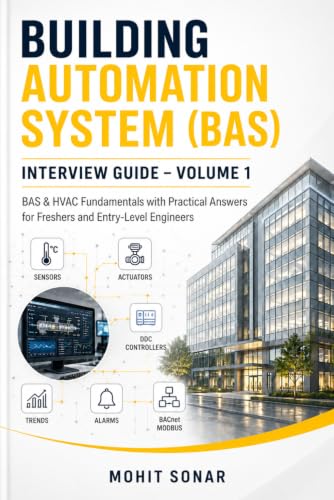
Building Automation System (BAS) Interview Guide – Volume 1: BAS & HVAC Fundamentals with Practical Answers for Freshers and Entry Level Engineers
Check price on Amazon
Building Automation Systems (BAS): A Practical Guide for Entry-Level Engineers & HVAC Technicians
Check price on Amazon
Building Automation Systems A to Z: How to Survive in a World Filled With BAS
Check price on Amazon
Building Automation System (BAS) Interview Guide – Volume 2: Advanced HVAC Control, Troubleshooting Scenarios, and Real‑World BAS Problem Solving
Check price on Amazon
BACOENG 4 CFM 1/3HP AC Vacuum Pump and Manifold Gauge Set | 110V HVAC Vacuum Pump Kit with Leak Detector, 5ft 3-color Hoses for R134a R410a R22 Automotive A/C & Mini Split HVAC Systems
Check price on Amazon
Johnson Controls Temperature Sensor, Nickel 1k ohm with Terminal Block TE-68NT-1N00S - 1 Each
Check price on Amazon
HVAC and Building Systems Reference Library CD (CD-Rom)
Check price on AmazonDisclaimer
Some of the content on this site uses AI assistance. Information is provided for educational purposes only. We are not responsible for any losses resulting from the use of this information. By using this site, you waive any right to bring legal claims against us arising from your use of the information provided. If you do not agree, please do not use this site. Read the full disclaimer.