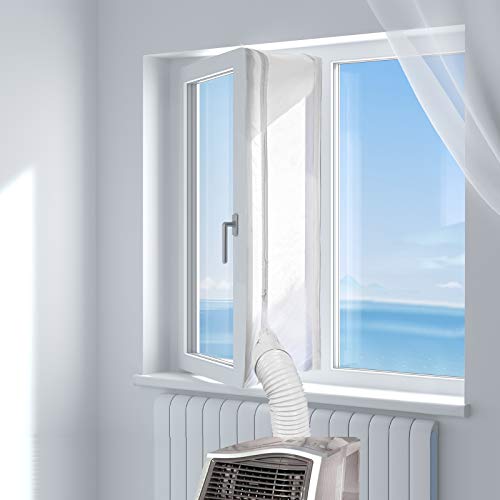
Casement Window Air Conditioner: The Complete Buyer's Guide
Everything you need to know about cooling a room through a narrow vertical window — sizing, installation, efficiency, and how to choose a casement AC that fits right the first time.
START WITH THE CHECKLISTWhy casement windows need their own AC category: A standard window air conditioner is built for a double-hung window that opens vertically. Casement windows — the ones that crank open outward like a door — leave only a tall, narrow opening on one side. A regular window unit simply cannot sit safely in that gap. A casement window air conditioner is purpose-built for this situation: it is tall and slim, and it mounts in the vertical opening without blocking the crank mechanism or leaving the unit unsupported.
If you have been told "an AC won't fit in that window," this guide will show you that it can — as long as you match the unit to the opening and follow the right installation method.
1. What a Casement Window Air Conditioner Actually Is
A casement window air conditioner is a self-contained cooling unit designed specifically for vertical, side-hinged windows. Instead of resting on the window sill and sliding into a horizontal opening, a casement AC is mounted in the tall vertical gap created when the window sash swings outward. The unit is typically supported by a mounting bracket that anchors to the window frame or the wall below the sill, so the weight of the compressor is carried by the bracket rather than by the glass or the moving sash.
These units are sometimes called vertical window air conditioners because of their orientation. They are relatively uncommon compared to standard window units, which is exactly why buyers often struggle to find one that fits. The market is smaller, so the range of capacities and features is narrower — but for homes with casement windows, they are often the only practical way to get window-mounted cooling without modifying the building.
Who a casement AC is for
- Renters and apartment dwellers with casement windows who cannot install a mini-split or alter the window opening.
- Older homes and historic buildings where casement windows are common and exterior modifications are restricted.
- Homeowners who want a single-room solution without committing to a ducted system or a permanent wall penetration.
- Anyone with a narrow window where a standard window AC is physically too wide to fit.
Key point before you shop
A casement AC is not simply a standard window AC turned sideways. The chassis, the mounting bracket, the airflow path, and the window sealing kit are all different. Buying a standard unit and "making it fit" is a safety risk and usually voids the warranty.
2. How Casement Units Differ from Standard Window ACs
Understanding the mechanical differences helps you evaluate listings and avoid mismatched products. The table below summarizes the main distinctions.
| Feature | Standard Window AC | Casement Window AC |
|---|---|---|
| Orientation | Horizontal, wide chassis | Vertical, tall and slim chassis |
| Window type | Double-hung (opens up/down) | Casement (cranks open outward) |
| Support method | Window sill + sash | Bracket anchored to frame or wall |
| Sealing kit | Side accordion panels | Vertical fill panels and frame seals |
| Typical capacity range | 5,000–25,000 BTU | Narrower; roughly 8,000–12,000 BTU common |
| Availability | Wide | Limited; fewer brands and models |
The most important practical difference is support. A standard window unit transfers much of its weight to the sill and is stabilized by the lowered sash. A casement unit cannot rely on a sash pressing down on it, so it uses a dedicated bracket or a frame-mounted rail. This is why the installation kit matters as much as the unit itself — and why a missing or generic kit is a red flag.
Airflow is also different. Casement units are often designed to exhaust hot air through the upper portion of the chassis while drawing room air through the front grille. Because the chassis is tall, the internal layout of the evaporator, condenser, and fan is rearranged compared with a horizontal unit. This affects noise distribution and how the air is directed into the room.
3. Sizing: Matching BTU to Room and Window
Capacity is the single most consequential decision. An undersized unit runs constantly and never reaches the set temperature; an oversized unit cools the air quickly but leaves the room humid and cycles on and off aggressively, which is uncomfortable and wears out the compressor faster. Use the room-size bands below as a starting reference, then adjust for the factors listed after the table.
| Room Size | Baseline Capacity | Typical Use Case |
|---|---|---|
| Up to 150 sq ft | 5,000–6,000 BTU | Small bedroom, home office |
| 150–250 sq ft | 8,000–10,000 BTU | Standard bedroom, small living room |
| 250–400 sq ft | 12,000–14,000 BTU | Large bedroom, studio apartment |
| 400–550 sq ft | 14,000–18,000 BTU | Open living area, loft |
These bands assume a standard ceiling height of about eight feet, average insulation, and a shaded or moderately sun-exposed window. Adjust upward if any of the following apply:
- Direct sun on the window for much of the day — add roughly 10 percent.
- Kitchen or room with heat-generating appliances — add capacity for the appliance load.
- Top floor or poorly insulated attic-adjacent room — add capacity to compensate for heat gain through the ceiling and walls.
- More than two occupants regularly in the room — each additional person adds a small but real load.
Adjust downward slightly if the room is heavily shaded, well insulated, or in a mild climate where the unit will mostly run at partial load. If you want a more precise number, run a room-by-room load estimate rather than relying on square footage alone. Our full AC sizing guide walks through the calculation step by step, and the BTU calculator by room size gives you a quick cross-check.
Window width is a hard constraint
Capacity is negotiable; window dimensions are not. Casement units are available in a limited range of widths and heights. Always confirm the unit's minimum and maximum window opening dimensions before comparing BTU ratings. A 12,000 BTU unit that does not fit your opening is useless regardless of how well it matches the room size.
4. Measuring Your Casement Window Correctly
Measure the opening, not the glass. You want the clear vertical gap through which the unit will pass when the window is fully open. Follow this sequence:
- Open the window fully. Crank it out until it stops. The opening you measure is the space the sash leaves behind.
- Measure the vertical opening height from the sill (or the top of the mounting rail) to the top of the frame opening. Record the smallest measurement across the opening — frames are rarely perfectly square.
- Measure the opening width. This is the narrow dimension. Casement ACs are typically around 14–16 inches wide, so record your width to the nearest eighth of an inch.
- Measure the sill depth and check the exterior. Confirm there is enough exterior clearance for the back of the unit to protrude and exhaust hot air. Check for obstructions such as shutters, siding, or nearby walls.
- Identify the mounting surface. Determine whether the bracket will anchor to the window frame, the wall below the sill, or both. This determines which installation kit you need.
- Note the crank handle position. Make sure the open sash and crank do not collide with the unit or its bracket.
Write the numbers down and compare them against the manufacturer's published minimum and maximum opening dimensions for each candidate unit. If your measurements are borderline, choose a unit whose range comfortably includes your opening rather than one that barely fits.
If you are also considering how the unit will be sealed and supported, review the options for a dedicated casement window air conditioner installation kit so you know what hardware should be in the box.
5. Types and Configurations
Casement ACs are not a single product category. The main variants differ in how they mount, what they include, and what they can do beyond cooling.
Frame-mounted versus bracket-supported units
Frame-mounted units sit in a rail that attaches to the window frame itself. They are easier to install and remove, which suits renters. Bracket-supported units use a metal bracket anchored to the wall or sill below the opening; the unit rests on the bracket and is secured to the frame at the top. Bracket systems are more stable for heavier units and are the better choice when the frame alone cannot carry the load.
Cooling-only versus cooling-and-heating
Most casement units are cooling-only. A smaller subset includes a heating element or a heat pump function. If you need year-round comfort from a single window installation, a casement window air conditioner with heat is worth evaluating — but check whether the heat function is resistive (simple electric element) or a reverse-cycle heat pump, since the two behave very differently in cold weather.
Capacity-specific models
Because the casement category is narrow, some capacities are only offered by a handful of models. The 12,000 BTU casement window air conditioner is a common mid-range choice for larger bedrooms and small living areas. If your room falls in that band, compare several models on dimensions, efficiency, and noise rather than assuming the first match is the best fit.
Related vertical and through-window options
Some buyers with narrow openings look beyond the casement category entirely. A casement window insert for air conditioner units can adapt certain vertical openings, and a car window air conditioner is a completely different product intended for vehicles — do not confuse the two when searching. If your window is actually a horizontal slider rather than a crank-out casement, a standard window air conditioner may be the simpler route.
6. Efficiency, Noise, and Features That Matter
Once the unit fits and the capacity is right, the remaining differences come down to how efficiently it runs, how loudly it runs, and which conveniences it offers.
Efficiency ratings
Window units are rated with CEER (Combined Energy Efficiency Ratio) rather than the SEER rating used for central systems. A higher CEER means more cooling per unit of electricity. Within the casement category, efficiency varies noticeably between entry-level and premium models, so it is worth comparing. Our explainer on SEER and efficiency ratings covers the underlying concepts, while the ENERGY STAR certified AC overview explains what the certification actually guarantees.
Noise
Casement units tend to be slightly louder than comparable horizontal window units because the tall chassis constrains the fan and compressor layout. If the unit will run at night in a bedroom, prioritize models with a dedicated low-fan setting and a sleep mode. Our guide to quiet air conditioners explains which specifications predict real-world noise.
Features worth having
- Programmable timer and sleep mode — reduces runtime during hours you do not need full cooling.
- Remote control or app control — convenient when the unit is mounted high in the frame.
- Washable filter with easy access — the filter is the single most important maintenance item; make sure you can reach it without removing the unit.
- Auto-restart after power interruption — useful in areas with unstable power.
- Dry mode / dehumidification — helpful in humid climates where sensible cooling is not the only goal.
Tier language instead of numbers
Throughout this guide we describe products by market position rather than by any numeric figure. An entry-level casement unit typically covers the basics — mechanical controls, a single fan speed, and a straightforward bracket. A mid-range model usually adds electronic controls, a timer, and better sealing hardware. A premium model generally offers higher efficiency, quieter operation, and more refined mounting hardware. A top-tier or professional-grade unit may include heat-pump functionality or smart controls. Use these tiers to compare models relative to each other, not as absolute judgments.
7. Installation Process and What to Expect
Casement AC installation is more involved than sliding a standard unit into a double-hung window, but it is still a manageable DIY project for a careful homeowner. The exact steps depend on the mounting system, but the general sequence is consistent.
- Dry-fit the unit. Before anchoring anything, set the unit in the opening (or on the bracket) to confirm clearance, sash movement, and exterior protrusion.
- Install the support bracket or rail. Anchor it to solid framing, not just to drywall or trim. Use the fasteners specified by the manufacturer and check that the bracket is level.
- Seal the opening. Fit the vertical fill panels and weather sealing supplied with the kit. Gaps around the unit let hot air back in and undermine cooling performance.
- Secure the unit. Follow the manufacturer's instructions for locking the chassis to the frame or bracket. Do not skip the anti-tip hardware.
- Check drainage. Casement units shed condensate; confirm the drain path slopes outward and is not blocked.
- Test operation. Run the unit through its full fan and cooling range and check for vibration, unusual noise, and air leaks around the seal.
If the bracket requires drilling into the exterior wall or the window frame is in poor condition, a professional installation is the safer choice. Our guide to when to call an HVAC technician covers the situations where DIY stops being sensible. For a broader overview of the process and cost factors, see the installation estimate guide.
Do not skip the sealing step
Casement windows leave an irregular gap around the unit. A poorly sealed installation can lose a meaningful share of cooling capacity to outside air infiltration. The fill panels and foam seals are not optional accessories — they are part of the system.
8. Casement ACs with Heat: When They Make Sense
A casement unit with a heating function can replace two separate appliances in a room that needs both cooling and supplemental warmth. That said, the heating side of these units is not equivalent to a central furnace.
- Resistive heating uses an electric element. It is simple and works in any temperature, but it is less efficient than a heat pump.
- Heat-pump heating moves heat rather than generating it, so it is more efficient in mild and moderate climates. In very cold weather, output drops and a backup element may take over.
Choose a heated model if the room is a bedroom, office, or addition that needs modest warmth during shoulder seasons rather than full winter heating. If you need reliable heating in freezing conditions, a dedicated heating system is the better investment. For a detailed comparison, see our guide to casement window air conditioners with heat.
9. Common Mistakes to Avoid
- Buying by BTU before measuring the window. Always confirm opening dimensions first; capacity is secondary if the unit will not fit.
- Assuming a standard window AC can be adapted. It cannot be safely mounted in a casement opening without the correct chassis and bracket.
- Oversizing to "be safe." An oversized unit short-cycles, leaving the room clammy and the compressor under stress.
- Ignoring the exterior. Back clearance matters; a unit that exhausts into a wall or beneath an overhang will underperform.
- Skipping the seal. Poor sealing is the most common cause of "my casement AC isn't cooling well" complaints.
- Neglecting the filter. A clogged filter reduces airflow and cooling capacity and can freeze the evaporator coil.
- Not checking the warranty terms for installation. Some manufacturers require professional installation or specific bracket hardware to honor the warranty.
10. Maintenance for Long-Term Performance
A casement AC will last longer and cool more consistently with a simple maintenance routine:
- Clean or replace the filter every two to four weeks during heavy use. This is the highest-impact maintenance task. Our guide on cleaning an AC filter covers the process.
- Inspect the exterior seal each season. Reapply weather stripping or foam where it has compressed or cracked.
- Check the bracket and fasteners annually. Vibration can loosen hardware over time.
- Clean the condenser coil at least once per cooling season if the unit is exposed to pollen, dust, or debris. See the condenser coil cleaning guide.
- Remove the unit or cover it during the off-season if the manufacturer recommends it, to protect the chassis from weather and pests.
- Watch for symptoms early. Reduced cooling, unusual noises, or water leaks are easier to fix when caught early — our AC not cooling troubleshooting guide walks through the common causes.
11. Final Buying Checklist
Use this checklist before you commit to a model. Each item is a decision point that affects whether the unit will actually work in your home.
- Window type confirmed: the window cranks open outward and leaves a vertical opening.
- Opening height and width measured and compared against the unit's published minimum and maximum dimensions.
- Exterior clearance confirmed for the back of the unit.
- Mounting method selected — frame-mounted or bracket-supported — based on the frame condition and unit weight.
- BTU band matched to room size with adjustments for sun, insulation, and occupancy.
- Efficiency compared across models within the capacity band.
- Noise expectations checked, especially if the unit will run overnight.
- Sealing kit included and appropriate for your opening.
- Heating function considered only if the room genuinely needs supplemental warmth.
- Installation plan realistic — DIY with the correct bracket, or professional installation if the frame or wall requires anchoring work.
Ready to compare casement window air conditioners?
Browse curated models that fit vertical openings, matched to room size and efficiency tier.
EXPLORE OPTIONS12. Frequently Asked Questions
Can I use a regular window air conditioner in a casement window?
No. A standard window AC is designed to sit horizontally in a double-hung window and is supported by the sill and lowered sash. A casement window has no sash to press down on the unit, and the opening is narrow and vertical. Attempting to adapt a standard unit is unsafe and typically voids the warranty.
What BTU size do I need for a casement AC?
Match the room, not the window. A room up to 150 sq ft usually needs 5,000–6,000 BTU; 150–250 sq ft needs 8,000–10,000 BTU; 250–400 sq ft needs 12,000–14,000 BTU. Adjust upward for direct sun, top floors, and heat-generating appliances. Because casement models are limited in capacity range, confirm the available units cover your calculated band before narrowing by other features.
Do casement window ACs come with heat?
Some do, but the selection is smaller than cooling-only models. Heated casement units use either a resistive element or a heat pump. They are best suited to supplemental warmth in a single room during mild weather, not as a replacement for a full heating system.
How much does it cost to install a casement window AC?
Installation complexity depends on the mounting method and the condition of the window frame. A frame-mounted unit with a supplied rail is a straightforward DIY job. A bracket-supported unit that requires anchoring into exterior wall framing is better handled by a professional. For a breakdown of typical installation scopes, see the installation estimate guide.
Why is my casement AC not cooling well?
The three most common causes are a clogged filter, a poor seal around the window opening, and an undersized unit. Check the filter first, then inspect the fill panels and weather seals, then verify that the unit's capacity matches the room. If those are fine, work through the general AC not cooling troubleshooting steps.
Can I install a casement AC in an apartment?
Usually yes, because the unit does not require permanent modification to the building — it mounts in the existing window opening and can be removed. Check your lease and building rules first, particularly regarding exterior protrusion and bracket anchoring. Frame-mounted units are generally the least invasive option for renters.
Are casement ACs more expensive than standard window units?
The casement category is smaller and less competitive, so models often sit at a higher relative position in the market compared with standard window units of similar capacity. Rather than comparing headline figures, compare within the casement category: an entry-level casement unit and a premium casement unit differ in efficiency, noise, controls, and mounting hardware, and those differences matter more than the category's overall market position.