
Ceiling Cassette Mini Split AC
The ultimate guide to recessed ceiling cassette air conditioners — how they work, where they shine, and how to choose the right unit for your space.
Explore Top PicksQuick answer: A ceiling cassette mini split is a ductless system whose indoor unit sits flush inside the ceiling and blows conditioned air in two, three, or four directions. It delivers even, draft-free comfort in open-plan rooms — and because it needs no ductwork, it is a natural fit for retrofits, new builds, and commercial interiors alike.
What Is a Ceiling Cassette Mini Split?
A ceiling cassette mini split pairs a recessed indoor head with an outdoor condenser. The indoor unit is installed so that only its slim grille is visible at the ceiling plane, while the fan, coil, and electronics sit inside the plenum above. Rather than blasting air from a wall or floor, the cassette distributes air through louvers that can be aimed individually — a design that makes it one of the most discreet comfort solutions on the market.
This configuration belongs to the wider family of ceiling cassette air conditioners, and it shares much of its DNA with wall-mounted mini splits: the same refrigerant loop, the same inverter compressor options, and the same split-system efficiency. The difference is purely in form factor and airflow behavior. If you are still mapping out the broader landscape, our ceiling cassette mini split overview is a helpful companion read, and the sibling article on the ceiling cassette mini split heat pump system covers combined cooling and heating configurations.
How a Ceiling Cassette Mini Split Works
Air is drawn upward through a central return grille, passes over the evaporator coil, and is then discharged horizontally through two to four adjustable louvers. Because the discharge is at ceiling level, the conditioned air spreads across the room before it drops — a pattern that avoids the cold spots you sometimes feel in front of a wall unit. Condensate is removed either by gravity drain or by a built-in condensate pump, which matters when the ceiling void cannot accommodate a downward slope.
Most modern cassette systems use inverter compressors, so they modulate output smoothly instead of cycling on and off. That characteristic is shared with the technology described in our inverter AC guide, and it is the main reason ceiling cassettes can hold a steady temperature without the pendulum swing of a fixed-speed unit.
Airflow patterns you can expect
- Two-way: compact cassettes for narrow rooms and corridors.
- Three-way: a practical middle ground for small offices and retail spaces.
- Four-way: the classic configuration for square, open-plan rooms.
Each louver can typically be adjusted independently, and many premium grilles support auto-swing or preset louver angles for occupied and unoccupied hours.
Ceiling Cassette vs. Other Mini Split Indoor Units
The cassette is one of several indoor head styles available for ductless systems. The comparison below uses neutral quality tiers rather than any numeric figures, so it stays useful regardless of when you read it.
| Indoor Unit | Best For | Aesthetic Impact | Installation Complexity | Typical Tier |
|---|---|---|---|---|
| Ceiling cassette | Open-plan living rooms, offices, retail spaces | Minimal — flush grille only | High — requires ceiling void and framing | mid-range to high-end tier |
| Wall-mounted | Bedrooms and single rooms | Moderate — visible wall box | Low to moderate | entry-level to premium |
| Floor-mounted | Rooms without ceiling void | Moderate — low wall presence | Low | mid-range |
| Ceiling-suspended | High ceilings and commercial halls | Visible but unobtrusive | Moderate | mid-range to high-end tier |
If you are weighing a recessed cassette against a suspended unit, the dedicated page on the ceiling-mounted mini split air conditioner explores both styles in more depth. For smaller footprints, the compact ceiling mini split variant is worth a look.
Advantages of Choosing a Cassette System
Discreet by design
Only a low-profile grille shows; the mechanicals hide above the ceiling, preserving clean sightlines.
Even distribution
Multi-directional louvers spread air across the room instead of concentrating it in one corner.
No duct losses
Because there is no duct run, there is no leakage or thermal loss through ductwork.
Zone control
Multi-zone condensers let a single outdoor unit serve several cassette heads independently.
Retrofit friendly
No existing duct system is required, which suits older buildings and renovations.
Built-in drainage options
Many units include a condensate pump, simplifying routing when a gravity slope is impractical.
Limitations Worth Knowing
Ceiling cassettes are not a universal answer, and a well-informed buyer should understand the trade-offs before committing.
- Ceiling void required: the plenum above the ceiling must be deep enough for the chassis plus clearance for airflow.
- Structural planning: the ceiling opening must be framed and finished neatly, which is a skilled trade task.
- Service access: filters are accessible from below, but deeper service may require panel removal from the room side.
- Higher installation complexity: compared with a wall head, a cassette install involves more trades and more planning.
- Not ideal for very low ceilings: the discharge path needs adequate clearance to avoid a downdraft sensation.
Sizing a Ceiling Cassette Mini Split
Capacity selection follows the same logic as any split system: match the unit to the room's heat load, not to the room's floor area alone. Ceiling height, window area, insulation, occupancy, and appliance heat all shift the calculation. Our how to size an air conditioner guide walks through the method, and the BTU calculator by room size gives a fast first estimate.
A few practical notes specific to cassettes:
- Open-plan rooms benefit from a four-way cassette positioned near the centre of the ceiling.
- Long narrow rooms often suit a two-way or three-way cassette aligned with the room's long axis.
- Multi-zone layouts let you combine cassette heads in living areas with wall heads in bedrooms, all on one condenser.
- Oversizing is a common mistake — it causes short cycling and uneven humidity control. The article on what happens if your AC is too big or too small explains the consequences.
Efficiency Ratings to Compare
Ceiling cassette systems are rated with the same metrics as other split systems. SEER2 and EER2 describe cooling efficiency, while HSPF2 describes heating efficiency for heat pump models. Higher ratings generally indicate better efficiency, but the right choice depends on your climate and usage pattern.
- What is a SEER rating? — the fundamentals explained.
- SEER vs SEER2 — how the updated DOE standards changed the numbers.
- What is an EER rating? — why peak-load efficiency matters in hot climates.
- What is an HSPF rating? — the heating counterpart for heat pump cassettes.
- ENERGY STAR certified AC — what the certification actually verifies.
Where Ceiling Cassettes Make the Most Sense
The form factor rewards certain room types far more than others.
- Open-plan living and dining areas: a central four-way cassette covers the whole space without visible hardware on the walls.
- Home offices and studios: quiet operation and even airflow suit long working sessions.
- Retail and hospitality spaces: the flush grille keeps the ceiling clean and the brand environment intact.
- Restaurants and cafés: multi-directional airflow handles variable occupancy without drafts.
- Renovations without ducts: cassette heads slot into a new ceiling with far less disruption than a ducted retrofit.
For whole-home layouts, cassettes are often combined with other head styles. The ductless vs ducted AC comparison is useful if you are deciding between a fully ductless approach and a hybrid design.
Installation Considerations
Installation is the stage where ceiling cassettes differ most from wall-mounted systems. The essentials:
- Ceiling opening and framing: the cut-out must be framed square and level, with the grille sitting flush to the finished ceiling.
- Plenum clearance: the void above must accommodate the chassis and leave room for the return airflow.
- Drain path: gravity drain where possible; a condensate pump where the slope is not achievable.
- Refrigerant lines: route the line set and communication cable cleanly through the ceiling void.
- Electrical supply: confirm the circuit and breaker match the unit's requirements.
Because the work involves several trades, choosing a qualified installer matters. Our guide on how to choose an HVAC contractor covers what to verify before signing. If you are planning around electrical capacity, the home electrical panel check is a sensible first step.
Maintenance for Ceiling Cassette Units
Routine care keeps airflow strong and efficiency stable. Most cassette grilles hinge down for filter access, so the filter routine is straightforward from below.
- Clean the AC filter every few weeks during heavy-use seasons.
- Replace the filter when washing no longer restores airflow.
- Seasonal AC checklist — a simple pre-season routine.
- Clean evaporator coils periodically to protect efficiency.
Ceiling cassettes benefit particularly from clean filters, because a clogged filter in a recessed unit is less obvious than on a wall head and can quietly reduce performance.
Troubleshooting Common Issues
Most cassette problems mirror those of any split system. Start with the basics before calling a technician.
- AC not cooling — the checklist that resolves most cases.
- AC leaking water — often a drain or condensate pump issue in cassette units.
- AC blowing warm air — from settings to refrigerant.
- AC making noise — vibration, fan, and louver sources.
- AC smells bad — moisture and microbial growth in the drain pan.
- AC frozen coils — airflow and refrigerant causes.
Tier Guide: Matching the Unit to Your Space
Because ceiling cassettes span a wide range of specifications, it helps to think in tiers rather than fixed features. The descriptors below are relative positions in the market, not absolute figures.
| Tier | Best For | What to Expect |
|---|---|---|
| entry-level | Small rooms and budget-conscious retrofits | Basic louver control, standard filtration, simple remote. |
| mid-range | Open-plan living areas and home offices | Inverter compressor, better fan curves, improved filter access. |
| premium | Primary living spaces and quiet-sensitive rooms | Lower sound levels, refined airflow control, smarter controls. |
| high-end tier | Whole-home and multi-zone systems | High efficiency ratings, advanced zoning, integrated control options. |
| commercial-grade | Retail, hospitality, and light commercial | Heavy-duty construction, longer service intervals, robust drainage. |
Whichever tier you choose, the practical rule is the same: a mid-range cassette with a well-matched installation will outperform a high-end unit that is badly sized or poorly installed.
Top Ceiling Cassette Mini Split Picks
⚠️ AFFILIATE DISCLOSURE: This website contains affiliate links. As an Amazon Associate, we earn from qualifying purchases. If you make a purchase through these links, we may receive a small commission at no additional cost to you. Read our full affiliate policy.

DELLA 12000 BTU Ceiling Cassette Mini Split AC, Hyper Heat at -13℉,22 SEER2 | 8-way 360° Airflow 230V,Energy Star,Work with Alexa,Pre-Charged Heat Pump Ductless Inverter System,Covers 550 Sq. Ft,16ft Kit
Check price on Amazon
Garvee 18000 BTU Ceiling Cassette Mini Split AC, 8-Way 360° Airflow | Remote Controller, Ductless Cooling & Heating Ceiling Air Conditioner, 208/230V, 16ft Kit
Check price on Amazon
ROVSUN 12000 BTU Smart WIFI Ceiling Cassette Mini Split AC/Heating System with Inverter & APP Control, 21 SEER2 Ductless Air Conditioner with Pre-Charged Condenser, Heat Pump & Installation Kit, 230V
Check price on Amazon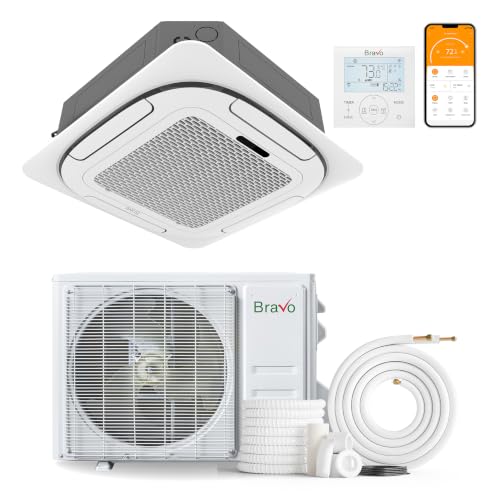
BRAVO 24000 BTU 230V Ceiling Cassette Mini Split - 20 SEER2 - Smart Kit | Year-Round Cooling & Heating, 16FT Installation Kit, Smart Kit, Drain Pump, Wall Thermostat, Pre-Charged, 2 Ton, Inverter
Check price on Amazon
ROVSUN WIFI 18000BTU Dual Zone (9K/12K) Ceiling Cassette Mini Split AC/Heater with Inverter, 25 SEER2 2 Zone Ductless Air Conditioner with Pre-Charged Condenser, Heat Pump & 25Ft Line Set, 208-230V
Check price on AmazonFrequently Asked Questions
What is a ceiling cassette mini split?
A ceiling cassette mini split is a ductless air conditioning system where the indoor unit is recessed into the ceiling. Only a slim grille is visible at the ceiling plane, while the fan, coil, and electronics sit above. Air is distributed in two to four directions for even, draft-free comfort.
How many square feet can a ceiling cassette mini split cool?
Single-zone ceiling cassette units typically cover between roughly 300 and 1,300 square feet depending on capacity, insulation, and climate. Multi-zone systems can cool a whole home when several indoor heads are connected to one outdoor condenser.
Does a ceiling cassette mini split require ductwork?
No. These systems are ductless. Installation requires a small ceiling opening, a plenum void for the chassis, a refrigerant line set, and a drain path — but no duct run. That makes them a strong retrofit option for buildings without existing ducts.
Can a ceiling cassette mini split also provide heat?
Yes. Many models are heat pumps that provide both cooling and heating. Heat pump cassettes carry an HSPF2 rating for heating efficiency, and they are a practical year-round solution in mild to moderate climates.
How much ceiling space does a cassette unit need?
It depends on the capacity and model, but most residential cassettes need a plenum depth that accommodates the chassis plus clearance for return airflow. The exact figure should be confirmed from the manufacturer's installation manual before the ceiling is framed.
Are ceiling cassettes quieter than wall-mounted mini splits?
Generally, yes — because the mechanicals sit above the ceiling rather than in the room. Premium cassette models are designed for very low sound levels, which is one reason they are popular in bedrooms, home offices, and hospitality spaces.
Can I use a ceiling cassette in a room with a low ceiling?
It is possible but not ideal. The discharge needs adequate clearance to avoid a downdraft sensation, and the ceiling void must still fit the chassis. In rooms with very low ceilings, a wall-mounted or floor-mounted head is often the better fit.
How often should the filter be cleaned?
Every two to four weeks during heavy-use seasons is a reasonable routine. Cassette filters are accessible from below via the hinged grille. Clean filters protect airflow and efficiency, and they are especially important in recessed units where reduced performance is less obvious.
Disclaimer
Some of the content on this site uses AI assistance. Information is provided for educational purposes only. We are not responsible for any losses resulting from the use of this information. By using this site, you waive any right to bring legal claims against us arising from your use of the information provided. If you do not agree, please do not use this site. Read the full disclaimer.