
Cold Air Coming Out But Not Cooling House
If your vents are blowing cold air yet the rooms stay warm, the problem is almost never the thermostat setting. This guide walks through the real causes — from airflow restriction to refrigerant faults — and shows you exactly what to check before you pick up the phone.
Start the DiagnosisQuick summary: A system that delivers cold air at the register but fails to cool the house is usually moving too little air, losing cold air through the ductwork, or running with an abnormal refrigerant charge. Begin with the air filter, the evaporator coil, and the outdoor condenser, then verify airflow at multiple vents before assuming the compressor has failed. Most of these faults are visible and fixable without specialized tools.
What "Cold Air But No Cooling" Actually Tells You
The phrase describes a split condition: the air leaving the supply registers is genuinely chilled, but the indoor temperature stays high. That combination narrows the problem significantly. If the system had lost its refrigerant entirely, the air would be lukewarm or room-temperature. If the compressor had failed, the air would also be warm. Cold air at the vent means the refrigeration cycle is still working at some level — the failure is downstream of that.
In practical terms, three categories account for the overwhelming majority of these cases:
- Insufficient air volume — the air is cold but there is simply not enough of it reaching the rooms, or it is moving too slowly to remove heat from the whole house.
- Cooling capacity loss — the system is producing cold air but at reduced output, often from a partial refrigerant charge, a partially blocked coil, or a failing component.
- Distribution failure — cold air is produced and delivered, but leaks, disconnects, or poor balancing send it to the wrong places or dump it into the attic.
Keeping these three categories in mind makes the diagnostic steps below far easier to interpret. Related symptoms such as a unit that runs but produces no cold air at all are covered in our guide to a central air conditioner not blowing cold air, while a system that never reaches the setpoint is discussed under central air turns on but doesn't cool.
Step-by-Step Diagnosis Before You Call Anyone
Work through these checks in order. Each one takes only a few minutes and eliminates a large share of possible causes. Stop as soon as you find a fault — there is no need to continue once the problem is identified.
1. Measure the temperature split at the register
Hold a thermometer at a supply register for several minutes after the system has run steadily for at least fifteen minutes. A healthy system typically delivers air roughly 15–20°F cooler than the return air. If the supply air is cold but only marginally cooler than the room, capacity is reduced. If it is very cold but the volume feels weak, airflow is the likely culprit. A system that has run for only a few minutes will not show a reliable reading.
2. Inspect and replace the air filter
A clogged filter is the single most common cause of this symptom. It restricts return airflow, which reduces the volume of cold air delivered to the rooms and can eventually freeze the evaporator coil. Hold the filter up to a light source; if you cannot see through it, replace it. During heavy cooling seasons, disposable filters should be changed every one to three months. If you are unsure about the schedule, our guide on when to replace the AC filter covers the timing in detail.
3. Check the evaporator coil for frost
Look at the indoor coil through the access panel, or check the refrigerant lines where they enter the air handler. A coating of white frost or ice on the coil or the larger insulated line is a clear sign of a frozen evaporator. Ice blocks airflow and insulates the coil, so the air that escapes is cold but the house never cools. Turn the system off at the thermostat and let the ice melt completely before restarting — running a frozen system can damage the compressor. Persistent freezing usually points back to restricted airflow or a low refrigerant charge; our article on AC frozen coils explains the full range of causes.
4. Confirm the outdoor condenser is running and clean
The outdoor fan should be spinning and warm air should be discharging from the top of the unit. If the fan is not turning, the system cannot reject heat and cooling capacity collapses even though the indoor blower still delivers cold air. Check the condenser coils for leaves, grass clippings, cottonwood fluff, or a matted layer of debris. A dirty condenser raises head pressure and reduces capacity. Clear a minimum of two feet of space around the unit and rinse the coil gently with a garden hose from the inside out. Our walkthrough on cleaning condenser coils covers the correct method without bending the fins.
5. Verify airflow at multiple registers
Open every supply and return register in the house and feel the airflow. Weak flow at some vents but strong flow at others suggests a duct problem, a closed damper, or a disconnected run. Weak flow everywhere points to a blower or filter issue. If some rooms receive no air at all, a duct may have separated in the attic or crawlspace. The related guide on cold air not coming out of vents in the house covers the vent-level checks in more depth.
6. Examine visible ductwork for leaks and disconnects
In attics and crawlspaces, look for separated flex duct connections, crushed sections, and gaps at the plenum. A leaking return duct in a hot attic pulls in 130°F air, which overwhelms the system's capacity; a leaking supply duct dumps cold air into the attic instead of the living space. Both conditions produce exactly the symptom described — cold air at the register, no meaningful cooling in the house. Sealing these joints is one of the highest-impact improvements you can make; our guide on how to seal air ducts explains the materials and technique.
7. Confirm the thermostat is calling for cooling correctly
Set the thermostat several degrees below the current room temperature and listen for the outdoor unit to start within a minute or two. If the indoor blower runs but the outdoor unit never starts, the problem is in the control circuit or the compressor contactor, not in the refrigerant loop. Our articles on the central air conditioner thermostat and central air thermostat not working cover the common control faults.
8. Rule out weather-related capacity limits
An air conditioner is rated at 95°F outdoor temperature. During a prolonged heat wave, a system that is correctly sized may run continuously and still lose ground, particularly in the late afternoon. This is not a malfunction — it is a design limit. The symptom is usually temporary and resolves when outdoor temperatures fall. If the house fails to cool even on moderate days, though, capacity or airflow is genuinely compromised.
Cause and Symptom Reference Table
Use this table to match what you observe with the most probable cause. It is organized from the simplest checks to the more involved ones.
| Observation | Most Likely Cause | First Action |
|---|---|---|
| Cold air at registers but weak volume everywhere | Clogged filter or dirty blower wheel | Replace filter; inspect blower |
| Cold air, but coil or refrigerant line is frosted | Frozen evaporator from restricted airflow or low charge | Shut system off; thaw; check filter and ducts |
| Outdoor fan not spinning while indoor unit runs | Failed condenser fan motor or capacitor | Turn off; schedule technician |
| Strong airflow in some rooms, none in others | Disconnected or crushed duct run, closed damper | Inspect attic and crawlspace ductwork |
| Cold air but house never reaches setpoint on mild days | Low refrigerant charge or failing compressor | Schedule refrigerant diagnostic |
| System runs continuously, cools only at night | Undersized unit or excessive heat gain | Load calculation and insulation review |
Why Airflow Problems Mimic Refrigerant Problems
Homeowners often assume that cold air at the vent rules out an airflow problem. The opposite is true. Restricted airflow produces air that is extremely cold but moves in a thin stream, and that stream cannot absorb enough heat from the house to change the indoor temperature. The coil becomes colder than normal because less warm air passes over it, which is precisely the condition that leads to freezing.
The blower wheel itself is often overlooked. Over years, dust accumulates on the blades and reduces the wheel's ability to move air without any visible clogging at the filter. A blower that is noticeably quieter than it used to be, or that delivers noticeably weaker airflow, is worth having cleaned by a technician. In systems with a belt-driven blower, a slipping or glazed belt produces the same effect.
Duct design matters as well. Long, convoluted flex duct runs with multiple sharp bends and undersized trunks lose a large share of their static pressure. If the system was installed without a proper load calculation, the ductwork may simply be too restrictive for the equipment attached to it. Our guide on how to size an air conditioner explains why correct sizing matters, and the BTU calculator by room size helps you sanity-check the equipment against the house.
Refrigerant and Mechanical Causes of Reduced Cooling
When airflow checks out, the next layer of causes involves the refrigeration circuit and the mechanical components around it. These are not homeowner service items, but understanding them helps you have a productive conversation with a technician.
Low refrigerant charge
A system that is slightly low on refrigerant can still produce cold air at the coil while losing capacity across the whole house. Refrigerant does not wear out — a low charge means a leak exists somewhere in the loop. Common leak points include flare fittings, Schrader valves, and brazed joints. A technician will locate the leak, repair it, evacuate the system, and recharge to the manufacturer's specified weight. Simply topping off the charge without finding the leak is a temporary measure at best.
Restricted metering device
A clogged or failing expansion valve or piston restricts refrigerant flow to the evaporator, reducing capacity. Symptoms often include a partially frosted coil and low suction pressure. This is diagnosed with manifold gauges and is outside the scope of DIY repair.
Failing compressor
A compressor that is beginning to fail may run but pump at reduced efficiency. The system produces some cold air but cannot keep up with the load. A technician confirms this with pressure and amperage readings. Compressor replacement is a significant repair, and in older systems it is often more sensible to evaluate the whole system; our article on replace vs repair cost walks through the decision framework.
Dirty evaporator coil
The indoor coil collects dust over time. A matted layer on the coil fins insulates the refrigerant from the air, reducing heat transfer even when airflow seems adequate. Coil cleaning is a routine maintenance task that restores capacity; our guide on cleaning evaporator coils covers the safe procedure.
When Only Some Rooms Stay Warm
A house that cools well in the living room but stays warm in the bedrooms is a distribution problem more often than a capacity problem. The most frequent culprits are:
- Unbalanced dampers — supply dampers near the plenum may be partially closed, starving remote rooms.
- Disconnected flex duct — a run that has slipped off its collar in the attic delivers its cold air to the attic rather than the room.
- Crushed or kinked duct — a sharp bend in flex duct can reduce flow by more than half.
- Missing return path — bedrooms with closed doors and no return air grille pressurize and stop receiving supply air. Undercutting the door is a simple, effective fix.
- Zoning faults — a stuck zone damper or failed zone controller can leave one part of the house without cooling.
If the layout of the house makes even cooling difficult, a zoned system or a ductless supplement may be the right long-term answer. Our article on HVAC zoning systems explains how zones are designed, and the comparison of ductless vs ducted AC covers the trade-offs.
Preventive Maintenance That Keeps This From Recurring
Most cases of "cold air but no cooling" are the result of skipped maintenance rather than sudden failure. A simple seasonal routine prevents the majority of them:
- Replace the filter monthly during peak season if you have pets or live in a dusty area; otherwise every two to three months.
- Rinse the outdoor condenser coil each spring and clear debris from around the unit.
- Schedule professional coil cleaning every two to three years, or annually in high-dust environments.
- Inspect accessible ductwork each season for disconnected or crushed runs.
- Book a professional tune-up before the cooling season begins to check refrigerant charge, capacitors, and contactors. Our guide on annual service explains what a proper visit includes.
A seasonal checklist makes this routine easier to follow; see the seasonal AC checklist for a printable sequence. For whole-home considerations, the AC maintenance guide goes deeper into long-term care.
When to Stop DIY and Call a Technician
Some faults are safely diagnosed and corrected at home. Others require refrigerant handling certification, specialized gauges, and electrical safety knowledge. Call a licensed HVAC technician if any of the following apply:
- The evaporator coil or refrigerant lines are frozen and freeze again after thawing.
- The outdoor fan does not spin, or the compressor hums and trips the breaker.
- You suspect a refrigerant leak — hissing sounds, oily residue near fittings, or repeated low-charge conditions.
- The system trips the circuit breaker or blows fuses.
- Airflow is weak everywhere and the blower wheel is visibly caked with dust.
- The house cannot be cooled even on moderate days after filter and coil checks.
When you do call, describe the temperature split you measured and which checks you completed. That information shortens the diagnostic visit and helps the technician bring the right parts. If the system turns out to be beyond economical repair, our article on central air conditioner replacement covers what to expect during the transition.
Frequently Asked Questions
Why is my AC blowing cold air but not cooling the house?
The most common causes are a dirty air filter, low refrigerant charge, frozen evaporator coils, blocked condenser airflow, duct leaks, or a system that is undersized for the heat load. Start with the filter and coil checks, then verify airflow at multiple registers before assuming a refrigerant fault.
Can a dirty filter cause the AC to blow cold but not cool?
Yes. A clogged filter restricts airflow, so the air that does emerge may feel cold but the volume is too low to remove heat from the whole house. Replace disposable filters every one to three months during heavy cooling seasons, and inspect the blower wheel for dust buildup as well.
Why does my AC blow cold air in one room but warm air in another?
Uneven cooling usually points to duct problems such as leaks, disconnected runs, crushed flex duct, or poorly balanced dampers. It can also indicate a zoning system fault or a single-zone system that short-cycles before remote rooms cool down. Inspect attic and crawlspace ductwork first.
Should I keep running my AC if it is not cooling the house?
If the outdoor unit is running but the house is not cooling, turn the system off at the thermostat to avoid compressor damage, especially if you suspect low refrigerant or frozen coils. A technician should diagnose the charge and airflow before the system runs again.
How cold should the air at the register be?
Supply air is typically 15–20°F cooler than the return air once the system has run steadily for at least fifteen minutes. If the split is much smaller, capacity is reduced. If the air is extremely cold but the volume is weak, airflow is restricted.
Can high outdoor temperatures cause this symptom?
Yes, within limits. An air conditioner is rated at 95°F outdoor temperature. During a prolonged heat wave, a correctly sized system may run continuously and still lose ground in the late afternoon. This is a design limit, not a malfunction. If the house fails to cool on moderate days, though, capacity or airflow is genuinely compromised.
Recommended Air Conditioners for Reliable Whole-House Cooling
⚠️ AFFILIATE DISCLOSURE: This website contains affiliate links. As an Amazon Associate, we earn from qualifying purchases. If you make a purchase through these links, we may receive a small commission at no additional cost to you. Read our full affiliate policy.

Arctic Air Pure Chill 2.0 Evaporative Air Cooler by Ontel - Powerful, Quiet, Lightweight and Portable Space Cooler with Hydro-Chill Technology For Bedroom, Office, Living Room & More,Blue
Check price on Amazon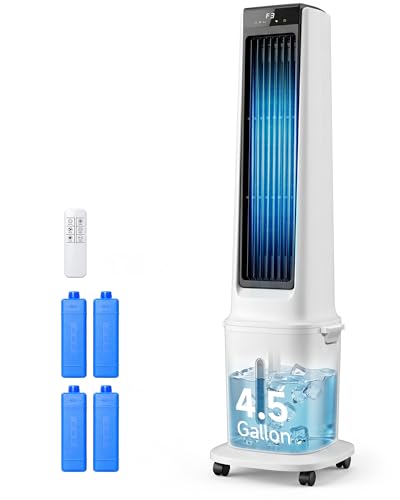
Air Choice Swamp Cooler, 46" Tower Cooling Fans that Blow Cold Air, 4.5Gal Removable Water Tank, 4 Ice Packs, 60° Oscillation, 3 Speeds, 12H Timer, Portable Evaporative Air Cooler for Bedroom Office
Check price on Amazon
Air Choice Swamp Cooler, 3000CFM 31" Evaporative Air Cooler, 5.5Gal Removable Tank & 4 Ice Box, 120° Oscillation, 3 Speeds, Remote, 12H Timer, 3-in-1 Air Cooling Fan for Outdoor, Office, Bedroom, Grey
Check price on Amazon
Arctic Air Chill Zone Evaporative Cooler with Hydro-Chill Technology, Portable Fan with 4 Adjustable Speeds, 8-Hour Cooling, Fan for Bedroom, Living Room, Basement, Office & More
Check price on Amazon
Air Choice Swamp Cooler, 3000CFM 31" Evaporative Air Cooler, 5.5Gal Removable Tank & 4 Ice Box, 120° Oscillation, 3 Speeds, Remote, 12H Timer, 3-in-1 Air Cooling Fan for Outdoor, Office, Bedroom, Blue
Check price on Amazon
Arctic Air Pure Chill Deluxe Evaporative Air Cooler, Swamp Cooler | Portable Room Cooler for Bedroom, Office & Living Room | Hydro-Chill Technology | Quiet, Lightweight Personal AC
Check price on Amazon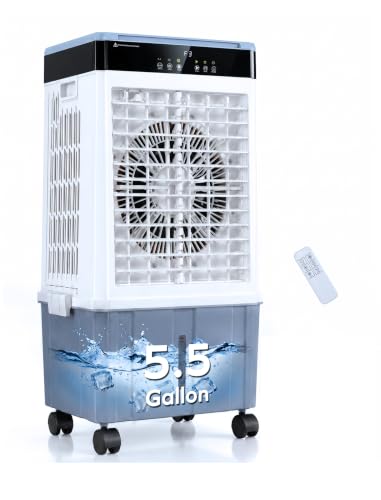
Air Choice Swamp Cooler, Evaporative Air Cooler, 4 Ice Box & 5.3 Gal Removable Tank, Auto Oscillation, 3 Speeds, Remote, 12H Timer, 3-in-1 Air Cooling Fan for Outdoor, Office, Home, Blue
Check price on Amazon