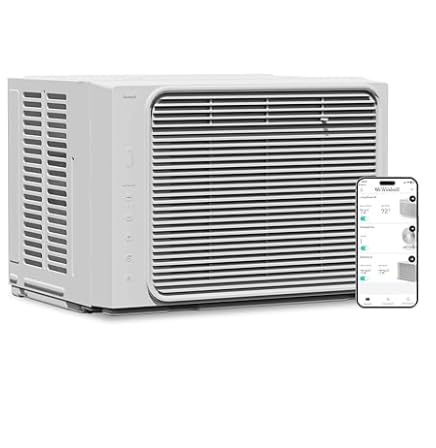
Energy Efficient Small Window Air Conditioner: Complete Guide
Everything you need to know before choosing a compact window unit that cools a small room effectively while keeping energy use in check — from BTU sizing and efficiency ratings to features, installation, and maintenance.
START WITH BTU SIZINGWho this guide is for: You already know you want a window air conditioner for a small space — a bedroom, home office, studio apartment, or dorm room — and you want one that runs efficiently. This guide explains how small window AC capacity is measured, which efficiency ratings matter, which features actually help in daily use, and how to install and maintain the unit so it keeps performing at its best over the long run.
What Makes a Small Window AC Energy Efficient?
An energy efficient small window air conditioner is not defined by a single specification. Efficiency comes from the combination of correct capacity, efficient compressor technology, good insulation of the unit itself, and how well the appliance is matched to the room it cools. A small unit that is oversized for the room will cycle on and off frequently, which wastes energy and wears the compressor. A unit that is undersized will run continuously without reaching the set temperature. The sweet spot is a unit whose cooling output matches the heat load of the space, paired with a competitive efficiency rating for its class.
Modern small window units have also improved in two important areas: compressor modulation and air management. Many mid-range and premium models include an energy-saving mode that lets the fan cycle with the compressor, plus a thermostat that reads room temperature more accurately. Together, these design changes make compact window cooling far more practical for daily use than older generations of the same product category. If your room is genuinely small, a well-chosen window unit is often the most straightforward efficient cooling path — it avoids the energy losses associated with ductwork, which is one reason ductless and ducted configurations are compared so often in efficiency discussions.
How to Size a Small Window AC for Your Room
Capacity for small window air conditioners is expressed in BTU (British Thermal Units) per hour. As a starting point, small window units commonly fall in the 5,000 to 8,000 BTU range, which generally suits rooms from roughly 100 to 350 square feet. The table below gives a practical reference. Treat these figures as a baseline, then adjust for sun exposure, ceiling height, occupancy, and kitchen heat.
| Room Size (sq ft) | Typical Cooling Capacity | Best For |
|---|---|---|
| Up to 150 | 5,000 – 6,000 BTU | Bedrooms, dorm rooms, small home offices |
| 150 – 250 | 6,000 – 8,000 BTU | Studio apartments, guest rooms, small living areas |
| 250 – 350 | 8,000 – 10,000 BTU | Larger bedrooms, combined office and lounge spaces |
| 350 – 450 | 10,000 – 12,000 BTU | Open-plan small apartments, sun-exposed rooms |
Two adjustments matter more than most buyers expect. First, a room that receives direct afternoon sun may need one step up in capacity — or, preferably, better shading, which is almost always the more efficient solution. Second, a kitchen adds substantial heat load from cooking appliances; if the unit cools a combined kitchen and living area, add roughly 4,000 BTU to the baseline. For a deeper walkthrough of load calculations, see the full guide on how to size an air conditioner, and for the compact end of the range, the breakdown of 5,000 BTU energy efficient options is a useful reference.
Avoid the common mistake of buying extra capacity "just in case." An oversized unit cools the air quickly but leaves the room humid, because it does not run long enough to remove moisture. It also short-cycles, which is harder on the compressor and less efficient overall. A right-sized unit that runs in longer, steadier cycles usually feels more comfortable and uses less energy over the season.
Efficiency Ratings Explained: CEER, EER, and ENERGY STAR
Window air conditioners are rated differently from central systems. The key metric is CEER (Combined Energy Efficiency Ratio), which replaced the older EER rating for room air conditioners. CEER is the ratio of cooling output to electrical input, adjusted to reflect typical operating conditions. A higher CEER means more cooling per unit of electricity. For small window units, ratings in the 11 to 12 range represent solid efficiency, while values above 12 are considered strong for the category. The U.S. Department of Energy sets minimum standards, and the ENERGY STAR certified window air conditioner program marks models that exceed those minimums by a meaningful margin.
SEER ratings, familiar from central systems, are not the right comparison for a plug-in window unit — which is why the article on what a SEER rating means explains the distinction clearly. For window units, focus on CEER and on whether the model carries ENERGY STAR certification. Also check the voltage: most small window units run on 115V standard household circuits, while larger capacities may require 230V. Choosing a unit that matches your existing outlet avoids electrical work and keeps the installation simple. If you are unsure about circuit capacity, the guide on amps and breaker size for air conditioners covers the safety basics.
Features That Improve Real-World Efficiency
Specification sheets can look similar while daily performance differs significantly. The features below are the ones that most reliably translate into lower energy use and better comfort in a small room:
- Energy-saving (eco) mode — the fan stops with the compressor, so the unit does not circulate air unnecessarily between cooling cycles.
- Programmable or 24-hour timer — cooling only when the room is occupied is one of the simplest efficiency wins available.
- Accurate digital thermostat — a precise set point reduces the tendency to set the temperature lower than needed.
- Sleep mode — gradually raises the set temperature overnight, matching how body temperature falls during sleep.
- Multi-speed fan — a low fan speed with the compressor running dehumidifies better than a high fan speed that blows air past the coil too quickly.
- Washable, easily accessible filter — a clean filter maintains airflow, and restricted airflow is one of the most common causes of efficiency loss.
- Directed airflow louvers — cooling the occupied zone rather than the ceiling reduces the need to over-cool the room.
- Auto-restart after power interruption — convenient in storm-prone regions, and it prevents the unit from defaulting to an inefficient setting.
Features that sound impressive but matter less for efficiency include decorative displays, remote controls without scheduling, and unusually high maximum fan speeds. A quiet, steady unit with good thermostat control will generally outperform a louder unit with a higher nominal output. If noise is a priority alongside efficiency, the guide to quiet energy efficient window units covers sound ratings in more detail.
Entry-Level vs Mid-Range vs Premium: Choosing Your Tier
Small window air conditioners fall into three broad market tiers. Understanding what each tier typically includes helps you decide where to draw the line for your needs — without focusing on any specific figure.
| Tier | Typical Characteristics | Best For |
|---|---|---|
| Entry-level | Mechanical or basic digital controls, single-speed fan, standard washable filter, compliant efficiency | Occasional use, guest rooms, simple cooling needs |
| Mid-range | Digital thermostat, energy-saving mode, timer, multi-speed fan, higher CEER, quieter operation | Daily use in bedrooms and home offices |
| Premium | Advanced thermostat accuracy, sleep scheduling, smart or Wi-Fi control, top-tier CEER for the class, refined airflow | Long daily runtime, smart-home integration, maximum efficiency |
The practical rule: the more hours per day the unit will run, the more the mid-range and premium tiers justify themselves through better efficiency and comfort. For a unit used a few weeks per year, an entry-level model with a compliant rating and a clean filter is a solid choice for the tier. For a bedroom unit that runs every night through summer, the improved thermostat and energy-saving mode of a mid-range model are worthwhile. Premium features like smart control add convenience and can support scheduling discipline, which itself saves energy.
Efficiency note: A higher-tier unit that is correctly sized will almost always use less energy over a season than an entry-level unit that is oversized. Match capacity first, then choose the tier that fits your usage pattern.
Installation Tips for Better Performance
Installation quality directly affects efficiency. A window unit that is not sealed properly leaks cooled air and pulls in hot outdoor air, forcing the compressor to work harder. Follow these practices:
- Use the window bracket or support — the unit must sit level and be secured; a tilted unit can leak condensate and vibrate.
- Seal the gap around the unit — use the included foam insulation and add weatherstripping if needed. Any daylight visible around the frame means air is escaping.
- Shade the outdoor side — an awning or shade reduces direct solar load on the condenser, improving efficiency without any electrical change.
- Choose a window with the right exposure — a north-facing window avoids the worst afternoon sun; if only a sunny window is available, exterior shading is the priority.
- Keep the airflow path clear — do not block the indoor vents with curtains or furniture, and keep the outdoor coil free of debris.
If your window opening is unusual or the unit feels unstable, the guide on the easiest window air conditioner to install covers bracket options and setup approaches. For rooms where a window installation is not practical, energy efficient portable room units are an alternative, though they are generally less efficient than a properly sealed window unit.
Maintenance Habits That Keep Efficiency High
A small window AC is a simple appliance, and most efficiency loss over time comes from two preventable issues: a clogged filter and a dirty condenser coil. Both restrict airflow, and restricted airflow makes the compressor run longer for the same cooling. Build these habits into your routine:
- Clean or replace the filter every two to four weeks during heavy use — a rinse under running water is usually enough for a washable filter; let it dry fully before reinstalling.
- Inspect the outdoor coil each season — remove leaves, dust, and pollen with a soft brush or vacuum; do this with the unit unplugged.
- Check the seal around the window annually — weatherstripping degrades, and a small gap becomes a meaningful energy loss.
- Listen for short cycling — frequent on-off behavior may signal a thermostat issue or an oversized unit; addressing it protects the compressor.
- Store the unit properly in the off-season — remove it or cover the exterior, and clean it before storage so the next season starts with clean coils.
For a fuller seasonal routine, the seasonal AC checklist covers the tasks in order. If the unit is not cooling as it should, the troubleshooting guide on why an AC is not cooling walks through the common causes before you consider service. And if you want to reduce energy use further across the whole home, the energy saving tips for air conditioning article covers thermostat strategy, ceiling fan use, and sealing.
Frequently Asked Questions
What size window AC is best for a small bedroom?
For a typical bedroom of up to 150 square feet, a 5,000 to 6,000 BTU unit is usually the right starting point. Rooms between 150 and 250 square feet generally call for 6,000 to 8,000 BTU. Adjust upward for direct afternoon sun or a kitchen nearby, and avoid oversizing — a correctly sized unit dehumidifies better and runs more efficiently. The guide on energy efficient air conditioners for small rooms expands on room-specific choices.
Is a higher CEER rating always better?
Within the same capacity class, a higher CEER means more cooling per unit of electricity, so yes — it is the right metric to compare. But CEER only matters after the unit is correctly sized. An oversized high-CEER unit can still use more energy than a right-sized mid-CEER unit because of short cycling. Compare CEER among units of the same BTU output, and confirm ENERGY STAR certification for an additional benchmark.
Does energy-saving mode really reduce consumption?
Yes, in most real-world use. Energy-saving mode cycles the fan off with the compressor instead of running the fan continuously. In a small room that reaches its set temperature quickly, this avoids circulating air when no cooling is being produced. The effect is modest but consistent, and it is one of the reasons mid-range units tend to outperform entry-level units in daily use.
Can I use a small window AC in a room without a standard window?
Window units require a suitable opening for support and ventilation. If a standard double-hung or slider window is not available, options include a through-the-wall installation or a portable unit. For ductless alternatives that avoid window mounting entirely, the energy efficient ductless air conditioner guide covers wall-mounted systems, which are typically more efficient than portable units.
How often should the filter be cleaned?
Every two to four weeks during active cooling season is a practical schedule for most homes. In dusty environments or with pets, clean it more often. A clogged filter is the single most common cause of reduced cooling and higher energy use in window units, and cleaning it takes only a few minutes.
Is it worth stepping up to a premium tier for a small unit?
It depends on runtime. For a unit used nightly through the summer, premium features such as a more accurate thermostat, refined sleep scheduling, and smart control support disciplined, efficient operation over many seasons. For occasional use, a mid-range model with energy-saving mode and a timer is a well-balanced choice. The right answer follows your usage pattern rather than the tier label alone.
Ready to compare models? The product section below features a curated selection of energy efficient small window air conditioners so you can review features side by side and choose the unit that matches your room and usage.
COMPARE RECOMMENDED MODELS