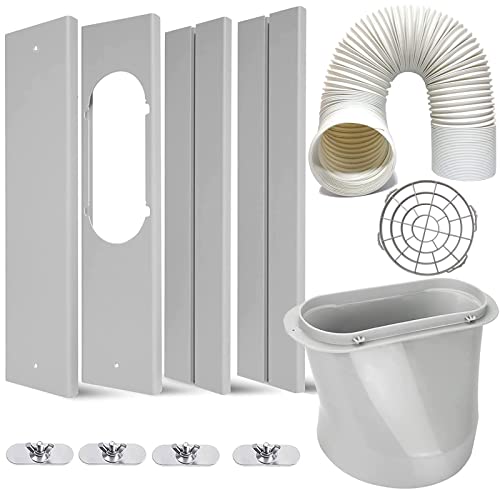
The Short Answer
If you want the most cooling performance per BTU, lower indoor noise, and automatic condensate drainage, a window air conditioner is usually the stronger choice. If you rent, move frequently, have restricted window openings, or cannot install a heavy unit, a portable air conditioner offers flexibility that a window unit cannot match. Neither is universally better; the right pick depends on your room, your building, and how you plan to use the unit.
Portable vs Window AC: Full Comparison Table
| Feature | Portable Air Conditioner | Window Air Conditioner |
|---|---|---|
| Installation | Roll into place, connect a vent hose to a window or door kit. No brackets or permanent modification. | Requires secure mounting in a window opening, often with support brackets and weather sealing. |
| Cooling Efficiency | Lower for the same BTU because the condenser sits indoors and the exhaust hose radiates heat back into the room. | Higher for the same BTU because the condenser and compressor are located outside the conditioned space. |
| Indoor Noise | Noticeably louder; compressor and fan are inside the room, usually around the unit itself. | Quieter indoors; the compressor is in the window frame, so most mechanical noise stays outside. |
| Condensate Handling | Collects in an internal tank that must be emptied, or drains continuously with a hose. | Drains outside automatically through a slight downward tilt in the window installation. |
| Portability | Moves from room to room on casters, though the vent kit must be relocated too. | Fixed installation; moving requires removing brackets and reinstalling in another window. |
| Window Requirements | Needs only a small opening for the vent hose; works with sliding doors and some casement windows via kits. | Requires a double-hung or slider window wide enough for the chassis and strong enough for the weight. |
| Renter Friendliness | High; no permanent modification and easy removal at move-out. | Moderate; may be restricted by lease terms, building rules, or window type. |
| Footprint | Takes up floor space and needs clearance around the unit for airflow. | Uses window space but leaves the floor clear. |
| Best For | Renters, odd window shapes, rooms without suitable window mounting, temporary or seasonal cooling. | Homeowners, standard double-hung windows, single-room cooling where efficiency and quiet matter. |
Portable AC: Strengths and Weaknesses
Portable Air Conditioner
Strengths
- No permanent installation or window modification
- Easy to move between rooms on casters
- Works with sliding doors and non-standard windows using vent kits
- Renter-friendly and simple to remove at move-out
- Dual-hose models reduce indoor pressure imbalance
Weaknesses
- Lower cooling efficiency for the same BTU rating
- Louder indoors because the compressor is in the room
- Condensate tank needs regular emptying unless a drain hose is used
- Exhaust hose can leak heat back into the room if not insulated
- Takes up floor space and needs clearance around the unit
Window Air Conditioner
Strengths
- Higher cooling efficiency for the same BTU rating
- Quieter indoors because the compressor sits outside
- Automatic condensate drainage through the window tilt
- Leaves floor space clear
- Simple mechanical design with fewer drain-related issues
Weaknesses
- Requires a suitable double-hung or slider window
- Installation needs brackets and weather sealing
- Heavy units can be difficult to lift and secure
- Not easily moved between rooms
- May be restricted by lease terms or building rules
Cooling Performance and Sizing
Both types are sized in BTU, but the same BTU rating does not deliver identical comfort. A window unit rated at 10,000 BTU generally cools a room more effectively than a portable unit rated at 10,000 BTU, because the window unit rejects heat directly outside instead of through a hose inside the room. If you are comparing units, treat the portable unit's rating as slightly optimistic and choose a model with dual-hose exhaust where possible. For a deeper look at matching capacity to room size, see our guide on sizing an air conditioner.
Room layout also matters. Portable units work best in open, rectangular rooms where the exhaust hose can run a short, straight path to the window. Long or kinked hoses reduce airflow and cooling performance. Window units are less sensitive to room shape because they deliver air directly into the space from the window frame.
Energy Use and Long-Term Efficiency
Because a window unit keeps the condenser outside, it typically uses less energy to remove the same amount of heat. Portable units lose efficiency in two ways: the compressor adds heat to the room it is cooling, and the exhaust hose radiates heat back indoors. Dual-hose portable models mitigate the pressure imbalance but do not fully close the efficiency gap. If energy use is a priority, compare the EER and CEER ratings on the label, and read our explainer on what the EER rating means before deciding.
For households that cool the same room every summer, a window unit is usually the more efficient long-term investment. For households that need cooling in different rooms across the season, a portable unit's flexibility can offset its lower efficiency. Our article on the most energy-efficient window air conditioner options explains what to look for on the label.
Noise and Comfort
Noise is one of the most noticeable differences. A window unit places the compressor and condenser fan outside, so the indoor sound is mostly airflow. A portable unit places the compressor inside the room, so the unit itself is the dominant noise source. In bedrooms and home offices, this difference matters. If quiet operation is essential, look at our guide to quiet and energy-efficient air conditioners and consider a window unit or a mini-split instead.
Comfort also depends on airflow direction. Window units typically have adjustable louvers that direct air across the room. Portable units often have a smaller throw and can create a more localized cooling effect, which is fine for a single seat but less even for a whole room.
Installation, Renters, and Building Rules
Installation is where portable units win decisively for many people. A portable AC needs only a vent kit and a nearby window or sliding door; no brackets, no drilling, and no permanent change to the building. Window units need a secure mount, support brackets for larger models, and weather sealing to prevent drafts and water intrusion. If you rent, check your lease before installing a window unit, and read our notes on questions to ask an installer if you are hiring help.
Some buildings restrict window units for safety or aesthetic reasons. In those cases, a portable unit with a sliding-door vent kit is often the only workable option. If you are comparing a portable unit to a window unit for a specific room, our article on portable air conditioners compared to window units goes deeper into room-by-room scenarios.
Maintenance and Longevity
Both types need filter cleaning and coil care, but the routines differ. Portable units require regular tank emptying and hose inspection; window units require seasonal removal, cleaning, and re-sealing. Window units that stay installed year-round can collect debris in the outdoor coil, so plan on an annual cleaning. Portable units benefit from storing the vent kit carefully and checking the hose for cracks. For general upkeep guidance, see our tips and maintenance section.
Longevity depends more on installation quality and cleaning habits than on the type itself. A well-maintained entry-level window unit can outlast a neglected premium portable unit, and vice versa. Focus on filter hygiene, coil cleanliness, and proper drainage to get the most years from either type.
Market Tiers: What Each Category Offers
Instead of focusing on prices, it helps to understand how products are positioned in the market. The table below uses universal tier descriptors so the comparison stays useful over time.
| Tier | Portable AC Characteristics | Window AC Characteristics | Best For |
|---|---|---|---|
| Entry-level | Single-hose exhaust, manual controls, basic filter, smaller BTU range | Basic mechanical controls, smaller BTU range, simple window mount | Occasional use, small rooms, temporary cooling |
| Mid-range | Dual-hose option, digital controls, timer, sleep mode, better airflow | Digital controls, remote, energy-saving mode, improved louver design | Everyday single-room cooling, bedrooms, home offices |
| High-end tier | Inverter compressor, quieter operation, smart controls, continuous drain | Inverter compressor, higher EER, smart controls, quieter fan | Primary-room cooling where comfort and efficiency matter |
| Top-tier | Premium build, advanced filtration, app control, very low noise | Highest efficiency ratings, premium build, advanced airflow control | Long-term single-room comfort, design-conscious spaces |
Which One Should You Choose?
The decision usually comes down to a few practical questions. If you answer yes to most of the following, a portable AC is likely the better fit:
- You rent or move frequently
- Your windows cannot safely hold a window unit
- You need cooling in more than one room across the season
- You cannot make permanent modifications to the building
If you answer yes to most of these, a window AC is likely the better fit:
- You own your home and can install a secure window mount
- You want the best cooling performance per BTU
- Indoor noise is a priority
- You want automatic condensate drainage and fewer tank empties
If neither type fits cleanly, a ductless mini-split is worth considering. It is a larger investment, but it delivers better efficiency, quieter operation, and longer service life. Our overview of mini-split systems explains when that upgrade makes sense.
Frequently Asked Questions
Is a portable air conditioner as effective as a window unit?
Can I use a portable air conditioner without a window?
Which type is quieter: portable or window AC?
Do portable air conditioners need to be drained?
Which is better for renters: portable or window AC?
Final Verdict
There is no single winner in the portable vs window AC debate. The right choice is the one that fits your room, your building rules, and your tolerance for installation work and noise.
- Choose a portable AC if you rent, need flexibility, have non-standard windows, or cannot install a permanent window mount.
- Choose a window AC if you own your home, have suitable double-hung windows, and want stronger cooling efficiency with lower indoor noise.
- Consider a mini-split if you want the best long-term comfort and efficiency and are ready for a professional installation.
If you are still weighing options, our in-room air conditioning units guide and our recommendations section can help you narrow the field before you buy.