
Portable Solar Panels: Complete Buying Guide
Everything you need to know about portable solar panels — panel types, wattage sizing, efficiency, real-world performance, and how to match a panel to a portable power station or off-grid cooling setup.
START THE GUIDEWhy this guide exists: Portable solar panels have become the backbone of off-grid power for camping, emergency backup, and remote work. But choosing the wrong panel — undersized, inefficient, or incompatible with your power station — wastes both time and energy. This guide walks you through every decision point so you can buy with confidence.
What Are Portable Solar Panels?
Portable solar panels are lightweight, folding, or briefcase-style photovoltaic modules designed to be carried, deployed quickly, and packed away again. Unlike rigid rooftop arrays, they prioritize portability over raw output per square foot. Most units range from roughly 50 watts to 400 watts and fold down to the size of a laptop bag or a small suitcase.
They are commonly used to recharge portable power stations, charge phones and laptops during outages, and support off-grid activities. A growing number of users pair them with compact cooling equipment — for example, a portable solar-powered air conditioner for camping — where panel output must be sized to the cooling unit's daily energy draw rather than to a single device charge.
Three qualities define a good portable panel: efficiency per square foot, durability of the folding frame and connectors, and compatibility with the charge controller or power station you already own. Everything else — weight, cable length, stand design — is secondary to these three.
Types of Portable Solar Panels
Portable panels are usually classified by cell technology and by physical form factor. Both dimensions matter when you compare products.
Monocrystalline Foldable
Highest efficiency per square foot and the best low-light behavior. Foldable monocrystalline panels dominate the portable category because they pack the most output into a carryable footprint.
Premium TierPolycrystalline Foldable
Larger and heavier for the same output, but durable and reliable. A solid choice when portability is secondary to long-term outdoor use.
Mid-RangeBriefcase / Suitcase Style
Two rigid panels hinged together with a built-in handle and fold-out stand. Heavier than fabric-backed foldables but more rigid and easier to angle toward the sun.
Balanced TierFabric-Backed Foldable
Thin, flexible panels stitched into a nylon or canvas backing. The lightest option for backpacking, though less durable under repeated rough handling.
Entry-LevelSolar Blanket
Large-area, very thin panels that roll or fold flat. Excellent for charging while stationary, but vulnerable to punctures and usually lower efficiency per square foot.
Essential TierRigid Portable Panel
A traditional framed panel with a carry handle and folding legs. Heavy but weather-resistant and ideal for semi-permanent off-grid installations that occasionally move.
High-End TierMonocrystalline vs. Polycrystalline
For portable use, monocrystalline is the better default. It delivers more watts per square foot, which directly translates into a smaller and lighter panel for the same output. Polycrystalline panels remain viable for stationary off-grid setups where size and weight are not constraints.
How Much Wattage Do You Need?
Wattage sizing is the single most common mistake in portable solar purchases. The correct approach is to work backward from what you need to recharge or run, and then account for real-world sunlight — which is never the full rated output of the panel.
Step 1: Estimate Your Daily Energy Need
List each device and its daily energy consumption in watt-hours (Wh). A laptop charging for four hours at 60 W consumes roughly 240 Wh. A portable power station being topped up from 30% to 100% consumes a share of its total capacity. Add these figures together to get your daily Wh requirement.
Step 2: Divide by Realistic Sun Hours
A panel rated at 200 W does not deliver 200 W for eight hours. In good conditions you might see 70–80% of rated output during peak sun hours, and most locations average four to six usable sun hours per day. Divide your daily Wh need by your realistic sun hours to arrive at the panel wattage you actually require.
Step 3: Match the Panel to the Battery or Load
The panel must also be compatible with the charge controller or power station input. A panel that produces more wattage than the input can accept is not dangerous, but the excess is wasted. Conversely, an undersized panel will take days to recharge a large power station.
| Use Case | Suggested Panel Range | Typical Pairing | Best For |
|---|---|---|---|
| Phones, tablets, small electronics | 50–100 W | Small power bank or USB-C input | Backpacking, day hikes |
| Laptops, cameras, lights | 100–200 W | Mid-capacity portable power station | Weekend camping, remote work |
| Power station recharge + small appliances | 200–300 W | Large portable power station | Extended camping, outage backup |
| Off-grid cooling and refrigeration | 300–400 W+ | High-capacity power station or solar generator | Van life, off-grid cabins, solar cooling |
Wattage figures above are guidance ranges, not product specifications. Always verify the input limits of your power station before pairing a panel.
Understanding Efficiency and Ratings
Portable solar panel ratings describe performance under standardized test conditions, not under a cloudy sky at 7 a.m. Understanding the difference between the headline number and real-world output prevents disappointment.
Efficiency Percentage
Cell efficiency describes how much of the sunlight hitting the panel is converted into electricity. Monocrystalline portable panels typically sit in the 20–23% range, while polycrystalline and thin-film options are lower. Higher efficiency means a smaller, lighter panel for the same wattage — a meaningful advantage when you are carrying it.
Temperature Coefficient
Solar panels lose output as they heat up. A panel with a better (less negative) temperature coefficient holds its output more steadily on hot days. This matters for portable panels left in direct sun for hours.
Ingress Protection (IP) Rating
Most foldable portable panels are rated IP65 or IP67, meaning they resist dust and water splashes. The junction box and connectors are the weak points — keep them dry even when the panel surface is weather-rated. For panels used near water or in exposed conditions, check the IP rating of the connectors separately.
Charge Controller Compatibility
Panels without a built-in controller require an external MPPT or PWM controller. Built-in controllers simplify setup but are usually entry-level quality. If you plan to pair the panel with a larger power station, confirm whether the station already contains an MPPT controller and set the panel to output within the station's accepted voltage range.
Real-World Output Rule of Thumb
Expect roughly 60–75% of the rated wattage during peak sun and substantially less in the early morning, late afternoon, or under thin cloud. Size your panel with that shortfall in mind rather than assuming the label wattage is delivered continuously.
Portability Features That Actually Matter
Two panels with identical wattage can differ dramatically in how usable they are in the field. These are the features worth prioritizing.
Folded weight and dimensions: A panel you can carry comfortably is used more often. Check the folded size against your pack or vehicle space.
Fold-out stand or kickstand: The ability to angle the panel toward the sun can recover a meaningful share of lost output compared with a flat-lying panel.
Cable length and connector type: Short cables force you to reposition the panel constantly. Longer cables and standard MC4 or DC connectors improve flexibility.
Built-in charge controller: Convenient for direct device charging, but confirm it supports the voltage and current your device expects.
Junction box sealing: A well-sealed junction box is the difference between a panel that survives a season outdoors and one that fails after the first rain.
Carry handle or bag: A reinforced handle or included protective bag protects the panel and makes transport far easier.
Where Portable Solar Panels Excel
Portable panels are not a replacement for a rooftop array — they are a tool for specific situations where grid power is unavailable or inconvenient.
Camping and Outdoor Recreation
The most common use. A panel paired with a portable power station keeps phones, cameras, lights, and small electronics charged. For trips where cooling is needed, pairing a panel with a portable tent AC or a solar-powered camping cooler turns a hot campsite into a usable space — provided the panel is sized to the cooling unit's daily draw.
Emergency and Outage Backup
During grid outages, a portable panel keeps critical devices running without fuel. This is where the wattage sizing in the earlier section becomes practical: a small panel will keep phones alive, while a larger one can meaningfully recharge a power station.
Off-Grid and Mobile Living
Van life, cabin setups, and mobile workstations use portable panels as a flexible supplement to a fixed array. When combined with a high-capacity power station, they can support sustained off-grid living — including running a compact cooling unit sized for the available solar input.
Charging While Mobile
A panel deployed on a vehicle roof or dashboard during a drive or a parked day adds charge with no additional effort. Panels that fold flat and stow securely are the practical choice here.
Ready to Compare Models?
Once you know your wattage target and your power station's input limits, the shortlist narrows quickly. The recommended panel selection below is organized to help you compare by tier and use case.
VIEW RECOMMENDED PANELSCommon Mistakes to Avoid
Most portable solar purchases that disappoint trace back to one of a handful of avoidable errors.
- Buying by headline wattage alone: The rated number assumes ideal sun. Real-world output is lower, and the gap widens for lower-efficiency panels.
- Ignoring the power station's input limit: A 400 W panel feeding a station that accepts 200 W wastes half its potential.
- Choosing a panel too heavy to deploy: If carrying it is a chore, it stays in the vehicle. Weight and folded size matter as much as output.
- Overlooking the charge controller: Panels without a built-in controller need an external one, and the controller must match the panel's voltage and current.
- Expecting air conditioning from a small panel: Standard AC units draw far more power than any portable panel can supply directly. Cooling on solar requires a purpose-built solar-powered cooling unit paired with a power station and a properly sized panel.
- Skipping the IP rating check: A panel rated for splashes is not the same as one that can sit in the rain. Read the ingress protection rating before leaving it outdoors.
Maintaining Portable Solar Panels
Portable panels need very little care, but the little they need matters for long-term output.
- Clean the surface regularly: Dust, pollen, and bird droppings reduce output measurably. Wipe with a soft cloth and mild soap — never abrasive cleaners or pressure washers.
- Inspect cables and connectors: Frayed cables and corroded connectors are the most common failure point. Check them before each trip.
- Store folded and dry: Moisture trapped in a folded panel can damage the backing and junction box over time.
- Avoid punctures on flexible panels: Thin fabric-backed panels are vulnerable to sharp objects. Transport them in a protective sleeve.
- Check the stand and frame: Loose hinges and cracked frames compromise panel angling and can let the panel fall. A quick inspection before deployment prevents damage.
Storage Tip
Store portable panels in a dry, temperature-controlled space. Extreme heat and prolonged moisture are the two conditions most likely to shorten panel life. If you keep a panel in a vehicle long-term, ensure the storage area is ventilated.
Frequently Asked Questions
Your need depends on the devices you plan to charge and the available sunlight. Small electronics such as phones and tablets typically need a 50 to 100-watt panel, while charging a portable power station or running a portable solar-powered air conditioner for camping usually requires 200 watts or more. Matching panel output to battery capacity and daily sun hours is the key to a reliable setup.
Monocrystalline panels generally deliver higher efficiency per square foot and perform better in low-light conditions, making them the preferred choice for portable and foldable designs. Polycrystalline panels are typically larger for the same output but remain a solid, durable option for stationary or semi-portable use.
Most foldable and briefcase-style portable solar panels carry an IP65 or IP67 weather-resistance rating, meaning they handle rain splashes and dust. However, the junction box and connectors should be kept dry, and panels should never be submerged. Always check the manufacturer's ingress protection rating before exposing a panel to weather.
A portable solar panel alone cannot power a standard air conditioner, but it can charge a portable power station that runs a small solar-powered cooling unit. For camping and off-grid cooling, look for a portable solar-powered air conditioner camping setup sized so that panel output matches the cooling unit's daily energy draw.
Most reputable portable panels carry a performance warranty of 20 to 25 years for the cells, though the folding frame, cable, and connectors are the parts that typically wear out first. With proper storage, cleaning, and cable care, the panel itself can remain productive for well over a decade. The practical lifespan of the portable assembly depends heavily on how well the hinges and connectors are maintained.
The Bottom Line
Portable solar panels reward careful planning. Start from your daily energy need, divide by realistic sun hours, confirm compatibility with your power station, and prioritize efficiency and durability over headline wattage. A well-matched panel — rather than the largest one on the shelf — is what makes an off-grid setup genuinely useful.
If your goal is off-grid cooling rather than general charging, the panel is only one component. Reviewing a dedicated solar camping cooling setup alongside your panel choice ensures the entire system is sized as a whole rather than assembled piecemeal.
Recommended Portable Solar Panels
⚠️ AFFILIATE DISCLOSURE: This website contains affiliate links. As an Amazon Associate, we earn from qualifying purchases. If you make a purchase through these links, we may receive a small commission at no additional cost to you. Read our full affiliate policy.
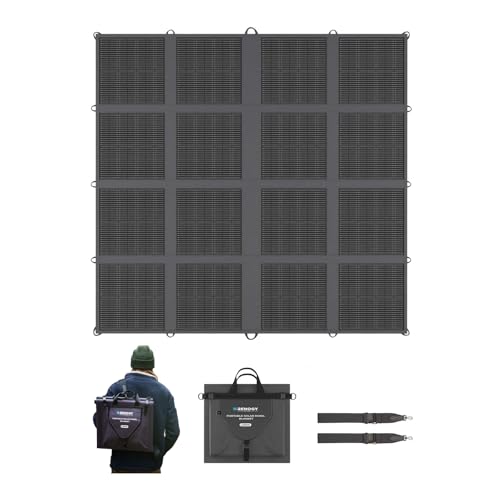
Renogy 400W Portable Solar Panel for Power Stations, 25% High Efficiency | N-Type 400 Watt Solar Panel Blanket, Backpack-Size Foldable Design Use Less Space, for Camping, RV, Pickup, And Marine
Check price on Amazon
RENOGY REGO 200W Portable Solar Panel, 25% Efficiency, Foldable | N-Type,IP65 Waterproof, for Camping, Hiking, Fishing, Outdoor, RV, Van, Boat, Off Grid Applications
Check price on Amazon
HQST 200W Portable Solar Panel, N-Type, 25% Efficiency, IP67 Waterproof | Only 11.82 lb, 3-in-1 Adapter Cable and Adjustable Kickstands for Power Stations, Camping, RV, Off-Grid & Emergency Backup
Check price on Amazon
Renogy 200W Portable Solar Panel for Power Stations, 25% Efficiency | N-Type 200 Watt Foldable Solar Panel with Kickstand, Lightweight USB-A/Type-C Outputs, for Camping, RV, Blackout, Off-Grid
Check price on Amazon
ZOUPW 480W Bifacial Portable Solar Panel N-Type 16BB for Power Station | 25% Efficiency Foldable Solar Charger for EcoFlow Delta/Bluetti/Anker C1000,IP68 Waterproof for Offgrid RV Home Power Backup
Check price on Amazon
ZOUPW 450W Portable Solar Panel N-Type 16BB for Power Station | 25% Efficiency Foldable Solar Panel for EcoFlow Delta/Anker C1000/Jackery/Bluetti,IP68 Waterproof for Offgrid RV Power Backup
Check price on Amazon
AMPSOS 36W Portable Solar Panel with Built-in MPPT: 23% Efficient M10 182mm Cells, Foldable USB-C Solar Charger for iPhone 17/16, iPad & Power Bank. Heavy Duty 900D Fabric for Camping & Backpacking
Check price on Amazon
CTOLITY 400W Portable Solar Panel for Power Station, Foldable Solar Charger | 23.4% High Efficiency, IP65 Waterproof, Adjustable Kickstand, 40V MC4/XT60/Anderson, for Camping RV Emergency Power Backup
Check price on AmazonDisclaimer
Some of the content on this site uses AI assistance. Information is provided for educational purposes only. We are not responsible for any losses resulting from the use of this information. By using this site, you waive any right to bring legal claims against us arising from your use of the information provided. If you do not agree, please do not use this site. Read the full disclaimer.