
Programmable Thermostat Without C Wire: Complete Guide
Discover how to upgrade your home's heating and cooling control when your existing wiring lacks a common wire. Learn about power-stealing models, adapters, and installation strategies that work.
START LEARNINGWhy this matters: Many older homes and heating systems were wired with only four thermostat wires — R, W, Y, and G. Modern programmable thermostats often require a fifth wire (the C wire) to supply constant power. This guide explains how to bridge that gap safely and effectively, so you can enjoy scheduling, energy savings, and smart comfort without rewiring your entire house.
What Is a C Wire and Why Do Thermostats Need It?
The C wire — short for common wire — is the return path in a low-voltage thermostat circuit. It completes the 24-volt loop from your HVAC transformer, allowing the thermostat to draw steady power to run its display, Wi-Fi radio, and onboard processor. Without a C wire, many modern programmable and smart thermostats cannot operate reliably because they depend on a continuous power source rather than stealing tiny amounts of current through the heating or cooling control wires.
Older mechanical and early digital thermostats were designed to run on battery power or to siphon minimal current through the R and W or Y wires. That approach works for simple relays but becomes problematic when a device needs Wi-Fi connectivity, a color screen, or advanced scheduling logic. Understanding this distinction is the first step toward choosing a compatible programmable thermostat for your home.
How a Programmable Thermostat Works Without a C Wire
Engineers have developed several strategies to power a programmable thermostat when a dedicated C wire is unavailable. Each method has trade-offs in reliability, installation complexity, and compatibility with your existing HVAC equipment.
Power Stealing (Current Siphoning)
The most common approach is called power stealing or current siphoning. The thermostat draws a small amount of current through the heating or cooling control circuit when that circuit is inactive. When the system calls for heat or cool, the thermostat briefly pauses its power draw to avoid interfering with the signal. This method works well on many forced-air furnaces and conventional air conditioners, but it can cause flickering lights, false calls, or erratic behavior on some boiler systems and certain zone valves.
Battery-Assisted Operation
Some programmable thermostats run primarily on alkaline or lithium batteries, using the HVAC wires only for signaling. These models are ideal when you want scheduling features without any wiring changes. The trade-off is that you must monitor and replace batteries regularly, and advanced features like Wi-Fi may drain them quickly.
C Wire Adapters and Add-a-Wire Kits
An add-a-wire kit (sometimes called a C wire adapter) multiplexes the existing four wires so that the thermostat receives a virtual C connection. These kits install at the furnace control board and at the thermostat, and they work with many single-stage and multi-stage systems. They are a practical middle ground when power stealing proves unreliable.
Compatibility note: Always verify that your HVAC control board and thermostat are compatible with the chosen method. Heat pumps, dual-fuel systems, and multi-stage equipment may require specific adapters or a dedicated C wire for reliable operation.
Checking Your Existing Thermostat Wiring
Before purchasing any programmable thermostat for heating and cooling, inspect the wiring behind your current thermostat. Turn off power to the HVAC system at the breaker, remove the thermostat cover, and photograph the wire terminals. Count the wires and note their colors.
- R or Rc/Rh: 24-volt power from the transformer
- W: Heat call (furnace or boiler)
- Y: Cool call (air conditioner or heat pump)
- G: Fan control
- C: Common wire (the one you may be missing)
- O/B: Reversing valve (heat pumps only)
- Aux/E: Emergency or auxiliary heat
If you see a blue or black wire tucked behind the wall but not connected, it may be an unused C wire waiting to be terminated. In that case, a professional can connect it at both the thermostat and the furnace control board, giving you a true C wire without running new cable.
Types of Programmable Thermostats That Work Without a C Wire
Not all no-C-wire thermostats are equal. The table below compares the main categories by their wiring strategy, typical use case, and market positioning. Descriptors reflect relative tier within the category, not absolute pricing.
| Category | Wiring Strategy | Best For | Market Tier |
|---|---|---|---|
| Battery-Powered Programmable | Runs on batteries; wires carry signals only | Simple 7-day scheduling; homes with basic single-stage systems | Essential tier |
| Power-Stealing Digital | Siphons current through R and W/Y when idle | Conventional furnaces and AC; users who want a display without batteries | Balanced tier |
| Add-a-Wire Kit Compatible | Uses a multiplexer to create a virtual C terminal | Four-wire homes needing a reliable C connection for advanced features | High-end tier |
| Smart Thermostat with Adapter | Includes or supports a C-wire adapter in the box | Wi-Fi scheduling, remote access, and integration with smart home platforms | Premium tier |
Installation Options and Step-by-Step Guidance
Option 1: Install a Battery-Powered Programmable Thermostat
- Turn off power to the HVAC system at the breaker panel.
- Remove the old thermostat and label each wire with the provided stickers.
- Mount the new thermostat base and connect the wires to matching terminals (R, W, Y, G).
- Insert fresh batteries and snap the thermostat onto the base.
- Restore power and test heating, cooling, and fan operation.
Option 2: Use a Power-Stealing Thermostat
- Confirm that your system is compatible — check the manufacturer's compatibility chart.
- Turn off power and label the existing wires.
- Connect the new thermostat according to the wiring diagram, typically R, W, Y, G, and sometimes O/B.
- Install the included resistor or jumper if the manufacturer specifies one for your system type.
- Restore power and verify that the thermostat powers on and the system responds to calls.
Option 3: Add a C Wire Adapter Kit
- Install the adapter module at the furnace control board according to the kit instructions.
- Connect the existing four wires to the adapter inputs.
- At the thermostat, connect the adapter's output wires to the corresponding terminals.
- Restore power and confirm that the thermostat receives steady power.
Key Takeaways
- Battery-powered models are the simplest path when no C wire exists.
- Power-stealing thermostats work on many conventional systems but may struggle with boilers and zone valves.
- Add-a-wire kits provide a reliable virtual C connection without running new cable.
- Always verify compatibility with your specific HVAC equipment before installation.
Common Problems and Troubleshooting Tips
Even compatible thermostats can misbehave if installation details are overlooked. The following issues are common when installing a programmable thermostat without a C wire:
- Thermostat loses power during a call: This often indicates that the power-stealing circuit is insufficient for your system. Adding a resistor or switching to an add-a-wire kit usually resolves it.
- System short-cycles: Check that the thermostat is configured for the correct system type (single-stage, multi-stage, heat pump). Incorrect configuration can cause rapid cycling.
- Display flickers or resets: Weak batteries or unstable power stealing are the usual culprits. Replace batteries and inspect wire connections.
- Fan runs continuously: Verify that the G wire is connected properly and that the thermostat's fan setting is on Auto rather than On.
If you are unsure about any step, consult a qualified HVAC technician. Improper wiring can damage the transformer or control board, leading to unnecessary repair expenses.
Buying Advice: Choosing the Right Model for Your Home
Start by identifying your system type and the number of wires available. If you have a conventional forced-air furnace and air conditioner with four wires, a battery-powered or power-stealing programmable thermostat is often sufficient. If you want Wi-Fi features or have a heat pump, an add-a-wire kit or a smart thermostat with an included adapter is a more robust choice.
Consider the following factors when comparing options:
- System compatibility: Check the manufacturer's compatibility chart for your specific equipment.
- Power method: Battery, power-stealing, or adapter-based — each has trade-offs in maintenance and reliability.
- Feature set: 7-day scheduling, geofencing, remote sensors, and smart home integration vary by model.
- Installation support: Some manufacturers provide detailed wiring diagrams and phone support for no-C-wire setups.
For related reading, explore our guide to pro thermostat options and remote HVAC thermostat features that can complement a no-C-wire installation.
Frequently Asked Questions
Can any programmable thermostat work without a C wire?
No. Some models require a C wire for reliable operation, especially those with Wi-Fi and color displays. Look for thermostats explicitly marketed as no-C-wire compatible or that include a power-stealing circuit or adapter.
Will a power-stealing thermostat damage my HVAC system?
When installed correctly on a compatible system, power-stealing thermostats are designed to operate safely. However, they can cause issues on some boilers and zone-valve systems. Always check the manufacturer's compatibility list.
Can I run a new C wire myself?
Running a new thermostat cable is possible for experienced DIYers, but it requires fishing wire through walls and connecting to the furnace control board. If you are not comfortable with low-voltage wiring, hire a qualified technician.
Do add-a-wire kits work with heat pumps?
Many add-a-wire kits support heat pumps, but compatibility varies by kit and by the number of stages in your system. Verify the kit's specifications before purchasing.
What is the difference between a C wire and a common wire?
They are the same thing. "C wire" is shorthand for common wire, which provides the return path for the 24-volt circuit that powers the thermostat.
Recommended Programmable Thermostats Without C Wire
⚠️ AFFILIATE DISCLOSURE: This website contains affiliate links. As an Amazon Associate, we earn from qualifying purchases. If you make a purchase through these links, we may receive a small commission at no additional cost to you. Read our full affiliate policy.

Honeywell Home X2P Programmable Thermostat, White | RTH20B Single-Stage, 1 Heat/1 Cool Compatibility, 5-2 Day Schedule
Check price on Amazon
WiFi Programmable Thermostats for House,Smart Air Conditioning Thermostat,Single-Stage 1Heat/ 1Cool APP Remote Control, 7-Day or 0-Day Programmable(C-Wire Required)
Check price on Amazon
Programmable Thermostat for Home, Single-Stage Systems,1 Heat/1 Cool,7 Day, 5/1/1 Day,Auto Mode Switching, Extremly Large LCD Display, White Backlight
Check price on Amazon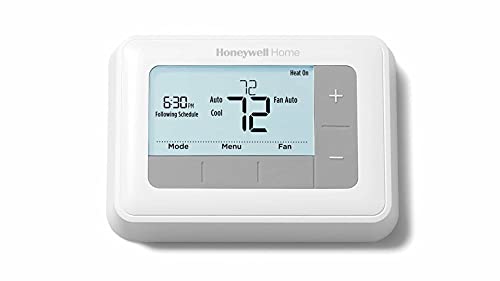
Honeywell Home 7-Day Flexible Programmable Thermostat | RTH7560E Extra-Large Backlit Display, White
Check price on Amazon