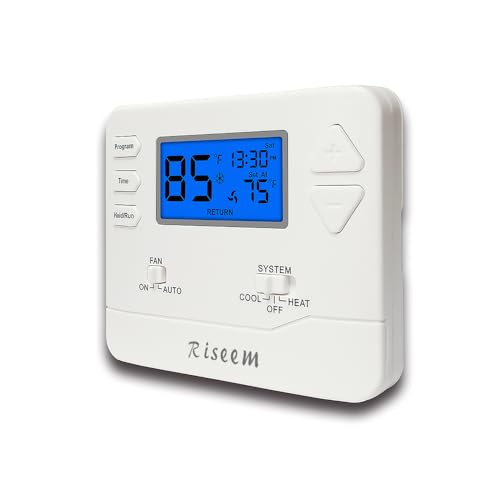
Programmable Thermostat: Complete Guide to Smart Temperature Control
Understand how programmable thermostats work, what features matter most, how they differ across tiers, and how to choose the right model for your heating and cooling system.
START LEARNINGWhy this guide matters: A programmable thermostat is one of the simplest upgrades you can make to your HVAC system. It helps you maintain consistent indoor comfort, reduce unnecessary runtime, and manage your heating and cooling schedule with precision. This guide walks you through everything you need to know before choosing a model.
What Is a Programmable Thermostat?
A programmable thermostat is a temperature control device that lets you set different heating and cooling targets for different times of the day. Instead of manually adjusting the temperature every morning, afternoon, and evening, you create a schedule once and the thermostat follows it automatically. This is especially useful for households with predictable routines.
Unlike a basic manual thermostat, which only responds to the current setting, a programmable model stores multiple schedule blocks — typically four or more — covering wake-up, away, return, and sleep periods. Each block can have its own target temperature, and the thermostat switches between them throughout the day. Many modern units also include weekday and weekend schedules, vacation modes, and adaptive recovery features.
Programmable thermostats for heating and cooling are designed to manage both the furnace and the air conditioner from a single interface. This makes them a practical upgrade for homes that rely on a combined HVAC system, and a natural companion to efficient cooling equipment such as a quiet air conditioner or a high-efficiency cooling setup.
How Programmable Thermostats Work
At its core, a programmable thermostat reads the indoor temperature through a built-in sensor and compares it to the target temperature for the current schedule block. When the reading drifts outside the acceptable range, the thermostat signals the HVAC system to start heating or cooling. Once the target is reached, it signals the system to stop or reduce output.
The "programmable" part comes from the schedule engine. You define time blocks and temperature setpoints through buttons, a dial, or a companion app. The thermostat then follows that schedule without further input. More advanced models add features like:
- Adaptive recovery: The thermostat learns how long your system takes to reach a target and starts early so the temperature is correct at the scheduled time.
- Geofencing: Some smart-capable models use your phone's location to switch to an away mode automatically.
- Remote sensors: Additional sensors placed in different rooms help balance temperatures in larger homes.
- Filter reminders and runtime tracking: Maintenance prompts based on actual usage rather than a fixed calendar.
Understanding these mechanics helps you evaluate whether a given model suits your HVAC system. For example, systems with older wiring may benefit from a programmable thermostat without C wire, which uses battery power or power-stealing technology instead of a dedicated common wire.
Key Features to Evaluate
Schedule Flexibility
Look for at least four schedule blocks per day with separate weekday and weekend programs. Seven-day programming offers the most control for varied routines.
Compatibility
Check whether the model supports your system type — single-stage, multi-stage, heat pump, or dual-fuel. C-wire requirements and terminal labels matter.
Display and Controls
Backlit displays, large buttons, and clear menus make setup and daily adjustments easier, especially for multi-person households.
Adaptive Recovery
This feature gradually adjusts temperature before a schedule change so comfort is maintained without sudden system surges.
Remote Access
Many current models offer app-based control, allowing you to adjust schedules or override settings from anywhere.
Maintenance Alerts
Filter change reminders and system diagnostics help keep your HVAC equipment running efficiently between service visits.
Programmable Thermostat Tiers: What to Expect
Programmable thermostats differ mainly in scheduling depth, connectivity, and build quality. The table below summarizes the general characteristics of each tier. Use these descriptors to compare models relative to one another, not as fixed benchmarks.
| Tier | Best For | Typical Characteristics |
|---|---|---|
| Essential Tier | Simple schedules and basic comfort control | Basic 5-2 or 5-1-1 scheduling, straightforward display, battery-powered options available. A solid choice for straightforward heating and cooling setups. |
| Balanced Tier | Households with varied weekday and weekend routines | Seven-day programming, larger backlit display, adaptive recovery, filter reminders, and better compatibility with multi-stage systems. |
| High-End Tier | Users who want app control and deeper customization | Wi-Fi connectivity, remote sensors, geofencing, detailed runtime reports, and premium build materials. Often integrates with smart home platforms. |
| Professional-Grade | Complex HVAC systems and installer-managed setups | Advanced diagnostics, support for dual-fuel and multi-zone systems, robust terminals, and configurations typically installed by HVAC professionals. |
Benefits of Upgrading to a Programmable Thermostat
Upgrading from a manual thermostat to a programmable model offers several practical advantages. The most immediate benefit is consistency: your home stays at the intended temperature at the intended time without daily manual adjustments. Over time, this translates into more efficient operation and less strain on the equipment.
- Better routine alignment: Schedule blocks match your daily patterns, so the system runs less when the house is empty.
- Improved comfort stability: Adaptive recovery smooths the transition between schedule periods.
- Efficient in the long run: Reduced unnecessary runtime contributes to lower energy consumption over time.
- Convenience: App-based models allow quick overrides and schedule edits from anywhere.
- Maintenance awareness: Filter reminders and usage reports help you keep the system clean and efficient.
If you are also evaluating broader HVAC upgrades, our guides on AC recommendations and pro air conditioner thermostat options can help you coordinate thermostat choices with system-level decisions.
Buying Guide: How to Choose the Right Model
Choosing a programmable thermostat starts with your existing system. Begin by identifying your HVAC equipment type, the number of stages it supports, and whether a common wire is present. If you are unsure, a quick look at the terminal labels on your current thermostat is a good first step. Many older systems lack a C-wire, which is why battery-powered and power-stealing models remain popular choices.
Next, consider your routine. If every day looks the same, a simpler 5-2 schedule may be sufficient. If weekends differ significantly, a seven-day model offers more flexibility. For larger homes with uneven temperatures, remote sensors and multi-sensor support can make a noticeable difference in comfort.
Finally, consider how you want to interact with the device. Button-and-dial interfaces are reliable and straightforward. App-based control adds convenience but depends on a stable Wi-Fi connection. A pro thermostat or programmable furnace thermostat may be preferable if you want a more installation-oriented setup or if your furnace and AC are managed as separate systems.
Installation and Setup Tips
Most programmable thermostats can be installed as a direct replacement for an existing thermostat, but the process requires care. Before removing the old unit, take a photo of the wiring and label each wire. Turn off power to the HVAC system at the breaker to avoid electrical hazards. Follow the manufacturer's wiring diagram precisely, and verify compatibility before connecting.
During setup, take time to configure the schedule accurately. A rushed configuration often leads to discomfort or unnecessary overrides. Use the adaptive recovery feature if available, and set reasonable temperature differentials. If your system includes a heat pump, confirm that the thermostat supports auxiliary heat and emergency heat modes.
For complex systems or unclear wiring, professional installation is the safer route. Our guide on pro HVAC thermostat options and remote HVAC thermostat models can help you understand when a professional-grade setup is appropriate.
Common Mistakes to Avoid
- Ignoring compatibility: Installing a model that does not support your system's stages or heat pump configuration can cause erratic operation.
- Overcomplicated schedules: Too many schedule blocks often lead to frequent overrides and reduced benefit.
- Skipping the C-wire check: If your system lacks a C-wire, choose a compatible model or plan for an alternative power solution.
- Placing the thermostat poorly: Direct sunlight, drafts, and proximity to vents can distort temperature readings.
- Not updating firmware: Smart-capable models benefit from regular firmware updates for stability and features.
Taking a few minutes to avoid these issues helps you get the most from your thermostat and protects the connected HVAC equipment.
Frequently Asked Questions
What is a programmable thermostat?
A programmable thermostat automatically adjusts heating and cooling settings according to a preset schedule, allowing different temperatures for different times of the day.
Do I need a C-wire for a programmable thermostat?
Many modern models require a C-wire for continuous power, but there are programmable thermostats without C wire that use battery power or power-stealing technology, making them suitable for older systems.
Can a programmable thermostat control both heating and cooling?
Yes, most programmable thermostats for heating and cooling manage both systems from a single interface and can switch modes automatically based on your schedule.
How long does a programmable thermostat last?
With proper installation and normal use, a programmable thermostat typically lasts many years. Build quality, environmental conditions, and firmware support for connected models influence longevity.
Is a programmable thermostat worth it for a small apartment?
Yes. Even in smaller spaces, a programmable schedule reduces manual adjustments and helps maintain consistent comfort. Battery-powered models are often a good fit for apartments with older wiring.
Ready to compare programmable thermostats? Explore the recommended models below and match a model to your HVAC system and routine.
View Recommended Models