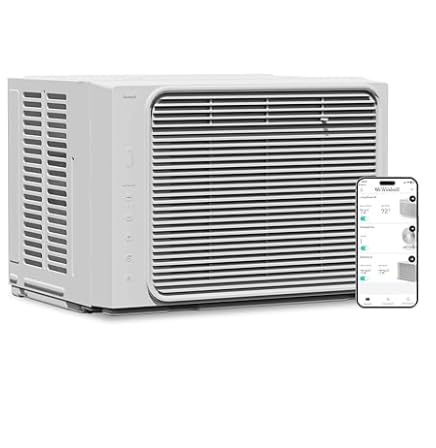
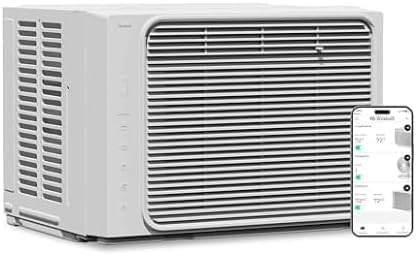
Top Energy Efficient Window Air Conditioners
Window ACs are the practical choice for renters and rooms without ductwork. This guide explains what truly drives efficiency, how to read CEER and EER ratings, and how to match a high-efficiency window unit to your room before you buy.
EXPLORE RECOMMENDED UNITSWhy Energy Efficiency Matters for Window ACs
A window air conditioner cools a single room by pulling heat from indoor air and releasing it outdoors through the back of the unit. Because it runs for hours during peak summer, the difference between a low-efficiency and a high-efficiency model compounds over the whole season. A unit with strong efficiency converts more of its electrical draw into useful cooling, so it reaches your target temperature faster and holds it with less compressor effort.
Efficiency is also about comfort. Well-engineered efficient models tend to include inverter compressors, better fan designs, and smarter control logic, which together reduce temperature swings and noise. If you are cooling a bedroom, a home office, or a rental apartment, this combination of lower energy draw and steadier comfort is the core reason to prioritize efficiency over raw cooling capacity alone. For a broader look at how window units fit into a room-by-room strategy, see this guide to the most efficient window air conditioner options.
Understanding CEER, EER, and SEER Ratings
Window AC efficiency is measured with a few related ratings. Knowing which number applies to your purchase prevents confusion at the store.
CEER (Combined Energy Efficiency Ratio)
CEER is the rating used for window air conditioners. It combines the standard EER test with an estimate of standby and off-mode power use, producing a single number that reflects real-world efficiency. Higher CEER means less electricity is consumed for the same cooling output. When comparing window units, CEER is the number to focus on.
EER (Energy Efficiency Ratio)
EER is the ratio of cooling output in BTU to electrical input in watts, measured at a fixed outdoor temperature. It is a pure performance snapshot. CEER builds on EER by accounting for standby losses, so two units with similar EER can differ in CEER.
SEER (Seasonal Energy Efficiency Ratio)
SEER is primarily used for central systems and mini-splits, not window units. It estimates efficiency across an entire cooling season. If you are comparing a window unit against a ductless system, SEER is useful context, but for the window unit itself, rely on CEER. For a deeper primer, read what is SEER rating and how it differs from the ratings on window boxes.
Efficiency Features That Actually Deliver
Not every feature labeled "eco" changes your energy use. The following technologies are the ones that measurably improve window AC efficiency.
- Inverter compressor: Varies speed continuously rather than cycling fully on and off. This is the single biggest efficiency and comfort upgrade in modern window units.
- Eco / energy-saver mode: Turns off the compressor once the room hits the set temperature and restarts it only when needed, reducing idle energy use.
- Programmable timer and sleep mode: Avoids cooling an empty room and gradually raises the setpoint overnight.
- Follow-me remote sensing: Uses a remote thermostat to cool based on where you actually are, preventing overcooling.
- Washable, high-density filter: A clean filter maintains airflow; restricted airflow forces the compressor to work harder.
- Auto fan and fan-only modes: Circulates air without running the compressor when full cooling is not needed.
- Wi-Fi and smart scheduling: Lets you pre-cool or shut off remotely, trimming wasted runtime. See AC with Wi-Fi and smart control for feature comparisons.
Product Tiers Compared
The window AC market splits into recognizable quality tiers. Use this framework to align expectations with your needs rather than chasing a single metric.
| Tier | Best For | Typical Efficiency Profile | Notable Traits |
|---|---|---|---|
| Entry-level | Occasional cooling, guest rooms, tight installation spaces | Standard CEER, fixed-speed compressor | Simple controls, basic filter, straightforward mechanical operation |
| Mid-range | Daily bedroom or living room use | Above-average CEER, eco mode, programmable timer | Better fan design, quieter operation, remote thermostat options |
| High-end tier | Long daily runtime, energy-conscious households | Top CEER in class, inverter compressor | Variable-speed cooling, smart app control, follow-me sensing, premium filtration |
Mid-range models usually deliver the most balanced efficiency-to-feature ratio, while high-end tier units justify themselves when a room is cooled for many hours per day. Entry-level units remain sensible for short seasonal use. If you are weighing a window unit against a floor-standing alternative, the comparison in standing air conditioners helps clarify trade-offs.
Sizing and Room Matching
Efficiency collapses if the unit is the wrong size. An oversized window AC cools too quickly, shuts off before dehumidifying, and then restarts frequently, wasting energy. An undersized unit runs continuously and never satisfies the thermostat.
- Base estimate: About 20 BTU per square foot of floor area.
- Add capacity for sun-facing windows, kitchens, rooms with many occupants, or poor insulation.
- Subtract capacity for heavily shaded rooms or basement-level spaces.
- Match the plug and voltage: Smaller units run on 115V; larger capacity models often require 230V circuits.
For precise room-by-room numbers, use a BTU calculator by room size and cross-check with how to size an air conditioner. If your goal is a compact unit for a small space, see the roundup of tiny window air conditioners.
Installation and Sealing for Real Efficiency
The most efficient window unit loses much of its advantage if air leaks around the frame. A tight installation is part of the efficiency equation.
- Measure the window opening and confirm the unit's minimum and maximum window width range.
- Use the included accordion panels and foam seals, and add weatherstripping where gaps remain.
- Provide a slight outdoor tilt so condensation drains away from the room.
- Support the unit with a proper bracket or secure sill support; sagging reduces sealing and can damage the chassis.
- Shade the outdoor side if possible; direct sun on the condenser raises energy use.
If your setup does not allow a window-mounted unit, explore stand-alone air conditioner units or through-the-wall AC as alternatives before committing.
Buyer's Checklist Before You Purchase
- Confirm the CEER rating is competitive within the BTU class you need.
- Check whether the model uses an inverter compressor for variable-speed efficiency.
- Verify the BTU capacity matches your room size and sun exposure.
- Confirm voltage and plug type match your outlet and circuit.
- Check the decibel rating if the unit will run near sleeping areas.
- Look for eco mode, programmable timer, and auto fan.
- Confirm filter access is easy for regular cleaning.
- Review warranty terms and whether professional installation is required.
Frequently Asked Questions
What makes a window air conditioner energy efficient?
Energy efficiency is primarily reflected by the CEER rating. Units with higher CEER convert more electricity into cooling. Inverter compressors, eco modes, programmable timers, and clean filters all contribute to lower real-world energy use.
Is an inverter window AC more efficient than a standard one?
Yes. An inverter compressor modulates speed instead of switching fully on and off, so it matches cooling output to demand. This reduces wasted energy and produces steadier temperatures, particularly during long cooling sessions.
Does a higher CEER rating always mean a better unit?
Not by itself. CEER measures electrical efficiency, but you should also confirm BTU capacity for your room, noise level, installation fit, and useful features. The best choice balances efficiency with practical performance for your space.
How do I choose the right BTU for a window AC?
Start with roughly 20 BTU per square foot, then increase capacity for sun exposure, kitchens, or rooms with multiple occupants. Avoid oversizing, since it causes short cycling and wastes energy. A BTU calculator gives a more precise estimate.