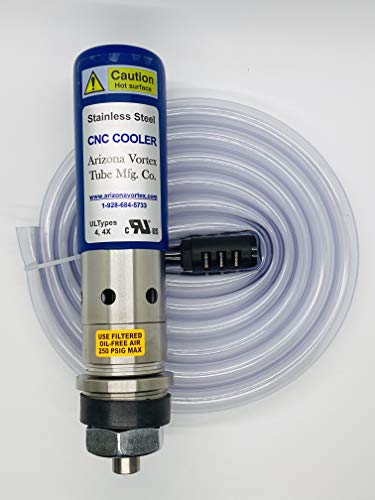
Vortex Cooling: Complete Guide to the Technology
What vortex cooling actually is, how a vortex tube produces cold air, where the technology fits, and where it does not belong in a home cooling plan.
A technology worth understanding before you invest in it: The term "vortex cooling" appears in product listings, industrial catalogs, and HVAC discussions, but it does not mean the same thing as a standard air conditioner. Before spending on any vortex-based product, you need to understand the underlying mechanism, what it is genuinely good at, and what it cannot do. This guide separates the engineering from the marketing so you can make an informed decision about whether vortex cooling belongs in your setup.
What Is Vortex Cooling?
Vortex cooling is a method of producing a stream of cold air using a vortex tube — a mechanical device with no moving parts. Compressed air enters the tube tangentially, spins at high speed inside a cylindrical chamber, and separates into two streams: a hot stream that exits one end and a cold stream that exits the other. The effect is real, repeatable, and well documented in industrial engineering.
Crucially, vortex cooling is not a refrigerant cycle. There is no compressor, no evaporator coil, and no refrigerant gas in the vortex tube itself. The tube relies on a supply of compressed air, which is why vortex cooling systems are always paired with an air compressor. That distinction matters enormously when comparing vortex cooling to a conventional air conditioner.
If you are coming from the broader world of residential AC and want to understand how refrigerant-based systems differ, the AC refrigerant cycle explanation provides the standard baseline.
How a Vortex Tube Produces Cold Air
The mechanism is elegant, which is part of why it attracts attention. Here is the sequence in plain terms:
- Compressed air enters the vortex tube through a tangential nozzle, creating a fast swirling flow inside the chamber.
- The swirling air moves toward the hot end of the tube, where a valve controls how much air escapes.
- As the outer layers of spinning air release energy, the inner core of the vortex becomes progressively colder.
- The cold core reverses direction and exits through the cold end, delivering a stream of chilled air.
- The hot outer layers exit through the opposite end, which is why vortex tubes produce both hot and cold streams simultaneously.
Because there are no moving parts, the vortex tube itself is remarkably durable. The limiting factor is almost always the compressed air supply, not the tube.
Where Vortex Cooling Is Actually Used
Spot Cooling of Machinery
Vortex tubes are commonly used to cool motors, bearings, and cutting tools during operation, where localized cooling prevents overheating without conditioning the entire space.
Electronics and Control Panels
Enclosed electrical cabinets and control panels benefit from a focused cold-air stream that keeps sensitive components within operating temperature limits.
Welding and Fabrication Stations
Welders and fabricators often use vortex cooling to cool workpieces or personal protective gear in environments where conventional AC is impractical.
Confined Industrial Work Areas
In tight spaces where a standard cooling unit will not fit, a vortex tube provides a compact cold-air source driven by existing compressed air lines.
Specialty Enclosures
Some equipment enclosures use vortex cooling to maintain internal temperatures without introducing refrigerant systems or large mechanical components.
Personal Cooling in Harsh Environments
Cooling vests and helmets used in foundries and heavy industry sometimes incorporate vortex tubes for directed personal cooling.
Advantages and Limitations
Advantages
- No moving parts in the vortex tube itself
- Compact and lightweight compared with refrigerant systems
- Delivers instant cold air with no cool-down delay
- Durable construction with minimal maintenance
- Effective for spot cooling in tight or hazardous spaces
- Can produce both hot and cold streams from the same device
Limitations
- Requires a compressed air supply to operate
- Not designed to cool an entire room or home
- Air compressor energy consumption can be substantial
- Noisy operation in many industrial configurations
- Cold air volume is small compared with a conventional AC
- Not a replacement for a refrigerant-based air conditioner
Vortex Cooling vs Conventional Air Conditioning
The most important thing to understand is that vortex cooling and conventional AC serve different purposes. They are not interchangeable.
| Consideration | Vortex Cooling | Conventional Air Conditioner |
|---|---|---|
| Operating principle | Compressed air separated in a vortex tube | Refrigerant cycle with compressor and evaporator |
| Cooling scope | Localized spot cooling | Room, zone, or whole-home cooling |
| Primary input | Compressed air | Electricity and refrigerant |
| Moving parts | None in the vortex tube | Compressor, fans, blower motor |
| Best suited to | Industrial spot cooling, enclosures, specialty applications | Residential and commercial space cooling |
| Residential fit | Not a practical substitute for home AC | Standard solution for home cooling |
Choosing the Right Tier of Vortex Cooling Equipment
If your application genuinely calls for vortex cooling, the equipment ranges from basic to highly engineered. Think in tiers rather than in figures:
| Tier | Typical Characteristics | Best For |
|---|---|---|
| Entry-Level | Basic vortex tube, manual hot-end valve, simple mounting | Occasional spot cooling, small enclosures, general workshop use |
| Mid-Range | Adjustable temperature control, improved nozzles, better mounting hardware | Consistent industrial spot cooling, control panel cooling, welding stations |
| Premium | Reinforced construction, precise flow control, quieter operation | Continuous-duty industrial use, sensitive electronics, high-demand environments |
| Luxury | Professional-grade materials, integrated controls, engineered airflow profiles | Precision manufacturing, specialty enclosure cooling, demanding commercial-grade requirements |
Mid-range vortex tubes typically offer the most balanced combination of control and durability for industrial use. Premium and luxury tiers are justified when the cooling target is sensitive, the duty cycle is continuous, or precision airflow matters.
Setting Up Vortex Cooling Correctly
Because vortex tubes depend on compressed air, setup focuses on the air supply as much as on the tube itself.
Air Supply Quality
Compressed air should be clean and dry. Moisture or oil contamination degrades performance and can damage the tube over time.
Pressure Requirements
Each vortex tube is rated for a specific operating pressure range. Running below that range reduces cold output; running above it stresses the tube unnecessarily.
Mounting and Aim
Position the tube so the cold end points directly at the target. Vortex cooling is directional by nature; misalignment wastes the cold stream.
Noise Management
Vortex tubes can be loud at high flow rates. Consider mufflers or enclosures where noise is a concern for operators.
Alternatives to Consider
If your actual goal is space cooling rather than spot cooling, the following are the appropriate categories to explore instead of vortex cooling:
Portable Air Conditioners
A practical option for renters and spaces without permanent installation. The most efficient portable air conditioner guide covers efficiency considerations for these units.
Ductless Mini Splits
For efficient, quiet room conditioning without ductwork, see the ductless mini split air conditioning systems overview.
Window Air Conditioners
A widely used solution for single-room cooling. The air conditioning unit 8000 BTU guide covers one of the most common capacity bands.
Central Systems
For whole-home cooling, the ratings of central air conditioning systems overview provides useful comparison context.
Explore Vortex Cooling and Related Cooling Equipment
Browse vortex cooling products and adjacent spot-cooling solutions below to compare options for your specific application.