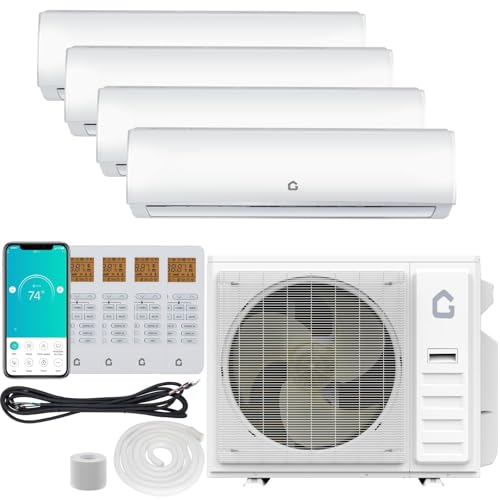
What a Whole House Ductless Heating and Cooling System Is
A whole house ductless heating and cooling system — often called a multi-zone mini-split heat pump — uses one outdoor compressor unit connected to several indoor air handlers, each mounted in a different room or zone. Instead of pushing conditioned air through a network of ducts, each indoor head delivers heated or cooled air directly into the space it serves. There is no central duct trunk, no supply and return grilles in every ceiling, and no energy lost to leaky ductwork.
The same system provides both heating and cooling by reversing the refrigerant cycle. In summer it moves heat from indoors to outdoors; in winter it extracts heat from outdoor air and moves it inside. This dual-function design is why a properly selected ductless heat pump can replace both a central air conditioner and a furnace in many homes.
If you are comparing this approach with traditional equipment, our overview of whole house air conditioning systems explains how ducted and ductless layouts differ in practice.
How Ductless Heating and Cooling Works
Each indoor unit contains an evaporator coil and a blower. Refrigerant lines and a communication cable run from the outdoor unit to each indoor head through a small wall penetration — typically about three inches in diameter. The outdoor unit houses the compressor and condenser coil. A wall-mounted remote or a smart thermostat controls each zone independently.
Key components of a multi-zone system
- Outdoor unit (condenser): one unit with a variable-speed inverter compressor sized to handle the combined load of all connected indoor heads.
- Indoor air handlers: wall-mounted, ceiling cassette, floor-mounted, or concealed ducted units, one per zone.
- Line sets: insulated refrigerant piping and communication wiring between indoor and outdoor units.
- Branch boxes or distribution boxes: used on some multi-zone systems to route refrigerant to multiple indoor units from a single outdoor connection point.
- Controls: individual remotes, wired controllers, or centralized smart thermostats with app access.
Because there are no ducts, there are no duct losses — a meaningful advantage in homes where ductwork runs through unconditioned attics or crawlspaces.
Why Homeowners Choose Ductless for the Whole Home
- No ductwork required: ideal for older homes, additions, and homes with no existing ducts. See our guide to whole house heating and air conditioning systems for a broader comparison.
- Room-by-room control: each zone is set independently, so unused rooms are not conditioned unnecessarily.
- High efficiency: top-tier ductless heat pumps achieve very high SEER2 and HSPF2 ratings because there are no duct losses and inverter compressors modulate smoothly.
- Quiet operation: indoor heads typically run in the low 20s to mid 30s dB range on low speed — noticeably quieter than a central air handler.
- Heating and cooling in one system: no separate furnace or boiler is needed in many climates.
- Faster, less invasive installation: a small wall penetration per zone instead of a full duct system.
System Types: Single-Zone, Multi-Zone, and Ducted Mini-Splits
Single-zone systems
One outdoor unit paired with one indoor head. Best for a single large room, an addition, a garage, or a sunroom. For a whole house, multiple single-zone systems can be installed, but a multi-zone system is usually more practical and visually cleaner.
Multi-zone systems
The standard whole house ductless configuration. One outdoor unit connects to two to eight indoor heads. Capacity is matched to the combined load, and the inverter compressor modulates to meet the actual demand of active zones. Most residential whole home installs use three to five zones.
Ducted mini-splits
A ducted mini-split uses a small, concealed air handler connected to short runs of ductwork — useful for conditioning several small rooms from one hidden unit, or for rooms where a wall-mounted head is not visually acceptable. They can be combined with wall-mounted heads on the same outdoor unit in a mixed-zone system.
Ceiling cassettes and floor-mounted units
Ceiling cassettes distribute air in four directions and suit larger open rooms. Floor-mounted units are common in cold climates because they deliver heat from near the floor, where it is most useful.
Planning tip: Match the indoor unit style to the room. Bedrooms often work best with a wall-mounted head placed high on an exterior wall, while living rooms with high ceilings may benefit from a ceiling cassette for even air distribution.
Sizing and Zoning a Whole Home System
Sizing a multi-zone ductless system is not a matter of adding up square footage. A proper Manual J load calculation accounts for insulation, window area and orientation, ceiling height, air infiltration, and local climate design temperatures. The outdoor unit is then selected to match the combined load of all connected indoor heads, and each indoor head is sized to its specific zone.
Zoning rules of thumb
- Each closed bedroom is typically its own zone.
- Open-plan living, dining, and kitchen areas can often share one larger zone or be split into two.
- Hallways, bathrooms, and closets are usually not zoned individually; they are served by adjacent zones or by leaving doors open.
- Multi-story homes generally need at least one zone per floor, and often more because heat rises.
Common sizing mistakes
- Oversizing the outdoor unit: leads to short cycling, poor dehumidification, and reduced comfort.
- Undersizing the outdoor unit: the system cannot keep up when all zones call for conditioning at once.
- Ignoring turndown ratio: a high-quality inverter compressor can modulate down to a low percentage of rated capacity, which improves part-load efficiency and comfort.
- Skipping the load calculation: the single most common cause of an underperforming whole house ductless installation.
Efficiency Ratings That Matter
Three ratings matter most when comparing whole house ductless systems:
- SEER2: seasonal cooling efficiency. Higher is better. Current US minimum standards vary by region.
- EER2: efficiency at peak cooling conditions. Useful for hot climates where the system runs near full capacity for long periods.
- HSPF2: seasonal heating efficiency. Critical if the system will be your primary heat source.
Because ductless systems avoid duct losses, a high-efficiency ductless heat pump often outperforms a comparably rated central system in real-world energy use. Inverter compressors are the main reason top-tier ductless units reach the highest efficiency bands.
| Tier | Typical Efficiency Band | Best For | Notable Characteristics |
|---|---|---|---|
| Entry-level | Meets current minimum standards | Mild climates, secondary zones, limited budgets | Single-speed or basic inverter compressor, simpler controls, adequate build quality |
| Mid-range | Above minimum, solid SEER2 and HSPF2 | Most whole home installations | Full inverter modulation, quiet operation, Wi-Fi control, good cold-weather performance |
| High-end tier | High SEER2 and HSPF2 | Cold climates, energy-conscious homes | Enhanced low-temperature heating, advanced filtration, precise zone control, premium build |
| Flagship tier | Top efficiency bands available | Whole home primary heating and cooling | Wide modulation range, very low minimum output, advanced smart features, best cold-climate ratings |
Cold-Climate Performance and Heating Capacity
Modern cold-climate ductless heat pumps maintain rated heating capacity well below freezing, and many continue to operate at reduced capacity at much lower outdoor temperatures. When evaluating a system for year-round use, check three things:
- Rated heating capacity at 5°F (–15°C) or 0°F (–18°C): this tells you how much heat the system can actually deliver in winter, not just at mild temperatures.
- Minimum operating temperature: the lowest outdoor temperature at which the system will run.
- HSPF2 rating: a high HSPF2 indicates efficient heating across the season, not just at peak.
In very cold climates, a cold-climate ductless system can serve as the primary heat source, often with a small backup source for extreme cold snaps. In milder climates, a standard mid-range heat pump is usually sufficient.
Tier Comparison: Entry-Level to Flagship
Ductless systems are best compared by tier rather than by individual model numbers, because specifications change frequently but market positioning is stable. Use the table above as a decision framework:
- Entry-level tier: a solid choice for mild climates, garage conversions, or secondary zones where the system will not be the primary heating source. Build quality is adequate, controls are basic, and modulation may be limited.
- Mid-range tier: the sweet spot for most whole home installations. Expect full inverter modulation, quiet indoor units, Wi-Fi control, and good year-round efficiency. Well-specified for the category.
- High-end tier: designed for cold climates and energy-focused households. Better low-temperature heating, more advanced filtration, and more precise zone control. A worthwhile investment if the system will run year-round as the primary HVAC source.
- Flagship tier: the widest modulation range, the lowest minimum output, and the best cold-climate ratings. These systems are the most efficient in the long run and offer the finest comfort control.
Installation Considerations and Placement
Outdoor unit placement
- Choose a location with good airflow and shade if possible.
- Keep the unit clear of snow accumulation in cold climates — a wall bracket or ground stand helps.
- Minimize line-set length and elevation differences between indoor and outdoor units.
- Observe manufacturer clearances from walls, fences, and adjacent units.
Indoor unit placement
- Mount wall heads high on an exterior wall, away from direct sunlight and heat sources.
- Position heads so air blows across the room, not directly onto seating or sleeping areas.
- Avoid placing a head above a doorway or in a location where furniture will block airflow.
- For ceiling cassettes, confirm ceiling cavity depth and structural support.
Electrical and permitting
- Multi-zone systems typically require a dedicated 208/230V circuit sized to the outdoor unit's rated current.
- Most jurisdictions require a permit for HVAC replacement or new installation. Confirm local requirements before work begins.
- Refrigerant handling must be performed by a licensed technician; line sets must be vacuumed and pressure-tested before charging.
Important: Ductless systems are sensitive to installation quality. A premium system installed poorly will underperform a mid-range system installed correctly. Choose an installer with documented multi-zone mini-split experience.
Maintenance and Long-Term Reliability
- Clean or wash indoor filters every two to four weeks during heavy use. Clogged filters reduce airflow and efficiency.
- Clean the outdoor coil annually and keep the area free of leaves and debris.
- Schedule professional maintenance once per year to check refrigerant charge, electrical connections, condensate drainage, and blower operation.
- Keep condensate drains clear — a clogged drain is the most common cause of indoor water leaks.
- Use the system regularly; heat pumps that run year-round tend to stay in better condition than systems left idle for months.
With proper maintenance, a well-installed ductless system typically lasts 15 to 20 years. Inverter compressors are the most expensive component; keeping refrigerant charge correct and the outdoor coil clean is the best way to protect them.
Ready to Compare Whole House Ductless Systems?
Use the product section below to explore current multi-zone mini-split options by tier, zone count, and efficiency class. Start with your load calculation, then match the system to your zones.
View Recommended SystemsFrequently Asked Questions
Can a ductless system heat and cool an entire house?
Yes. A multi-zone ductless heat pump with one outdoor unit and several indoor air handlers can condition a whole home, provided the system is properly sized and each zone is correctly placed. Open-plan areas can share a larger head, while closed bedrooms usually need their own zone.
How many indoor units do I need for a whole house ductless system?
Most homes use one indoor head per primary room or zone — typically three to six heads. The exact number depends on the floor plan, how many rooms are occupied simultaneously, and whether open-plan spaces can share a single unit.
Is a ductless heat pump efficient in cold climates?
Modern cold-climate ductless heat pumps are rated to operate well below freezing and can serve as a primary heating source in many regions. Check the HSPF2 rating and the manufacturer's minimum operating temperature for your climate zone before choosing.
How long does a whole house ductless system last?
A well-installed system typically lasts 15 to 20 years with regular filter cleaning and annual professional maintenance. Compressor longevity depends mostly on correct refrigerant charge and a clean outdoor coil.
Does a ductless system work in every room of a house?
Almost every room can be served, but very small rooms such as bathrooms and closets are usually not zoned individually. They are served by adjacent zones or by leaving doors open. Hallways are typically not conditioned directly.
Can I add zones later?
Some multi-zone outdoor units have spare ports for additional indoor heads, making future expansion possible. Confirm the available port count and the outdoor unit's remaining capacity before assuming an upgrade path.