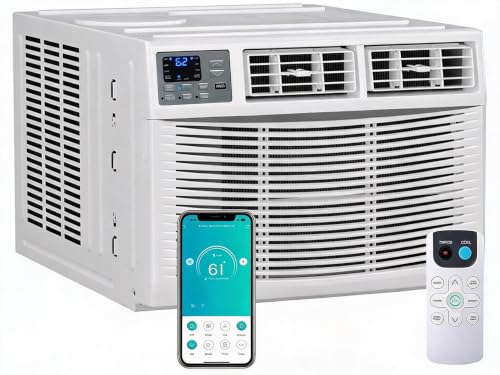
Window Unit With Heater: Complete Guide
One unit for year-round comfort. Learn how heat-and-cool window air conditioners work, what to check before buying, and how to choose the right capacity for your room.
START LEARNINGWhy a Window Unit With Heater Makes Sense: A window air conditioner with a built-in heater combines two seasonal appliances into a single installation. Instead of removing the AC every autumn and installing a separate space heater, you get cooling in summer and supplemental warmth in cooler months from the same window footprint. For bedrooms, home offices, add-on rooms, and rental units where extending ductwork is impractical, this combined approach is a practical and space-efficient solution — provided you understand how the heating side works and what its limits are.
How a Window Unit With Heater Works
A heat-and-cool window unit is essentially a standard window air conditioner with an added heating element. In cooling mode, it operates exactly like a conventional window AC: refrigerant circulates through the evaporator and condenser coils, and the compressor moves heat from indoors to outdoors. In heating mode, the compressor typically shuts off and a heating element — usually a positive temperature coefficient (PTC) ceramic heater or a resistance coil — warms air that is blown into the room by the indoor fan.
This is an important distinction. The heating side of most window units with heaters is resistive heating, not a reverse-cycle heat pump. That means it does not "move" heat from outside; it generates heat electrically. Resistive heat is reliable and works in any outdoor temperature, but it consumes more electricity per unit of heat delivered than a heat pump would. Understanding this helps you set realistic expectations for performance and operating characteristics.
Some higher-end models use a heat pump mechanism instead, reversing the refrigerant cycle to absorb heat from outdoor air. These are more efficient in mild climates but lose capacity as outdoor temperatures drop. If you are comparing technologies, our guide to HVAC heat pumps explains how the reverse-cycle approach differs from resistive heat.
Cooling and Heating Capacity Explained
Window units with heaters are rated separately for cooling (BTU per hour) and heating (watts or BTUs). The two ratings are not interchangeable, and the heating capacity is often lower than the cooling capacity. This matters when you are deciding whether the unit can carry you through winter.
| Specification | Typical Range | What It Means for You |
|---|---|---|
| Cooling capacity | 8,000 – 12,000 BTU | Covers roughly 250–450 sq ft, depending on climate and insulation |
| Heating capacity | 3,000 – 5,000 BTU equivalent | Supplemental warmth for a single room, not whole-home heating |
| Heating element type | PTC ceramic or resistance coil | Fast warm-up; consistent output regardless of outdoor temperature |
| Electrical requirement | 115V or 230V dedicated circuit | Larger heat models often require 230V; check before buying |
For sizing the cooling side, match BTU to room square footage using the standard 20 BTU per square foot guideline, then adjust for sun exposure, ceiling height, and occupancy. Our guide on how to size an air conditioner walks through the calculation. For the heating side, treat the unit as a supplemental heat source for the same room — it is not designed to replace a central furnace.
Key Features to Evaluate
Heating Element Type
PTC ceramic heaters are self-regulating and reach operating temperature quickly, which makes them common in mid-range and premium window units. Resistance coils are simpler and found in entry-level models. Both work; ceramic elements tend to be more consistent and safer in enclosed spaces.
Thermostat and Timer
Look for a unit with a programmable thermostat and a 24-hour timer. These features let the unit cycle on and off automatically in both heating and cooling modes, which improves comfort and reduces unnecessary runtime. Digital displays are easier to set precisely than mechanical dials.
Remote and Smart Controls
Many mid-tier and high-end units include a remote control, and some support Wi-Fi or app control. Smart compatibility is useful if you want to schedule heating before you arrive home. If you plan to integrate with a smart home system, verify the app and voice-assistant support before purchase.
Energy Efficiency (CEER/SEER)
Window AC efficiency is expressed as CEER (Combined Energy Efficiency Ratio). Higher CEER means lower energy consumption in cooling mode. Heating efficiency for resistive elements is effectively fixed, so the cooling rating is the main differentiator. Our overview of the most efficient window air conditioner explains how to interpret these ratings.
Advantages and Limitations
Advantages
- One installation covers both cooling and supplemental heating
- No need to remove the AC in autumn or store a separate heater
- Ideal for bedrooms, home offices, and add-on rooms
- Heating works even in very cold outdoor temperatures
- Simpler and less invasive than extending ductwork
Limitations
- Heating capacity is supplemental, not a furnace replacement
- Resistive heating uses more electricity per BTU than a heat pump
- Larger heat models may require a 230V dedicated circuit
- Window installation limits placement and blocks some light
- Cooling efficiency varies; check CEER before buying
If your goal is year-round comfort for a single room and you have a suitable window, a heat-and-cool window unit is a practical fit. If you need to heat multiple rooms or replace a central system, a different approach is warranted. For homes where a window installation is not possible, a ductless mini-split AC with heat pump capability may be a better long-term investment.
Installation and Safety Considerations
Window units with heaters draw more current than cooling-only models, so electrical planning matters:
- Dedicated circuit — Most units should be on a dedicated circuit. Larger heat models often require 230V. Check the nameplate rating and confirm your panel can support the load. Our guide on 110V vs 240V AC units explains the difference.
- Secure mounting — The unit must be level and properly supported. Follow the manufacturer's bracket or support requirements. An improperly supported unit can sag, vibrate, and leak.
- Clearances — Keep the outdoor side free of obstructions so the condenser can reject heat efficiently in summer. In heating mode, ensure the indoor airflow path is unobstructed.
- Window compatibility — Measure the window opening and check the unit's minimum and maximum window width requirements. Casement and slider windows may need adapters or may not be suitable.
- Professional installation — For 230V models or units above a certain weight, professional installation is recommended. A qualified HVAC technician can confirm circuit capacity and proper support.
If you are comparing installation approaches, our overview of through-the-wall AC covers the wall-sleeve alternative, which can be a cleaner permanent option in some rooms.
Maintenance for Year-Round Performance
A heat-and-cool window unit sees use in more seasons than a cooling-only model, so maintenance pays off:
- Clean the air filter regularly — In heating mode, restricted airflow causes the heating element to run hotter and the unit to cycle on its safety limit. Clean or replace the filter every two to four weeks during heavy use. Our guide to cleaning air conditioner filters covers the process.
- Inspect the heating element and fan — Dust buildup on the heating element or fan blades reduces efficiency and can create odors. A professional seasonal inspection is worthwhile.
- Check the condensate path — In cooling mode, condensate must drain properly. Clogged drain paths can cause water to back up into the unit. Our guide on cleaning the AC drain explains how to clear blockages.
- Secure the unit before cold weather — If the unit stays installed year-round, confirm it is sealed against drafts and that the outdoor cover (if used) does not obstruct airflow when the unit runs in heating mode.
- Seasonal cleaning of the outdoor coil — Dust and pollen on the condenser coil reduce cooling efficiency. A gentle rinse and soft brush cleaning each spring keeps performance up. Our HVAC maintenance guide provides a broader checklist.
Frequently Asked Questions
Can a window unit with a heater replace my furnace?
No. The heating element in a window unit is designed as supplemental heat for the room where it is installed. It lacks the capacity, ductwork, and safety systems of a central furnace. It is best used to take the chill off a bedroom, office, or add-on room, not to heat an entire home.
How much does it heat compared with how much it cools?
Heating output is typically lower than cooling capacity. A unit rated for 10,000 BTU of cooling might deliver the equivalent of 3,000–5,000 BTU of heating. That is enough for a single room in mild to moderate cold, but not for extreme cold or large spaces. Check the manufacturer's heating specification for the exact figure.
Do heat-and-cool window units require a special electrical circuit?
Larger heating models often require a 230V dedicated circuit, while smaller units may run on standard 115V. Always check the nameplate rating and the plug type before buying. If you are unsure whether your panel can support the load, consult a licensed electrician or HVAC technician.
Is a heat pump window unit more efficient than a resistive heater?
In mild climates, a heat pump mechanism can be more efficient because it moves heat rather than generating it. However, heat pump capacity drops as outdoor temperatures fall, and most window units with heaters use resistive elements for reliability in cold weather. Consider your climate before choosing.
Can I leave the unit installed all year?
Yes, that is one of the main advantages of a heat-and-cool unit. Ensure the installation is properly sealed against drafts and that the unit is supported correctly. If you use an exterior cover in winter, remove it before running the unit in heating mode so airflow is not blocked.
Why does my window unit with heater smell when heating starts?
A slight odor when the heater first runs is usually dust burning off the heating element. It typically fades after a few minutes. Persistent or strong odors may indicate dust buildup inside the unit or a more serious issue and should be checked by a technician. Regular filter cleaning helps prevent this.
Ready to Choose a Window Unit With Heater?
You now understand how heat-and-cool window units work and what to check before buying. Explore recommended models below, or compare features to find the right fit for your room.
EXPLORE OPTIONS