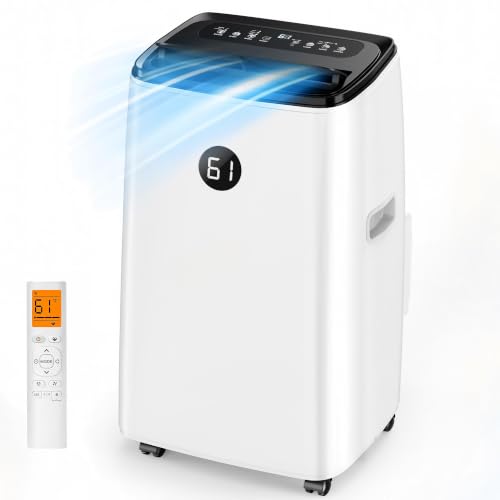
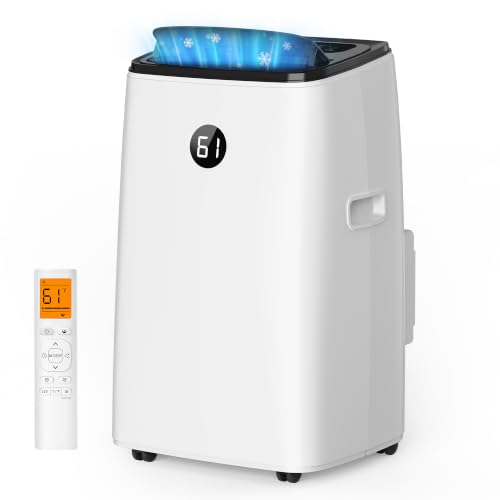
14000 BTU Portable Air Conditioner: Complete Buying Guide
Understand cooling capacity, electrical requirements, key features, and how to choose the right 14000 BTU portable air conditioner for large rooms, open-plan spaces, and homes without ductwork.
JUMP TO TOP PICKSWhat Is a 14000 BTU Portable Air Conditioner?
A 14000 BTU portable air conditioner is a freestanding, wheel-mounted cooling unit that delivers roughly 14,000 British Thermal Units of cooling per hour. It sits directly in the room it cools, requires no permanent installation, and exhausts hot air through a flexible hose routed out of a window or vent. Because it does not rely on ductwork, this class of unit is a practical option for older homes, rental apartments, converted garages, home additions, and open-plan living areas where a central system or mini-split is impractical to install.
Compared with smaller 8,000 and 10,000 BTU units, the 14000 BTU class is positioned in the mid-tier to high-end tier of the portable cooling market. These units typically carry a higher cooling output, a larger chassis, and often a dual-hose or advanced single-hose exhaust design. Many models in this class also add heat pump functionality, dehumidification modes, and smart app control, which makes them versatile across seasons.
Positioning in the market: A 14000 BTU portable AC sits in the mid-range to high-end tier of portable cooling. It offers substantially more capacity than entry-level units while remaining more flexible than permanent mini-split or through-the-wall systems.
Room Size and Cooling Coverage
Manufacturers commonly rate a 14000 BTU portable air conditioner for rooms between 500 and 700 square feet. That range is a starting point, not a guarantee. Real-world cooling performance depends on ceiling height, insulation quality, window area, sun exposure, local climate, and the number of occupants or heat-producing appliances in the room.
| Room Scenario | Typical Square Footage | 14000 BTU Suitability |
|---|---|---|
| Standard bedroom | 150 – 300 sq ft | Oversized; consider a smaller unit |
| Large living room or open-plan area | 400 – 600 sq ft | Well matched in the mid-tier range |
| Open-plan kitchen and living combo | 500 – 700 sq ft | Appropriate; account for kitchen heat gain |
| Converted garage or workshop | 400 – 650 sq ft | Appropriate if insulated |
| Sunroom or room with large west-facing windows | 350 – 500 sq ft | May need a higher-capacity unit |
| Room with very high ceilings (over 10 ft) | 400 – 500 sq ft | May underperform; consider a larger class |
If your room sits near the upper end of the coverage range, or if the space has significant heat gain, look for a model with a high EER or CEER rating and a dual-hose exhaust design. If your room is closer to 300 square feet, a 14000 BTU unit will cool quickly but may cycle on and off more frequently, which can be less efficient than a properly matched smaller unit. For smaller rooms, our 12000 to 14000 BTU capacity guide offers a more detailed comparison.
How BTU Is Calculated for Real Rooms
The basic rule of thumb is roughly 20 BTU per square foot for an average room with standard 8-foot ceilings. That places a 14000 BTU unit in the 700-square-foot range under ideal conditions. However, that formula assumes average insulation, average window area, and a moderate climate. Adjustments are necessary for the following factors:
- Ceiling height: Add roughly 10 percent capacity for every foot above 8 feet.
- Sun exposure: South- and west-facing rooms gain more heat and may need 10 to 20 percent more capacity.
- Occupants: Add roughly 600 BTU per additional person beyond two occupants.
- Kitchen appliances: Open-plan kitchens with active cooking add significant heat load.
- Insulation and window quality: Poor insulation or single-pane windows increase the required capacity.
For a more precise estimate, use our BTU calculator by room size or review the full AC sizing guide. Proper sizing prevents short cycling, which wastes energy and wears down the compressor faster.
Key Features That Matter
Single-Hose vs Dual-Hose Exhaust
Single-hose units draw room air, use it to cool the condenser, and exhaust it outdoors. That creates negative pressure, which pulls warm outdoor air back into the room through gaps. Dual-hose units separate the intake and exhaust airstreams, which reduces that pressure imbalance and generally delivers more consistent cooling. Dual-hose designs are common in the high-end tier of the 14000 BTU class and are worth prioritizing for rooms near the upper end of the coverage range.
EER and CEER Ratings
EER (Energy Efficiency Ratio) measures cooling output per watt of electricity. CEER (Combined Energy Efficiency Ratio) is a newer rating that factors in standby power and part-load performance. Higher numbers indicate better efficiency. For a 14000 BTU unit, look for a CEER in the upper range of the category; premium models typically outperform entry-level units by a noticeable margin on this metric. Our EER rating explainer walks through how to interpret these numbers.
Noise Level
Portable air conditioners are generally louder than mini-splits or central systems because the compressor and fan sit inside the room. A 14000 BTU unit typically produces 52 to 58 dB on high fan speed. Models marketed as quiet AC units may drop into the upper 40s on low speed. If the unit will run in a bedroom or home office, compare decibel ratings carefully. Our quiet AC guide covers this in more detail.
Modes and Controls
- Cooling mode: The core function; all units offer it.
- Dehumidification mode: Removes moisture without overcooling; useful in humid climates.
- Fan-only mode: Circulates air without running the compressor.
- Heating mode: Some 14000 BTU models include a heat pump, which extends usability into shoulder seasons. See our guide to 14000 BTU portable AC with heat and remote control for models in this category.
- Smart controls: Wi-Fi, app scheduling, and voice assistant compatibility are increasingly common in the mid-range and high-end tiers. Our AC with Wi-Fi and smart control guide explains the practical benefits.
Drainage System
Portable AC units collect condensate. Some drain continuously via a hose, some use a self-evaporative system that burns off most moisture through the exhaust, and some require manual emptying of a tank. Self-evaporative designs are convenient but not always sufficient in very humid conditions; a continuous drain option adds flexibility.
Electrical Requirements and Circuit Planning
Most 14000 BTU portable air conditioners run on a standard 115V household outlet and draw roughly 11 to 13 amps. That is close to the limit of a standard 15-amp circuit, so the unit should be plugged into a dedicated circuit whenever possible. Running a 14000 BTU portable AC on a shared circuit alongside a microwave, space heater, or hair dryer can trip the breaker repeatedly.
Some high-end or heavy-duty 14000 BTU models require a 230V outlet. These are less common but exist in the commercial-grade segment. Before purchasing, confirm the voltage requirement and check whether your room has the appropriate outlet. Our guides on 110V vs 240V AC units and amps and breaker size explain how to verify circuit capacity safely.
Safety note: Never use an extension cord with a 14000 BTU portable air conditioner unless the cord is rated for the unit's amperage. A dedicated wall outlet on its own circuit is the safest configuration.
Pros and Cons of the 14000 BTU Class
Advantages
- No permanent installation or structural modification
- Sufficient capacity for large rooms and open-plan spaces
- Movable between rooms on casters
- Many models include heat pump and dehumidification modes
- Works in homes without ductwork or window-friendly layouts
- Smart controls increasingly standard in the mid-range tier
Limitations
- Louder than mini-split and central systems
- Requires window or vent access for exhaust
- Takes up floor space
- Heavier than smaller portable units
- Single-hose designs can create negative pressure
- Condensate management can require attention in humid climates
Portable vs Window vs Mini-Split
Choosing between a 14000 BTU portable unit and other cooling types depends on installation constraints, room layout, and long-term plans. The table below compares the main options at a similar capacity level.
| System Type | Installation | Efficiency | Noise | Best For |
|---|---|---|---|---|
| 14000 BTU Portable AC | Minimal; window kit and hose | Moderate | Moderate to high | Rentals, temporary spaces, rooms without ductwork |
| 14000 BTU Window AC | Moderate; requires window frame support | Higher | Moderate | Standard double-hung windows with secure mounting |
| 14000 BTU Mini-Split | Professional installation required | Highest | Low | Long-term whole-room comfort, low noise priority |
Window units generally outperform portable units on efficiency because the compressor sits outside the conditioned space. Mini-splits outperform both but require professional installation. If your priority is flexibility and minimal installation effort, a portable unit is the practical choice. If you have a suitable window and want better efficiency, compare our 14000 BTU window AC with heat page. For a ductless long-term solution, the 18000 BTU mini-split heat pump covers a larger footprint.
Installation and Placement Tips
Proper placement directly affects cooling performance, noise, and efficiency. Follow these guidelines when setting up a 14000 BTU portable air conditioner:
- Choose the right window: Sliding windows and double-hung windows work with most window kits. Casement windows may require a specialized panel. Avoid windows with direct, intense afternoon sun if possible.
- Keep the exhaust hose short and straight: The shorter and straighter the hose, the less the compressor has to work. Avoid loops, kinks, and long runs.
- Seal the window opening: Use the included foam or fabric seals to prevent hot outdoor air from re-entering the room.
- Maintain clearance: Leave at least 12 to 18 inches of space around the unit for airflow, and keep it away from curtains, furniture, and heat sources.
- Level the unit: Most portable ACs should sit on a level surface for proper condensate drainage. Check the manual for the recommended tilt, if any.
- Plan the drainage: If the unit uses a continuous drain hose, route it so water flows downhill to a floor drain or outside.
For rooms where a standard window kit is not viable, consider a sliding door kit or a wall vent. Our 5-inch exhaust hose guide explains hose sizing and compatibility.
Maintenance for Long-Term Performance
A 14000 BTU portable air conditioner is a long-term investment when maintained properly. A consistent maintenance routine keeps efficiency high and reduces the risk of mid-season breakdowns.
- Clean or replace the air filter every two to four weeks during peak season. Dusty homes and pet households may need more frequent cleaning.
- Inspect the exhaust hose monthly for kinks, tears, or condensation buildup. Replace damaged hoses promptly.
- Empty or drain condensate regularly. If the unit is self-evaporative, still check for standing water in very humid conditions.
- Clean the exterior and intake grilles with a soft brush or vacuum to prevent dust buildup.
- Store the unit properly in the off-season. Drain all water, clean the filter, coil the hose without kinks, and cover the unit to prevent dust ingress.
- Schedule an annual inspection if the unit runs heavily. Our seasonal AC checklist provides a step-by-step seasonal routine.
If the unit stops cooling effectively despite maintenance, review our AC not cooling troubleshooting guide before assuming the compressor has failed.
How to Choose the Right Model
The right 14000 BTU portable air conditioner depends on how you intend to use it. Consider the following decision framework:
- For a primary living space: Prioritize a dual-hose design, a high CEER rating, and a quieter operation profile. This is the high-end tier of the category.
- For a bedroom or home office: Noise is the dominant factor. Look for models with a low-speed mode in the upper 40s dB range, and consider a unit with a heat pump if you need shoulder-season warmth.
- For a rental or temporary setup: A mid-range model with a reliable window kit, caster wheels, and a straightforward control panel is sufficient. Smart features are optional.
- For a humid climate: Prioritize dehumidification performance and a continuous drain option over smart features.
- For a large open-plan space: Confirm the square-footage rating with a realistic adjustment for ceiling height and sun exposure, and lean toward a dual-hose model.
Final tip: Check the unit's electrical requirements before ordering. A 14000 BTU portable AC is a substantial appliance, and matching it to the right circuit prevents nuisance tripping and keeps the compressor operating efficiently for years.
Frequently Asked Questions
What size room can a 14000 BTU portable air conditioner cool?
A 14000 BTU portable air conditioner is generally designed to cool rooms between 500 and 700 square feet, depending on ceiling height, insulation quality, sun exposure, and the number of occupants or heat-generating appliances in the space.
Does a 14000 BTU portable AC require special electrical wiring?
Most 14000 BTU portable air conditioners run on a standard 115V household outlet with a dedicated circuit. However, some high-end and heavy-duty models may require a 230V outlet. Always check the manufacturer's electrical requirements and ensure the circuit can handle the unit's amperage before installation.
How many amps does a 14000 BTU portable air conditioner use?
A typical 14000 BTU portable air conditioner draws approximately 11 to 13 amps on a 115V circuit. For a 230V model, the amperage is roughly half. It is advisable to plug the unit into a dedicated circuit to prevent tripping breakers when other appliances are running.
Can a 14000 BTU portable air conditioner be used in a room without windows?
A portable air conditioner needs a way to exhaust hot air outdoors. Without a window, you would need an alternative exhaust route such as a sliding door kit, a wall vent, or a drop ceiling access. Most portable AC units come with window kits, but special venting solutions exist for rooms without standard windows.
How often should the exhaust hose and filter be cleaned on a 14000 BTU portable AC?
The air filter should be cleaned every two to four weeks during peak cooling season, or more often in dusty environments. The exhaust hose should be checked monthly for kinks, blockages, or condensation buildup. Regular maintenance keeps the unit running efficiently and extends its lifespan.