24V AC Thermostat: The Complete Buyer's Handbook
Understand how 24-volt thermostats work, verify compatibility, decode wiring terminals, and choose the right control for your heating and cooling system.
Start the GuideWhy this guide matters: A thermostat is the command center of your HVAC system. Choosing the wrong one can lead to short cycling, comfort complaints, or wasted energy. This guide gives you the technical clarity you need before you buy.
What Is a 24V AC Thermostat?
A 24V AC thermostat is a low-voltage control device that manages heating, cooling, and fan operation in most residential HVAC systems. The "24V AC" refers to the low-voltage alternating current supplied by the system's transformer, which powers the thermostat and carries switching signals to the equipment. This control voltage is the de facto standard for residential furnaces, air handlers, and heat pumps across North America.
Unlike line-voltage thermostats used for baseboard heaters or some radiant systems, a 24V thermostat does not switch high current directly. Instead, it closes low-voltage circuits that energize relays, contactors, and control boards inside the HVAC equipment. That separation is what makes 24V thermostats safe to handle during installation and why they dominate the residential market.
The 24V control circuit typically includes a transformer, a thermostat, and the equipment control board. The thermostat's terminals are labeled by function — R for power, C for common, W for heat, Y for cooling, G for fan, and O/B for heat pump reversing valves. Understanding these labels is the foundation of compatibility.
How a 24V Thermostat Works
When the room temperature drifts from the setpoint, the thermostat closes a circuit between R and the relevant terminal. For cooling, it connects R to Y, which signals the compressor contactor to engage. For heating, it connects R to W, which signals the furnace or heat pump to produce heat. The G terminal controls the indoor blower fan independently.
The C-wire (common) provides a continuous return path for 24V power, allowing the thermostat to draw steady current for its display, processor, and wireless radio. Older electromechanical thermostats were often battery-powered and did not need a C-wire. Modern smart thermostats almost always do.
Because the thermostat is a switch, not a power source, the transformer inside the air handler or furnace must be sized to support the thermostat's current draw. Most standard transformers supply enough power for a single thermostat, but some smart models with large color screens and Wi-Fi radios can stress marginal transformers.
Types of 24V Thermostats
Non-Programmable
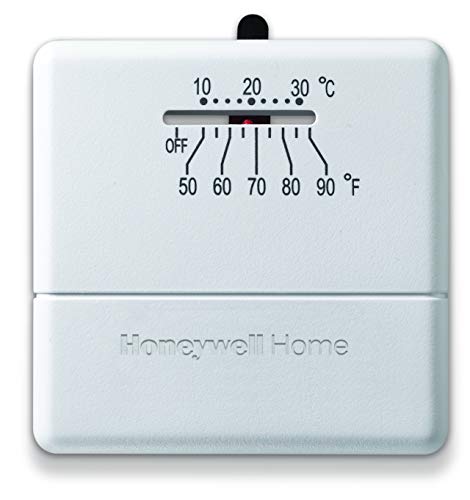
The simplest option. You set a temperature and the thermostat maintains it. Reliable, easy to wire, and ideal for single-stage systems where scheduling is not a priority.
Programmable
Supports daily schedules for wake, away, and sleep periods. A solid choice for households with predictable routines and single-stage or two-stage equipment.
Smart / Wi-Fi
Connects to an app for remote control, learning schedules, and energy reports. Requires a C-wire in most cases. Best for tech-forward users who want granular control.
Multi-Stage & Heat Pump
Designed for systems with two-stage compressors, auxiliary heat, or reversing valves. Includes O/B terminals and staging logic for efficient operation.
Commercial / Zoned
Built for multi-zone control, remote sensors, and building automation. Typically installed by contractors and configured with commissioning tools.
Battery-Powered
No C-wire required. Runs on AA or AAA batteries and switches the 24V circuit without drawing standby power. A practical fallback when wiring is limited.
Compatibility Check Before You Buy
Before choosing a 24V thermostat, confirm three things: your system type, your wiring, and your transformer capacity. First, identify whether you have a conventional furnace and air conditioner, a heat pump, or a dual-fuel system. Heat pumps require an O/B reversing valve terminal, while conventional systems do not.
Second, remove your current thermostat from its backplate and photograph the wiring. Note which terminals are connected. If you see R, W, Y, G, and C, you likely have a standard 24V setup. If you see O or B, you have a heat pump. If you see W2, Y2, or AUX, you have multi-stage or auxiliary heat.
Third, check for a C-wire. If your current thermostat is battery-powered and there is no wire on the C terminal, you may need to run a new wire, use a C-wire adapter, or choose a battery-powered model. A qualified technician can confirm transformer capacity and whether an adapter is safe for your equipment.
If you are troubleshooting a thermostat that is set to cool but the system is not responding, the issue may be wiring, a tripped float switch, or a control board fault rather than the thermostat itself. See our guide on thermostat set to cool but AC not turning on for a step-by-step diagnostic path.
For wireless alternatives that reduce wiring complexity, review our overview of the wireless HVAC thermostat and the wireless air conditioner thermostat. If you are considering a full system upgrade, the zoned HVAC system and zoned air conditioning guides explain how multiple thermostats coordinate.
Thermostat Terminal Reference
| Terminal | Function | When It Matters |
|---|---|---|
| R / Rc / Rh | 24V power from transformer | Always required; Rc and Rh may be jumpered on conventional systems. |
| C | Common wire (return path) | Required for most smart thermostats; powers display and Wi-Fi. |
| W / W1 / W2 | Heating stage(s) | Single-stage heat uses W; W2 adds second-stage or auxiliary heat. |
| Y / Y1 / Y2 | Cooling stage(s) | Y engages the compressor; Y2 supports two-stage cooling. |
| G | Indoor blower fan | Controls fan-only operation and participates in fan delay logic. |
| O / B | Reversing valve (heat pump) | O for cooling-mode reversing valves, B for heating-mode valves; required for heat pumps. |
| AUX / E | Auxiliary / emergency heat | Heat pump systems with electric backup heat; critical in cold climates. |
Key Buying Factors
System compatibility. Match the thermostat to your equipment type. A single-stage thermostat on a two-stage system will work but will not exploit the second stage. A conventional thermostat on a heat pump will not control the reversing valve correctly.
C-wire requirement. Confirm whether the model needs a C-wire or includes an adapter. Smart thermostats with color displays and Wi-Fi are the most demanding. Battery-powered models are the most forgiving.
Staging support. If your system has two-stage cooling, two-stage heating, or auxiliary heat, choose a thermostat with the corresponding terminals and staging logic. Mid-range models often support two stages, while top-tier models add dual-fuel and dehumidification control.
Control features. Programmable schedules, geofencing, remote sensors, humidity control, and app-based diagnostics vary by tier. Entry-level models focus on reliable switching; top-tier models add sensor averaging, runtime reports, and integration with home automation platforms.
Display and usability. A backlit display, clear terminal labels, and guided setup reduce installation errors. Some premium models include on-device wiring detection that flags miswired terminals before power-up.
Build quality. Look for reinforced backplates, high-grade relay contacts, and weather-resistant finishes in humid or coastal installations. Solid build quality matters more than feature count for long-term reliability.
Installation and Safety Notes
- Always turn off power to the HVAC system at the breaker before removing or installing a thermostat.
- Photograph the existing wiring before disconnecting anything. Terminal labels vary slightly between brands.
- Do not let thermostat wires touch each other while the system is powered; a short can blow the low-voltage transformer fuse.
- If you are adding a C-wire, verify the transformer's VA rating and the thermostat's current draw. Undersized transformers cause intermittent resets.
- For heat pump systems, confirm the O/B terminal configuration in the thermostat's setup menu; an incorrect setting reverses heating and cooling.
- If the system does not respond after installation, stop and consult a licensed technician. Control board faults and float switch trips are common causes that are not thermostat-related.
If your air conditioner is running but not cooling, the thermostat may be functioning correctly while the fault lies elsewhere. Our diagnostic guides on AC not blowing cold air in the house and air conditioner running but not cooling walk through the most common causes. For central system issues, see AC is on but house is not cooling.
Frequently Asked Questions
What is a 24V AC thermostat?
How do I know if my thermostat is 24V?
What is a C-wire and why does my thermostat need it?
Can I install a 24V thermostat myself?
What is the difference between single-stage, multi-stage, and heat pump thermostats?
Why does my thermostat need a common wire if it has batteries?
Ready to Choose Your 24V Thermostat?
Review the recommended models below, confirm compatibility with your system, and explore the options that match your tier and feature needs.
View Recommended Thermostats