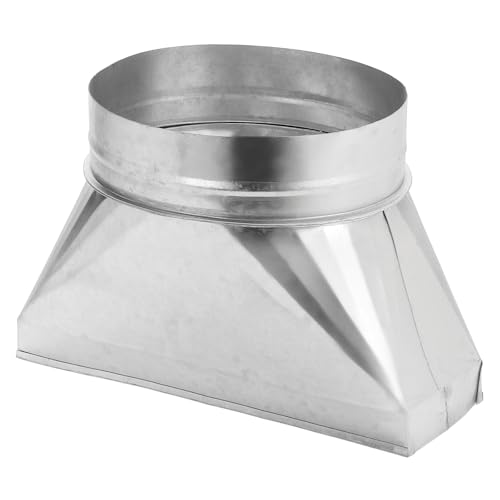
8 Inch Round to Rectangular Duct Transition
Everything you need to know about connecting an 8-inch round duct to a rectangular trunk line — sizing, airflow, installation, and the specifications that matter before you buy.
Why this transition matters: An 8 inch round to rectangular duct transition is a small fitting with an outsized role. It is the bridge between a round branch duct and a rectangular trunk, plenum, or register boot. Get the dimensions and the taper right and air moves quietly and efficiently. Get it wrong and you inherit turbulence, noise, and reduced airflow at the register. This guide explains exactly how the fitting works so you can choose with confidence.
Homeowners and HVAC installers run into the same scenario again and again: the main duct run is rectangular, but the branch feeding a room is round. That mismatch is normal — rectangular ductwork is common in trunk-and-branch systems because it fits inside wall chases and ceiling cavities, while round duct is preferred for branches because it is efficient, easier to route, and produces less pressure loss per foot. The component that resolves this mismatch is the round to rectangular duct transition, and the 8-inch size is one of the most frequently specified.
If your system includes flexible branch runs, it helps to understand the duct itself; our overview of 8in flex duct explains how the branch side behaves once the transition is installed. For larger branch lines feeding multiple rooms, the principles are similar to those covered in the 6 inch flexible ductwork guide, just scaled up.
What Is an 8 Inch Round to Rectangular Duct Transition?
An 8 inch round to rectangular duct transition is a sheet metal fitting with a circular opening on one end (8 inches nominal diameter) and a rectangular opening on the other. The transition tapers from one shape to the other over a short length — typically 8 to 14 inches — so that the cross-sectional area changes gradually rather than abruptly. That gradual change is what keeps airflow stable and keeps noise down.
These fittings go by several names in the trade: round-to-rectangle transition, round-to-rect duct adapter, takeoff transition, and square-to-round adapter (when the rectangular side is close to square). They are usually fabricated from galvanized steel, though high-end and commercial-grade versions may use heavier gauge metal or include a factory-applied insulation jacket.
Where the fitting is used
- Trunk-to-branch connections — the most common application, where a round branch duct taps into a rectangular trunk line.
- Plenum takeoffs — connecting a round run to a rectangular supply plenum on an air handler or furnace.
- Register boots — adapting an 8-inch round duct to a rectangular floor or ceiling register opening.
- Retrofit work — when a new round branch must connect to existing rectangular ductwork.
For systems where the branch is a flexible run rather than rigid pipe, the transition is typically paired with a length of flex duct. Our guide to 6 flex duct covers the smaller branch size and the same pairing logic applies here.
Sizing: Matching the Round and Rectangular Openings
The most important specification is equivalent cross-sectional area. An 8-inch round duct has an internal area of roughly 50.3 square inches. The rectangular side of the transition should be sized so that its area is close to that figure — ideally within about 10 percent. If the rectangular opening is significantly smaller, the transition becomes a bottleneck and static pressure rises. If it is significantly larger, air velocity drops and the branch may under-deliver.
Common rectangular dimensions for an 8-inch round transition
| Rectangular Size (inches) | Area (sq in) | Match Quality | Best For |
|---|---|---|---|
| 6 × 8 | 48.0 | Close — slight restriction | Short branch runs, tight chases |
| 7 × 7 | 49.0 | Close — near-square | Square plenum takeoffs |
| 6 × 9 | 54.0 | Good — slight expansion | Standard trunk tap-ins |
| 8 × 7 | 56.0 | Good — common stock size | General residential branch work |
| 8 × 8 | 64.0 | Generous — low velocity | Quiet operation, longer runs |
| 10 × 6 | 60.0 | Good — wide profile | Low-clearance ceiling cavities |
The taper length also matters. A longer transition (10 to 14 inches) produces a gentler change of shape and less turbulence than a stubby 8-inch fitting. Where space allows, a longer taper is the quieter choice. In tight chases — the kind often found alongside 6 inch wall vent installations — a shorter fitting may be the only option, and the trade-off is slightly higher noise at the register.
How the Transition Affects Airflow and Static Pressure
Every fitting in a duct system adds resistance, measured as static pressure loss. A well-designed round-to-rectangular transition adds very little — typically in the range of 0.02 to 0.05 inches of water column at normal residential velocities. A poorly designed one can add several times that. The difference comes down to three factors:
- Taper angle. A gentle taper keeps air attached to the walls of the fitting. A steep taper causes separation, eddies, and noise.
- Area ratio. As noted above, keeping the rectangular area close to the round area avoids both restriction and sudden expansion.
- Internal finish. Burrs, sharp seams, and rough galvanized edges trip airflow. Quality fittings have smooth, deburred seams.
In practice, the transition is rarely the largest source of pressure loss in a branch. Duct length, elbows, and the register itself usually contribute more. But because the transition sits at the junction between trunk and branch, it is a high-visibility point in the system, and upgrading it is one of the simpler improvements you can make. If you are also working on the exhaust side of a portable setup, the 6 inch exhaust hose guide shows how the same principles apply to flexible connections.
Types of 8 Inch Round to Rectangular Transitions
Not all transitions are built the same. The market generally divides into three tiers, and the tier you choose should reflect where the fitting sits, how accessible it will be for service, and how quiet the room needs to be.
| Tier | Construction | Best For | Notes |
|---|---|---|---|
| Entry-level | 26-gauge galvanized steel, crimped round end | Concealed ceiling or crawlspace runs | Solid choice for the tier; functional and widely stocked |
| Mid-range | 24-gauge galvanized steel, rolled seams, deburred edges | Visible basement or garage ductwork | Competitive within its class; noticeably quieter |
| Premium | 22-gauge or heavier, factory insulation jacket, airtight seams | Conditioned spaces, noise-sensitive rooms, commercial-grade work | Feature-rich for its class; the long-term investment option |
Insulated versions deserve a special mention. When a transition passes through an unconditioned space — an attic, a garage ceiling, a crawlspace — condensation on the cold metal is a real risk, and an insulated fitting prevents it. The premium tier typically includes this jacket from the factory, while mid-range and entry-level fittings often require field-applied insulation wrap.
Installation Overview
The transition itself is a simple component, but the quality of the installation determines whether it performs as designed. The sequence below reflects standard residential practice.
-
Confirm the dimensions
Measure the round branch duct's outer diameter and the rectangular opening's actual inside dimensions. Nominal sizes and actual sizes can differ by a quarter inch or more.
-
Seal the connection points
Apply duct mastic or foil tape to both the round and rectangular seams. Airtight seams are the single biggest factor in transition performance after sizing.
-
Secure the round end
Slide the crimped round end into the branch duct and secure it with at least three sheet metal screws evenly spaced around the circumference.
-
Secure the rectangular end
Fold or screw the rectangular flange to the trunk or plenum. Use a continuous bead of mastic along the joint after fastening.
-
Insulate where required
Wrap the fitting with duct insulation if it passes through unconditioned space, and tape all insulation seams.
-
Test airflow
After the system is running, check airflow at the register and listen for whistling or rattle at the transition. Both are signs of an imperfect seal.
If you are installing the transition as part of a larger branch run, the process parallels what is described in the flexible ductwork installation overview. And if the branch terminates at a wall register, the wall vent installation notes cover the termination side.
What to Check Before You Buy
When you are comparing options, the specifications that matter are straightforward. Use this checklist to evaluate any 8 inch round to rectangular duct transition you are considering.
- Round diameter is a true 8 inches (not a nominal size that measures smaller)
- Rectangular opening area is within about 10 percent of 50.3 sq in
- Taper length is at least 8 inches, ideally 10 to 14
- Steel gauge is appropriate for the location (26-gauge minimum, 24-gauge or heavier for visible runs)
- Seams are rolled or welded, not just spot-tacked
- Edges are deburred and free of sharp galvanized burrs
- Insulated jacket if the fitting passes through unconditioned space
- Crimped end is clearly marked and sized to fit standard branch duct
- Compatible with the fastening method you plan to use (screws, mastic, foil tape)
- Manufacturer specifies the fitting for HVAC supply or return use, as applicable
Frequently Asked Questions
What size rectangular duct matches an 8-inch round duct?
An 8-inch round duct has an area of about 50.3 square inches. Rectangular dimensions in the 6×8 to 8×7 range come closest. A 6×8 opening (48 sq in) is slightly restrictive; an 8×7 opening (56 sq in) is slightly generous. Both are common and work well when the taper is gradual.
Can I use a rectangular-to-round transition on a return duct?
Yes. The same sizing principles apply, though return ducts often run at lower velocity and are more tolerant of slight area mismatches. Confirm that the fitting is rated for the application and seal it as carefully as a supply fitting.
Does the taper length really matter?
Yes. A longer taper (10 to 14 inches) allows the air to change shape gradually, which reduces turbulence and noise. A shorter fitting saves space but can produce a noticeable whistle at higher velocities. Where space permits, choose the longer taper.
Should the transition be insulated?
If it passes through an unconditioned space such as an attic, garage, or crawlspace, yes. Insulation prevents condensation on the cold metal and reduces energy loss. Fittings in conditioned space generally do not require it.
How do I seal the transition for airtight performance?
Use duct mastic or foil tape on both the round and rectangular joints. Avoid standard cloth-backed duct tape, which degrades over time. A continuous bead of mastic along the rectangular flange is the most durable approach.
Can I install this transition myself?
Many homeowners do, particularly for accessible branch runs. The work involves cutting or fitting duct, fastening with sheet metal screws, and sealing seams. If the transition is inside a wall cavity or part of a fire-rated assembly, a licensed HVAC contractor is the safer choice.
Ready to Compare Options?
Browse the recommended fittings below and check availability for your duct size.
Explore Recommended TransitionsChoosing the right transition is a small decision that pays off every time the system runs. Match the area, favor a gradual taper, seal the seams, and insulate where the fitting crosses unconditioned space. With those four points covered, an 8 inch round to rectangular duct transition does its job quietly for the life of the system.