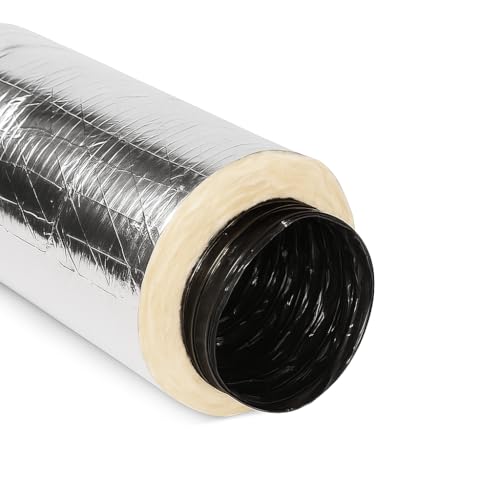
6 Inch Flexible Ductwork: The Complete Guide
Everything you need to know about sizing, insulation, installation, and choosing the right 6 inch flex duct for your HVAC system
EXPLORE THE GUIDEWhy 6 inch flexible ductwork matters: The ductwork is the circulatory system of your HVAC setup. A properly sized and sealed 6 inch flex duct delivers conditioned air efficiently, keeps static pressure in check, and helps your system run the way the manufacturer intended. This guide walks you through the specifications, insulation grades, and installation best practices so you can choose with confidence.
What Is 6 Inch Flexible Ductwork?
Six inch flexible ductwork is a round, factory-made air duct with a nominal inner diameter of 6 inches. It is built from a wire helix that supports a flexible inner core, usually made of polyester or aluminum foil, wrapped in fiberglass insulation and finished with an outer vapor barrier jacket. This construction allows the duct to bend around obstacles, making it a practical choice for retrofits, attic runs, and tight mechanical closets where rigid galvanized duct would be difficult to route.
The 6 inch size sits in the middle of the residential flex duct range. It is often used for branch supply runs feeding individual registers, short return connections, and as a transition between a trunk line and a room diffuser. Because it moves a moderate volume of air, it pairs well with standard residential air handlers and smaller mini-split or packaged systems that require a compact duct path. If your layout calls for a longer or higher-volume branch, you may also want to compare it with an 8 inch flex duct before finalizing the design.
Understanding how flex duct differs from rigid duct is important for planning. Flexible duct offers convenience and lower installation labor, but it also introduces higher friction loss per foot. That trade-off is why careful sizing, short runs, and minimal bends are essential for a quiet, efficient system.
Key Specifications of 6 Inch Flex Duct
When you shop for 6 inch flexible ductwork, the product listing will usually show a set of core specifications. These values determine how the duct performs in your system and whether it meets local energy code requirements. Use the table below as a quick reference while comparing options.
| Specification | Typical Range | What It Means for You |
|---|---|---|
| Nominal Diameter | 6 inch inner diameter | Fits standard 6 inch collars, takeoffs, and register boots. |
| Insulation R-Value | R-4.2, R-6, R-8 | Higher R-value reduces heat gain and condensation risk; R-6 and R-8 are common for unconditioned spaces. |
| Inner Core Material | Polyester, aluminum foil, or combination | Affects temperature rating, noise, and durability of the air path. |
| Outer Jacket | Reinforced foil-scrim-kraft (FSK) or metallized polyester | Acts as a vapor barrier; must be sealed tightly at joints. |
| Maximum Operating Temperature | Usually 200°F to 250°F depending on core | Confirms suitability for standard heating and cooling supply air. |
| Standard Lengths | 25 ft and 50 ft sections (some 100 ft) | Plan cut lengths and leftover material for your layout. |
| Pressure Rating | Typically 1 to 4 inches water gauge (wg) | Match to your system's static pressure to avoid jacket ballooning. |
| Flame/Smoke Rating | Class 1 air duct (UL 181 listed) | Required by most building codes for residential HVAC duct. |
Choosing the Right Insulation R-Value
Insulation is where many buyers get tripped up. The R-value tells you how well the duct resists heat transfer. A higher R-value means less heat gain in summer and less heat loss in winter, which translates to more consistent room temperatures and less strain on the equipment.
R-4.2 — Essential Tier
R-4.2 flex duct is the most basic insulation level. It is usually specified for short runs inside conditioned spaces, such as a utility closet or a conditioned basement ceiling. Because the surrounding air is already close to the supply air temperature, the lower insulation level is acceptable. This tier is common in older construction and in budget-focused system designs, but it is less suitable for attics or crawl spaces where temperature swings are significant.
R-6 — Balanced Mid-Tier
R-6 is the most widely specified insulation level for residential 6 inch flexible ductwork. It offers a solid balance between thermal performance and physical flexibility. In most climate zones, R-6 meets or exceeds energy code minimums for ducts in unconditioned spaces. If you are replacing an existing duct run or designing a new branch line, R-6 is a dependable default that works well for supply and return connections alike.
R-8 — High-End Tier
R-8 is the premium insulation option for flex duct. It is thicker, slightly stiffer, and best suited to unconditioned attics, garages, and crawl spaces where the temperature differential between the duct and the surrounding air is large. In hot climates or cold climates, R-8 reduces condensation on the outer jacket and limits energy loss over longer runs. The trade-off is reduced flexibility and a larger outside diameter, which can complicate routing in tight joist bays.
Sizing and Airflow: How Much Air Can a 6 Inch Duct Move?
A 6 inch flex duct is generally sized to deliver roughly 75 to 110 CFM depending on the acceptable friction rate and the number of bends. The exact figure depends on the system's static pressure budget and the length of the run. For a typical residential branch serving a single register, a 6 inch duct is a common match for rooms that need around 100 CFM.
Airflow through flex duct is affected by three main factors:
- Length of the run: Every additional foot adds friction. Keep 6 inch runs as short as the layout allows.
- Number and tightness of bends: A sharp 90-degree bend creates far more resistance than a gentle sweep. Two 90-degree bends is often cited as a practical upper limit for a single flex run.
- Compression and sagging: A duct that is compressed or sagging loses cross-sectional area and restricts airflow. Support the duct so it stays fully round.
If your load calculation calls for more than about 110 CFM on a single branch, stepping up to an 8 inch flex duct is usually the better engineering choice. Oversized duct reduces velocity and noise, while undersized duct increases static pressure and can starve the room of air. For a whole-house perspective on matching duct size to equipment capacity, the broader guidance on AC ductwork replacement is a useful reference point.
Installation Best Practices for 6 Inch Flex Duct
Even a well-specified duct underperforms if it is installed carelessly. The following practices are the ones that HVAC technicians return to again and again on quality installations.
1. Keep runs short and bends gentle
Route the duct along the most direct path available. Use sweeping bends rather than sharp elbows, and avoid compressing the duct against framing or other trades. If a bend must be tight, consider a metal adjustable elbow at that point to preserve the round shape and reduce friction.
2. Support the duct properly
Use wide hanger straps or saddle supports at intervals recommended by the manufacturer, typically every 4 to 5 feet. Do not use narrow wire or zip ties that pinch the insulation. Sagging between supports is one of the most common causes of reduced airflow in flex duct systems.
3. Seal every joint
The connection between the flex duct and the metal collar or takeoff is a major leak point. Pull the inner core over the collar, secure it with a UL 181-listed tie or clamp, then pull the insulation and jacket over the connection and seal the jacket with mastic or approved tape. The vapor barrier must be continuous to prevent condensation.
4. Avoid sharp turns at the boot
Where the duct meets the register boot, allow a short straight section before the boot if space permits. A duct that turns immediately into the boot creates turbulence and can reduce delivered airflow to the room.
5. Do not bury flex duct in loose insulation without protection
While some codes allow flex duct to be buried in attic insulation, the duct must still be supported and protected from compression. Check local code requirements, and keep the jacket intact and sealed.
- Confirm the duct is UL 181 listed and rated for your system's temperature and pressure.
- Cut the duct squarely and avoid tearing the inner core.
- Use a metal collar or takeoff that matches the 6 inch nominal size.
- Seal the inner core, insulation, and jacket in that order.
- Support the duct so it stays round and does not sag.
- Inspect the full run before closing up ceilings or walls.
Common Mistakes to Avoid
Most performance complaints tied to 6 inch flexible ductwork trace back to a handful of avoidable errors. Being aware of them before you install or replace a run can save significant time and frustration.
- Using flex duct for long trunk runs: Flex duct is best for short branches. Long trunk lines should be rigid duct with flex only at the final connection.
- Compressing the duct to fit a tight space: Compression reduces airflow. Reroute the run or use a different duct type instead of squeezing the flex duct.
- Leaving the jacket unsealed: An unsealed vapor barrier invites condensation and energy loss. Seal every seam and connection.
- Ignoring the pressure rating: A duct rated for low pressure can balloon or collapse in a higher-pressure system. Match the rating to your equipment.
- Skipping the load calculation: Duct size should follow the room-by-room airflow requirement, not guesswork. A proper load calculation prevents both undersized and oversized branches.
Where 6 Inch Flexible Ductwork Fits in Your System
Six inch flex duct is a versatile branch duct, but it is not a universal replacement for every part of the system. The table below summarizes where it is typically used and where a different size or material is a better fit.
| Application | 6 Inch Flex Duct Fit | Notes |
|---|---|---|
| Bedroom supply branch | Excellent fit | Common for rooms requiring around 100 CFM. |
| Bathroom exhaust-style supply | Good fit for short runs | Keep run short and seal the boot connection. |
| Small return air connection | Conditional fit | Larger returns often need 8 inch or 10 inch duct. |
| Main trunk line | Not recommended | Use rigid duct for trunk runs to control pressure and airflow. |
| Portable AC exhaust extension | Different product | Portable units use a dedicated 6 inch exhaust hose for portable air conditioners, not HVAC flex duct. |
| Duct transition between sizes | Use with a fitting | An 8 inch round to rectangular duct transition can bridge round flex to rectangular trunk. |
For projects that involve a portable air conditioner rather than a central system, the duct requirements are different. A portable unit uses a flexible exhaust hose, and the correct accessory is a 6 inch wall vent for portable air conditioners paired with the matching hose. Mixing HVAC flex duct with portable AC hardware is a common source of confusion, so confirm which system you are working on before ordering parts.
Maintaining 6 Inch Flexible Ductwork
Flex duct requires less maintenance than rigid duct because it has fewer seams, but it is not maintenance-free. The inner core can accumulate dust over time, and the outer jacket can be damaged by pests, construction activity, or careless storage.
- Inspect annually: Look for tears in the jacket, disconnected joints, and sagging sections.
- Replace damaged sections: A torn vapor barrier or crushed core should be replaced rather than patched if the damage is extensive.
- Keep the filter clean: A clean air filter reduces dust loading in the duct and helps maintain airflow.
- Watch for condensation: Moisture on the jacket points to an insulation or sealing problem that should be corrected promptly.
- Protect during renovations: Cap open duct ends during construction to keep debris out of the system.
How to Choose the Right 6 Inch Flex Duct
With the specifications and installation practices in mind, the buying decision becomes more straightforward. Focus on these four criteria, in this order:
- Confirm the application: Is this a short branch in a conditioned space, or a longer run through an unconditioned attic? The answer determines the insulation tier.
- Select the R-value: Choose R-6 as a balanced default, step up to R-8 for harsh environments, and reserve R-4.2 for short interior runs.
- Verify the certifications: Look for UL 181 listing and a clear pressure and temperature rating on the label.
- Check the length and quantity: Order enough duct to complete the run without splicing where possible, and plan for a small allowance for cuts and connections.
Buyers researching similar components often compare the 6 inch flex duct listing alongside related fittings and transitions to make sure the whole assembly matches. It is also worth reviewing the broader ductwork guidance on this site before committing to a full layout, especially if the project involves replacing more than one branch.
Frequently Asked Questions
What is 6 inch flexible ductwork used for?
It is most often used for branch supply runs to individual rooms, short return connections, and transitions between trunk lines and register boots. It is a practical choice for retrofits and tight mechanical spaces where rigid duct is difficult to route.
What R-value should I choose for 6 inch flex duct?
R-6 is a solid mid-tier default for most residential installations. Choose R-8 for unconditioned attics, garages, or crawl spaces in harsh climates, and reserve R-4.2 for short runs inside conditioned spaces where thermal loss is minimal.
How long can a 6 inch flex duct run be?
Keep a single 6 inch run under about 25 feet with no more than two 90-degree bends. Longer runs increase static pressure and reduce delivered airflow. If the layout requires a longer path, consider a larger diameter or a rigid duct section.
Can 6 inch flex duct be used for return air?
It can be used for small return connections, but most return air paths require larger diameters such as 8 inch or 10 inch to handle the required airflow quietly. Confirm the return airflow requirement before selecting the size.
Does flex duct reduce airflow compared with rigid duct?
Yes, flexible duct has higher friction loss per foot than rigid galvanized duct, mainly due to the corrugated inner core. This is why flex duct is best limited to short branch runs and why installation quality — keeping runs short, bends gentle, and the duct fully round — matters so much.
Is 6 inch flex duct the same as a portable AC exhaust hose?
No. HVAC flex duct is a permanent, insulated duct for central systems. A portable air conditioner uses a separate exhaust hose, and the matching accessory is a dedicated wall vent. The two products serve different purposes and are not interchangeable.