
6 Flex Duct: The Complete Guide to Flexible Ductwork
Everything you need to know about 6-inch flexible duct — sizing, insulation, installation best practices, and how to choose the right flex duct for your air conditioning system.
START READINGQuick Summary: A 6 flex duct is a 6-inch diameter flexible duct used to distribute conditioned air from an HVAC system to rooms, or to connect exhaust and return-air paths. It is popular for retrofits, tight spaces, and short branch runs, but it requires careful installation to avoid pressure loss and energy waste.
What Is a 6 Flex Duct?
A 6 flex duct (often written as 6-inch flex duct) is a round, flexible duct with a nominal 6-inch inside diameter. Unlike rigid sheet-metal ductwork, it can bend around corners and fit into attics, crawlspaces, and joist bays without extensive fitting fabrication. Most residential 6-inch flex ducts are insulated to reduce condensation and heat gain, which makes them suitable for cooling applications in humid climates.
The core is usually made of a reinforced plastic film supported by a wire helix. The outer jacket protects the insulation and provides a vapor barrier. Because flex duct is compressible, its performance depends heavily on how it is installed: sharp bends, excessive sag, and long runs can dramatically reduce airflow.
Why Choose a 6-Inch Flex Duct?
Six-inch flex duct is one of the most common branch-duct sizes for residential air conditioning. It offers a practical balance between airflow capacity and physical flexibility. Here are the main reasons installers and homeowners choose it:
- Easy routing: It bends around obstacles, making it ideal for retrofit projects and homes without accessible duct chases.
- Fewer joints: Long flexible sections reduce the number of leak-prone connections compared with rigid duct assemblies.
- Built-in insulation: Most 6-inch flex ducts come with insulation and a vapor barrier, helping control condensation and heat gain.
- Quiet operation: The flexible walls and insulation can dampen noise compared with bare metal ductwork.
- Widely available: Standard sizing means compatible boots, collars, and registers are easy to source.
That said, flex duct is not automatically better than rigid duct. For long main trunks or high-static-pressure systems, rigid ductwork usually performs better. Flex duct works best for short branch runs where its flexibility is a genuine advantage.
6 Flex Duct Sizing and Airflow Basics
Understanding airflow is essential before buying or installing a 6-inch flex duct. The capacity of a duct depends on velocity, friction loss, and the total equivalent length of the run. In general residential design, a 6-inch flex duct is often used for a single room register or a small zone, but the exact capacity depends on the system's static pressure and the duct's layout.
Key sizing considerations include:
- Room load: Calculate the room's cooling requirement before selecting duct size. A 6-inch branch may be too small for a large, sun-exposed room.
- Equivalent length: Every bend, compression, and fitting adds friction. A flex duct that is compressed to half its length can lose a significant portion of its airflow capacity.
- Static pressure: Flex duct has higher friction loss per foot than rigid metal duct, so long runs should be avoided or upsized.
- Register compatibility: Ensure the 6-inch collar or boot matches the register and the duct's actual inside diameter.
For related sizing guidance, see our AC sizing guide and the BTU calculator by room size.
Insulated vs. Non-Insulated 6 Flex Duct
Most 6-inch flex ducts sold for HVAC use are insulated, but non-insulated versions exist for specific applications. Choosing between them depends on where the duct runs and what it carries.
Insulated 6 flex duct is the standard choice for conditioned air supply and return runs in unconditioned spaces such as attics and crawlspaces. The insulation reduces heat gain in summer and heat loss in winter, and the outer jacket acts as a vapor barrier to control condensation.
Non-insulated 6 flex duct is typically used for short exhaust runs, fresh-air intakes, or applications where the surrounding space is already conditioned. It is lighter and more flexible but offers no thermal protection.
If your project involves a portable unit rather than central ductwork, the 6-inch exhaust hose for portable air conditioners is a related but different product with its own installation rules.
How to Install 6 Flex Duct Correctly
Installation quality has a larger effect on flex duct performance than most homeowners realize. A poorly installed 6-inch flex duct can waste energy and starve a room of airflow even if the air conditioner itself is working perfectly. Follow these best practices:
- Keep runs short and straight. Use flex duct for the final branch connection, not for long trunk runs. Shorter runs mean lower friction loss.
- Avoid sharp bends. A 90-degree elbow formed by bending flex duct creates high resistance. Use a metal elbow or a gentle sweep instead.
- Do not over-compress. Cutting the duct too short and stretching it can work, but compressing it lengthwise reduces its inside diameter and airflow capacity.
- Support the duct properly. Use wide hangers or saddles at recommended intervals. Narrow straps can crush the insulation and the inner core.
- Seal every joint. Use mastic or approved tape at the collar, boot, and register connections. Leaky joints waste conditioned air.
- Leave slack for movement. Allow a gentle sag rather than a tight straight line, but avoid deep U-shaped dips that trap air and collect condensation.
- Protect the vapor barrier. Repair any tears in the outer jacket with approved tape to prevent condensation inside the insulation.
For related duct components, see the 8-inch round-to-rectangular duct transition and general ductwork design guide.
Common 6 Flex Duct Mistakes to Avoid
Many airflow complaints trace back to avoidable flex duct errors. Watch out for these problems:
- Long, winding runs: Extra length and turns increase resistance and reduce delivered airflow.
- Sagging duct: A deep sag acts like a trap and can also collect moisture.
- Crushed insulation: Over-tight straps compress the insulation and reduce its R-value.
- Unsealed connections: Gaps at collars and boots leak air into attics and crawlspaces.
- Mismatched sizing: Using a 6-inch branch for a room that needs more airflow leads to hot spots.
- Improper termination: Duct ends must connect securely to boots, registers, or plenums, not just be taped loosely.
6 Flex Duct vs. 8-Inch Flex Duct
Six-inch and eight-inch flex ducts serve different roles. A 6-inch duct is typically used for individual room branches, while an 8-inch duct may serve larger rooms or short sub-trunks. The larger diameter moves more air at the same velocity, but it also takes more space and may not fit tight chases. For comparison, see our guide to 8-inch flex duct.
Choosing between them should be based on the room load, the length of the run, and the available space — not simply on what fits most easily.
Maintenance and Longevity Tips
Flex duct requires less maintenance than rigid duct, but it is not maintenance-free. Inspect accessible runs annually for tears, disconnected joints, condensation, and sagging. Keep the outer jacket clean and dry, and repair small tears promptly with approved tape. In humid climates, check that the vapor barrier is intact and that the duct is not resting in standing water.
If you notice weak airflow in one room, the problem may be a kinked or disconnected 6-inch flex duct rather than the air conditioner itself. A technician can perform a pressure test and inspect the duct run.
Related Duct and AC Components
Planning a complete installation often involves more than one duct component. Useful related guides include:
- 6-inch flexible ductwork overview
- 6-inch wall vent for portable AC
- AC ductwork replacement guide
- How to seal air ducts
- Ductless vs ducted AC comparison
Frequently Asked Questions
What does "6 flex duct" mean?
It refers to a flexible duct with a nominal 6-inch inside diameter, commonly used for HVAC branch runs and short connections.
Can I use 6-inch flex duct for a main trunk?
Generally no. Flex duct has higher friction loss than rigid duct, so main trunks are usually built from rigid sheet metal or duct board.
How long can a 6-inch flex duct run be?
There is no universal maximum, but shorter runs perform better. Long runs with multiple bends should be avoided or upsized.
Do I need insulated 6 flex duct?
If the duct runs through an unconditioned attic, crawlspace, or garage, insulated duct is strongly recommended to prevent heat gain and condensation.
How do I connect 6 flex duct to a register?
Use a compatible 6-inch collar or boot, slide the duct over it, and seal the connection with mastic or approved tape. Avoid over-tightening straps that crush the insulation.
Recommended 6 Flex Duct Products
⚠️ AFFILIATE DISCLOSURE: This website contains affiliate links. As an Amazon Associate, we earn from qualifying purchases. If you make a purchase through these links, we may receive a small commission at no additional cost to you. Read our full affiliate policy.

6 Inch 25 Feet R4.2 Insulated Flexible Duct | High-Efficiency Thermal Insulation | Suitable for Heating & Cooling
Check price on Amazon
AC Infinity Flexible 6-Inch Aluminum Ducting, 25-Feet Long | Heavy-Duty 4-Layer Protection, Steel-Wire Spiral Structure, Flexible & Extendable, for Heating Cooling Ventilation & Exhaust
Check price on Amazon
VEVOR 6 Inch Insulated Flexible Duct R-4.2,25 Feet Long with 2 Duct Clamps, Heavy-Duty Three Layer Protection Air Ducting Hose for HVAC Heating Cooling Ventilation and Exhaust Ductwork Insulation
Check price on Amazon
VIVOSUN 6 Inch Flex Aluminum Ducting, 25 Ft Air Duct with 2 Clamps, Silver | High-Temp Aluminum Duct, Adjustable Length & Shape for Easy Mounting, Compatible with Dryers & Inline Duct Fans
Check price on Amazon
TEAIERXY 6 Inch 8 Feet Dryer Vent Hose,Flexible Insulated Air Ducting,Vent Hose PVC Aluminum Foil with 2 Clamps for HVAC Ventilation(Black)
Check price on Amazon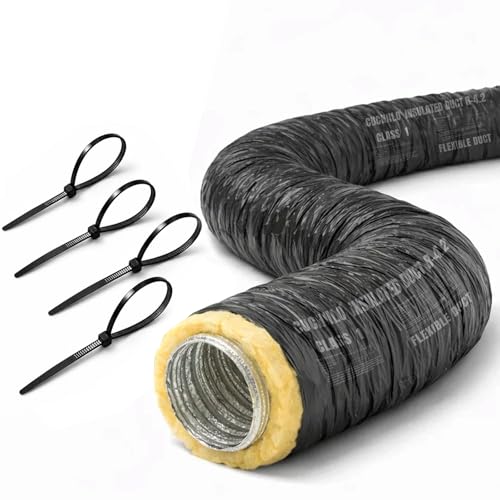
6 Inch Insulated Flexible Duct 25 FT, R4 HVAC Flex Duct with Black Jacket, Fiberglass Insulation, Aluminum Foil Core for Ventilation & Exhaust
Check price on Amazon