AC Units That Hang on the Wall: Complete Guide
Wall-mounted air conditioners are one of the most popular cooling solutions for rooms without ductwork. This guide explains how they work, how to size them, what to expect during installation, and how to choose the right wall-hung unit for your space.
START LEARNINGAC Units Guide Philosophy: A wall-mounted air conditioner is more than a cooling appliance — it is a long-term investment in comfort. Before you buy, understand the technology, the sizing requirements, and the installation implications. Learn first, then choose with confidence.
What Are AC Units That Hang on the Wall?
AC units that hang on the wall are indoor air-handling units mounted high on a room wall, typically part of a ductless mini-split system. The indoor unit — often called a high-wall unit — contains the evaporator coil, blower fan, and air filter, while the compressor and condenser sit in an outdoor unit connected by refrigerant lines through a small wall penetration.
This configuration is popular because it delivers conditioned air directly into the room without the need for ductwork. It is especially useful in older homes, additions, converted attics, garages, and apartments where installing ducts would be impractical or disruptive. If your space lacks ductwork, our guide on adding air conditioning to a house without ductwork explains the broader options.
Wall-hung systems are also a strong fit for apartments and rentals, where structural changes are limited. You can read more about cooling strategies in our guide on AC units for apartments.
How Wall-Mounted Air Conditioners Work
A wall-mounted mini-split operates on the same refrigeration cycle as any air conditioner. The indoor unit draws warm room air through its filter and across a cold evaporator coil. The heat is absorbed by the refrigerant, and the cooled air is blown back into the room. The refrigerant then travels to the outdoor unit, where the heat is released and the cycle repeats.
Most modern wall-mounted units use inverter compressors, which modulate speed to maintain the set temperature rather than cycling on and off. This results in more stable temperatures and often better efficiency. For a deeper explanation, see our article on inverter AC technology.
The indoor unit is typically controlled by a remote or a wall thermostat. Some models support Wi-Fi and smart-home integration. If thermostat control matters to you, our guide on AC with thermostat covers the options.
Types of Wall-Hung AC Units
Not all wall-mounted air conditioners are the same. The category includes several distinct product types, each suited to different situations.
1. Ductless Mini-Split High-Wall Units
This is the most common interpretation of "AC units that hang on the wall." The indoor air handler is mounted near the ceiling, and the outdoor compressor sits on a pad or bracket outside. Systems can be single-zone (one indoor unit) or multi-zone (multiple indoor units connected to one outdoor unit).
2. Through-the-Wall Air Conditioners
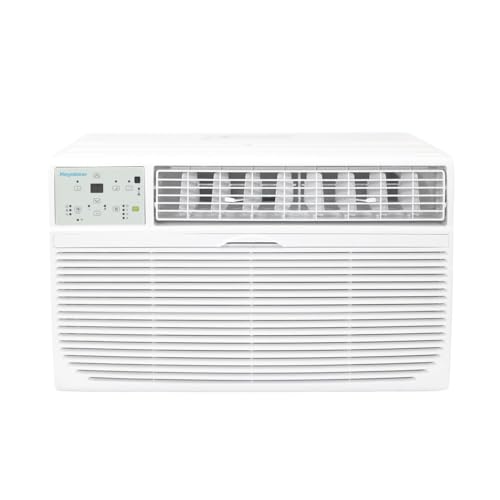
These units are installed through a sleeve in the wall rather than in a window. They are sometimes confused with wall-hung mini-splits, but they are self-contained units that exhaust directly through the wall. If you are comparing installation methods, our guide on AC unit for the wall explores this category in detail.
3. Wall-Mounted Portable and Specialty Units
A smaller category includes wall-mounted evaporative coolers and specialty units. These are less common for whole-room cooling and should be evaluated carefully against your climate and room requirements.
Tip: If you are unsure whether a wall-hung mini-split or a through-the-wall unit fits your situation, consider the wall structure, available outdoor space, and whether you want a single-room solution or multi-room coverage.
Wall-Mounted AC vs Other Cooling Options
Understanding how wall-hung units compare with alternatives helps you make a more informed decision. The table below summarizes the key differences.
| Feature | High-Wall Mini-Split | Window AC | Portable AC | Central AC |
|---|---|---|---|---|
| Requires window | No | Yes | No (needs venting) | No |
| Requires ductwork | No | No | No | Yes |
| Coverage | Single room or zone | Single room | Single room | Whole home |
| Installation complexity | Professional recommended | DIY-friendly | Minimal | Professional required |
| Noise level | Very quiet indoors | Moderate to loud | Moderate | Quiet indoors |
| Efficiency class | Often premium tier | Entry to mid-tier | Entry to mid-tier | Mid to premium tier |
If you want a broader comparison of cooling methods, our guides on portable air conditioners and window air conditioners provide more detail. For homes where ducts already exist, central air may be the more practical path; see adding air conditioning to existing ducted heating.
Pros and Cons of Wall-Mounted Air Conditioners
Advantages
- No ductwork required
- Does not block windows
- Quiet indoor operation
- Zone-by-zone cooling control
- Modern inverter models are highly efficient
- Clean, unobtrusive wall-mounted appearance
- Can include heat pump function for year-round use
Considerations
- Professional installation is strongly recommended
- Requires a wall penetration for lines
- Outdoor unit needs suitable placement and clearance
- Higher upfront complexity than window units
- Each indoor unit serves a limited area
Many wall-mounted systems can also provide heating when equipped with a heat pump. If that interests you, our guide on AC with heat pump explains how the reverse cycle works.
How to Size a Wall-Hung Air Conditioner
Sizing is one of the most important decisions you will make. An undersized unit will struggle to cool the room, while an oversized unit may short-cycle, leading to uneven temperatures and higher humidity. The goal is to match the unit's capacity to the room's actual cooling load.
Capacity is measured in British Thermal Units (BTU). A common starting rule is roughly 20 BTU per square foot of floor area, but this is only a baseline. Ceiling height, insulation, window area, sun exposure, occupancy, and appliance heat all affect the real load.
Quick BTU Reference
| Room Area | Approximate Capacity | Typical Use |
|---|---|---|
| Up to 150 sq ft | 5,000–6,000 BTU | Small bedroom, studio corner |
| 150–250 sq ft | 8,000–10,000 BTU | Bedroom, home office |
| 250–400 sq ft | 12,000–14,000 BTU | Living room, large bedroom |
| 400–600 sq ft | 18,000–24,000 BTU | Open-plan living area |
| 600+ sq ft | Multi-zone or larger single unit | Whole-floor or multi-room |
For a more precise calculation, use our guide on how to size an air conditioner and the BTU calculator by room size. If you are cooling a small room specifically, the recommendations in AC unit for small room are a helpful supplement.
Placement and Installation Essentials
Proper placement affects comfort, efficiency, and the longevity of the equipment. The indoor unit should be mounted high on an exterior wall where possible, with clear space for airflow in front of and above the unit. Avoid mounting directly above heat sources, electronics that are sensitive to condensation, or areas where furniture would block the air stream.
The outdoor unit needs adequate clearance for air intake and discharge, and should be positioned to minimize noise transmission into bedrooms or neighboring properties. Refrigerant line length and elevation differences must stay within the manufacturer's published limits.
While some skilled homeowners attempt DIY mini-split installation, refrigerant handling requires proper equipment and, in many jurisdictions, certification. Our article on EPA refrigerant handling rules provides context on why this matters.
Installation Checklist
- Confirm the wall structure can support the indoor unit's weight and vibration
- Select a location with unobstructed airflow and a clear path to the outdoor unit
- Verify electrical capacity; many systems require a dedicated circuit
- Plan condensate drainage with a slight downward slope
- Keep line-set length and elevation within manufacturer limits
- Have the system pressure-tested and evacuated before charging
Efficiency, Running Behavior, and Long-Term Use
Wall-mounted mini-splits are available across a wide efficiency spectrum. Entry-level models are functional and straightforward, while mid-range and high-end tier units often add inverter compressors, improved filtration, quieter fans, and smart controls. Premium and top-tier models may include advanced humidity management and multi-zone capability.
Efficiency is typically expressed through SEER2 for cooling and HSPF2 for heating. Higher ratings generally correlate with lower energy use over the life of the system. If efficiency is a priority, our overview of SEER ratings and ENERGY STAR certified AC will help you interpret the labels.
Maintenance is another factor in long-term performance. Cleaning or replacing the indoor filter regularly, keeping the outdoor coil clear of debris, and scheduling periodic professional checks will help the system maintain its efficiency. For routine care, see our guide on AC unit filters and AC ventilation cleaning.
Common Problems and Troubleshooting
Even well-installed wall-mounted systems can develop issues over time. Recognizing the symptoms early can save you from more extensive repairs.
- Not cooling: A dirty filter, low refrigerant, or a failing component can reduce cooling. See AC unit is running but not cooling.
- Fan running but no cold air: This often points to a compressor or refrigerant issue. Our article on AC unit fan spinning but no cold air walks through the possibilities.
- Airflow problems: Blocked filters, fan faults, or ductless unit obstructions can reduce airflow. Read AC unit is running but not blowing air.
- Thermostat not being reached: If the room never reaches the set temperature, the unit may be undersized, low on refrigerant, or affected by heat gain. See AC unit not keeping up with thermostat.
For a broader diagnostic guide, our page on AC unit working but not blowing cold air covers many common scenarios in one place.
Who Should Choose a Wall-Mounted AC?
Wall-hung air conditioners are a strong fit for:
- Rooms without existing ductwork
- Older homes where duct installation is impractical
- Additions, sunrooms, garages, and converted spaces
- Apartments and rentals where window units are restricted
- Homeowners who want zone-by-zone temperature control
They may be less suitable if you need to cool an entire home with one unit, if outdoor space for the compressor is limited, or if local regulations restrict exterior equipment placement. For homes without windows in the target room, our article on AC unit for a room with no windows is a useful companion.
If you are weighing a wall-mounted ductless unit against a window unit, the overview in AC unit that doesn't require a window may help clarify the trade-offs.
Frequently Asked Questions
What are AC units that hang on the wall called?
They are commonly called high-wall mini-split units, wall-mounted ductless air conditioners, or wall-hung AC units. Most are part of a ductless mini-split system where the indoor air handler is mounted high on a wall and connected to an outdoor compressor via refrigerant lines.
Do wall-mounted AC units require a window?
No. Wall-mounted mini-split units only require a small hole through the wall for refrigerant lines, power, and drainage. This makes them suitable for rooms that lack a suitable window or where window space is needed.
How high should a wall-mounted AC be installed?
Most manufacturers recommend mounting the indoor unit between 6 and 8 feet above the floor, with at least 6 to 12 inches of clearance from the ceiling. The unit should be positioned to allow unobstructed airflow across the room.
Are wall-hung air conditioners energy efficient?
Yes. Modern ductless wall-mounted units are available in premium and top-tier efficiency classes, often achieving high SEER2 ratings. Because they deliver cooled air directly to the room without duct losses, they can be efficient in the long run compared with ducted systems in certain home layouts.
Can one wall-mounted unit cool an entire house?
A single wall-mounted unit is designed for one room or a defined open area. For whole-home cooling you would typically need a multi-zone system with several indoor wall units connected to one outdoor unit, or a different system type such as central air.
Ready to Compare Wall-Mounted AC Options?
Explore our curated selection of wall-hung air conditioners and ductless mini-split systems below, then match the unit to your room size and efficiency goals.
VIEW RECOMMENDED UNITS