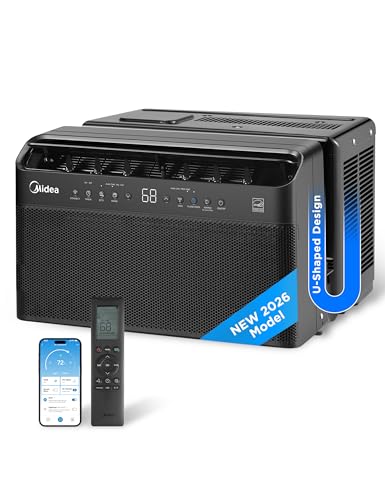
Air Conditioner That Fits in a Small Window
Narrow window openings do not have to mean a hot room. Learn how to measure your window correctly, understand the spec limits of compact AC units, and choose a model that cools efficiently without forcing an oversized frame into a small opening.
EXPLORE COMPACT MODELSWhy Window Fit Matters More Than You Think
A window air conditioner relies on a secure, stable installation to work safely and efficiently. The unit's frame, side panels, and mounting bracket must sit flush against the window sill and sash. When an AC is too wide for the opening, homeowners often resort to unsafe workarounds — removing the sash, leaving gaps unsealed, or propping the unit on improvised supports. These shortcuts reduce cooling performance, let in outside air and insects, and create a genuine safety risk.
Beyond safety, fit directly affects efficiency. A unit that does not seal properly against the window frame will leak cooled air and pull in warm outside air, forcing the compressor to run longer. That is why understanding the actual dimensions of your window opening before you shop is the single most important step. If your window is unusually narrow, you may also want to read our guide on air conditioners for small window openings for additional context on sizing standards.
Key insight: The minimum window width stated by manufacturers refers to the clear opening between the window jamb and the sash — not the total window frame width. Always measure the space where the unit will actually sit, and leave a small margin for the window bracket and side panels.
How to Measure Your Window Opening Correctly
Before comparing any models, take three measurements with a tape measure and write them down. Use the smallest measurement in each direction, because window frames are rarely perfectly square.
-
Measure the width
Measure the clear horizontal opening between the left and right window jamb at the point where the AC will rest. This is the width the unit's chassis must pass through. Most narrow window AC units require at least 21 to 23 inches of clear width.
-
Measure the height
Measure the vertical clearance from the window sill to the bottom of the raised sash. A partially raised sash determines the usable height. Compact units typically need 13 to 15 inches of vertical clearance.
-
Measure the sill depth
Measure from the interior edge of the sill to the exterior edge. The AC needs enough sill depth to support its frame, and the rear of the unit must extend outward so exhaust air vents properly. A depth of at least 3 inches inside is common for compact models.
Once you have these three numbers, compare them against the "minimum window width" and "minimum window height" figures in each product's specification sheet. If your window is a slider or casement style, the measurement approach changes — see our notes on air conditioners that fit in sliding windows for that scenario.
The Specs That Define a "Small Window" AC
Not every compact-looking unit is actually designed for a narrow opening. The table below summarizes the typical specification ranges you should look for when shopping for a small window opening. These are general market ranges, not figures tied to any single model.
| Specification | Typical Range for Small Window AC | What It Means for You |
|---|---|---|
| Minimum window width | 21 – 23 inches | The narrowest clear opening the chassis can pass through |
| Minimum window height | 13 – 15 inches | Vertical clearance needed with the sash raised |
| Cooling capacity | 5,000 – 8,000 BTU | Sized for rooms up to roughly 250 square feet |
| Unit width (chassis) | 15 – 19 inches | Physical width of the unit body, excluding side panels |
| Unit height (chassis) | 12 – 14 inches | Physical height of the unit body |
| Efficiency tier | Entry-level to high-end tier | Compact units exist across all efficiency tiers, including ENERGY STAR models |
| Voltage | 110V – 115V | Standard household circuit for small-capacity units |
Pay attention to the distinction between "unit width" and "minimum window width." The unit width is the physical chassis, while the minimum window width includes the side panels and mounting hardware that seal the gap between the unit and the window frame. A unit that is 16 inches wide may still require a 21-inch window opening once the accordion panels are installed.
Types of AC Units for Narrow Windows
There is more than one way to cool a room with a narrow window. The right choice depends on whether you own or rent, whether the window opens vertically or horizontally, and whether you want a permanent or removable solution.
Compact Window AC
The most direct solution. These units are purpose-built for narrow openings, usually 5,000 to 8,000 BTU, and often come with a slide-out chassis for easier cleaning. They are the standard choice for double-hung windows with limited width. Entry-level and mid-range tiers dominate this category, with a few premium models offering inverter compressors.
Through-the-Wall AC
If the window is simply too small and you have an exterior wall available, a through-the-wall unit avoids the window entirely. Installation is more involved and usually requires professional help, but it frees up the window completely. Read more about this path in our guide to air conditioning units without a window.
Portable AC with Window Kit
A portable unit only needs a small vent opening, and many kits include adapters for narrow windows. This is a practical choice for renters or casement windows that cannot accept a window unit. The trade-off is lower efficiency and a larger indoor footprint. See our comparison of air conditioning units without external ventilation for context.
Mini-Split System
If you want to preserve the window entirely and avoid a bulky indoor appliance, a ductless mini-split needs only a small wall penetration for refrigerant lines. It is a premium to luxury tier investment, but it delivers the quietest and most efficient cooling. Explore air conditioning options for homes without ductwork for the full picture.
For most homeowners with a narrow double-hung window, a compact window AC is the simplest path. If your window opens sideways rather than up and down, the options narrow further — our article on air conditioners for windows that open sideways covers the adapters and techniques that make that possible.
Matching BTU to Room Size in a Compact Frame
A small window limits the physical size of the unit, but it should not limit your cooling performance. Compact units are available in several capacity ranges, and choosing the right one prevents two common problems: an undersized unit that never reaches the set temperature, and an oversized unit that cools too quickly and short cycles.
As a general rule, use about 20 BTU per square foot of floor area for a standard room with average ceiling height and insulation. A 100-square-foot bedroom needs roughly 5,000 BTU. A 200-square-foot living area needs roughly 8,000 BTU. For a more precise calculation, our BTU calculator by room size helps account for ceiling height, sun exposure, and occupancy.
Avoid short cycling: If you install an oversized compact unit in a small room, it will blast cold air, satisfy the thermostat quickly, and shut off before it has removed the humidity. The room feels clammy and the compressor wears out faster. Match the BTU rating to the room, not to the biggest unit that fits the window. Learn more about air conditioner short cycling and why it matters.
If your narrow-window room is larger than 250 square feet, a single compact window unit may struggle. In that case, consider a air conditioner that does not need a window or a multi-zone approach rather than forcing an undersized unit into service.
Installation Tips for Small Window Units
A correct installation is what makes a compact AC last. These practical steps apply to most narrow window models and will help you avoid the most common mistakes.
-
Use the manufacturer's bracket or support
Compact units still have weight, and the window sill alone may not provide adequate support. Use the included mounting bracket or an adjustable window bracket. If drilling is not an option, a no-drilling bracket is a viable alternative — see our notes on an air conditioner window bracket with no drilling.
-
Seal the side panels properly
The accordion side panels must fill the entire gap between the unit and the window frame. If the gap is uneven, use weatherstripping or foam insulation to close the remaining space. Any leak will reduce efficiency and invite insects indoors.
-
Maintain a slight outward tilt
Window AC units should tilt slightly toward the outside so condensation drains away from the room. A tilt of about one-quarter inch per foot is typical. Check your model's manual for the exact recommendation.
-
Confirm the electrical circuit
Most compact 5,000 to 8,000 BTU units run on a standard 110V to 115V household circuit. Confirm the amperage requirement and avoid sharing the circuit with other high-draw appliances. Our guide to air conditioner watts explains how to check the load.
-
Plan for seasonal removal and maintenance
If you remove the unit each season, label the panels and keep the mounting hardware together. Regular filter cleaning keeps the unit efficient and is the first step when an AC stops cooling properly — see air conditioner running but not cooling for troubleshooting guidance.
Frequently Asked Questions
What is the smallest width available for a window air conditioner?
The narrowest window AC units on the market typically require a minimum window width of around 21 to 23 inches. These compact models are designed specifically for small window openings and are usually in the 5,000 to 8,000 BTU range.
Can I install a regular window AC in a small window?
A standard window AC unit often requires a minimum window width of 24 to 26 inches. If your window opening is narrower than that, you will need a compact or narrow window AC model built for smaller openings. Attempting to force a larger unit into a small window is unsafe and ineffective.
What BTU size do I need for a small window AC?
For a room up to 150 square feet, a 5,000 BTU unit is usually sufficient. For rooms between 150 and 250 square feet, an 8,000 BTU model works well. Always match the BTU rating to your room size so the unit cools effectively without short cycling.
Are narrow window air conditioners as efficient as standard ones?
Yes, many compact window AC units carry ENERGY STAR certification and inverter compressors. Their efficiency depends on the model tier rather than the physical size. Premium and high-end tier compact units often match the efficiency ratings of larger standard window units.
What if my window is too small for any window AC?
If your clear opening is narrower than about 21 inches, a window unit may not be feasible. In that case, a portable AC with a narrow window kit, a through-the-wall unit, or a mini-split system are the practical alternatives. Each trades a different installation requirement for the window constraint.
Making the Final Decision
A narrow window narrows your options, but it does not eliminate them. Start with accurate measurements of width, height, and sill depth. Compare those numbers against the minimum opening specifications, not just the chassis dimensions. Then match the BTU rating to your room size so the unit runs long enough to remove humidity without wasting energy. If a window unit simply will not fit, the alternative paths — portable, through-the-wall, or mini-split — each solve the problem in a different way. Once you have your measurements and room size in hand, you are ready to evaluate the models in the section below with confidence.