
Energy Saving Window Air Conditioner: The Complete Buyer’s Guide
Understand efficiency ratings, sizing, compressor technology, smart controls, and maintenance habits that keep a window unit running at peak efficiency season after season.
Start With Efficiency RatingsWho this guide is for: If you already know a window air conditioner fits your room and you want the most energy efficient option available, this page walks you through every decision point. You will learn what the efficiency labels actually mean, how oversizing quietly wastes energy, which features matter in daily use, and how routine care protects the efficiency you paid for.
Why Window AC Efficiency Deserves Careful Attention
A window air conditioner is a self-contained cooling system: the compressor, condenser coil, evaporator coil, and fan all sit inside a single chassis mounted in a window opening. Because the unit is compact, every efficiency gain or loss is concentrated. A well-chosen, well-maintained model can cool a bedroom using a fraction of the electricity of an older single-speed unit. A poorly sized or neglected model can run almost continuously and still leave the room uncomfortable.
Window units also differ from central systems in one important way: they are replaced far more often and are far easier to compare side by side. That makes the buying decision unusually consequential. Getting the efficiency rating, capacity, and feature set right at the point of purchase locks in years of lower energy use with no retrofit required. If you are weighing window cooling against a whole-home approach, our overview of air conditioner energy efficiency explains how the concepts connect.
Three factors dominate real-world efficiency: the rated efficiency of the unit, whether the capacity matches the room, and how well the unit is installed and maintained. This guide addresses all three in order.
Efficiency Ratings Explained: EER, CEER, and ENERGY STAR
Window air conditioners are rated on a different scale than central systems. Instead of SEER, you will see EER and CEER on the label. Understanding the difference prevents comparing the wrong numbers.
EER (Energy Efficiency Ratio)
EER is the ratio of cooling output in BTU to electrical input in watts, measured at a single set of standard test conditions (95°F outdoor temperature). A higher EER means more cooling per unit of electricity under that specific condition. EER is useful for comparing units on a like-for-like basis, but it does not reflect part-load performance or the effect of varying outdoor temperatures.
CEER (Combined Energy Efficiency Ratio)
CEER is the modern rating that appears on the yellow EnergyGuide label for room air conditioners. It incorporates a seasonal part-load factor and standby power consumption, so it better reflects how a unit performs across a cooling season rather than at one fixed test point. When two window units differ in CEER, the higher number is the stronger efficiency signal for typical residential use.
ENERGY STAR Certification
ENERGY STAR certified window units must meet efficiency thresholds set above the federal minimum. Certification is a reliable first filter, but it does not distinguish between two certified units. Once you have narrowed the field to certified models, compare CEER values directly. Our guide to ENERGY STAR window air conditioners covers the certification criteria in more detail.
| Tier | Typical CEER Band | What It Means in Practice | Best For |
|---|---|---|---|
| Entry-level | Below 11 | Meets baseline standards; acceptable for occasional use in mild climates. | Guest rooms, seasonal cabins, short-term rentals |
| Mid-range | 11 to 12.9 | Solid efficiency for daily use; often includes eco mode and a remote. | Bedrooms and living rooms used most evenings |
| High-end tier | 13 to 14.9 | Strong efficiency; frequently pairs inverter compressors with smart controls. | Rooms cooled for long daily stretches |
| Top-tier | 15 and above | Best available efficiency; premium components and advanced airflow design. | Hot climates and heavy continuous use |
Sizing: The Most Common Efficiency Mistake
Oversizing is the single most common reason a window air conditioner underperforms on efficiency. A unit that is too large cools the air quickly, satisfies the thermostat, and shuts off before it has removed much humidity. The room feels clammy, the thermostat calls for cooling again shortly after, and the compressor cycles rapidly. Short cycling wastes energy, adds wear, and produces an uncomfortable result even though the unit’s rated efficiency may be excellent.
Undersizing has the opposite failure mode: the unit runs continuously, never reaches the setpoint on hot days, and consumes more energy than a correctly sized model because it is always at full output. The goal is a match, not a margin.
| Room Size | Starting BTU Range | Typical Use Case |
|---|---|---|
| Up to 150 sq ft | 5,000 to 6,000 BTU | Small bedroom, home office, nursery |
| 150 to 250 sq ft | 8,000 to 10,000 BTU | Standard bedroom, small living room |
| 250 to 400 sq ft | 12,000 to 14,000 BTU | Large bedroom, studio apartment, open living area |
| 400 to 550 sq ft | 15,000 to 18,000 BTU | Open-plan living and dining space |
| 550 to 700 sq ft | 20,000 to 24,000 BTU | Large open room or small apartment |
The table is a starting point. Adjust upward for a room that receives direct afternoon sun, has poor insulation, sits on a top floor, or has many windows. Adjust downward for a shaded room, a basement-level space, or a room with very few occupants and little heat-generating equipment. For a full walkthrough of the calculation method, see our guide on how to size an air conditioner.
Compressor Technology: Single-Speed vs Inverter
The compressor is the component that consumes most of a window unit’s electricity. How it is controlled determines how efficiently the unit responds to changing conditions.
Single-Speed Compressors
A conventional single-speed compressor is either fully on or fully off. It cools at a fixed rate until the thermostat is satisfied, then stops. This design is simple and durable, and many entry-level and mid-range window units still use it. The efficiency penalty comes from cycling losses and from the temperature swing that occurs between on and off periods.
Inverter Compressors
An inverter compressor varies its speed continuously. Instead of switching on and off, it slows down as the room approaches the setpoint and runs steadily at low output to hold conditions. This approach reduces temperature swings, avoids repeated high-current startup draws, and generally uses less energy across a cooling season. Inverter window units are increasingly common in the high-end tier and above. Our article on the energy efficient inverter air conditioner explains the underlying mechanism in depth.
For a room that is cooled for long stretches every day, an inverter model is usually the more energy-conscious choice. For occasional use in a mild climate, a well-rated single-speed unit remains a reasonable option, especially when budget is better directed toward correct sizing and a tight window seal.
Features That Support Energy Savings
Beyond the compressor, several features directly influence daily energy use. Prioritize the ones that match how you actually operate the unit.
Eco / Energy Saver Mode
The fan cycles off with the compressor once the setpoint is reached, and the unit periodically samples room temperature. Useful in rooms that are unoccupied for parts of the day.
Programmable Timer
Set the unit to start shortly before you arrive and stop after you leave. Eliminates cooling an empty room, which is one of the simplest efficiency gains available.
Smart Thermostat Integration
Wi-Fi models can follow schedules, respond to geofencing, or accept voice commands. A digital air conditioner thermostat makes precise setpoints easier to maintain.
Multiple Fan Speeds
Low fan speed with a steady compressor is often more efficient for humidity removal than high fan speed with frequent cycling. Adjustable speeds let you tune to conditions.
Washable Filter with Indicator
A clean filter is the cheapest efficiency upgrade available. A filter indicator light removes the guesswork from maintenance intervals.
Sleep Mode
Gradually raises the setpoint overnight as body temperature drops. Small setpoint changes compound into meaningful seasonal savings.
Installation Details That Protect Efficiency
A window unit’s rated efficiency assumes a proper installation. Gaps around the chassis let conditioned air escape and outside air enter, forcing the compressor to work harder. The following steps preserve the efficiency you paid for:
- Seal the perimeter. Use foam weatherstripping or the included insulation panels along the top and sides of the window opening. Close and lock the window against the unit where the design allows.
- Slight downward tilt. The unit should tilt slightly toward the outside so condensate drains away from the room rather than pooling.
- Support the outdoor side. Use the manufacturer’s bracket or a properly rated support. A sagging unit can distort the chassis and stress the seal.
- Shade the outdoor coil. Direct sun on the condenser raises head pressure and reduces efficiency. An awning or exterior shade helps.
- Avoid extension cords. Window units should plug directly into a dedicated outlet. If the run is long, consult our notes on an extension cord for an 8000 BTU air conditioner for safe alternatives.
- Check the electrical circuit. Confirm the outlet and breaker match the unit’s requirements before installation. A permit may be required in some jurisdictions; see do I need a permit for AC.
Maintenance Habits That Preserve Efficiency
Window units lose efficiency gradually, and the loss is easy to miss because the unit keeps running. A consistent maintenance routine restores and protects performance:
- Clean the filter every two to four weeks during heavy use. Rinse with lukewarm water and let it dry fully before reinstalling. A clogged filter restricts airflow and forces the compressor to run longer.
- Clean the evaporator coil at the start of each cooling season. A soft brush and coil cleaner remove dust that insulates the coil and reduces heat transfer.
- Inspect the condenser coil from the outside. Remove debris, leaves, and lint. Straighten bent fins with a fin comb.
- Check the drain path. A blocked drain can cause water to pool and, in humid conditions, promote mold growth that affects air quality and airflow.
- Inspect the window seal each season. Replace compressed weatherstripping before it becomes a gap.
- Store properly in the off-season. If you remove the unit, clean it thoroughly, dry it, and store it covered to prevent dust buildup inside the coils.
If you want a broader routine that covers the whole system rather than just the window unit, our guidance on how to reduce your AC electricity bill puts these habits in a household-wide context.
How Window AC Compares to Other Efficient Cooling Options
A window unit is not the only route to efficient spot cooling. Understanding the alternatives helps confirm whether it is the right fit for your room.
- Portable air conditioners offer flexibility but typically have lower efficiency because the exhaust hose introduces heat gain. Our comparison of the energy efficient portable air conditioner explains where portables make sense.
- Ductless mini-splits deliver higher efficiency and quieter operation, but require professional installation and a larger upfront commitment. See energy efficient window unit options for a direct comparison of window versus mini-split trade-offs.
- Through-the-wall units are permanently installed and avoid window sealing issues. Our guide to the energy efficient through-the-wall air conditioner covers that category.
- Central systems make sense for whole-home cooling but are disproportionate for a single room. For context on scale, see energy efficient central air conditioners.
For most single-room applications where a window opening is available, a well-rated window unit remains the most direct path to efficient cooling without structural work.
A Practical Shortlisting Method
When comparing models, work through the criteria in this order. Each step narrows the field without requiring you to weigh every specification at once.
- Step 1: Confirm capacity. Calculate the BTU range for your room and eliminate anything outside it. This step alone removes most mismatches.
- Step 2: Compare CEER. Among the correctly sized units, rank by CEER. Use the tier table above as a frame of reference.
- Step 3: Check the compressor type. Prefer inverter models if the room is cooled for long daily periods.
- Step 4: Match features to habits. Timer and eco mode for working households; smart controls for households that want remote management; sleep mode for bedrooms.
- Step 5: Verify installation requirements. Confirm window width, electrical circuit, and support bracket compatibility before committing.
- Step 6: Read owner reviews for reliability. Look for patterns in long-term feedback rather than single-star complaints about delivery.
If you are also weighing efficiency upgrades elsewhere in the home, our overview of energy efficient AC and high efficiency HVAC systems provides the broader context for how room-level choices fit into a whole-home strategy.
Frequently Asked Questions
What EER or CEER rating should an energy saving window air conditioner have?
Look for a CEER of at least 12 for a solid mid-tier model. High-end tier and top-tier window units reach 14 or above. CEER is the modern rating shown on the yellow EnergyGuide label and reflects seasonal performance better than the older EER value.
Does an inverter window air conditioner use less energy?
Yes. An inverter compressor modulates its speed instead of switching fully on and off. This reduces temperature swings and cycling losses, which is why inverter models are usually more energy efficient in real-world use than single-speed units of the same capacity.
What size window AC do I need for a bedroom?
A room up to roughly 150 square feet typically needs 5,000 to 6,000 BTU. Rooms between 150 and 250 square feet usually need 8,000 to 10,000 BTU. Oversizing wastes energy through short cycling, so always run a BTU calculation before choosing.
Does an ENERGY STAR window air conditioner save energy?
Yes. ENERGY STAR certified window units meet stricter efficiency thresholds than standard models. Certification is a reliable shortcut when comparing similar capacities, though you should still compare CEER values between certified units.
How can I lower the energy use of my existing window AC?
Clean the filter every two to four weeks, seal gaps around the window frame, shade the outdoor side of the unit, set the thermostat higher when away, and use the fan-only or eco mode when humidity is low. Regular coil cleaning also restores lost efficiency.
Is it better to run a window AC all day or turn it off when I leave?
Turning it off or using a timer is generally more efficient for a single room. A window unit does not benefit from the thermal inertia arguments sometimes made for central systems; cooling an empty room is wasted energy. Use the timer to start the unit shortly before you return.
How long does a well-maintained window air conditioner last?
With regular filter cleaning, seasonal coil cleaning, and proper winter storage, a quality window unit typically serves for many cooling seasons. Maintenance matters more than the initial tier for longevity, though higher-tier units generally use more durable components.
Recommended Energy Saving Window Air Conditioners
⚠️ AFFILIATE DISCLOSURE: This website contains affiliate links. As an Amazon Associate, we earn from qualifying purchases. If you make a purchase through these links, we may receive a small commission at no additional cost to you. Read our full affiliate policy.

Midea 6,000 BTU Window Air Conditioner, Electronic Control, 250 Sq Ft, New | 3-In-1 Cool/Fan/Dehumidifier Modes, Easy-To-Use Controls, Remote Control, And Cooling For Bedrooms, Studies and Home Offices
Check price on Amazon
Midea 6,000 BTU U Shaped Window Air Conditioner, Cools up to 250 Sq Ft | Ultra Quiet U-Shaped Design, Inverter Control, Open Window Flexibility, Alexa/Google Assistant, 37% Energy Savings, 2026 New
Check price on Amazon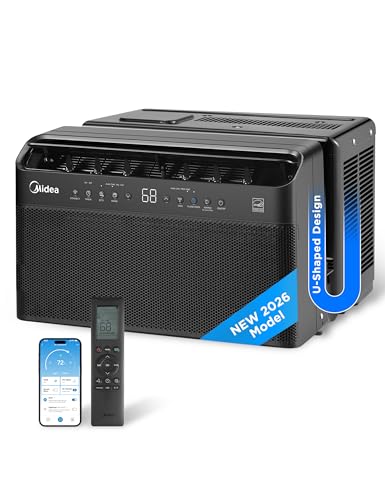
Midea 6,000 BTU U Shaped Window Air Conditioner, Cools up to 250 Sq Ft | Ultra Quiet U-Shaped Design, Inverter Control, Open Window Flexibility, Alexa/Google Assistant, 37% Energy Savings, Jet Black
Check price on Amazon
Midea 10,000 BTU U Shaped Window Air Conditioner, Cools up to 450 Sq Ft | Ultra Quiet U-Shaped Design, Inverter Control, Open Window Flexibility, Alexa/Google Assistant, 37% Energy Savings, 2026 New
Check price on Amazon
Frigidaire 5,000 BTU Window-Mounted Air Conditioner, Cools Up to 150 Sq. Ft., Quiet Operation, Effortless Temperature Control, 2 Fan Speeds, Auto Restart, White
Check price on Amazon
Midea 10,000 BTU Smart Inverter 115V Window Air Conditioner, 450 Sq Ft | Smart Control With App and Alexa Compatibility, Energy Saving Inverter Technology, Quiet, Remote control, Easy Installation
Check price on Amazon
Midea 5,000 BTU EasyCool Small Window Air Conditioner - Cool up to 150 Sq. Ft. with Easy-to-Use Mechanical Controls and Reusable Filter, Perfect for Small Bedroom, Living Room, Home Office
Check price on Amazon