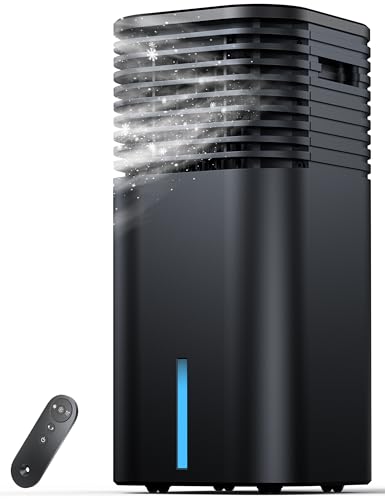
Fully Evaporative Portable Air Conditioner
A practical guide to fully evaporative portable air conditioners: how evaporative cooling works, where these units perform well, which features matter, and how to keep one running efficiently through the cooling season.
START LEARNINGQuick answer: A fully evaporative portable air conditioner — also called a portable evaporative cooler or swamp cooler — cools air by passing it through a water-saturated pad. As water evaporates, it absorbs heat from the air, lowering the temperature of the outgoing airflow. These units work best in dry climates with low humidity, and they need constant ventilation because they add moisture to the air. They are not the same as compressor-based portable AC units, which use refrigerant to remove heat.
What Is a Fully Evaporative Portable Air Conditioner?
A fully evaporative portable air conditioner is a freestanding cooling device that relies entirely on evaporation to lower air temperature. Inside the unit, a pump circulates water from a tank over a cooling pad, and a fan pulls warm outside air through the wet pad. As the air passes through, some water evaporates and absorbs heat from the air stream, producing a cooler, more humid output that is directed into the room.
The phrase "fully evaporative" matters. Some portable devices combine an evaporative pad with a small compressor, but a fully evaporative unit uses no refrigerant and no compressor at all. That distinction affects performance, power draw, and the conditions where the unit is genuinely useful. If you are comparing designs, our overview of the evaporative air cooler portable air conditioner category explains the broader landscape.
How Evaporative Cooling Works
The physics are simple and reliable: water absorbs heat as it changes from liquid to vapor. In a fully evaporative cooler, the fan continuously draws air through a wet pad, and the evaporation that occurs inside the pad removes heat from the air before it exits into the room.
- Water tank: Holds the water supply. Capacity determines how long the unit can run before a refill is needed.
- Pump: Moves water from the tank to the top of the cooling pad so the pad stays saturated.
- Cooling pad: A honeycomb or rigid media pad where evaporation occurs. Pad condition directly affects cooling performance.
- Fan and blower: Pulls outside air through the pad and pushes the cooled air into the room.
- Ventilation requirement: Because the unit adds moisture to the air, it needs a path for air exchange — usually an open window or door. Without that exchange, humidity rises and cooling effectiveness drops.
This is fundamentally different from a compressor-based unit. A standard portable air conditioner removes heat and moisture and exhausts warm air through a hose. A fully evaporative unit adds moisture and cools by evaporation, so the room needs airflow to avoid becoming humid. The trade-off is explained in more detail in our comparison of evaporative cooler maintenance practices.
Where Evaporative Cooling Works Best
Climate is the single most important factor in whether a fully evaporative cooler will perform well. Evaporative cooling depends on dry air; in humid conditions, the air is already close to saturation and cannot absorb much additional moisture, so the cooling effect becomes minimal.
Hot, Dry Climates
Desert and semi-arid regions with low relative humidity are the ideal setting. The drier the air, the more evaporation occurs and the greater the temperature drop.
Ideal conditionsWell-Ventilated Spaces
Rooms, garages, workshops, and patios with cross-ventilation allow moisture-laden air to escape and fresh dry air to enter. This keeps cooling effective.
Ventilation-friendlySpot Cooling Outdoors
Covered patios, garages, and workspaces are natural fits because the surrounding air volume is large and moisture disperses quickly.
Outdoor and semi-outdoorLow-Humidity Indoor Use
Indoors, evaporative coolers can be useful in dry climates when a window is cracked open to provide the necessary air exchange.
Dry indoor airNot for Humid Regions
In humid climates, the cooling effect is limited and the added moisture can make the space feel worse. Compressor-based cooling is a better choice there.
Climate-limitedNot for Enclosed Rooms
A fully evaporative unit running in a closed, unventilated room will raise humidity without delivering meaningful temperature reduction.
Ventilation requiredIf your climate is humid, a compressor-based unit is usually the more practical option. Our guide to the most cost effective portable air conditioner explores the trade-offs across portable cooling categories.
Key Features Worth Comparing
Feature lists for evaporative coolers look similar across brands. The differences that affect real-world performance are usually water capacity, pad design, airflow, and control quality.
| Feature | Why It Matters | What to Look For |
|---|---|---|
| Water tank capacity | Determines runtime between refills | Larger tanks reduce interruptions; check whether a continuous drain option exists |
| Cooling pad type | Directly affects evaporation efficiency | Rigid honeycomb media pads generally outperform thin cellulose pads |
| Airflow (CFM) | Determines coverage and how far the cool air reaches | Match airflow to room or area size; too little airflow limits usefulness |
| Fan speed settings | Allows balancing noise and cooling output | Three or more speeds with a low setting for quiet operation |
| Oscillation | Spreads airflow across a wider area | Useful in larger rooms and outdoor spaces |
| Controls and timer | Convenience and scheduling | Remote control, timer, and clear display improve daily use |
| Mobility | Determines how easily the unit can be moved | Casters and a balanced base make relocation practical |
Build quality also matters. A solid build and reinforced housing reduce vibration and extend service life, especially in garages and workshops where the unit may be moved frequently.
Tier Overview
Evaporative coolers are available across a range of specifications. The tiers below describe relative market positioning rather than any specific figure, and they help you think about which category fits your use case.
Essential Tier
Compact units with modest airflow and a smaller tank. Suitable for personal spot cooling near a desk or seating area in dry climates.
Entry-levelBalanced Tier
Larger tanks, better pads, and more fan speeds. A solid choice for bedrooms, living areas, and covered patios in dry climates.
Mid-rangeHigh-End Tier
High airflow, premium pad media, robust housings, and advanced controls. Suited to large spaces, workshops, and semi-outdoor use where performance matters.
PremiumInstallation and Setup Considerations
Setup is simpler than a compressor-based portable AC, but a few details determine whether the unit actually performs as intended.
- Position near fresh air: Place the unit where it can draw in dry outside air, ideally near an open window or door. Do not place it in a closed corner.
- Provide cross-ventilation: A second opening on the opposite side of the room lets moist air escape, which keeps the cooling effect stable.
- Level surface: A level floor prevents the water tank from tipping and keeps the pump primed correctly.
- Water supply: Fill the tank to the indicated level and, where possible, use the continuous fill or drain option for extended operation.
- Electrical safety: Use a grounded outlet and avoid extension cords where possible. Outdoor use requires an outlet rated for the environment.
- Airflow path: Do not block the intake or outlet grilles; the unit needs unobstructed airflow in both directions.
For units used on patios or in garages, verifying the outlet and circuit capacity in advance avoids tripping breakers. Our overview of electrical outlet plugs is a useful reference for matching the plug type to the outlet.
Maintenance That Keeps Performance High
Evaporative coolers depend on water, and that means maintenance is not optional. Mineral buildup and biological growth are the most common causes of declining performance and unpleasant odors.
- Drain and refill regularly: Do not let water sit in the tank for long periods. Empty the tank after use and refill with fresh water.
- Clean the cooling pad: Rinse or replace the pad according to the manufacturer's guidance. A clogged pad reduces evaporation and cooling output.
- Descale the tank: Mineral deposits from hard water accumulate over time. Periodic descaling keeps the pump and pad working correctly.
- Dry the unit before storage: Run the fan without water for a short period and drain the tank fully before storing for the season.
- Inspect the pump and fan: Unusual noise or reduced water flow usually points to a pump issue or debris in the fan housing.
The full maintenance routine is covered in our guide to evaporative cooler maintenance. If you notice persistent odor or reduced airflow, the unit may need a deeper clean or a new pad before the next season.
Evaporative vs Compressor-Based Portable Cooling
The two categories are often confused, but they solve different problems and work under different conditions.
| Category | How It Cools | Best Climate | Ventilation |
|---|---|---|---|
| Fully evaporative cooler | Evaporation of water into the air stream | Hot, dry climates | Needs open window or door |
| Compressor-based portable AC | Refrigerant cycle removes heat and moisture | Any climate, including humid | Exhaust hose to outside |
If your priority is dehumidification or reliable cooling in humid weather, a compressor-based unit is the correct tool. Our overview of the dual inverter portable air conditioner category explains what to expect from that design. If your climate is dry and ventilation is available, evaporative cooling is an efficient and practical alternative.
Common Mistakes to Avoid
- Using a fully evaporative unit in a closed room. Without air exchange, humidity rises and the cooling effect fades.
- Expecting compressor-level cooling. Evaporative coolers produce a temperature drop, not refrigeration. Expectations should match the technology.
- Buying for a humid climate. Performance is closely tied to ambient humidity. Confirm the climate first.
- Neglecting the pad. A fouled pad is the most common cause of declining performance.
- Leaving water in the tank between uses. Stagnant water causes odor and promotes biological growth.
Frequently Asked Questions
Does a fully evaporative portable air conditioner actually cool a room?
Yes, in dry climates and in spaces with adequate ventilation. It lowers the temperature of the air passing through the pad. In humid climates or closed rooms, the cooling effect is limited and humidity rises, so performance expectations should be calibrated to the environment.
Do I need to open a window when using one?
Yes. Fully evaporative units add moisture to the air, and without an air exchange path, humidity builds up. A slightly open window or door on the opposite side of the room provides the airflow needed for the unit to keep cooling effectively.
How often should I change the water?
Drain and refill the tank after each use or at least daily during active use. Fresh water reduces odor and mineral buildup. If the unit will not be used for a few days, empty the tank completely.
Can I use an evaporative cooler in a bedroom?
Yes, in dry climates and with some ventilation. Many units have low fan settings that are quiet enough for sleeping. Place the unit so the airflow reaches the bed without blowing directly on occupants, and keep a window cracked for air exchange.
How is it different from a misting fan?
A misting fan sprays fine water droplets into the air, while an evaporative cooler passes air through a wet pad so evaporation occurs inside the unit. Evaporative coolers generally deliver more consistent cooling and do not leave surfaces damp from mist.
Bottom Line
A fully evaporative portable air conditioner is a practical and efficient cooling option in dry climates, especially in spaces with good ventilation such as patios, garages, workshops, and dry indoor rooms. Its performance is tied to ambient humidity and airflow, so matching the unit to the environment is the most important decision.
Choose the tier based on the space and how far the airflow needs to reach, then commit to basic maintenance: fresh water, a clean pad, and proper drying before storage. Review the recommended models below to move from planning to selection.