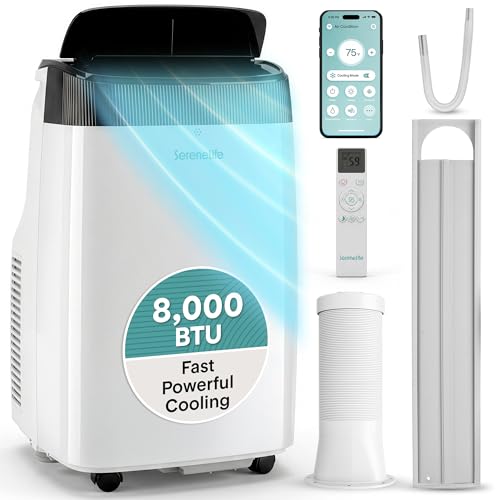
Quietest 8000 BTU Portable Air Conditioner: Silent Cooling Guide
Find a genuinely quiet 8000 BTU portable air conditioner for bedrooms, home offices, and studios. Learn what noise levels really mean, which features reduce sound, and how to choose a model that keeps you cool without keeping you awake.
Explore Quiet FeaturesWhy this guide exists: Most portable AC listings advertise cooling capacity but say very little about real-world noise. If you need an 8000 BTU unit for a room where you sleep, study, or take calls, sound output matters as much as airflow. This guide explains exactly how to identify the quietest 8000 BTU portable air conditioner for your space, and what to look for beyond the decibel number on the box.
What an 8000 BTU Portable Air Conditioner Can Do
An 8000 BTU portable air conditioner is a mid-capacity single-hose or dual-hose unit designed to cool a single room. In practical terms, it suits spaces of roughly 150 to 250 square feet, assuming a standard ceiling height and average insulation. That range covers most bedrooms, small living rooms, home offices, and studio apartments.
Compared with smaller 5000 to 6000 BTU models, an 8000 BTU unit moves more air and cools a larger area, but it also tends to produce slightly more sound because of the larger compressor and fan. That is why the quietest 8000 BTU portable air conditioner category is so valuable: it delivers the extra cooling capacity without forcing you to accept a loud living space.
Capacity is only half of the story. Room orientation, window size, sun exposure, and the number of occupants all affect how hard the unit has to work. A room that is heavily sunlit or poorly insulated may push the compressor to run longer, which increases perceived noise. If you are unsure about your room's requirement, review our guide on quiet portable air conditioners for small rooms to compare capacity against noise expectations.
Decibel Basics: What "Quiet" Really Means
Portable air conditioner noise is measured in decibels, abbreviated as dB. The scale is logarithmic, meaning a 10 dB increase is perceived as roughly twice as loud. That is why a unit rated at 60 dB feels much more intrusive than one at 52 dB, even though the numbers look close on paper.
Use this reference table to interpret manufacturer noise ratings in context:
| Noise Level | Real-World Comparison | Best Suited For |
|---|---|---|
| Under 50 dB | Quiet library or soft whisper | Bedrooms, nurseries, recording spaces |
| 50 to 53 dB | Quiet conversation | Sleep, focused work, reading |
| 54 to 56 dB | Normal conversation | Living rooms, casual home offices |
| 57 to 60 dB | Background office noise | Short cooling sessions, daytime use |
| Above 60 dB | Busy street or vacuum cleaner | Temporary cooling in utility areas |
For a true sleep-friendly experience, aim for a model that stays at or below roughly 52 dB on its lowest fan speed. Many quiet-tier 8000 BTU models achieve this, while entry-level units often sit in the mid-to-high 50s even on low. Keep in mind that decibel ratings are usually taken at a specified distance, often one meter, so placement in the room matters just as much as the specification sheet.
Features That Make an 8000 BTU Portable AC Quieter
Not all quiet models achieve their low noise output the same way. Understanding the engineering behind the sound helps you judge whether a listing is genuinely quiet or simply marketing language. The following features are the strongest indicators of a truly silent portable air conditioner.
Inverter Compressor
Instead of switching on and off at full power, an inverter compressor modulates its speed. This avoids the loud compressor cycling that many entry-level units produce and keeps the sound profile steadier and softer.
Sound-Dampening Insulation
Foam insulation around the compressor compartment and internal panels absorbs vibration and muffles mechanical noise. This is one of the most reliable indicators of a quiet-tier build.
Variable Fan Speeds
A genuinely low fan setting is critical. Some units claim multiple speeds but never drop below a moderate airflow. Look for a low setting that stays under 52 dB and moves enough air to remain comfortable.
Sleep Mode
Sleep mode gradually adjusts temperature and fan speed, reducing both cooling intensity and noise overnight. It is a small feature with a large impact on bedroom usability.
Dual-Hose Design
Dual-hose models separate intake and exhaust airflow, which can reduce strain on the fan and compressor. The result is often a more stable and slightly quieter operation than single-hose designs.
Rubber Vibration Mounts
Compressors and fans mounted on rubber isolators transfer less vibration to the cabinet and floor. This reduces the low-frequency hum that many users find most distracting.
When comparing models, treat these features as a checklist rather than a single deciding factor. A high-end tier model with an inverter compressor, insulation, and a genuine low fan speed is the most reliable path to quiet operation. If you want to broaden your comparison across capacities, our overview of the quietest portable air conditioners covers how these features scale across different BTU classes.
Sizing and Placement: Quiet Operation Starts Before You Buy
The quietest 8000 BTU portable air conditioner can still feel loud if it is oversized, undersized, or placed poorly. A unit that is too small will run at maximum fan speed for long periods, which is the loudest possible operating state. A unit that is too large will short-cycle, producing frequent compressor starts that are more noticeable than steady operation.
Follow these practical steps to keep noise low:
- Match capacity to the room. Use 8000 BTU for roughly 150 to 250 square feet. If your room is larger or heavily sunlit, consider a higher capacity model from our quietest 10000 BTU portable air conditioner guide rather than forcing an 8000 BTU unit to overwork.
- Position the unit away from seating and sleeping areas. Even a quiet unit is noticeably louder within one meter. Aim for at least two meters of distance between the unit and your bed or desk.
- Seal the window vent properly. A poorly sealed vent kit lets hot air back in, forcing the compressor to run longer and louder. Use the supplied window kit and seal gaps with foam or weatherstripping.
- Keep the exhaust hose short and straight. Long, kinked hoses increase back pressure and make the fan work harder. Route the hose as directly as possible to the window.
- Place the unit on a stable, level surface. Uneven floors cause vibration, which transfers through the cabinet and amplifies perceived noise.
If you are comparing portable cooling with other formats, our analysis of the pros and cons of portable air conditioners explains when a portable unit makes sense versus a window or mini-split system. For rooms where noise is the top priority, a quiet window air conditioner with remote control can sometimes be a quieter alternative because the compressor sits outside the room.
Comparing Quiet Tiers for 8000 BTU Portable ACs
To make the market easier to navigate, we classify 8000 BTU portable air conditioners into three practical tiers based on build quality and noise engineering. This is a relative classification, not a reflection of any specific brand or retailer.
| Tier | Typical Noise Profile | Key Characteristics | Best For |
|---|---|---|---|
| Entry-Level Tier | Mid-to-high 50s dB on low | Standard compressor, basic fan speeds, minimal insulation | Daytime cooling in living areas where some background noise is acceptable |
| Mid-Range Tier | Low 50s dB on low | Inverter or improved compressor, partial insulation, sleep mode | Bedrooms and home offices where quiet operation is important |
| High-End Tier | Under 50 dB on low | Full sound-dampening, dual-hose design, vibration isolation, precise fan control | Sleep-sensitive users, nurseries, recording or study spaces |
In practice, the gap between entry-level and mid-range tier is the most meaningful for most buyers. Entry-level units are often louder on their lowest setting than mid-range models are on medium. If silence is the priority, start your comparison at the mid-range tier and move upward only if the room demands it.
Maintenance Habits That Keep Your Portable AC Quiet
Even the quietest 8000 BTU portable air conditioner will grow louder over time if it is neglected. Dust and debris increase resistance in the airflow path, forcing the fan to work harder and generating more noise. A simple maintenance routine keeps sound output close to the manufacturer's specification.
- Clean or replace the air filter every two to four weeks during heavy use. A clogged filter is one of the most common causes of increased fan noise.
- Check the exhaust hose for kinks and blockages. Restricted airflow raises fan load and sound.
- Empty the condensate tank promptly. Some units become louder or cycle oddly when the water level is high.
- Inspect the fan blades and cabinet for dust buildup at the start of each cooling season.
- Listen for new rattles or hums. A sudden change in noise often signals a loose panel, worn mount, or debris inside the unit.
If you notice a persistent rattle or grinding sound that cleaning does not resolve, it is worth reviewing common repair scenarios before assuming the unit needs replacement. For broader troubleshooting, our guide on repairing a portable air conditioner covers the most frequent causes of unusual noise.
Ready to Compare Quiet 8000 BTU Models?
Browse a curated selection of 8000 BTU portable air conditioners chosen for their noise engineering, build quality, and suitability for bedrooms and home offices. Each listing links to detailed specifications so you can compare features directly.
View Quiet 8000 BTU OptionsWho Should Choose a Quiet 8000 BTU Portable AC?
A quiet 8000 BTU portable air conditioner is the right fit for a specific set of situations. You will get the most value from this category if any of the following apply:
- You sleep in the room you are cooling. Bedrooms are the most noise-sensitive environment, and a unit above roughly 55 dB on low will disrupt sleep for many people.
- You work from home in the same room. Background noise during calls and video meetings is a common complaint with louder portable units.
- You live in a rental or cannot install a window or mini-split system. Portable units remain the most flexible option when permanent installation is not allowed.
- You need to cool a room of roughly 150 to 250 square feet. This is the sweet spot for 8000 BTU capacity, where the unit does not need to run at maximum output for long periods.
- You want a balance between capacity and portability. Larger 12000 to 14000 BTU units cool more area but are heavier and often louder; 8000 BTU is a practical middle ground.
If your room is smaller, a lower-capacity unit may be quieter overall. Our guide to the quietest 5000 BTU portable air conditioner covers compact rooms where less cooling capacity is sufficient. If your room is larger, stepping up to a higher-capacity quiet model is usually more effective than running an 8000 BTU unit at full speed all day.
Frequently Asked Questions
How quiet is an 8000 BTU portable air conditioner?
Noise output varies by model and fan speed. Many units operate around 50 to 56 decibels on low fan speed, while high settings can reach the low 60s. Premium models with inverter compressors and sound-dampening insulation often run noticeably quieter than entry-level units, sometimes dropping below 50 decibels on their lowest setting.
What decibel level is considered quiet for a portable AC?
For bedrooms and home offices, a noise level at or below 52 decibels on low fan speed is generally considered quiet. Anything around 55 decibels is comparable to a normal conversation, while levels above 60 decibels begin to feel intrusive in a quiet room. Ratings are usually measured at a set distance, so actual perceived noise depends on where the unit sits relative to you.
Can I sleep with an 8000 BTU portable air conditioner running?
Yes, if you choose a model with a low-speed setting under roughly 52 decibels and use the sleep mode. Inverter-driven compressors and units with quiet fan blades are the best match for bedrooms. Positioning the unit away from the bed, sealing the window vent properly, and placing the unit on a stable surface all reduce perceived noise during the night.
Why are some portable air conditioners louder than others?
The main factors are compressor type, fan design, cabinet insulation, and vibration isolation. Inverter compressors modulate speed instead of cycling on and off at full power, which produces a steadier and often quieter sound. Additional insulation and rubber mounts reduce vibration noise, while a well-designed fan moves air with less turbulence.
How many square feet does an 8000 BTU portable AC cool?
An 8000 BTU portable air conditioner typically cools a room of roughly 150 to 250 square feet, depending on ceiling height, insulation, window area, and sun exposure. Rooms with heavy sun load or poor insulation may need a slightly higher capacity to maintain comfort without running at maximum fan speed.
Do dual-hose portable ACs run quieter than single-hose models?
Dual-hose models separate intake and exhaust airflow, which can reduce strain on the fan and compressor compared with single-hose designs. In practice, many dual-hose units operate with a more stable and slightly lower noise profile, especially under continuous load. However, build quality and insulation still matter more than hose configuration alone.
For a broader view of quiet cooling options across categories, you can also compare the quietest air conditioners overall or review quiet 14000 BTU portable models if your space is larger than the 8000 BTU sweet spot. And if you are still deciding between portable and window formats, the quietest and most efficient portable air conditioner guide is a useful next read.