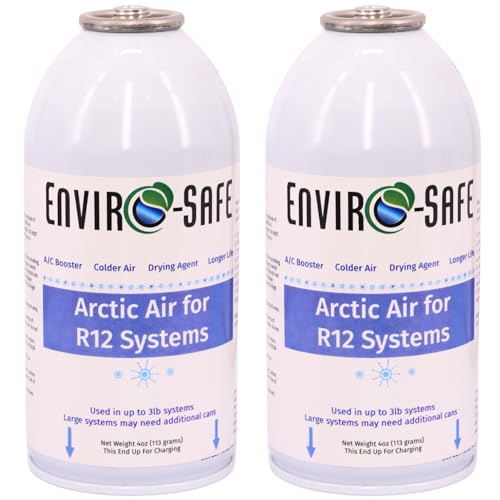
R12 Freon: What It Is and Why It Matters Today
R12 was the dominant refrigerant for decades in air conditioners and vehicle systems, but its ozone-depleting properties led to a global phase-out. This guide explains what R12 freon is, why it was banned, what it means for older equipment, and which replacement refrigerants are used in modern systems.
Quick answer: R12 (dichlorodifluoromethane) is a chlorofluorocarbon (CFC) refrigerant that was widely used in air conditioners, refrigerators, and vehicle AC systems until it was phased out under the Montreal Protocol because it depletes the ozone layer. It is no longer produced or sold for new equipment in the United States. Systems still using R12 require retrofit or replacement.
What Is R12 Freon?
R12, chemically known as dichlorodifluoromethane, is a CFC refrigerant introduced in the 1930s as a safer alternative to the toxic refrigerants used before it. It became the standard refrigerant for residential air conditioners, refrigerators, and automotive AC systems through most of the 20th century. Its low toxicity, stability, and efficient cooling performance made it popular across many applications.
The term "freon" is a brand name that became a generic term for refrigerants in general. When people say "R12 freon," they usually mean the specific CFC refrigerant R12, not the broader family of refrigerants. Modern systems use different refrigerants such as R410A, R32, and R454B, which have far lower ozone-depleting potential.
1 Chemical Identity
R12 is a chlorofluorocarbon with the formula CCl2F2. It is non-flammable, stable, and efficient as a refrigerant, which is why it was so widely adopted.
2 Ozone Impact
R12 has an ozone depletion potential (ODP) of 1.0, the highest reference value. A single chlorine atom from a CFC molecule can destroy thousands of ozone molecules in the stratosphere.
3 Phase-Out Timeline
The Montreal Protocol (1987) set a global schedule to eliminate CFC production. In the United States, R12 production for new equipment ended in the mid-1990s, and the EPA has restricted its sale and handling since.
4 Where R12 Was Used
R12 was common in residential air conditioners, window units, refrigerators, freezers, and vehicle AC systems built before the mid-1990s. Older equipment still in service may still contain R12.
5 Regulatory Status Today
R12 is no longer produced for new equipment in the United States. Handling it requires EPA Section 608 certification. Knowingly venting R12 into the atmosphere is illegal.
6 Availability Today
R12 is available only through reclaimed stock and specialty suppliers. Availability is limited and shrinking, which makes repairs on R12 systems increasingly difficult to justify.
Why R12 Was Phased Out
The scientific consensus in the 1980s linked CFC refrigerants like R12 to the thinning of the ozone layer, which protects life on Earth from harmful ultraviolet radiation. The Montreal Protocol, signed in 1987 and ratified by nearly every country, established a schedule to phase out CFC production. R12 was among the first refrigerants targeted because of its high ozone depletion potential.
The phase-out was not a ban on using existing R12 in already-installed equipment. Instead, it stopped new production and introduced strict rules for handling, recovery, and recycling. Over time, reclaimed R12 supplies have shrunk, and the cost of servicing R12 systems has risen. This is why most older R12 equipment has been retired or retrofitted to a modern refrigerant.
R12 vs Modern Refrigerants
Modern refrigerants are chosen for lower ozone impact, lower global warming potential, and compatibility with newer system designs. The table below compares R12 with the refrigerants most commonly used today.
| Refrigerant | Type | Ozone Impact | Typical Use |
|---|---|---|---|
| R12 | CFC | High — ODP 1.0 | Legacy AC, refrigeration, vehicle AC |
| R22 | HCFC | Moderate — ODP 0.055 | Legacy residential AC (also phased out) |
| R134a | HFC | Zero ODP, high GWP | Vehicle AC, some refrigeration |
| R410A | HFC blend | Zero ODP, high GWP | Residential AC and heat pumps (being replaced) |
| R32 | HFC | Zero ODP, lower GWP than R410A | New residential AC and heat pumps |
| R454B | HFO blend | Zero ODP, lower GWP | Next-generation residential AC |
What This Means for Homeowners
If you own equipment that still uses R12, you have three realistic options: continue servicing the existing system, retrofit it to a modern refrigerant, or replace it entirely. Each path has trade-offs.
Continue Servicing
Reclaimed R12 is still available through specialty suppliers, but it is limited and handling is regulated. Repairs may be possible but can be difficult to sustain long term.
Retrofit to a Modern Refrigerant
Some systems can be retrofitted to R134a or a compatible replacement. This requires replacing the lubricant, seals, and possibly the expansion device. It is not always cost-effective.
Replace the System
For most older R12 systems, replacement with a modern high-efficiency unit is the more practical long-term path. New systems use lower-GWP refrigerants and deliver much better efficiency.
Important note: R12 is a regulated refrigerant. Do not attempt to purchase, handle, or vent R12 without EPA Section 608 certification. Venting refrigerant into the atmosphere is illegal in the United States and damages the ozone layer. Always work with a licensed HVAC technician for R12 recovery, retrofit, or disposal.
R12 vs R22: Understanding the Confusion
R12 and R22 are often confused because both were phased out and both appear in older HVAC equipment. They are different refrigerants with different chemical compositions, different phase-out timelines, and different retrofit paths.
- R12 is a CFC with an ODP of 1.0. It was used in vehicle AC and small refrigeration as well as some early residential systems.
- R22 is an HCFC with an ODP of 0.055. It was the dominant refrigerant in residential split systems for decades and is also being phased out, but on a later schedule than R12.
- Replacement refrigerants differ: R12 systems often retrofit to R134a, while R22 systems are typically replaced rather than retrofitted. See R22 replacement for the R22-specific path.
- Both refrigerants are regulated under EPA Section 608, and both require certified technicians for handling.
Related Refrigerant Topics
R12 is part of a broader story about refrigerant regulation and the shift to lower-impact alternatives. These related guides cover the surrounding topics:
- R22 replacement — the phase-out path for the refrigerant that followed R12 in residential AC.
- HVAC refrigerant cycle — how refrigerant moves through a system to move heat.
- Common AC problems — troubleshooting when cooling drops off, including low refrigerant symptoms.
- My AC is not cooling my house — a homeowner checklist when cooling performance falls short.
- Air conditioner is running but not cooling the house — isolating whether the issue is refrigerant, airflow, or electrical.
Maintaining Older Systems and Planning Ahead
If you are still running an older system, focus on keeping it efficient while you plan the eventual transition. Regular maintenance reduces the chance of a refrigerant leak, which matters more on R12 equipment because reclaimed supplies are limited.
- Schedule an annual professional tune-up before cooling season.
- Replace air filters monthly during peak use to protect airflow and coil performance.
- Watch for ice on the indoor coil — this can signal low refrigerant or restricted airflow.
- Keep the outdoor unit clear of debris and confirm the condenser fan spins freely.
- Plan replacement before a mid-season failure, not during one.
For broader upkeep guidance, see the HVAC maintenance guide, the HVAC inspection checklist, and consider a maintenance plan for older equipment.
Dealing With an Older R12 System?
If your system still uses R12, a licensed technician can confirm the refrigerant type, assess the leak, and walk you through retrofit and replacement options. The product section below highlights modern replacement air conditioners that use current refrigerants.
Find a Qualified HVAC Contractor