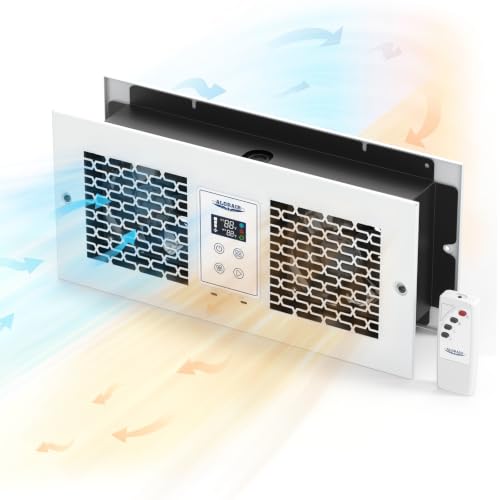
Room to Room Transfer Fan with Thermostat
Hot and cold spots are one of the most common comfort complaints in homes. A room to room transfer fan with thermostat moves conditioned air between spaces to balance temperatures, without extending ductwork or adding a second HVAC system. This guide explains how the fan works, how to size it, where to install it, and what to look for in each tier.
How It WorksQuick answer: A room to room transfer fan with thermostat is a through-wall fan installed in an interior wall. It pulls air from a well-conditioned room into a room that runs too warm, and its built-in thermostat activates the fan only when the target temperature is reached. It is a sensible, low-impact upgrade for homes with ductwork imbalances, closed-door rooms, or second-floor bedrooms that struggle to stay cool. It is not a replacement for adequate cooling capacity or proper duct design.
What This Guide Covers
How a Transfer Fan with Thermostat Works
The fan mounts in an interior wall between two rooms. It draws air from the source room and discharges it into the destination room, using a short duct or wall sleeve. The built-in thermostat monitors the destination room temperature. When the room rises above the setpoint, the fan runs; when the room reaches the setpoint, the fan shuts off. This on-demand operation keeps the fan from running unnecessarily and avoids over-cooling the destination space.
Unlike a ceiling fan, which moves air within a single room, a transfer fan moves air between rooms. Unlike an HVAC system, it does not heat or cool the air. It redistributes air that the central system has already conditioned, reducing temperature differences between rooms. That makes it a practical companion to a central AC system that cools some rooms well but leaves others noticeably warmer. For homeowners dealing with uneven cooling, this is a targeted way to address the imbalance without a full duct redesign.
Thermostat Control
The thermostat is what distinguishes a transfer fan from a simple through-wall fan. Instead of running continuously, the fan activates when the destination room needs cooling and stops when the setpoint is reached. This reduces noise and energy use, and it keeps the fan from over-pressurizing a room that has already reached a comfortable temperature.
Airflow Capacity
Airflow capacity is measured in cubic feet per minute (CFM). A fan that is too small will not move enough air to make a difference, while a fan that is too large can create drafts or pressurize the room. Match CFM to the room volume and the amount of heat gain in the destination room. Manufacturers publish airflow ratings, and the contractor or installer can help size the fan to the space.
Noise Level
Because the fan mounts in a wall, noise can be a real concern. Look for models with sound ratings in sones or decibels. Premium-tier fans typically use better motor mounts, isolation gaskets, and quieter blades. If the fan shares a wall with a bedroom or office, prioritizing quiet operation is worthwhile.
Benefits and Best Use Cases
A transfer fan is most useful in homes where the HVAC system is fundamentally healthy but the distribution is uneven. Common scenarios include upstairs bedrooms that run warmer than downstairs living areas, additions that share a wall with a conditioned room, and closed-door home offices that stay stuffy while the rest of the house is comfortable.
Where a Transfer Fan Excels
- Second-floor bedrooms that stay warmer than the first floor.
- Additions or converted garages that share a wall with a conditioned room.
- Home offices, craft rooms, or guest rooms that are closed off from the main airflow.
- Homes with undersized returns or long duct runs that starve certain rooms.
- Rooms with large windows or sun exposure that gain heat faster than the HVAC system can remove it.
In each case, the goal is to redistribute already-conditioned air rather than generate new cooling. If the room is consistently 8 to 10 degrees warmer than the rest of the house even with the HVAC running, the underlying issue may be undersized ductwork or insufficient system capacity. In that case, a transfer fan helps but does not fully solve the problem. For troubleshooting, see the guide on an air conditioner running but not cooling the house and the guide on an air conditioner that turns on but has no air coming out.
Features to Compare Across Tiers
Transfer fans are available across several market tiers. The table below summarizes what each tier typically delivers so you can compare options on features rather than on fluctuating retail figures.
| Tier | Best For | Typical Characteristics |
|---|---|---|
| Essential tier | Budget-conscious upgrades and single-room needs | Basic on/off thermostat, single speed, louder operation, straightforward install |
| Balanced tier | Most homes seeking quiet, adjustable operation | Adjustable thermostat range, two speeds, quieter motor mount, better grille design |
| High-end tier | Bedrooms, offices, and homes where noise matters | Variable speed or ECM motor, near-silent operation, advanced controls, durable construction |
When comparing tiers, focus on the features that matter in your specific application. A fan installed in a hallway or utility area can lean toward the essential tier. A fan installed in a shared wall with a bedroom, nursery, or home office deserves the balanced or high-end tier for quiet operation and reliable control.
Placement and Installation
Placement determines how well the fan performs. The goal is to move air from a source room that is well-conditioned into a destination room that needs relief, without creating drafts or pressurizing either space.
Placement Checklist
- Choose an interior wall shared by the two rooms, above furniture height.
- Keep the fan away from doorways so air does not immediately escape.
- Check for studs, wiring, and plumbing before cutting. A stud finder and a quick visual inspection are essential.
- Confirm that both rooms have a path for air to return, or the fan will pressurize the destination room.
- Follow the manufacturer's clearance requirements for the grille and the wall sleeve.
- Connect the fan to a properly grounded circuit and follow local electrical code.
- Seal around the wall sleeve with insulation and caulk to prevent air leaks and drafts.
If you are installing the fan as part of a larger HVAC project, coordinate with the contractor so the fan is not competing with duct improvements. A pre-project HVAC inspection helps identify whether the room imbalance is caused by duct design, equipment capacity, or airflow restrictions. The HVAC design guide explains the principles behind balanced airflow.
Limitations and Alternatives
A transfer fan is a useful tool, but it has limits. It cannot cool a room beyond the temperature of the air it moves. If the source room is also warm, the fan will not help. It also does not solve humidity problems, duct leaks, or insufficient system capacity.
When a Transfer Fan Is Not Enough
If the target room is consistently 8 to 10 degrees warmer than the rest of the house even with the HVAC running, the underlying issue may be undersized ductwork, a blocked duct run, or insufficient cooling capacity. In these cases, the fan may help but will not fully resolve the problem. A contractor should evaluate the duct system and the equipment sizing before assuming a transfer fan will fix the imbalance.
Alternative Solutions to Consider
Depending on the cause of the imbalance, other solutions may be more effective. A ductless mini-split provides dedicated cooling for a room that the central system cannot reach. Zoning systems allow separate temperature control for different areas. Duct sealing and insulation improvements reduce losses before air reaches the rooms. For a comparison, see the guide on multi-zone ductless AC and the guide on HVAC zoning systems.
Frequently Asked Questions
What is a room to room transfer fan with thermostat?
A room to room transfer fan with thermostat is a through-wall fan that moves conditioned air from one room to another. The built-in thermostat activates the fan when the target room reaches a set temperature, balancing comfort without extending ductwork or adding a second HVAC system.
How does a transfer fan improve comfort?
Many homes have rooms that run warmer or cooler than the rest of the house due to duct layout, sun exposure, or closed doors. A transfer fan moves air between rooms to equalize temperatures, reducing hot and cold spots and making the whole home feel more consistent.
Where should I install a room to room transfer fan?
Install the fan in an interior wall between a well-conditioned room and a room that runs too warm. Keep the fan above furniture and away from doorways. Choose a location that lets air move freely at both ends and follow the manufacturer's clearance requirements.
Is a transfer fan a replacement for a second AC unit?
No. A transfer fan balances temperatures using air that is already conditioned. It does not create cooling. In rooms that are consistently much warmer than the rest of the house due to undersized ductwork or insufficient capacity, a dedicated mini-split or ductless system may be the better solution.
How noisy are transfer fans?
Noise varies widely by tier. Essential-tier fans can be noticeably audible, especially at high speed. Balanced-tier and high-end-tier fans use better motor mounts and quieter blades, and they are usually the better choice for bedrooms and offices.
Ready to Balance Temperatures in Your Home?
A transfer fan with thermostat is a practical upgrade for homes with uneven cooling. If you are unsure whether it will solve your specific issue, a licensed HVAC contractor can evaluate the duct system and recommend the right approach.
Find HVAC ProfessionalsTop Room to Room Transfer Fans with Thermostat
⚠️ AFFILIATE DISCLOSURE: This website contains affiliate links. As an Amazon Associate, we earn from qualifying purchases. If you make a purchase through these links, we may receive a small commission at no additional cost to you. Read our full affiliate policy.

Apexicalo Hardwired Reversible Room to Room Fan, 300 CFM Through Wall Fan | No Plug, Bidirectional airflow, Thermostat 35F-99F, 5 Speeds, Fits 3.8-7.4 in Walls, Bedroom, Kitchen, Laundry
Check price on Amazon
AC Infinity Through Wall Fan 6”, Dual Zone Sensors with Reversible Airflow | Smart Room-to-Room Fan w/ Auto Temperature Balancing, WiFi App Control, IR Remote, 10 Speeds for Kitchen, Laundry, Workshops
Check price on Amazon
Ehiair 8" Room to Room Fan with Remote, 320 CFM Through Wall Fan | 10 Speeds Quiet DC Motor Room to Room Air Transfer Fan & Exhaust Fan for Bedroom, Laundry, Kitchen, Garage, ETL Certified
Check price on Amazon
Tjernlund AS1 AireShare Room-To-Room Fan Ventilator, Hardwired,70 CFM | Hardwired room-to-room transfer fan moves up to 70 CFM to balance temperatures between adjacent rooms; verify placement.
Check price on Amazon
Apexicalo Room to Room Fan with Remote Control, 300CFM Through Wall Vent Fan with Temperature Control, 5-Speed Circulating Ventilation, for Kitchen, Laundry, Hardwired, RTR300-CV
Check price on Amazon