Solar Panel That Can Power an Air Conditioner: Complete Sizing Guide
Everything you need to know about choosing solar panels for an air conditioner — wattage calculations, inverter selection, battery options, and off-grid design.
Start Your ResearchWhy this guide matters: If you are researching a solar panel that can power an air conditioner, you likely want to reduce grid dependence, cool an off-grid cabin, or lower long-term electricity use. This guide walks you through the sizing logic, system components, and practical decisions so you can plan a solar setup that reliably runs your AC without guesswork.
Can a Solar Panel Really Power an Air Conditioner?
Yes — with the right sizing. Air conditioners are among the most power-hungry household appliances, so a single panel is rarely enough. The question is not whether solar can power an AC, but how much solar capacity, storage, and inverter power are required for your specific unit and usage pattern. Small window and portable ACs can be supported by modest off-grid arrays, while central AC systems demand substantially larger solar installations.
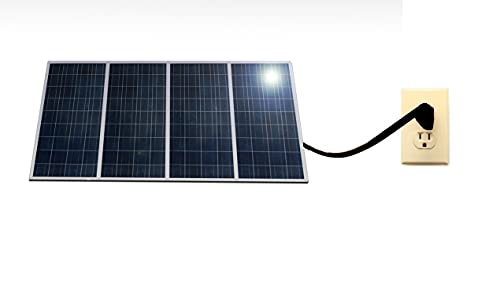
Two system types are common: grid-tied solar (panels feed your home and offset AC consumption through net metering) and off-grid or hybrid systems (panels, batteries, and inverter run the AC directly). The choice shapes both the equipment list and the sizing math.
Step 1: Determine Your AC's Power Draw
Start with the air conditioner's electrical consumption. This information is on the unit's label or in the manual. Two numbers matter:
- Running watts: The continuous power the AC draws while the compressor is operating.
- Starting watts (surge): The brief spike when the compressor starts, often two to three times the running watts. Inverter ACs and units with soft-start features reduce this spike significantly. Learn more about soft start for air conditioners.
As a reference, small window units typically draw between 400 and 700 running watts, mid-size window units around 900 to 1,200 watts, and central AC systems several thousand watts. Efficiency ratings like CEER and SEER directly influence these figures, which is why choosing an efficient unit matters as much as the solar array itself.
Step 2: Estimate Daily Energy Use
Multiply running watts by the number of hours the AC runs per day to get daily watt-hours (Wh). For example, a 600-watt window AC running 8 hours per day consumes roughly 4,800 Wh, or 4.8 kWh. This figure drives panel count and battery capacity in off-grid designs.
Real-world runtime varies with outdoor temperature, insulation, thermostat settings, and unit efficiency. If you want to estimate solar needs more precisely for your location, our solar calculator provides a structured approach.
| AC Type | Typical Running Watts | Suggested Solar Array (Off-Grid) | Best For |
|---|---|---|---|
| Small window AC (5,000–6,000 BTU) | ~400–600 W | ~1,500–2,500 W of panels | Cabins, small rooms, off-grid retreats |
| Mid-size window AC (8,000–10,000 BTU) | ~800–1,200 W | ~2,500–4,000 W of panels | Larger rooms, guest houses |
| Portable AC (8,000–12,000 BTU) | ~900–1,300 W | ~2,500–4,500 W of panels | Rentals, temporary setups, campers |
| Mini split (9,000–12,000 BTU) | ~700–1,500 W | ~2,000–5,000 W of panels | Efficient whole-room cooling, off-grid homes |
| Central AC (2–3 tons) | ~3,000–5,000 W | ~8,000–15,000+ W of panels | Whole-home cooling with grid-tied or hybrid solar |
These figures are general starting points. Exact sizing depends on your location's peak sun hours, panel efficiency, inverter losses, and desired autonomy (how long the system must run without sun).
Step 3: Choose the Right Solar Setup
Grid-Tied Solar
Panels feed the home's electrical panel and offset AC consumption. No batteries required. Best for homes with reliable grid power and net metering.
Hybrid Solar
Combines grid connection with a battery bank. Provides backup during outages and can run the AC from solar plus stored energy.
Off-Grid Solar
Panels, charge controller, batteries, and inverter operate independently. Sized generously to cover cloudy days and evening runtime.
Solar-Ready AC Units
Some AC units, especially solar mini splits and solar-friendly portable models, are designed to accept DC solar input directly. Explore solar-powered air conditioning units.
Step 4: Select Panels, Inverter, and Batteries
Once daily energy use and peak sun hours are known, divide daily watt-hours by peak sun hours to estimate the panel wattage needed. Then add a safety margin (typically 20–30%) for inefficiencies and weather variability.
- Panels: Monocrystalline panels offer higher efficiency per square foot, which matters for limited roof or ground space.
- Inverter: Must handle both running watts and surge watts of the AC. Pure sine wave inverters are required for compressor-driven appliances. See our guide to solar-powered air conditioners for inverter selection detail.
- Charge controller: MPPT controllers maximize energy harvest from panels, especially in variable conditions.
- Batteries: Lithium iron phosphate (LiFePO4) batteries are the current standard for off-grid AC setups due to depth of discharge, cycle life, and safety. Size the bank to cover evening runtime and cloudy-day reserves.
If you are considering a mini split as the cooling source, our guides to solar-powered mini splits and solar-powered mini split air conditioning cover the specifics of these efficient systems.
Practical Considerations Before You Commit
- Roof or ground space: Larger arrays require more area. Verify available space and orientation (south-facing in the northern hemisphere is ideal).
- Shading: Even partial shade on a panel can significantly reduce output. Plan around trees and structures.
- Permits and interconnection: Grid-tied systems typically require utility approval and local permits. Off-grid systems may still need building permits for structural mounting.
- Battery location: Batteries should be in a temperature-controlled, ventilated space for longevity and safety.
- Future expansion: Design the inverter and charge controller with headroom so you can add panels or batteries later.
- AC efficiency upgrades: A more efficient AC reduces the entire system's size and complexity. Reviewing solar-powered heat pumps and air conditioners is a useful next step.
Common Scenarios and Recommended Approaches
The right approach varies with the use case. A few common scenarios illustrate the trade-offs:
- Off-grid cabin with a small window AC: A 1,500–2,500 W panel array paired with a 5–10 kWh battery bank and a pure sine wave inverter can reliably run a 5,000–6,000 BTU unit during daylight and into the evening. See our guide to a solar-powered air conditioner for camping for adjacent off-grid considerations.
- Rooftop solar for a home with central AC: A grid-tied system sized to offset a significant share of annual consumption is typical. Battery backup is optional but useful for outage resilience.
- Portable setup for a camper or tiny home: A solar-powered portable air conditioner paired with a compact solar kit and lithium battery can provide targeted cooling without a full home installation.
- Split system with dedicated solar: A solar-powered split system air conditioner can be sized to run primarily on solar during peak sun hours, with grid assist at night.
Maintenance and Long-Term Reliability
- Clean panels periodically to maintain output; dust and pollen reduce efficiency.
- Inspect wiring and connections annually for corrosion or loosening.
- Monitor battery state of health and replace when capacity degrades significantly.
- Track inverter performance to catch efficiency drops early.
- Trim vegetation that shades panels as seasons change.
Common Questions About Solar Power for Air Conditioners
How many solar panels do I need to run an air conditioner?
It depends on the AC's wattage and daily runtime. A small window unit may need roughly 4–6 panels of around 400 W each for off-grid operation, while central AC can require dozens of panels. The table above offers a starting reference.
Can I run an air conditioner directly from solar panels without batteries?
Yes, if the solar array and inverter are sized to match the AC's running and surge watts, and you only need cooling during peak sun hours. Batteries are needed for evening or cloudy-day runtime.
Will a solar-powered AC work at night?
Only with battery storage or a grid connection. Off-grid night runtime requires a battery bank sized for evening hours, while grid-tied systems draw from the grid at night.
Is a mini split better than a window AC for solar power?
Mini splits are typically more efficient per BTU, which reduces the solar array size needed. However, they cost more upfront. For small off-grid setups, a solar-powered mini split air conditioning setup can be an excellent long-term choice.
Can solar panels power central air conditioning?
Yes, but central AC requires a substantially larger array. Grid-tied solar is the most practical route for central systems. See our guide to solar panels for central air conditioning.
Narrowing Down Your Options
When planning a solar system for an air conditioner, organize your evaluation around four criteria: the AC's actual power draw, your required daily runtime, whether you need off-grid independence or grid-tied offset, and available space for panels and batteries. Entry-level off-grid kits suit small window units and campers, mid-range systems cover mini splits and larger rooms, and high-end tier or professional-grade installations support central AC and whole-home cooling.
For further reading, explore our resources on solar-powered heating and air conditioning, solar-operated air conditioners, and solar panel air conditioning units.
Ready to Explore Solar-Ready Cooling Options?
Browse our curated selection of solar panels, inverters, batteries, and efficient AC units suited for solar-powered cooling.
View Recommended Models