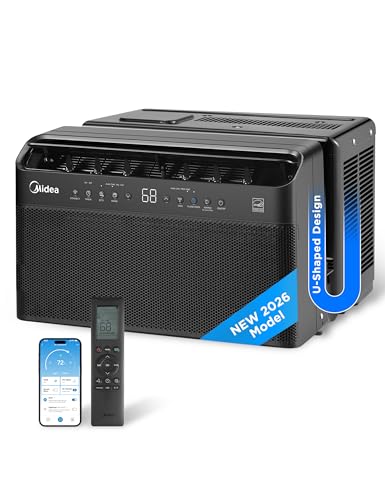
U Shaped Air Conditioners: The Complete Buyer's Guide
Everything you need to know before choosing a U shaped air conditioner — how the U profile works, why it is quieter, which window types it suits, how to size it correctly, and what to check before you commit to a model.
Start the GuideWhat Is a U Shaped Air Conditioner?
A U shaped air conditioner is a window-mounted cooling unit built around a U profile chassis. Instead of a single rectangular box that sits entirely inside or protrudes straight out of the window, the unit is formed so the window sash can close down into the middle gap of the U. The indoor section stays inside the room, the outdoor section sits outside, and the window frame itself becomes part of the support structure.
This form factor has become popular among homeowners and renters who want the simplicity of a window air conditioner without the typical drawbacks — heavy indoor noise, blocked window views, and awkward sealing. Because the sash closes into the unit, the opening is naturally sealed along the top, which improves both comfort and efficiency.
U shaped units are a distinct category from conventional window air conditioners, which you can explore in our broader guide to types of air conditioning units. If you are still comparing form factors, the dedicated U shaped AC unit overview is a useful companion read.
How the U Shaped Design Works
The engineering idea behind the U shape is simple: separate the noisy parts from the living space. In a conventional window unit, the compressor and condenser fan sit in the same chassis that extends into the room, and vibration travels through the casing. In a U shaped design, those components are pushed into the outdoor leg of the U, while the indoor leg carries the evaporator coil and the blower that circulates cool air.
Because the window sash closes down into the gap, three things happen at once:
- The unit is mechanically supported from above and below by the window frame.
- The indoor and outdoor sections are physically separated by the window glass and sash.
- The opening is sealed more tightly than a typical accordion-panel window kit.
Most U shaped models are designed for double-hung windows, where the lower sash slides down into the U gap. Installation is usually a two-person job for larger capacities, and many units ship with a support bracket or require one for safety. For heavier units, an external bracket is strongly recommended — the same principle covered in our guide to universal window AC support brackets.
Key Benefits of U Shaped Air Conditioners
1. Noticeably quieter indoors
Because the compressor and condenser fan sit outside the room, the dominant noise source is moved away from the occupant. The indoor side mainly handles airflow, so U shaped units typically produce a softer, more consistent sound profile than conventional window units of similar capacity. This matters most in bedrooms and home offices where steady background noise is disruptive.
2. The window can close
With a standard window unit, the sash stays partly open or is replaced by a flimsy panel. A U shaped unit lets the sash close down into the gap, which restores the window's insulation, reduces street noise, and keeps the view less obstructed. It also makes the installation look more intentional and finished.
3. Better sealing and efficiency
A flush-closing sash reduces air leakage around the unit. Less leakage means the unit works less to maintain the set temperature, which supports better energy performance over the season. Efficiency still depends on the unit's rating, but the installation itself is a real advantage.
4. Easier to remove and store seasonally
Many U shaped models are designed to be lifted out of the window frame without dismantling the whole installation. That makes off-season storage simpler and reduces the risk of damage during removal.
5. Cleaner look and better security
A closed sash means the window is not permanently propped open, which improves home security and reduces the chance of rain or debris entering the room.
6. Good fit for renters
Because the installation is reversible and does not require cutting the wall, U shaped units are a practical option for renters who cannot modify the property. Our guide to types of residential air conditioning systems compares this approach with ducted and ductless alternatives.
Limitations and Trade-Offs to Know
U shaped air conditioners are not the right answer for every home. Before you commit, weigh these trade-offs:
- Window compatibility is limited. Most models are built for double-hung windows. Sliding, casement, and awning windows usually need a different solution, and only some models offer kits for horizontal sliders.
- Heavier than they look. The outdoor section holds the compressor, so lifting and positioning the unit safely often requires two people and a proper bracket.
- Capacity range is narrower. U shaped units are most common in small to medium capacities. Very large rooms usually need a different system type.
- Outdoor clearance matters. The outdoor leg needs airflow. Recessed windows, deep sills, or nearby walls can restrict performance.
- Model availability varies. The category is smaller than standard window ACs, so your shortlist may be limited compared with conventional units.
If your window type is a poor match, a portable or ductless option may be more practical. Our guides to using a portable air conditioner without a window and ductless mini-split AC cover those alternatives in detail.
Window Types and Installation Fit
Installation compatibility is the single most important practical question with this category. The table below summarizes how U shaped units typically fit different window styles. Always confirm the specific model's requirements before purchase.
| Window Type | Typical Compatibility | What to Check |
|---|---|---|
| Double-hung (vertical sliding) | Best fit — the standard target | Sash width, frame depth, and whether the lower sash closes into the U gap |
| Single-hung | Usually compatible | Confirm the fixed upper sash does not interfere with the unit's top profile |
| Horizontal sliding | Model-dependent | Look for a manufacturer kit or a unit explicitly rated for horizontal sliders |
| Casement / awning | Rarely compatible | Crank mechanisms and outward opening usually rule out U shaped units |
| Bay / bow windows | Case-by-case | Angled frames and shallow sills often complicate support and sealing |
Measure the window opening width, the sash height, and the sill depth before ordering. If your window is an unusual size, our guide to very small air conditioner window options may help you narrow the field. For sliding windows, the vertical sliding window air conditioner kit guide explains the adapter approach.
How to Size a U Shaped AC Correctly
Sizing works the same way as any room air conditioner: match capacity to the room's heat load, not just its floor area. An oversized unit cools quickly but cycles on and off too often, which leaves the room feeling clammy and wears the compressor. An undersized unit runs continuously and never quite catches up.
Use this starting point, then adjust for real-world conditions:
| Room Size | Starting Capacity | Best For |
|---|---|---|
| Up to 150 sq ft | 5,000 – 6,000 BTU | Bedrooms, small offices, studios |
| 150 – 250 sq ft | 8,000 – 10,000 BTU | Medium bedrooms, living areas |
| 250 – 400 sq ft | 12,000 – 14,000 BTU | Large rooms, open-plan spaces |
| 400 sq ft and above | Consider a different system type | Whole-home or multi-room cooling |
Adjust upward for south- or west-facing windows, high ceilings, poor insulation, kitchens, and rooms with several occupants or electronics. Adjust downward for shaded rooms and good insulation. For a deeper walkthrough, see our guides to how to size an air conditioner and the BTU calculator by room size.
U Shaped vs Other Window AC Designs
How does the U shaped design compare with the alternatives most buyers consider?
| Design | Indoor Noise | Window Closure | Installation Effort | Best For |
|---|---|---|---|---|
| U shaped | Low | Yes — sash closes into gap | Moderate; often two-person | Bedrooms, home offices, quiet spaces |
| Standard window AC | Moderate to high | Partial; panel kit | Moderate | General-purpose cooling |
| Through-the-wall | Moderate | Not applicable | High; wall modification | Permanent installations |
| Portable AC | Moderate | Hose vent kit | Low | Renters, flexible placement |
| Ductless mini-split | Very low | Small wall penetration | High; professional install | Whole-room comfort, multiple zones |
For a broader comparison of system categories, see types of air conditioning systems and type of air conditioning systems. If you are weighing a permanent wall installation instead, the through-the-wall AC guide covers the trade-offs.
How to Choose the Right U Shaped Model
Once you have confirmed window compatibility and sizing, use this checklist to narrow your shortlist. The goal is to match the model to your room and habits, not to chase specifications you will never use.
Core specification checklist
- Capacity: Start from the sizing table above and adjust for sun exposure, ceiling height, and insulation.
- Efficiency rating: Look for a strong efficiency rating for the category. Our guides to SEER ratings and ENERGY STAR certified AC explain what the numbers mean in practice.
- Noise level: Check the indoor sound rating. Quiet operation is the main reason to choose this design, so do not compromise on it.
- Operating modes: Cooling, fan-only, dehumidify, and a sleep mode are useful in bedrooms. Some models add an energy-saver mode.
- Controls: Remote control and programmable timers are common. Smart or Wi-Fi control appears on higher-tier models.
- Filter access: A washable filter that slides out from the indoor side makes routine maintenance far easier.
- Installation hardware: Confirm whether a support bracket is included and whether the model fits your exact window dimensions.
- Warranty: Compare coverage on the sealed system and the compressor, which are the parts that matter most over time.
Tier-based guidance
Think in terms of tiers rather than specific figures. Entry-level U shaped units cover the essentials — cooling, fan mode, a basic remote, and washable filtration — and suit guest rooms and seasonal use. Mid-range models typically add better efficiency, quieter operation, sleep modes, and more precise timers. Top-tier models add smart control, more refined airflow management, and stronger warranty coverage for daily use in primary bedrooms or home offices.
For a broader view of efficiency-focused choices, see most energy efficient AC and highest SEER air conditioner. If quiet operation is your top priority, the quiet air conditioner guide compares sound profiles across categories.
Maintenance and Long-Term Care
A U shaped unit is easier to maintain than many people expect, but the routine matters. Follow these habits to keep performance steady season after season:
- Clean or replace the filter every two to four weeks during heavy use. A clogged filter reduces airflow and forces the unit to work harder. Our guide to how to clean an AC filter walks through the process.
- Inspect the outdoor section for leaves, pollen, and debris. Clear the condenser area so airflow is not restricted.
- Check the seal around the sash at the start of each season. A clean, tight fit preserves the efficiency advantage of the design.
- Remove and store the unit during the off-season if it is not needed for heating. Clean it before storage and cover it to keep dust out.
- Schedule a seasonal check for the coils and drainage path. The seasonal AC checklist is a practical reference.
If you notice reduced cooling, unusual noise, or water pooling, address it early. Our troubleshooting guides to AC not cooling and AC leaking water cover the most common causes and fixes.
Ready to Compare U Shaped Models?
You have the framework: confirm window compatibility, size the room correctly, prioritize quiet operation and efficiency, and check the installation hardware. The shortlist below applies those criteria to currently available models.
Compare U Shaped Air ConditionersFrequently Asked Questions
What is a U shaped air conditioner?
A U shaped air conditioner is a window-style unit whose chassis is built in a U profile, allowing the window sash to close down into the gap so the unit is supported from above and below while most of the noisy compressor components sit outside the room.
Are U shaped air conditioners quieter than standard window ACs?
Yes. Because the compressor and condenser fan are positioned in the outdoor section of the U chassis, the indoor side mainly contains the evaporator and blower, which typically results in noticeably lower indoor sound levels compared with conventional window units of similar capacity.
Can a U shaped AC fit in a sliding window?
Most U shaped units are designed for double-hung windows where the lower sash closes into the U gap. Some models offer kits or configurations for horizontal sliding windows, but you should confirm compatibility with the specific model before purchase.
Do U shaped air conditioners need a special bracket?
Many U shaped units include a support bracket or use the window frame itself for support. For heavier capacities or installations above ground level, an external support bracket is strongly recommended to meet safety and building requirements.
What BTU size should I choose for a U shaped AC?
Match the BTU rating to room size and heat load: roughly 5,000 to 6,000 BTU for up to 150 square feet, 8,000 to 10,000 BTU for 150 to 250 square feet, and 12,000 BTU and above for larger or sun-exposed rooms. Ceiling height, insulation, window area, and occupancy all affect the final sizing.