120V AC Thermostat: Complete Buyer's Handbook
Everything you need to know about line-voltage thermostats for window, portable, and through-the-wall air conditioners running on standard 120-volt power
START LEARNINGWhy this guide matters: A 120V AC thermostat is the control center of your cooling system. Choosing the wrong model or wiring it incorrectly can leave your air conditioner running inefficiently, cycling too often, or failing to turn on at all. This handbook walks you through thermostat types, compatibility, wiring basics, and installation so you can make a confident, informed decision before you buy.
What Is a 120V AC Thermostat?
A 120V AC thermostat is a line-voltage thermostat built to control cooling equipment that operates on standard 120-volt household current. Unlike low-voltage thermostats (typically 24V) used with central HVAC systems, a 120V thermostat handles the full load current of the appliance it controls. This makes it the natural match for window air conditioners, portable AC units, and many through-the-wall units that plug into a standard 120V outlet or are hardwired to a 120V circuit.
Because line-voltage thermostats switch mains power directly, they are often simpler in design but require more careful handling during installation. They are commonly used in single-room cooling setups, rental properties, workshops, and older homes where running low-voltage control wiring is impractical. If you are comparing voltage options for your cooling equipment, our guide on 110V vs 240V air conditioners explains how circuit capacity affects your choices.
Types of 120V Thermostats
Not all 120V thermostats are the same. The right choice depends on whether you need cooling only, heating and cooling, or programmable scheduling. The table below summarizes the main categories and who each one suits best.
| Type | Best For | Key Features | Tier |
|---|---|---|---|
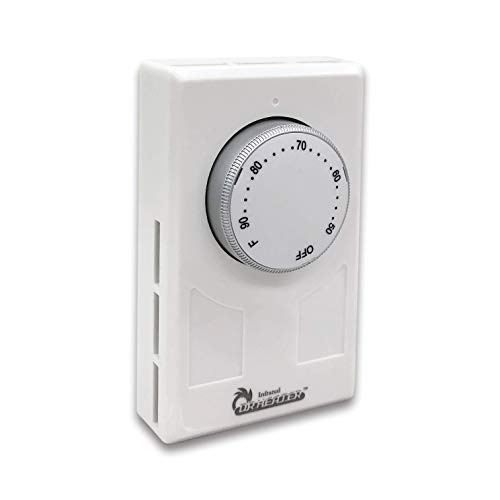
| Mechanical line-voltage thermostat | Simple window AC setups, garages, workshops | Dial or slider control, no batteries, basic on/off cycling | Entry-level |
| Digital non-programmable thermostat | Bedrooms, home offices, guest rooms | LCD display, precise temperature setpoint, manual mode | Mid-range |
| Programmable 120V thermostat | Living spaces with predictable daily schedules | 7-day or 5-2 scheduling, vacation mode, backlit display | Mid-tier to high-end tier |
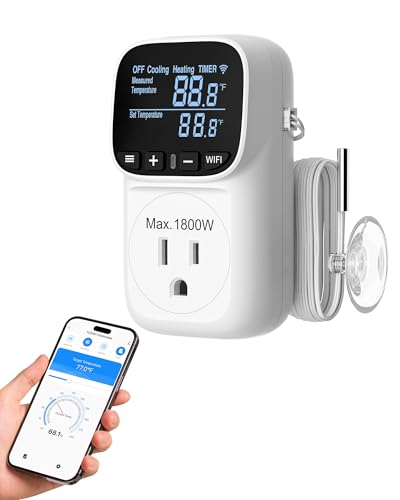
| Smart 120V thermostat | Tech-forward homes, remote monitoring | Wi-Fi control, app scheduling, voice assistant support | Premium |
| Heat/cool line-voltage thermostat | Window AC units with heat strips or heat pumps | Mode switching, fan control, auxiliary heat support | High-end tier |
If your unit includes a heating function, look for a thermostat rated for both cooling and heating. For units without a heat pump, our article on a mini-split air conditioner without a heat pump offers useful context on cooling-only configurations.
Compatibility: Will a 120V Thermostat Work With Your AC?
Compatibility is the single most important check before purchasing. A 120V thermostat is designed for 120-volt circuits and will not work correctly with a 240-volt unit. Verify the following before you buy:
- Voltage rating: Confirm your AC unit runs on 120V. The nameplate or owner's manual lists the rated voltage.
- Amperage capacity: The thermostat must be rated for the current your unit draws. Check the compressor and fan amperage on the unit label.
- Wiring configuration: Cooling-only models typically need two wires; heat/cool models may need three or four. Match the thermostat to your existing wiring.
- Mounting location: Line-voltage thermostats are often mounted on the wall near the unit. Ensure the location is out of direct sunlight and away from drafts.
For units that plug into a wall outlet, a plug-in thermostat or a thermostat-integrated unit may be simpler than hardwiring a wall thermostat. If you are deciding between installation approaches, our HVAC installation overview covers the trade-offs.
Key Features to Look For
Once compatibility is confirmed, focus on features that improve comfort and reliability. The most useful features for 120V cooling setups include:
- Accurate temperature sensing: Digital models with ±1°F accuracy outperform mechanical dials for consistent comfort.
- Adjustable differential: A thermostat with a configurable swing setting prevents short cycling and reduces wear on the compressor.
- Fan control: Separate fan-only mode helps circulate air between cooling cycles.
- Backlit display: Helpful for bedrooms and basements where the thermostat is in a dim location.
- Lockout or tamper protection: Useful in commercial spaces and rental properties.
- Compressor delay protection: Prevents rapid restart after a power interruption, protecting the compressor.
If you plan to integrate the thermostat with a broader climate control setup, a mini-split Wi-Fi thermostat guide explains how smart control works across different system types. For general thermostat education, the thermostat guide is a good companion read.
Wiring Basics for 120V Thermostats
Understanding the wiring layout before installation reduces mistakes. Most 120V line-voltage thermostats follow a straightforward pattern:
| Wire | Function | Typical Color | Notes |
|---|---|---|---|
| Line (L) | Incoming hot power from the circuit | Black or red | Always de-energize at the breaker before touching |
| Load | Power to the AC unit | Black or red | Switched by the thermostat |
| Neutral | Return path | White | Required for some digital models and 120V circuits |
| Ground | Safety ground | Green or bare copper | Must be connected per code |
Cooling-only thermostats often use just the line and load wires, while heat/cool models add a reversing valve or heat relay wire. Always follow the manufacturer's wiring diagram; color conventions can vary between brands. If your setup involves a wall-mounted unit with heat, the guide on a wall air conditioner with heat may clarify wiring expectations.
Step-by-Step Installation Overview
Installing a 120V thermostat is a manageable DIY project for someone comfortable with basic electrical work. Follow this sequence carefully:
- Turn off power at the circuit breaker and verify with a non-contact voltage tester.
- Remove the old thermostat and label each wire with tape so you know where it belongs.
- Mount the new base plate level on the wall, using anchors if the wall is drywall.
- Connect the wires to the labeled terminals on the new thermostat, matching line, load, neutral, and ground.
- Secure the thermostat body to the base plate and restore power at the breaker.
- Test the system by setting a temperature and confirming the AC turns on and off correctly.
If at any point the wiring does not match the diagram, stop and call a professional. Electrical work carries real risk, and a qualified technician can complete the job safely and to code. For larger projects involving ductwork or system replacement, review our HVAC installation resources.
120V Thermostat vs Low-Voltage Thermostat
It helps to understand why 120V thermostats exist alongside the more familiar 24V thermostats used in central systems. The comparison below highlights the practical differences.
| Aspect | 120V Line-Voltage Thermostat | 24V Low-Voltage Thermostat |
|---|---|---|
| Typical use | Window, portable, and through-the-wall AC units | Central AC, furnaces, heat pumps |
| Wiring | Direct mains wiring, 2–4 wires | Low-voltage control wiring, 4–8 wires |
| Installation risk | Higher — mains voltage present | Lower — safe to handle when de-energized |
| Feature depth | Basic to smart, fewer advanced integrations | Extensive, including multi-stage and zoning support |
| Best for | Single-room cooling and simple retrofits | Whole-home HVAC control |
For a broader look at how thermostat choices fit into whole-home cooling, see the whole-house AC system overview.
Common Mistakes to Avoid
- Ignoring the voltage rating: Using a 120V thermostat on a 240V circuit is dangerous and voids warranties.
- Underrating amperage: A thermostat rated below your unit's draw will overheat and fail prematurely.
- Skipping the breaker: Always cut power before touching wires, even if the unit appears off.
- Mounting in direct sunlight: A thermostat in a sunlit spot reads false temperatures and short-cycles the AC.
- No compressor delay: Rapid restart after outages can damage compressors; choose a model with delay protection.
If your AC is running but not cooling properly, the issue may not be the thermostat at all. Our troubleshooting guide on an air conditioner running but not blowing air helps isolate the cause. Regular HVAC cleaning and service also keeps thermostat-controlled systems performing reliably.
Frequently Asked Questions
What is a 120V AC thermostat?
A 120V AC thermostat is a line-voltage thermostat designed to control air conditioning equipment that runs on standard 120-volt household power, such as window AC units, portable air conditioners, and certain through-the-wall units.
Can I install a 120V thermostat myself?
Many 120V line-voltage thermostats are designed for DIY installation, but you must turn off power at the circuit breaker first. If you are not comfortable working with electrical wiring, hire a licensed electrician.
How many wires does a 120V thermostat need?
Most 120V line-voltage thermostats require two wires for cooling-only models, and up to four wires for heating and cooling models. Always verify the wiring diagram for your specific thermostat and AC unit.
Can a 120V thermostat control a 240V AC unit?
No. A 120V thermostat is designed for 120-volt circuits and should not be used with a 240-volt AC unit. Using a thermostat on a mismatched voltage can damage the equipment and create a safety hazard.
Do I need a smart thermostat for a window AC unit?
Not necessarily. A digital non-programmable or programmable 120V thermostat handles most single-room cooling needs well. A smart model adds Wi-Fi scheduling and remote control, which is a worthwhile upgrade if you want app-based convenience.
Final thoughts: A 120V AC thermostat is a small component with a big impact on comfort and equipment longevity. Confirm your unit's voltage and amperage, choose a thermostat that matches your wiring and feature needs, and install it with proper safety precautions. With the right line-voltage thermostat, your window or portable AC will cycle accurately, run efficiently, and keep your space consistently comfortable. When in doubt about wiring or compatibility, a licensed HVAC professional is always the safest path.