
8000 BTU 115V Through the Wall Air Conditioner
Your complete guide to sizing, installing, and choosing the right through-the-wall unit for medium rooms — without sacrificing efficiency or comfort
START THE GUIDEAn 8000 BTU 115V through the wall air conditioner is one of the most practical cooling solutions for medium-sized rooms that need a permanent, window-free installation. Unlike window units that block natural light and can be removed by intruders, a through-the-wall model sits inside a dedicated sleeve in your exterior wall — freeing the window entirely and delivering a cleaner, more secure setup.
This guide is written for homeowners and renters who already know they want a through-the-wall unit and now need to confirm that 8,000 BTU at 115 volts is the right specification for their space. You will learn how to verify room sizing, understand the electrical requirements, evaluate efficiency ratings, and compare the key features that separate an entry-level unit from a premium model — so you can make a confident decision before you buy.
What This Guide Covers
- What an 8000 BTU 115V Through the Wall AC Is
- Is 8,000 BTU Right for Your Room?
- Understanding the 115V Power Requirement
- Installation: Sleeves, Walls, and Permits
- Efficiency Ratings and Long-Term Operation
- Features That Matter: Tier by Tier
- Advantages and Trade-Offs
- How to Choose the Right Unit
- Frequently Asked Questions
What an 8000 BTU 115V Through the Wall AC Is
A through-the-wall air conditioner is a self-contained cooling unit designed to be mounted permanently inside a wall sleeve. The 8,000 BTU rating describes its cooling capacity — enough to remove heat from roughly 300 to 400 square feet of living space under normal conditions. The 115V specification refers to the electrical circuit it draws from, which is the standard household voltage in the United States and matches a conventional 15-amp branch circuit.
The combination of 8,000 BTU and 115V is significant because it sits at the upper edge of what standard household wiring can support without a dedicated 240V circuit. That makes this configuration the sweet spot for medium bedrooms, home offices, and living rooms where running new wiring would be inconvenient.
| Specification | Typical Value | What It Means for You |
|---|---|---|
| Cooling Capacity | 8,000 BTU | Cools roughly 300–400 sq ft in average conditions |
| Voltage | 115V | Standard US household outlet circuit, 15-amp breaker |
| Amperage Draw | ~7–9 amps (cooling) | Fits a standard 15-amp circuit with headroom |
| Mounting | Wall sleeve | Permanent, window-free installation |
| Typical Tier | Entry-level to mid-range | Balanced feature set for the category |
Is 8,000 BTU Right for Your Room?
Sizing is the single most important decision you will make. An undersized unit runs constantly and never reaches the set temperature, while an oversized unit cools too quickly and cycles on and off, leaving the room clammy and driving up energy use. For an 8,000 BTU through-the-wall unit, the target room range is generally 300 to 400 square feet, but that baseline needs adjustment for real-world conditions.
Use these adjustment rules to confirm whether 8,000 BTU fits your specific space:
- Add roughly 10% capacity for rooms with full afternoon sun exposure.
- Add roughly 10% for rooms with two or more occupants on a regular basis.
- Add roughly 10% for kitchens or rooms with heat-generating appliances.
- Subtract roughly 10% for heavily shaded rooms or north-facing walls.
- Subtract capacity for rooms with good insulation and modern double-pane windows.
If your room falls well below 300 square feet, an 8,000 BTU unit will short-cycle and may feel damp. If it exceeds 400 square feet, expect the unit to struggle during peak summer heat. For a whole-home perspective rather than a single room, review our complete air conditioner sizing guide to understand how individual room capacity fits into a larger system.
Understanding the 115V Power Requirement
The 115V designation is a practical advantage. An 8,000 BTU unit typically draws between 7 and 9 amps during cooling, which leaves comfortable headroom on a standard 15-amp household circuit. In most homes, that means you can dedicate an existing outlet near the installation wall rather than paying for a new 240V line.
That said, a through-the-wall unit is a permanent installation, and best practice calls for a dedicated circuit — one that serves only the air conditioner. Sharing a circuit with other heavy loads can trip the breaker during peak demand. Before installation, confirm your electrical panel has capacity and that the outlet near the sleeve is on a circuit with no other major appliances. If you are unsure, an electrician can verify the load in under an hour.
If your home's wiring is older or the panel is already near capacity, our guide on installing air conditioning in an old house covers the common electrical upgrades that older properties require.
Installation: Sleeves, Walls, and Permits
A through-the-wall unit installs into a sleeve — a metal or plastic frame set into the exterior wall. Some units ship with a sleeve included; others require you to purchase one separately, and sleeve dimensions vary between manufacturers. This is the detail most buyers overlook: confirm the sleeve size and compatibility before ordering, because a unit that does not fit your existing sleeve means cutting a new opening or returning the product.
The installation itself involves cutting an opening in the exterior wall, framing it, setting the sleeve, sealing around it, and providing proper drainage so condensate water exits away from the foundation. Because this modifies the building envelope, most jurisdictions require a permit. Our guide on how to get an AC permit walks through the typical requirements.
For a deeper look at the general installation sequence, see our air conditioner installation guide. If you are mounting the unit yourself rather than hiring a contractor, review mounting a window AC unit in the wall — many of the structural and sealing principles overlap with through-the-wall installation.
- Measure the wall thickness and confirm the sleeve depth matches.
- Verify the sleeve opening dimensions against the unit's published sleeve size.
- Ensure the exterior location has clearance for airflow and drainage.
- Check local permit requirements before cutting any wall opening.
- Seal the perimeter with exterior-grade caulk and insulation to prevent drafts.
Efficiency Ratings and Long-Term Operation
Through-the-wall units are permanent installations, so efficiency matters more than it would for a seasonal window unit you might replace every few years. Look for the CEER rating (Combined Energy Efficiency Ratio) on through-the-wall models — it accounts for standby power draw, which is relevant for units that stay plugged in year-round.
An entry-level unit may carry a modest CEER, while mid-range and premium models often deliver meaningfully better efficiency through improved compressors, better coil design, and smarter fan control. Over a multi-year horizon, the difference in electricity consumption between efficiency tiers can be substantial. If your goal is minimizing long-term operating impact, prioritize the higher-efficiency models within the 8,000 BTU 115V category.
Regular maintenance protects that efficiency. Cleaning the filter every two to four weeks during cooling season and having the coils cleaned annually keeps the unit performing near its rated efficiency. Our guides on how to clean an AC filter and cleaning condenser coils cover the routine steps.
Features That Matter: Tier by Tier
Not every feature is worth paying for, but a few make a real difference in daily use. Here is how the 8,000 BTU 115V through-the-wall category breaks down by tier:
| Tier | Typical Features | Best For |
|---|---|---|
| Entry-level | Mechanical controls, basic fan speeds, washable filter, standard CEER | Renters, guest rooms, occasional-use spaces |
| Mid-range | Digital thermostat, remote control, sleep mode, 24-hour timer, improved CEER | Bedrooms and home offices used daily |
| Premium | Wi-Fi or smart control, auto-restart, dehumidify mode, higher CEER, quieter operation | Primary living spaces where comfort and scheduling matter |
For a smart-controlled setup, compare the options in our guide to thermostat-controlled air conditioners. If noise is a concern — and it often is for bedrooms — our quiet air conditioner guide explains which design choices reduce sound levels.
Advantages and Trade-Offs
Advantages
- Frees the window for light and view
- Permanent, secure installation
- Runs on standard 115V household power
- Does not consume floor space like a portable unit
- Typically quieter than portable units of similar capacity
Trade-Offs
- Requires cutting into an exterior wall
- Often needs a permit and professional install
- Not portable — cooling is fixed to one room
- Sleeve dimensions must match the unit
- Harder to relocate than a window unit
How to Choose the Right Unit
With the technical groundwork covered, the decision comes down to five practical checks. Work through them in order:
- Confirm room size falls within the 300–400 sq ft adjusted range for 8,000 BTU.
- Verify the sleeve — does your wall already have one, and does the unit match its dimensions?
- Check the circuit — is there a dedicated 115V outlet near the installation wall?
- Choose your tier — entry-level for occasional use, mid-range for daily comfort, premium for smart control and efficiency.
- Plan the install — permit, contractor, sealing, and drainage.
If you are weighing a through-the-wall unit against a portable alternative, our comparison of a through-the-wall portable air conditioner explains when each makes more sense. And if your existing sleeve is unusually small, the guide to the smallest through-the-wall air conditioner covers compact options.
For related window-mounted choices, you can also explore the 8,000 BTU ENERGY STAR window air conditioner — a useful reference point for comparing capacity and efficiency across form factors.
Frequently Asked Questions
Can an 8000 BTU 115V unit cool a room larger than 400 square feet?
It can, but it will run continuously during hot weather and may not maintain the set temperature. For rooms above 400 square feet, a higher-capacity unit or a supplemental cooling source is the better approach.
Does a through-the-wall unit need a dedicated circuit?
It is strongly recommended. While an 8,000 BTU 115V unit typically draws only 7–9 amps, dedicating the circuit prevents nuisance breaker trips when other appliances share the line.
Can I install a through-the-wall unit in an apartment?
Only with landlord approval and, in most cases, a building permit. Modifying an exterior wall is a structural change, so check your lease and local regulations first.
What is the difference between a sleeve and the unit itself?
The sleeve is the permanent frame set into the wall. The unit slides into the sleeve. Some units include a sleeve; others require you to buy one separately in the correct size.
How often should I clean the filter?
Every two to four weeks during cooling season. A clogged filter reduces airflow, lowers efficiency, and can cause the evaporator coil to freeze.
Recommended 8000 BTU 115V Through the Wall Air Conditioners
⚠️ AFFILIATE DISCLOSURE: This website contains affiliate links. As an Amazon Associate, we earn from qualifying purchases. If you make a purchase through these links, we may receive a small commission at no additional cost to you. Read our full affiliate policy.

Durastar 8,000 BTU Through the Wall 115V Air Conditioner and Remote | Coverage area 700 square feet
Check price on Amazon
OLMO 8,000 BTU 115V Through-the-Wall AC, Cooling Only, Built-In Smart Kit | Air Conditioner, R-32 Eco-Friendly Refrigerant, Remote Included, 0.67 Ton
Check price on Amazon
OLMO 8,000 BTU 115V Through-the-Wall AC & Heater, with Wall Sleeve | Cooling & Heating, Built-In Smart Kit, R-32 Eco-Friendly Refrigerant, Remote Included, 0.67 Ton
Check price on Amazon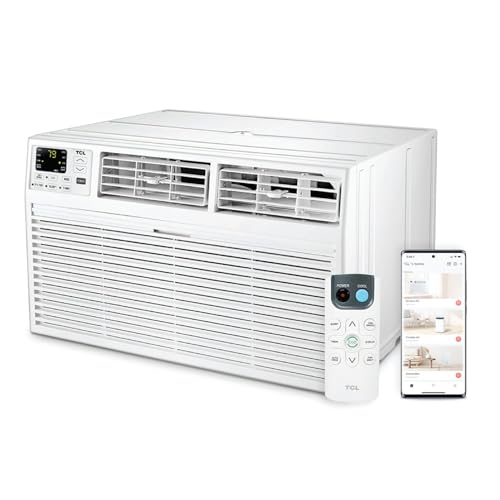
TCL 8,000 BTU Smart Through-the-Wall Air Conditioner with Heater,115V WiFi | 115V, Wall Mounted, Heater, Dehumidifier, Remote Control, Works with Alexa and Google Assistant, Rooms up to 450 Sq.Ft.
Check price on Amazon
Durastar 8,000 BTU Through the Wall 115V Air Conditioner and Sleeve | 4200 BTU Supplemental Heating, Coverage area 350 square feet, Remote Included
Check price on Amazon
OLMO 8,000 BTU 115V Through-the-Wall AC, Cooling Only, with Wall Sleeve | Air Conditioner, Built-In Smart Kit, R-32 Eco-Friendly Refrigerant, Remote Included, 0.67 Ton
Check price on Amazon
Whirlpool 8,000 BTU Wall Air Conditioner, up to 350 Sq Ft., White | Supplemental Heat, Dehumidifier, Remote Control,for Apartment, Living Room and Small Rooms up to 350 Square Feet
Check price on Amazon