Air Conditioner Pump: The Complete Guide to Condensate Pumps and Drainage
Everything you need to know about the pump that keeps your air conditioner draining properly — how it works, which type fits your setup, how to size and install it, and how to troubleshoot common problems before they cause water damage.
Start LearningOn This Page
- What an Air Conditioner Pump Is and Why It Matters
- How a Condensate Pump Works
- Types of Air Conditioner Pumps
- Sizing and Choosing the Right Pump
- Installation and Drainage Routing
- Maintenance for Long-Term Reliability
- Troubleshooting Common Pump Problems
- When to Replace the Pump
- Frequently Asked Questions
AC Units Guide Philosophy: A well-informed homeowner makes confident decisions. Understanding how your air conditioner pump works — and how to keep it running — helps you protect your home from water damage and keep your cooling system operating efficiently.
What an Air Conditioner Pump Is and Why It Matters
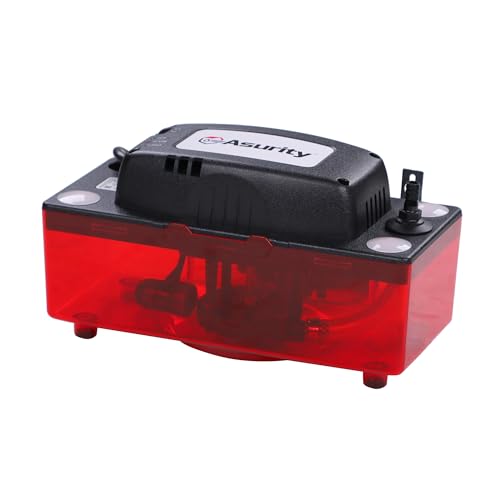
An air conditioner pump — most often called a condensate pump — is a small electric device that removes the water your AC produces as it cools the air. During normal operation, warm indoor air passes over the cold evaporator coil. Moisture in that air condenses on the coil, drips into a drain pan, and must then be carried away from the unit.
In many homes, gravity does the job: the drain pan is positioned so water flows down a sloped pipe to a floor drain, utility sink, or the outdoors. But not every installation allows that. When the indoor unit sits in a basement, attic, closet, or crawlspace where a downward slope to a suitable drain is impossible, an air conditioner pump becomes essential. It collects the water in a reservoir and pushes it upward or across a distance to a safe discharge point.
This matters because standing water is one of the most common causes of AC-related property damage. A failed or undersized pump can lead to overflowing drain pans, ceiling stains, soggy insulation, and in serious cases, mold growth and structural damage. Understanding the pump that handles your condensate — and knowing the warning signs of failure — is a practical investment in your home.
If you are diagnosing a cooling problem rather than a drainage problem, it helps to separate the two. A pump that has stopped working will usually trigger a safety switch and shut the system down, while cooling issues such as an AC that runs but does not cool often point to refrigerant, airflow, or compressor problems instead. Knowing which system is at fault saves time and avoids unnecessary service calls.
How a Condensate Pump Works
Most residential condensate pumps follow the same simple sequence:
- Collection: Water from the drain pan flows through a short inlet hose into a small reservoir inside the pump body.
- Level sensing: A float switch rises with the water level. Mechanical floats use a physical lever, while newer pumps may use electronic sensors.
- Activation: When the float reaches a set level, it closes the circuit and starts the pump motor.
- Discharge: The motor drives an impeller that pushes water out through a flexible discharge line to a distant drain point, often several feet above or away from the unit.
- Shutoff and safety: When the reservoir empties, the float drops and the pump stops. If water ever rises beyond the normal trigger point — for example because the discharge line is clogged — a secondary safety switch can shut off the AC to prevent overflow.
That last feature is worth emphasizing. Many modern pumps include a high-level safety switch that is wired into the air handler's control circuit. When the reservoir overfills, the switch interrupts the cooling call and stops the system before water spills onto the floor. If your AC shuts down unexpectedly on humid days and then restarts after a while, a tripped condensate safety switch is a strong suspect — and a good reason to inspect the pump and its discharge line promptly.
Pumps are typically rated by their lifting capacity (how high they can push water) and flow rate (gallons or liters per hour). A pump that is fine for a small mini-split in a closet may be completely inadequate for a large central system in an attic with a long, high run to the nearest drain.
Types of Air Conditioner Pumps
The market offers several families of pumps, each suited to different installations. Rather than comparing them by cost, it is more useful to think in terms of market position and application. The descriptors below — entry-level, mid-range, premium, and professional-grade — describe relative positioning within the category.
Standard Reservoir Condensate Pumps
The most common choice for residential central AC and mini-splits. These entry-level to mid-range units use a tank-and-float design and are well-suited to typical closet, basement, and attic installations with moderate lift requirements.
High-Lift and High-Capacity Pumps
Mid-range to premium models designed for long vertical runs, such as attic units discharging to a distant roof drain or basement units pumping up to a first-floor utility sink. They offer stronger motors and larger reservoirs.
Tankless / Low-Profile Pumps
Compact premium units that fit into tight spaces behind wall-mounted mini-splits or inside shallow closets. They trade reservoir capacity for a slim footprint and are popular in modern ductless installations.
Ductless Mini-Split Drain Pumps
Purpose-built small pumps for wall-mounted indoor heads. Often mid-range in positioning, they are quiet, compact, and designed to integrate neatly with the line-set cover.
Condensate Removal Pumps for Furnaces and Air Handlers
Heavier-duty professional-grade pumps for whole-home systems, including high-efficiency furnaces that produce acidic condensate. These often include neutralizer compatibility and robust safety switching.
Peristaltic and Diaphragm Pumps
Specialty designs for low-flow, high-head applications or where debris tolerance matters. Typically premium to professional-grade and used in commercial or unusual residential layouts.
For most homeowners replacing an existing pump, matching the original type and capacity is the simplest path. If you are designing a new installation, the next section covers how to size the pump correctly.
Sizing and Choosing the Right Pump
Two numbers drive pump selection: the volume of condensate your system produces and the total lift plus run required to reach a drain. Getting either wrong leads to short cycling, overflow, or premature failure.
Estimating Condensate Volume
As a rule of thumb, a residential AC produces roughly 0.5 to 1 gallon of condensate per hour per ton of cooling capacity in humid conditions, and less in dry climates. A 3-ton central system in a humid summer might therefore generate 1.5 to 3 gallons per hour at peak. Choose a pump whose rated flow comfortably exceeds your peak production — typically at least double the expected hourly volume.
Calculating Lift and Run
Measure the vertical distance from the pump to the highest point of the discharge line (the lift) and the horizontal distance to the drain (the run). Most manufacturers publish a performance curve showing flow at various lift heights. A pump rated for 15 feet of lift may only move a trickle at that height, so select a model that delivers adequate flow at your actual lift. Long horizontal runs add friction, so keep discharge lines as short and straight as practical.
| Tier | Typical Application | Best For |
|---|---|---|
| Entry-level | Standard closet or basement installations, short lift | Basic residential replacement |
| Mid-range | Attic units, moderate lift, long runs | Most central AC systems |
| Premium | High lift, quiet operation, compact spaces | Mini-splits and tight installations |
| Professional-grade | Furnace condensate, commercial duty, continuous operation | High-efficiency furnaces and whole-home systems |
Beyond capacity, look for features that improve reliability: a high-level safety switch, a check valve to prevent backflow, vibration isolation for quiet operation, and a removable reservoir or easy-clean design. These details separate a pump that lasts a decade from one that needs attention every season.
Installation and Drainage Routing
Proper installation is as important as pump selection. Even a premium pump will fail early if it is mounted poorly or discharges into a restricted line.
Placement
- Mount the pump on a stable, level surface close to the drain pan, ideally below the pan outlet so water flows in by gravity.
- Keep the pump accessible for inspection and cleaning — avoid burying it behind finished walls.
- Isolate vibration with rubber feet or a mounting pad to reduce noise transmitted through the structure.
Discharge Line Routing
- Use the manufacturer-recommended tubing size; undersized line increases back pressure and shortens motor life.
- Avoid kinks, sharp bends, and long horizontal traps that can collect water and promote algae growth.
- Route the discharge to a code-compliant destination: a utility sink, floor drain, condensate neutralizer, or approved exterior location. Never terminate where water can pool against the foundation or create a slip hazard.
- Install an inline check valve if the pump does not include one, to prevent water from draining back into the reservoir after each cycle.
Electrical and Safety
Most residential pumps plug into a standard outlet near the unit, but the safety switch is typically wired into the air handler's low-voltage circuit by a technician. If you are replacing a pump and the wiring looks unfamiliar, have a qualified HVAC professional handle the connection. Proper integration ensures the system shuts down safely if the pump ever fails.
During installation it is also a good time to inspect the drain pan itself. A cracked or rusted pan will undermine any pump — see our guidance on drip pan replacement if yours shows signs of wear. And if the indoor coil is dirty or icing, condensate production can spike unexpectedly; cleaning the evaporator coil helps keep drainage predictable.
Maintenance for Long-Term Reliability
Condensate pumps are simple machines, but they live in a wet environment and are exposed to dust, biofilm, and mineral deposits. A few minutes of routine care each season dramatically extends service life.
- Inspect the reservoir: Remove the tank (if removable) and check for slime, sediment, or debris. Rinse with warm water and a mild cleaner.
- Test the float: Gently lift the float to confirm the pump activates, then lower it to confirm shutoff. A sticky float is a leading cause of overflow.
- Flush the discharge line: Pour a cup of water mixed with a little white vinegar through the line periodically to dissolve biofilm and keep flow unrestricted.
- Check the safety switch: Confirm it interrupts the cooling call when the reservoir is full; this is best done during a professional maintenance visit.
- Inspect hoses and fittings: Look for cracks, loose clamps, or brittle tubing and replace as needed before they leak.
Pairing pump maintenance with your broader seasonal routine is efficient. A seasonal AC checklist that includes filter changes, coil inspection, and a pump test keeps the whole system healthy. If your system is making unusual noises that seem to come from the pump area, our guide to AC making loud noise inside the house can help you isolate the source.
Troubleshooting Common Pump Problems
Most pump problems fall into a handful of categories. Use this quick diagnostic list to narrow things down before calling a technician.
| Symptom | Likely Cause | First Step |
|---|---|---|
| Water pooling around indoor unit | Clogged discharge line, stuck float, or failed motor | Check discharge tubing for kinks and clear the reservoir |
| Pump hums but does not move water | Impeller jammed by debris or seized bearing | Disconnect power, inspect impeller, clean or replace pump |
| AC shuts down on humid days | High-level safety switch tripped | Inspect pump and discharge line; reset after clearing the fault |
| Pump runs continuously | Float stuck in the up position or check valve missing | Test float movement; verify check valve installation |
| Water backs up into the pan | Discharge line clogged or routed uphill incorrectly | Flush the line and verify proper lift and slope |
It is also worth distinguishing a pump problem from a cooling problem. If the indoor unit is running but the space is not getting cool, and there is no water on the floor, the pump may be fine and the issue may lie elsewhere — for example, an AC that is on but not producing cold air or a fan that runs without moving air. Conversely, if you see water in the pan and the system has shut down, the pump or its safety circuit is the prime suspect.
Persistent leaks can also originate outside the pump. Water appearing near the ceiling or inside a wall may indicate a blocked primary drain line or a frozen coil, not a pump failure. Our guides to AC leaking water through the ceiling and AC leaking water inside the wall cover those scenarios in detail.
When to Replace the Pump
Condensate pumps are consumable components, not lifetime parts. Most residential units last somewhere between five and ten years depending on water quality, duty cycle, and maintenance. Replacement is usually the right call when:
- The motor is noisy, smells hot, or fails to start even after cleaning.
- The housing is cracked or the reservoir no longer seals properly.
- The safety switch has failed and cannot be reliably repaired.
- The pump no longer meets the lift or flow requirements of a changed installation.
Replacing a like-for-like pump is a manageable task for a confident homeowner, but it still involves electrical safety and drainage routing. If you are unsure, a qualified technician can complete the swap quickly and verify that the safety switch is properly integrated. Our page on air conditioner pump replacement walks through the process step by step.
Upgrading to a model with a higher lift rating or a more robust safety switch is often worthwhile if your current pump has needed repeated attention. It is a long-term investment in reliability rather than a recurring repair cycle.
Frequently Asked Questions
What does an air conditioner pump do?
An air conditioner pump, commonly called a condensate pump, collects the water that forms on the evaporator coil and moves it to a drain location away from the unit. It is essential when gravity drainage is not possible.
How do I know if my AC pump is failing?
Common signs include water pooling around the indoor unit, a humming pump that does not move water, frequent safety switch trips, and visible overflow from the reservoir. Addressing these early prevents water damage.
Can I install a condensate pump myself?
Replacing a like-for-like pump is often a manageable DIY task for a confident homeowner, but new installations, electrical work, and drainage routing are best handled by a qualified HVAC technician to ensure code compliance.
How often should a condensate pump be cleaned?
At least once per cooling season, and more often in humid climates or dusty environments. Regular cleaning prevents biofilm and sediment from jamming the float or impeller.
Why does my AC shut off when the pump runs?
Many pumps include a high-level safety switch wired into the system. If the reservoir overfills because the discharge line is blocked, the switch interrupts cooling to prevent overflow. Clearing the blockage and resetting the system usually resolves it.
Can a condensate pump be used for a furnace?
High-efficiency furnaces also produce condensate, but it is acidic. Use a pump rated for furnace condensate, ideally paired with a neutralizer, rather than a standard AC pump.
Bottom line: Your air conditioner pump is a small component with a big job. Choosing the right type and capacity, installing it correctly, and giving it a few minutes of care each season will keep your system draining reliably and protect your home from water damage. When in doubt, consult a qualified HVAC professional — and keep learning before you buy.