
Air Conditioning Unit for Living Room: The Complete Selection Guide
The living room is the space where families gather, guests are entertained, and quiet evenings unfold. Choosing the right air conditioning unit for this space means balancing cooling power, noise levels, energy efficiency, and installation practicality. This guide walks you through every decision point so you can select a unit that delivers lasting comfort without guesswork.
Explore Recommended UnitsWhy the Living Room Demands a Thoughtful AC Choice
A living room is rarely just a room. It is a multi-purpose environment where people watch television, read, host gatherings, and relax. That variety creates cooling challenges that a bedroom does not present. Occupancy fluctuates throughout the day, electronics and lighting add heat load, and large windows can introduce significant solar gain. A unit that is too small will struggle to keep up during peak afternoon hours, while an oversized unit will cool the air too quickly without removing humidity, leaving the room feeling clammy.
The living room also tends to be the space where noise is least welcome. Conversation, television audio, and quiet reading all suffer when a compressor or fan hums intrusively. This is why noise specifications deserve as much attention as cooling capacity when you are comparing a air conditioning unit for living room use. A unit that cools effectively but disrupts the atmosphere of the room has not solved the real problem.
Finally, the living room is usually the most visible part of the home. Guests see it, and the indoor unit becomes part of the interior design. A wall-mounted mini-split, a discreet floor unit, or a well-integrated window unit all make different visual statements. The best choice is one that fits both the room's thermal profile and its aesthetic character.
Air Conditioner Types That Suit a Living Room
Not every AC format works well in a living room. The right choice depends on whether you own or rent, whether the room has exterior walls and windows, and how much installation work you are prepared to undertake. The four categories below cover the realistic options for most homes.
Ductless Mini-Split
A wall-mounted indoor head connected to an outdoor condenser by a small refrigerant line. Mini-splits are exceptionally quiet indoors, highly efficient, and preserve window space. They are the strongest long-term investment for a living room that is used daily, though they require professional installation and a suitable exterior wall for the line set.
Window Air Conditioner
A self-contained unit that sits in a double-hung window. Window units are straightforward to install and remove, making them popular with renters. The trade-offs are visible installation, some window obstruction, and higher indoor noise than a mini-split. Modern inverter window units have narrowed the noise gap considerably.
Portable Air Conditioner
A floor-standing unit on casters that vents exhaust air through a window hose. Portability is the main advantage, but portable units are generally less efficient than window or mini-split alternatives and occupy floor space. They suit temporary setups and rooms where permanent installation is not possible.
Central Air Conditioning
If your home already has ductwork, extending central cooling to the living room is often the most seamless option. Central systems distribute conditioned air invisibly and can be zoned for independent control. The decision hinges on duct condition and whether the existing system has spare capacity.
Homeowners exploring options for a living room without ductwork often find that a mini-split offers the best balance of comfort and efficiency. Renters and those in temporary housing usually gravitate toward window or portable units. For a broader comparison of formats, see the guide on air conditioning options for homes without ductwork. If your living room window is an unusual shape, the article on air conditioners for windows that open sideways addresses the fitting challenges directly.
How to Size an Air Conditioner for Your Living Room
Sizing is the single most consequential decision in this process. Cooling capacity is measured in British Thermal Units (BTU). An undersized unit runs continuously and never quite reaches the set temperature, while an oversized unit short-cycles, which reduces dehumidification and accelerates wear on the compressor. The goal is a unit that runs in long, steady cycles during the hottest part of the day.
A simplified starting point is to multiply the room's square footage by 20 BTU. However, that baseline assumes average ceiling height, moderate window area, and two occupants. Real living rooms rarely match those assumptions, so adjustments are necessary.
| Living Room Size | Baseline BTU | Typical AC Format | Best For |
|---|---|---|---|
| Up to 150 sq ft | 5,000 – 6,000 BTU | Window or portable | Compact apartments and studios |
| 150 – 250 sq ft | 8,000 – 10,000 BTU | Window or small mini-split | Standard living rooms |
| 250 – 400 sq ft | 12,000 – 14,000 BTU | Mini-split or large window | Open-plan living and dining areas |
| 400 – 600 sq ft | 18,000 – 24,000 BTU | Mini-split or central | Large great rooms |
| 600+ sq ft | 24,000+ BTU | Central or multi-zone mini-split | Whole-floor living spaces |
Adjust the baseline upward for each of the following conditions: ceilings taller than eight feet, large west- or south-facing windows, poor insulation, a kitchen adjacent to the living area, more than two regular occupants, or substantial electronic heat sources such as a home theater setup. Adjust downward for heavily shaded rooms or rooms in mild climates. If you want a more precise approach, the guide on choosing an air conditioner unit for a room walks through the full calculation in detail.
Efficiency Ratings and What They Mean for a Living Room
Because living rooms often run for six to ten hours a day during cooling season, efficiency has an outsized influence on long-term operating performance. The two metrics that matter most are SEER2, which measures cooling efficiency over a season, and EER2, which measures efficiency at peak outdoor temperature. Higher numbers indicate greater efficiency. In the United States, the minimum SEER2 threshold varies by region, and ENERGY STAR certification indicates performance above the federal baseline.
Compressor technology matters as much as the rating. Inverter-driven compressors modulate their speed continuously rather than switching on and off at full power. In a living room, this translates to steadier temperatures, quieter operation, and better humidity control. If you are weighing the two approaches, the comparison of inverter versus non-inverter air conditioners is essential reading before you commit. For rooms where the unit will run for long stretches, an inverter model is almost always the more sensible choice.
It is also worth checking whether a unit carries ENERGY STAR certification, since qualifying models meet stricter efficiency criteria and may be eligible for utility rebates. The article on ENERGY STAR window air conditioners explains how certification is verified and what it means in practice.
Features Worth Prioritizing in a Living Room AC
Beyond capacity and efficiency, certain features materially improve the living room experience. Noise level is arguably the most underrated specification. Measured in decibels, a quiet unit in the low 40s or below is barely noticeable during conversation, while a louder unit in the mid-50s competes with television audio. When comparing models, look for sound pressure ratings rather than vague marketing claims.
Airflow direction control matters in a room where people sit for extended periods. Adjustable louvers and swing modes let you direct cool air along the ceiling rather than at seated occupants. Smart connectivity is another feature that has matured; Wi-Fi-enabled units allow scheduling and remote control, which is useful for pre-cooling the living room before you arrive home. The guide on Wi-Fi air conditioners covers compatibility and app quality considerations.
If anyone in the household has allergies, a unit with a multi-stage filtration system or an integrated air purifier can add meaningful value. The article on air conditioners with built-in air purifiers compares filtration approaches. Self-cleaning functions, which dry the evaporator coil after shutdown to inhibit mold growth, are a worthwhile convenience in humid climates.
- Sound rating in the low 40s dB or below for conversation-friendly operation
- Inverter compressor for stable temperature and humidity control
- Adjustable airflow louvers and swing mode
- Programmable timer or Wi-Fi scheduling
- Washable or replaceable filter with accessible front panel
- Auto-restart after power interruption
- Sleep or eco mode for evening use
Placement and Installation Considerations
Where the unit sits determines how evenly the room cools. For a wall-mounted mini-split, position the indoor head high on a wall that allows the airflow to travel across the seating area rather than directly onto it. Avoid mounting above heat sources such as televisions, fireplaces, or radiators, and keep the unit away from direct sunlight, which can confuse the temperature sensor. The outdoor condenser needs clear space on all sides for heat rejection and should not be enclosed in a tight alcove.
Window units should be installed on a wall that receives the least direct afternoon sun, ideally on the north or east side. Secure the unit with a proper bracket and ensure a slight outward tilt so condensate drains correctly. If drilling is not an option, the article on window brackets without drilling describes safer alternatives. Portable units need a window or sliding door for the exhaust hose; keep the hose as short and straight as possible to avoid efficiency losses.
Electrical capacity deserves early attention. A 12,000 BTU window unit may draw enough current to require a dedicated circuit, and mini-splits almost always do. Confirm the circuit rating and outlet type before installation to avoid mid-summer surprises. If the living room shares a circuit with other heavy loads, an electrician should evaluate the panel before you finalize the purchase.
Maintenance Habits That Extend Your Unit's Lifespan
A living room AC works hard, and regular maintenance is what keeps it performing at its rated efficiency. The single most important task is cleaning or replacing the filter every four to six weeks during active use. A clogged filter restricts airflow, forces the compressor to work harder, and can lead to coil freezing. Most units have a washable filter that can be rinsed and dried in minutes.
Beyond the filter, schedule a professional tune-up at the start of each cooling season. A technician will clean the coils, check refrigerant charge, inspect electrical connections, and verify that the condensate drain is clear. Skipping this step is one of the most common reasons units lose capacity over time. The guide on air conditioner service and maintenance outlines what a thorough seasonal service should include. If you notice the unit running constantly without reaching the set temperature, the article on an air conditioner running constantly but not cooling helps you diagnose the cause before it becomes a repair.
Keep the outdoor condenser clear of debris, leaves, and vegetation. A unit that cannot reject heat efficiently will consume more energy and wear out faster. In coastal or dusty environments, more frequent coil cleaning is advisable.
Recommended Air Conditioning Units for Living Rooms
⚠️ AFFILIATE DISCLOSURE: This website contains affiliate links. As an Amazon Associate, we earn from qualifying purchases. If you make a purchase through these links, we may receive a small commission at no additional cost to you. Read our full affiliate policy.

Midea 5,000 BTU EasyCool Small Window Air Conditioner - Cool up to 150 Sq. Ft. with Easy-to-Use Mechanical Controls and Reusable Filter, Perfect for Small Bedroom, Living Room, Home Office
Check price on Amazon
GE Window Air Conditioner 5,000 BTU AC Unit for Small Spaces up to 150 sq ft with Manual Controls & 2 Cooling Modes, Easy Install Kit, White
Check price on Amazon
10,000BTU Energy Saving Portable Air Conditioners for Rooms up to 550 Sq Ft | Self-Evaporating Portable AC Unit with Remote Control&24H Timer, Cool/Dry/Fan/Sleep, LED Display&Installation Kits for Home
Check price on Amazon
Midea 10,000 BTU U Shaped Window Air Conditioner, Cools up to 450 Sq Ft | Ultra Quiet U-Shaped Design, Inverter Control, Open Window Flexibility, Alexa/Google Assistant, 37% Energy Savings, 2026 New
Check price on Amazon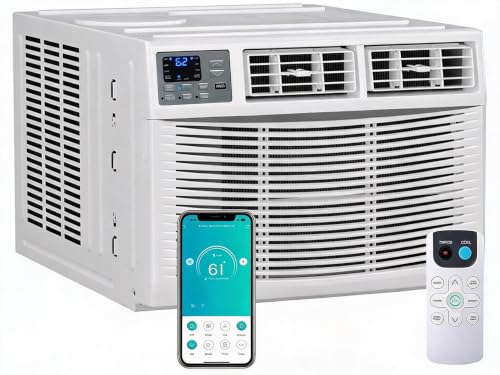
18000 BTU Window Air Conditioner & Heater Combo – APP & Remote Control | Dehumidifier, Fan Efficient Cooling & Heating for Rooms up to 1000 Sq Ft – Ideal for Apartment, Living Room, Bedroom
Check price on Amazon
14000 BTU Portable Air Conditioner | Cools Rooms up to 750 Sq. Ft., with Remote Control & Window Kit, for Home, Bedroom, Office Use
Check price on Amazon
DELLA 6000 BTU Energy Saving Window Air Conditioner, Cools Up to 250 Sq. Ft | WIFI Smart Controls, GEO Location, Work with Alexa, Easy Install,Reusable Filter,Remote, Dehumidifier, Fan
Check price on Amazon
Windowless Air Conditioner & Heater Combo Unit 2000W White,55cm | Ductless Wall Mount AC for Garage & Apartment, No Hose Needed, Portable Heating Fan with Touch & 2-8H Timer
Check price on AmazonFrequently Asked Questions
What size air conditioning unit do I need for my living room?
Living rooms typically need between 8,000 and 14,000 BTU depending on square footage, ceiling height, window exposure, and occupancy. A 300 square foot living room generally requires around 8,000 BTU, while a 500 square foot open-plan living area may need 12,000 BTU or more. Always perform a proper load calculation rather than relying on square footage alone.
Which type of AC is best for a living room?
Ductless mini-split systems are often the best choice for living rooms because they are quiet, energy efficient, and do not require ductwork. Window and portable units suit renters or rooms without installation options, while central air remains ideal for whole-home cooling where ductwork already exists.
Should I choose an inverter or non-inverter AC for a living room?
An inverter AC is generally recommended for living rooms because it maintains a more stable temperature, runs quieter, and uses less energy over extended periods of use, which suits the long daily operating hours typical of a living room.
Where should I place an air conditioning unit in a living room?
Place the indoor unit on a wall that allows even airflow across the seating area, avoid directing cold air at people or heat sources, keep it away from direct sunlight and obstructions, and ensure the outdoor unit has adequate clearance for heat rejection.
Does a living room AC need a dedicated electrical circuit?
Larger living room units, especially those above 12,000 BTU or mini-splits, often require a dedicated circuit and may run on 240V. Check the nameplate rating and consult a licensed electrician to confirm your panel and wiring can safely support the unit.