
Dehumidifier for Basement: Complete Buyer's Guide
Excess moisture is the most common basement problem in American homes. This guide explains how basement dehumidifiers work, how to size one correctly, which features matter, and how to maintain the unit so your below-grade space stays dry, odor-free, and healthy year-round.
Explore Dehumidifier TypesA basement is naturally prone to dampness. Soil surrounding the foundation releases water vapor, cool concrete surfaces encourage condensation, and limited airflow traps humid air indoors. When relative humidity climbs above 50 percent, mold, mildew, musty odors, and structural deterioration follow quickly. A dedicated dehumidifier for basement use is the most reliable way to keep that humidity in check without relying on guesswork.
This guide is written for homeowners who already know they need a dehumidifier and are now deciding which type, capacity, and feature set will actually solve their basement moisture problem. You will find sizing guidance, a comparison of compressor versus desiccant technology, placement advice, maintenance routines, and a structured FAQ. Once you finish reading, you will be ready to choose a unit with confidence.
Why Your Basement Needs a Dehumidifier
Basements sit below grade, which means they are in constant contact with soil moisture. Hydrostatic pressure pushes water vapor through concrete walls and floors, a process known as capillary action. Because basement air is cooler than the rest of the house, that vapor condenses on cold surfaces, feeding mold colonies and rusting metal fixtures. Finished basements with carpet and drywall are especially vulnerable because organic materials absorb moisture and stay damp for long periods.
The consequences go beyond odor. Persistent humidity above 60 percent accelerates wood rot, weakens drywall joints, damages stored furniture and documents, and can aggravate respiratory conditions for sensitive occupants. Many homeowners first notice the problem as a musty smell or condensation on pipes and windows. If you are unsure whether moisture is already an issue, a simple humidity meter will confirm whether a dehumidifier is warranted. For a broader look at household moisture control, read our guide on decreasing humidity in your house.
A properly sized dehumidifier keeps the basement between 40 and 50 percent relative humidity. At that level, mold spores cannot easily establish, stored items remain dry, and the air feels fresher. It is a modest investment that protects the entire structure above it, since moisture migrating upward can affect living spaces on the first floor.
Key insight: Basement dehumidification is not seasonal in most climates. Even in winter, cool foundation walls create condensation points. A unit with a low-temperature operating range or a desiccant design is often the better long-term choice for unfinished basements.
Compressor vs Desiccant: Choosing the Right Technology
Two core technologies dominate the residential market, and the right choice depends largely on the temperature of your basement. Compressor units use a refrigeration cycle to condense moisture on cold coils. Desiccant units pass air over a moisture-absorbing wheel that is regenerated with heat. Each design excels in different conditions.
Compressor Dehumidifiers
Most efficient above 65 degrees Fahrenheit. These are the standard choice for finished, heated basements. They deliver strong moisture removal per unit of energy and are available across all capacity tiers. Performance drops noticeably in cold spaces, and coils can frost below 60 degrees Fahrenheit unless the model includes a defrost cycle.
Desiccant Dehumidifiers
Effective at temperatures as low as 40 degrees Fahrenheit. Ideal for unfinished basements, crawl spaces, and unheated storage areas. They are lighter and more portable but generally use more energy than compressor units at warm temperatures. Choose this technology when cold-weather operation is a priority.
Whole-House Dehumidifiers
Ducted units integrated with your HVAC system. They condition the entire basement and sometimes the whole home through existing ductwork. Professional-grade installation is typical, and these systems are the most effective option for large or chronically damp basements. A ducted dehumidifier is the natural fit when ductwork already exists.
Crawl Space Dehumidifiers
Heavy-duty units engineered for low-clearance spaces and harsh conditions. They typically feature sealed housings, remote humidistats, and condensate pumps. If your basement includes an adjacent crawl space, this category deserves separate consideration.
If you are also considering cooling equipment, it helps to understand the boundary between the two technologies. A dehumidifier removes moisture but does not meaningfully cool air, while an air conditioner cools and dehumidifies as a side effect. Our comparison of dehumidifier vs AC explains where each excels. A dehumidifier is not a replacement for air conditioning, and an AC alone will not control basement humidity in a cold, below-grade space. For homes that need both functions, consider whether a whole-house dehumidifier makes sense alongside your existing cooling system.
How to Size a Dehumidifier for Your Basement
Capacity is expressed in pints of moisture removed per 24 hours. Undersizing leaves the space damp, while oversizing wastes energy and short-cycles the compressor. Use square footage and moisture severity as starting points, then adjust for temperature and dampness.
| Basement Size | Moderate Dampness | Heavy Dampness | Recommended Tier |
|---|---|---|---|
| Up to 500 sq ft | 20 pints | 30 pints | Entry-level |
| 500 – 1,000 sq ft | 30 pints | 50 pints | Mid-range |
| 1,000 – 1,500 sq ft | 50 pints | 70 pints | High-end tier |
| Over 1,500 sq ft | 70 pints | Whole-house system | Professional-grade |
These figures assume a standard eight-foot ceiling and typical foundation conditions. Add capacity for any of the following: visible standing water, persistent musty odor, exposed dirt floors, laundry equipment in the basement, or frequent condensation on pipes. In very cold basements, favor a desiccant model or a compressor unit with an explicit low-temperature rating. If your home also has a crawl space or an attic with moisture issues, a separate unit may be needed for each zone. Related reading: do I need a dehumidifier in my house.
Placement and Drainage Setup
Position the dehumidifier in the most humid zone of the basement, ideally near the center of the space so air circulates evenly. Keep at least 12 inches of clearance around the unit for airflow. Do not place it inside a closed closet or corner, where it will recirculate its own exhaust. If the basement is divided into rooms, choose a central location or run a fan to distribute air.
Drainage is often overlooked. A unit with only a small internal tank requires frequent emptying, which is impractical for a damp basement. Prefer a model with a continuous drain hose connection and route the hose to a floor drain, sump pit, or utility sink. If no gravity drain exists, a built-in or add-on condensate pump solves the problem. The same principles that govern drain pump setup for AC units apply to dehumidifier drainage.
For homes with existing ductwork, a ducted dehumidifier can be integrated directly into the HVAC system, distributing dry air throughout the basement and improving performance in adjoining rooms. This approach also avoids the "damp pocket" problem that plagues single-room portables in large, compartmented basements.
Features That Matter
Feature sets vary widely, and some are far more useful than others. The following list covers what actually affects day-to-day usability in a basement.
- Built-in humidistat: Lets the unit cycle automatically to a target humidity level. This is the single most valuable feature for continuous basement operation.
- Continuous drain: Essential for unattended operation. Pair it with a condensate pump if no gravity drain is available.
- Auto-defrost: Prevents coil icing in cool basements. Compressor units without defrost struggle below 60 degrees Fahrenheit.
- Low-temperature operation: A must for unheated basements. Desiccant units handle this natively; compressor units need explicit ratings.
- Washable filter: Reduces maintenance overhead and protects the coil. A clogged filter is the most common cause of reduced performance.
- Digital controls and auto-restart: Useful during power interruptions and for precise humidity targeting.
- Remote humidistat or Wi-Fi: Convenient for large homes or when the unit sits in an inconvenient location.
- Casters or handles: Practical if you plan to move the unit seasonally between basement zones.
Keep expectations realistic about noise. Compressor units produce a steady hum comparable to a small refrigerator; desiccant units can be slightly louder. If the basement is a living space, prioritize a model with a quiet fan setting or plan to locate the unit away from seating areas.
Market Tiers Explained
Basement dehumidifiers fall into broad market tiers that reflect build quality, capacity, and feature depth. These descriptors are relative to one another and remain stable over time, unlike currency-based comparisons.
| Tier | Typical Capacity Range | Best For | Build Characteristics |
|---|---|---|---|
| Entry-level | 20 – 30 pints | Small finished basements, closets, occasional use | Lightweight housing, basic mechanical humidistat, manual tank |
| Mid-range | 30 – 50 pints | Average basements up to 1,000 sq ft | Digital controls, auto-defrost, continuous drain port |
| High-end tier | 50 – 70 pints | Large or heavily damp basements | Reinforced housing, quiet fan modes, improved filtration |
| Professional-grade | 70+ pints or whole-house | Whole-home systems, crawl spaces, commercial-grade use | Sealed components, remote humidistat, duct integration, condensate pump |
Higher tiers generally justify themselves in continuous-duty applications. A mid-range model that runs all summer in a 900-square-foot basement will outlast and outperform an entry-level unit pressed into the same role. Conversely, an entry-level unit is a solid choice for a small, lightly damp basement used only for storage. The key is matching the tier to the duty cycle, not to a notional budget bracket.
For households that already own a portable air conditioner with a dehumidify mode, note that those modes are supplementary. A dual-hose portable AC with dehumidifier function can help in shoulder seasons, but a dedicated basement dehumidifier remains the primary tool for continuous moisture control. Likewise, if you are comparing dehumidifier designs, our overview of different kinds of air conditioning units helps clarify where each category fits.
Maintenance Routine
A basement dehumidifier runs for long stretches, often around the clock during humid months. Consistent maintenance keeps it efficient and extends service life.
- Clean or replace the filter every two to four weeks during peak season. A clogged filter forces the compressor to work harder and reduces moisture removal.
- Empty or check the drain line weekly. If using continuous drainage, confirm the hose is not kinked and the outlet is clear.
- Inspect the coils quarterly. Dust buildup on evaporator coils reduces efficiency. Vacuum gently or follow the manufacturer's cleaning instructions.
- Check the humidistat calibration seasonally. A separate humidity meter provides an independent reading so you can confirm the unit is reaching its target.
- Store the unit properly off-season. Empty the tank, clean the filter, and cover the unit to prevent dust ingress if it is not used year-round.
- Schedule professional service every two to three years for high-end and professional-grade units, especially ducted systems integrated with HVAC.
Watch for warning signs: frost on the coils, water pooling around the base, a compressor that runs without collecting water, or a persistent musty smell despite continuous operation. These usually indicate a refrigerant issue, a blocked drain, or a failing humidistat, and prompt attention prevents larger problems. For broader household air quality maintenance, see our guide on DIY HVAC repair.
Pro tip: Run the dehumidifier continuously at 45 percent relative humidity during humid months rather than cycling it on and off manually. Stable humidity prevents mold from gaining a foothold and reduces strain on the compressor.
Ready to Compare Basement Dehumidifier Options?
Browse our curated selection of basement dehumidifiers across capacity tiers and technology types. Each listing includes specifications, feature summaries, and direct links to learn more.
View Recommended ModelsRecommended Dehumidifiers for Basement
⚠️ AFFILIATE DISCLOSURE: This website contains affiliate links. As an Amazon Associate, we earn from qualifying purchases. If you make a purchase through these links, we may receive a small commission at no additional cost to you. Read our full affiliate policy.

SEMKAP 2500 Sq. Ft Dehumidifier for Basement, 30Pint Dehumidifiers for Home
Check price on Amazon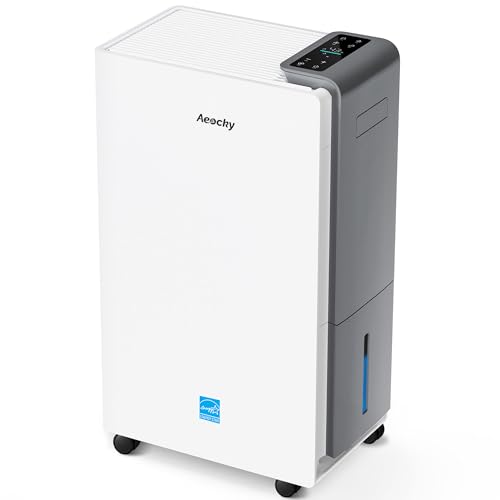
AEOCKY 5500 Sq.Ft Energy Star Most Efficient 2025 Dehumidifier for Basement | Max 80 Pint/D, Dehumidifier with Drain Hose for Home, Large Room, Bedroom, Bathroom, Intelligent Humidistat
Check price on Amazon
BEDRED Dehumidifier, 95Oz Dehumidifier for Home 1000 Sq.Ft | Quiet, Auto Shutoff, Sleep Mode, 7 Color Ambient Light for Bedroom, Bathroom, Basement (Black)
Check price on Amazon
Waykar 80 Pints 5000 Sq. Ft 2025 Energy Star Dehumidifier for Basement | 90° Auto Swing, 30%–80% Humidity Control for home, Continuous drainage support, Whole-House Dehumidification, Auto-defrost
Check price on Amazon
KNKA 2500 Ft² Max 34 Pints Dehumidifier for Basement with Drain Hose, White | Dehumidifiers for Home, Bedroom, Bathroom, Large Room, Three Modes, Intelligent Humidity Control, Dry Clothes, 24HR Timer
Check price on Amazon
Dehumidifier,4500 Sq.Ft Energy Star Dehumidifier for Basement,Drain Hose | Humidity Control and Auto Shut-off,Quiet Smart Compressor for Home, Bathroom, Garage and Large Rooms
Check price on Amazon
4500Sq.Ft dehumidifier for basement with Drain Hose Energy Star | Intelligent Humidity Control, 90° Adjustable Air Outlet, 24-hour Timer,Child Lock, Drying Clothes, 1.72 Gal Tank, for Bedroom
Check price on Amazon
ToLife Dehumidifier, 1000 Sq Ft 95 oz Tank with Sleep Mode, Auto Shutoff | Portable for Home, Bedroom, Bathroom and Basement with 7-Color LED Light, Grey
Check price on AmazonFrequently Asked Questions
What size dehumidifier do I need for my basement?
For a basement up to 500 square feet with moderate dampness, an entry-level 20-pint unit is usually sufficient. For spaces between 500 and 1,000 square feet, a mid-range 30 to 50-pint model works well. For basements over 1,000 square feet or with heavy moisture, choose a high-end tier 70-pint unit or a whole-house dehumidifier.
Do I need a desiccant or compressor dehumidifier for my basement?
Compressor dehumidifiers are more efficient in warm conditions above 65 degrees Fahrenheit, which suits most finished basements. Desiccant dehumidifiers continue to perform in cold temperatures below 60 degrees Fahrenheit, making them the better choice for unfinished or unheated basements and crawl spaces.
How often should I empty the dehumidifier tank?
In a damp basement, the tank may need emptying once or twice a day. If you connect a continuous drain hose, you can avoid manual emptying entirely, which is a recommended setup for whole-house or high-capacity units.
What humidity level should I set my basement dehumidifier to?
Aim for a relative humidity between 40 and 50 percent. This range discourages mold growth, protects stored items, and prevents musty odors without making the space uncomfortably dry.
Can a dehumidifier replace an air conditioner in the basement?
No. A dehumidifier removes moisture but does not cool the air the way an air conditioner does. For full comfort in a finished basement, you may need both. Understanding the difference between a dehumidifier and an AC helps you choose the right combination.
Choosing a dehumidifier for a basement comes down to three decisions: technology, capacity, and drainage. Match the technology to your basement temperature, size the capacity to your square footage and moisture severity, and plan a continuous drain so the unit can operate unattended. From there, features like auto-defrost, a built-in humidistat, and washable filtration separate a reliable long-term performer from a seasonal stopgap.
If your basement also lacks cooling or has broader air quality concerns, explore related topics such as decreasing humidity in your house and whether a dehumidifier is right for your home. A dry, stable basement protects your home's structure and creates usable living space. The right unit makes that outcome routine.