Window AC Unit Cost: A Complete Buying Guide
Understand what shapes the market position of a window air conditioner — from BTU capacity and efficiency ratings to build quality and smart features — so you can choose the right tier for your room and your needs.
Explore the GuideA window air conditioner remains one of the most practical ways to cool a single room without modifying ductwork or committing to a whole-home system. If you have been comparing options, you have likely noticed that two units of similar size can sit in very different positions in the market. That gap is not random — it reflects real differences in capacity, efficiency, build quality, noise control, and smart features.
This guide explains what shapes the market tier of a window AC unit so that you can match a unit to your room and your priorities. Whether you need a simple starter-tier cooler for a bedroom or a high-end tier model with inverter technology and app control, understanding these factors helps you make a decision you will be comfortable with for years.
Quick orientation: A window unit's position in the market is driven mainly by four things — cooling capacity (BTU), energy efficiency rating, compressor technology, and feature set. Build quality and noise control then separate units within the same capacity band.
Key Factors Behind the Market Position
Before comparing specific models, it helps to understand the variables that consistently separate one tier from another. These are the levers manufacturers use to position a unit, and they are the same levers you should use when evaluating whether a model fits your needs.
- Cooling capacity (BTU): The single largest driver. A 5,000 BTU unit for a small bedroom is fundamentally a different product than a 12,000 BTU unit for a large living space. Capacity determines the compressor size and the physical dimensions of the unit.
- Energy efficiency rating (CEER/EER): Higher-efficiency units use better compressors, improved coils, and more precise controls. This is one of the clearest signals of which tier a model belongs to.
- Compressor technology: Fixed-speed compressors are typical of entry-level models. Inverter compressors — which modulate speed continuously — are found in mid-range and premium units and deliver steadier temperatures and quieter operation.
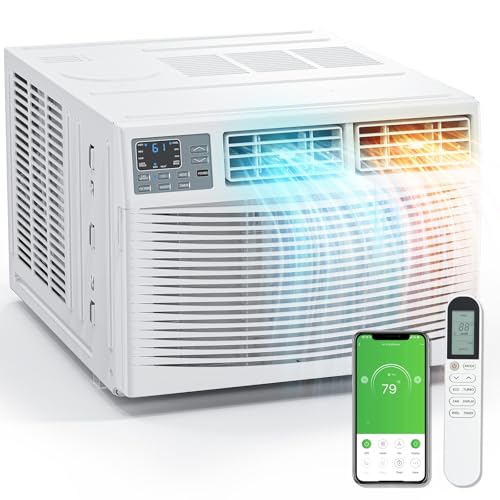
- Feature set: Remote controls, programmable timers, sleep modes, Wi-Fi connectivity, voice assistant support, and washable or self-cleaning filters all add to a unit's position in the market.
- Build quality and noise control: Heavier cabinets, better insulation, and quieter fans separate premium units from essential-tier ones, even when BTU ratings match.
- Installation hardware: Support brackets, window sealing kits, and accordion panels included in the box affect both safety and the completeness of the package.
When you read product listings, look beyond the headline BTU figure. The efficiency rating and compressor type tell you far more about how a unit will behave in daily use than capacity alone.
Entry-Level, Mid-Range, and Premium Tiers
To compare window AC units without relying on volatile figures, it helps to sort them into three broad tiers. These descriptors reflect where a model sits relative to others in its capacity class, based on construction, efficiency, and features — not on any specific figure.
| Tier | Typical Characteristics | Best For |
|---|---|---|
| Entry-level | Fixed-speed compressor, mechanical or basic electronic controls, standard filter, straightforward cabinet design. | Occasional use in bedrooms or guest rooms where simplicity and a compact footprint matter most. |
| Mid-range | Higher efficiency ratings, digital thermostat, remote control, sleep timer, improved fan and coil design, quieter operation. | Daily use in living rooms or home offices where comfort and running efficiency are priorities. |
| Premium | Inverter compressor, Wi-Fi and app control, voice assistant support, washable or self-cleaning filters, reinforced cabinet, lowest noise levels. | Primary living spaces, smart homes, and buyers who want precise temperature control and long-term efficiency. |
These tiers are relative, not absolute. A mid-range 8,000 BTU unit may offer a better overall experience than a premium unit with mismatched capacity for your room. Always match capacity first, then choose the tier that fits your priorities.
Capacity Tiers by Room Size
Capacity is measured in British Thermal Units (BTU). Selecting the right capacity is the most important decision you will make, because an undersized unit will struggle on hot days and an oversized unit will short-cycle, leaving the room feeling clammy. Use the table below as a starting point, then adjust for sun exposure, ceiling height, and the number of occupants.
| Capacity Band | Typical Room Size | Common Use Case |
|---|---|---|
| 5,000 – 6,000 BTU | Up to 150 sq ft | Bedrooms, small home offices, dorm rooms |
| 8,000 – 10,000 BTU | 150 – 250 sq ft | Medium bedrooms, living areas, guest rooms |
| 12,000 – 14,000 BTU | 250 – 400 sq ft | Large living rooms, open-plan spaces |
| 15,000 – 18,000 BTU | 400 – 550 sq ft | Large rooms, small studios, open areas |
| 20,000 – 25,000 BTU | 550 – 800 sq ft | Large living areas, multi-room open spaces |
If you are unsure about capacity, a more precise approach is to calculate the load based on square footage, insulation, sun exposure, and occupancy. For a deeper walkthrough, see our guide on how to size an air conditioner and the BTU calculator by room size.
For very small rooms, our 5,000–6,000 BTU window AC guide covers the entry tier in detail. For mid-sized rooms, the 8,000–10,000 BTU category is the most common starting point. Larger living spaces generally fall into the 12,000–14,000 BTU range.
Efficiency and Long-Term Running Considerations
Efficiency is the second major factor shaping a window unit's market position. The combined energy efficiency ratio (CEER) expresses how much cooling a unit delivers per unit of electricity consumed. Higher CEER ratings indicate a more efficient unit, which typically uses better compressors, improved coils, and more precise controls.
Efficiency matters most for units that run for many hours per day. In a bedroom used only at night, the difference between tiers is modest. In a living room that runs through the afternoon, a higher-efficiency unit in the mid-range or premium tier will generally deliver more consistent comfort and steadier energy use over the season.
Look for the ENERGY STAR label: Certified window units meet a higher efficiency threshold than the federal minimum. If long-term running efficiency is a priority, browse energy-efficient window air conditioners and ENERGY STAR window units with Wi-Fi.
For a broader explanation of efficiency metrics, see what a SEER rating is and what an EER rating is. Those guides apply mainly to central systems, but the underlying principles — higher ratings mean better efficiency — carry over to window units as well.
Installation and Setup Considerations
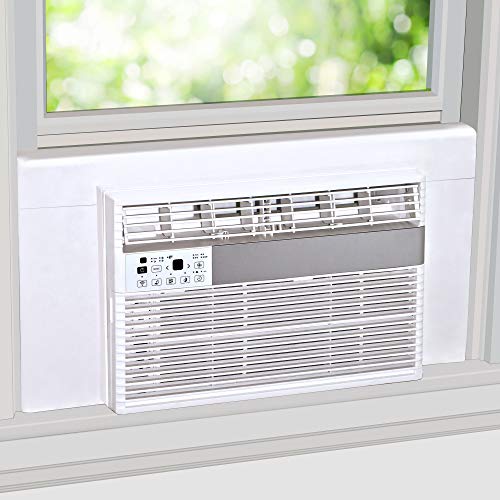
Most window AC units are designed for do-it-yourself installation. Units up to roughly 12,000 BTU usually include an accordion panel kit and a support bracket, and can be installed in a standard double-hung window in under an hour. Larger units — typically above 15,000 BTU — are heavier and may require two people or a professional for safe installation.
Before installing, confirm three things: the window opening matches the unit's minimum and maximum width, there is a nearby grounded outlet on a dedicated circuit, and the window frame can bear the unit's weight with the included support bracket. If you plan to install the unit yourself, our step-by-step guides on how to install an air conditioner in a window and how to put in a window AC unit cover the process in detail.
If your window is not suitable — for example, a casement window or a wall that cannot support a bracket — a through-the-wall installation or a portable unit may be a better fit. For portable options, see our guide to easy-to-use portable air conditioners.
How to Choose the Right Unit
With the factors above in mind, here is a practical sequence for choosing a window AC unit:
- Measure your room. Calculate square footage and note ceiling height, sun exposure, and how many people use the room. This determines your capacity band.
- Decide how often the unit will run. Occasional use favors the entry-level tier. Daily use in a primary living space favors mid-range or premium tiers with better efficiency and quieter operation.
- Check the efficiency rating. If the unit will run for many hours per day, prioritize a higher CEER and look for the ENERGY STAR label.
- Consider smart features. Wi-Fi control, scheduling, and voice assistant support are convenient if you want to manage cooling remotely. They are hallmarks of the premium tier.
- Verify the installation requirements. Confirm window dimensions, outlet type, and whether the included bracket suits your window. If not, factor in a support kit.
- Read reviews on noise and durability. Noise level and build quality separate units within the same capacity band, and reviews from long-term owners are the best signal.
If you are still deciding between a window unit and other cooling options, our comparison of window air conditioners and portable air conditioners may help you narrow the field. For homes without suitable windows, ductless mini-split systems are a more permanent alternative.
Frequently Asked Questions
What factors affect a window AC unit's market position the most?
Capacity (BTU), energy efficiency rating, compressor technology, and feature set are the biggest factors. Higher-BTU units with inverter compressors and Wi-Fi controls sit in a higher tier than basic entry-level models with fixed-speed compressors.
Is a higher BTU window AC always better?
No. An oversized unit cools too quickly and short-cycles, which hurts dehumidification and efficiency. Match BTU to room size and heat load for the best results. Our sizing guide explains the calculation in detail.
Do window AC units require professional installation?
Most units up to about 12,000 BTU are designed for DIY installation with the included bracket or support kit. Heavier units and through-the-wall conversions may need a professional for safety and to comply with local requirements.
How long does a window AC unit typically last?
With regular filter cleaning and seasonal maintenance, a well-built window unit commonly lasts 8 to 12 years. Mid-range and premium units with better coils and compressors tend to hold their performance longer than entry-level models under heavy use.
Can a window AC unit heat as well as cool?
Some models include a heat pump or electric heating element, but most window units are cooling-only. If you need year-round comfort from a single unit, look for a model with a heat pump function, or consider a ductless mini-split heat pump system for a more capable solution.
What is the difference between CEER and EER for window units?
EER measures efficiency at a single test condition, while CEER accounts for standby power and seasonal variation, making it a better real-world indicator for window units. Higher CEER means more efficient operation over a cooling season.