
How Much Is a Wall Mounted Air Conditioner?
A complete research guide to wall mounted air conditioning systems — how they work, what sizing and efficiency factors matter, how installation is approached, and how to choose the right system for a room, apartment, or whole home.
Start With the BasicsResearch first, decide with confidence. If you are reading this page, you likely already know you want a wall mounted air conditioner and are comparing system types, features, and efficiency before choosing a product. This guide answers the questions that come up most often during that research stage, so you can evaluate options on equal terms.
What This Guide Covers
- What a wall mounted air conditioner actually is
- How wall mounted systems work
- Single-zone vs. multi-zone configurations
- Sizing: BTU and load calculation
- Efficiency ratings that matter (SEER2, HSPF2)
- Market tiers and what each tier typically delivers
- Installation considerations
- Maintenance and long-term ownership
- How to decide between options
- Frequently asked questions
What a Wall Mounted Air Conditioner Actually Is
A wall mounted air conditioner is the indoor component of a ductless mini-split system. It is a slim, rectangular unit mounted high on a wall, usually near the ceiling, that blows conditioned air directly into the room. It connects to an outdoor condenser unit through a small bundle of refrigerant lines, power wiring, and condensate drainage that passes through a single hole in the wall.
Unlike a window air conditioner, a wall mounted unit does not sit in a window opening, and unlike central air conditioning, it does not rely on a network of ducts. That distinction matters for how the system is sized, installed, and maintained. If you are comparing wall units against window units, the guide to heat and air conditioner window units covers the trade-offs in detail.
Wall mounted systems are popular in homes without existing ductwork, in additions and converted spaces, in apartments where window units are restricted, and in rooms that central systems do not reach well. They are also common in commercial spaces such as offices, small retail areas, and server rooms, where a single room needs independent temperature control.
How Wall Mounted Systems Work
The system operates on a standard refrigeration cycle. The indoor wall unit pulls room air through a filter and across an evaporator coil. The coil absorbs heat from the air, cooling it, and a blower pushes the cooled air back into the room. A fan inside the wall unit distributes that air, and adjustable louvers direct it horizontally and vertically.
The absorbed heat travels as refrigerant through the line set to the outdoor condenser, where a compressor raises the refrigerant pressure and a fan releases the heat to the outside air. The refrigerant then returns to the indoor coil to repeat the cycle. In systems with a heat pump, the cycle can reverse to provide heating in cooler months, which is why wall mounted units are often described as year-round comfort systems rather than cooling-only devices.
Condensate forms on the indoor coil as humidity condenses out of the air. It drains through a condensate line, typically to the outside of the building. Proper condensate management is one of the details that separates a well-installed system from a problematic one, and it is worth confirming with any installer you evaluate.
Inverter vs. Non-Inverter Operation
Most modern wall mounted systems use inverter compressors. An inverter compressor can vary its speed continuously rather than switching fully on and off, which allows it to match the cooling load more precisely. In practice, this often means more stable room temperatures, quieter operation at partial load, and better efficiency during long running periods. Non-inverter systems still exist at the entry-level end of the market and can be appropriate for lightly used rooms, but inverter technology has become the default for mid-range and premium wall mounted units.
If you want a deeper comparison of these two architectures, see our article on heat pump vs. air conditioner, which also explains how the compressor technology affects year-round performance.
Single-Zone vs. Multi-Zone Configurations
A single-zone wall mounted system pairs one indoor wall unit with one outdoor condenser. It is the most straightforward configuration and is ideal for a single room, a studio apartment, a converted garage, or a home office. Installation is simpler, and the system is easier to maintain because there is only one indoor unit to service.
A multi-zone system connects two to five indoor units (which can be wall mounted, ceiling cassette, or floor mounted) to a single outdoor condenser. Each indoor unit has its own temperature control, so different rooms can be kept at different setpoints. Multi-zone systems are common in whole-home retrofits and in homes where ductwork is impractical. The trade-off is a more complex installation and a higher reliance on a single outdoor unit: if the condenser fails, every zone is affected.
If your plan is to cool an entire house rather than one or two rooms, it is worth comparing wall mounted multi-zone systems against other approaches. Our guides to ductless heating and air conditioning units and hidden ductless mini-splits explain where each configuration tends to fit best.
Sizing: BTU and Load Calculation
Sizing is the single most important technical decision for a wall mounted air conditioner. An undersized unit will struggle to reach the setpoint on hot days, run continuously, and wear out faster. An oversized unit will cool quickly but will not remove humidity effectively, and it may cycle on and off in short bursts, which feels uncomfortable and reduces efficiency.
Contractors use a load calculation, often referred to as a Manual J calculation in North America, to determine the correct capacity. It accounts for room dimensions, ceiling height, insulation quality, window area and orientation, air infiltration, occupancy, and local climate. A common rule of thumb is roughly 20 BTU per square foot of floor area, but that shortcut ignores too many variables to be reliable on its own.
| Room Scenario | Typical Capacity Band | Best For |
|---|---|---|
| Small bedroom or home office | 9,000 – 12,000 BTU | Single occupant, standard insulation |
| Medium living room | 12,000 – 18,000 BTU | Open-plan layouts, average window area |
| Large living area or open kitchen | 18,000 – 24,000 BTU | High ceilings, multiple windows |
| Studio apartment (whole unit) | 12,000 – 18,000 BTU | Single-zone wall mounted system |
| Whole home (multi-zone) | Zone-by-zone calculation | Two to five indoor units on one condenser |
For a more detailed walkthrough, the air conditioning unit overview expands on sizing logic for different building types. If you are comparing a wall unit against a central system for a whole house, air conditioner for a house explains how load calculations scale up.
Efficiency Ratings That Matter
Efficiency ratings tell you how much cooling or heating a system delivers per unit of electricity. For wall mounted systems, the two ratings that matter most are SEER2 for cooling and HSPF2 for heating. Both are updated versions of older metrics, aligned with current US Department of Energy standards.
Higher ratings generally indicate a more efficient system, but the practical benefit depends on how much the system runs and how extreme your climate is. A high-efficiency inverter unit in a hot climate that runs for many hours per day will usually deliver more noticeable efficiency gains than the same unit in a mild climate used intermittently. Efficiency also interacts with sizing: a correctly sized unit will operate closer to its rated efficiency than an oversized or undersized one.
For a full explanation of the metrics, see our articles on SEER ratings and HSPF ratings. If you are evaluating energy-efficient models specifically, the guide to high-efficiency air conditioner units covers the trade-offs between efficiency tiers.
Market Tiers and What Each Tier Typically Delivers
Wall mounted air conditioners are sold across a range of market positions. Rather than focusing on transaction amounts, it is more useful to understand what each tier generally delivers in terms of build quality, features, and long-term performance. The descriptors below are consistent across this guide and are used in place of numeric comparisons.
| Tier | Typical Characteristics | Best For |
|---|---|---|
| Entry-level | Basic features, standard compressor technology, simpler controls | Occasional-use rooms, starter setups |
| Mid-range | Inverter compressors, quieter operation, better filtration options | Primary living spaces, daily use |
| Premium | Higher efficiency ratings, advanced airflow control, smart features | Whole-home systems, high-use rooms |
| Top-tier / flagship | Highest efficiency, premium materials, refined noise control, advanced connectivity | Luxury retrofits, professional installations |
The main practical difference between tiers is not a single specification but the combination of compressor technology, noise level, filtration, and control features. Entry-level models can perform well in light-duty situations, while mid-range models typically offer the most balanced feature set for everyday residential use. Premium and top-tier units make more sense when the system will run for long hours, when noise is a priority, or when the installation is part of a larger renovation.
Installation Considerations
Installation quality has a major effect on how a wall mounted system performs over its lifetime. The core steps are straightforward in concept but require care in practice: selecting the indoor unit location, mounting the backplate, drilling the wall penetration for the line set, running refrigerant and condensate lines, connecting the outdoor unit, and evacuating and charging the system.
Indoor unit placement should prioritize even air distribution and unobstructed airflow. Avoid mounting directly above heat sources, in corners where airflow is blocked, or where the unit would blow directly onto seating areas for long periods. The outdoor unit needs adequate clearance for airflow and should be positioned to minimize noise transmission into bedrooms and neighboring properties.
Electrical requirements vary by system capacity. Smaller single-zone systems may run on a dedicated 110V circuit, while larger and multi-zone systems typically require 240V. If you are unsure what your panel can support, our guide on 110V vs. 240V air conditioners explains the differences. For installations that involve a wall unit and a heating system together, the article on heating and air conditioning in one unit covers combined configurations.
Permitting requirements depend on the jurisdiction. Some areas require a permit for refrigerant line work and electrical connections; others have simplified processes for like-for-like replacements. The guide to installing a split air conditioner walks through the typical sequence of an installation project.
Maintenance and Long-Term Ownership
A wall mounted air conditioner is a long-term investment, and its service life depends heavily on maintenance. The most important routine task is filter cleaning. Filters should be checked monthly during heavy use and cleaned or replaced as needed. Clogged filters reduce airflow, force the system to work harder, and can lead to coil icing.
Beyond filters, annual professional maintenance should include coil cleaning, condensate drain inspection, refrigerant charge verification, and electrical connection checks. Outdoor units should be kept clear of debris, leaves, and snow. If the system is a heat pump, the reversing valve and defrost cycle should be included in the service checklist.
The article on HVAC cleaning and service provides a broader maintenance framework, and HVAC preventative maintenance explains what a structured maintenance plan typically includes. If you are maintaining a combined heating and cooling system, the furnace and air conditioner tune-up guide covers the dual-system checklist.
Typical Service Life
With proper installation and maintenance, a wall mounted system can provide reliable service well beyond a decade. Inverter compressors tend to have longer service lives than fixed-speed compressors when maintained correctly. The most common causes of premature failure are poor installation, neglected filters, refrigerant leaks from improperly flared connections, and electrical issues from undersized circuits.
How to Decide Between Options
At the research stage, the most useful approach is to evaluate wall mounted systems against a few clear criteria rather than trying to compare every specification at once:
- Room or whole-home scope. Decide whether you need a single-zone system for one room or a multi-zone system for several spaces. This determines the system architecture before any model comparison begins.
- Cooling vs. year-round comfort. If you need heating as well as cooling, prioritize heat pump models with strong HSPF2 ratings. If cooling is the only requirement, a cooling-only model may be simpler and easier to maintain.
- Efficiency tier. Match the efficiency rating to how much the system will run. High-use rooms and hot climates benefit most from premium and top-tier efficiency.
- Noise and airflow. Bedrooms and home offices benefit from quieter mid-range and premium models with refined fan control.
- Installation quality. The best model in the world underperforms if it is installed poorly. Choose an installer with refrigerant handling credentials and a clear commissioning process.
For related comparisons, see the guides on combined heating and air conditioning units, split system heating and air conditioning, and heat pump cooling and heating split systems. Each covers a slightly different configuration that may overlap with wall mounted systems depending on your home layout.
Ready to Compare Wall Mounted Options?
Once you have a clear picture of sizing, efficiency tier, and installation requirements, the next step is to compare specific models against your room requirements and climate.
Explore Model OptionsFrequently Asked Questions
What is a wall mounted air conditioner?
A wall mounted air conditioner is the indoor unit of a ductless mini-split system. It is installed high on a wall and delivers conditioned air directly into the room without ductwork, connecting to an outdoor condenser through a small wall penetration.
How does a wall mounted air conditioner work?
The indoor unit draws in room air, passes it over an evaporator coil to cool it, and blows it back into the room. Refrigerant carries absorbed heat to an outdoor condenser unit, which releases it outside. In heat pump models, the cycle can reverse for heating.
What size wall mounted air conditioner do I need?
Sizing depends on room area, ceiling height, insulation, window exposure, occupancy, and climate. A general starting point is around 20 BTU per square foot, but a professional load calculation is the most reliable method and is strongly recommended before purchase.
Are wall mounted air conditioners energy efficient?
Many wall mounted units are highly efficient, particularly inverter-driven models with high SEER2 ratings. Actual efficiency depends on the model tier, system design, sizing accuracy, and installation quality.
How long does a wall mounted air conditioner last?
With regular filter cleaning and annual professional maintenance, a well-installed wall mounted system can last well over a decade. Inverter models generally have longer service lives when maintained correctly.
Can a wall mounted air conditioner heat as well as cool?
Yes, if it is a heat pump model. Heat pump wall mounted systems can reverse the refrigerant cycle to provide heating in cooler months. Cooling-only models are also available and are simpler to maintain if heating is not required.
Related Reading
Recommended Wall Mounted Air Conditioners
⚠️ AFFILIATE DISCLOSURE: This website contains affiliate links. As an Amazon Associate, we earn from qualifying purchases. If you make a purchase through these links, we may receive a small commission at no additional cost to you. Read our full affiliate policy.

Windowless Air Conditioner & Heater Combo Unit 2000W White,55cm | Ductless Wall Mount AC for Garage & Apartment, No Hose Needed, Portable Heating Fan with Touch & 2-8H Timer
Check price on Amazon
BPTCUE Dual Use Compact Portable Wall Mounted Air Conditioner Hot Cold for Bedroom, 2 in 1 Air Conditioner Heater
Check price on Amazon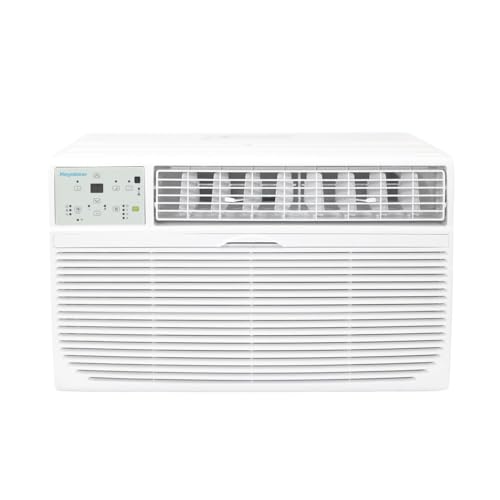
Keystone 12,000 BTU Wall Mounted AC Unit and Dehumidifier up to 550 Sq. Ft. | 115V, Remote Control , Wall Mounted, Quiet, High Efficiency AC for Bedroom, Bathroom, Nursery, and Medium Sized Rooms
Check price on Amazon
COSTWAY 12000BTU Mini Split Air Conditioner& Heater | 20 SEER2 115V Wall-Mounted Ductless AC Cools up to 750 Sq. Ft, Energy Efficient Inverter AC with Heat Pump
Check price on Amazon
LG 10,000 BTU Through the Wall Air Conditioner, 115V, Cools up to 440 Sq. Ft. for Bedroom, Living Room, Apartment, with Remote, 3 Cool & Fan Speeds, Wall AC Unit, White
Check price on Amazon
Keystone 8,000 BTU Wall Mounted Air Conditioner with Supplemental Heat and Dehumidifier Function, 115V, Wall AC for Small-Medium Sized Rooms up to 350 Sq.Ft. with Remote, Quiet, High Efficiency AC
Check price on Amazon
Wall-Mounted Air Conditioner Heater, 1800W PTC Heating, Quiet Operation, Remote Control, Timer, No Window Installation, Compact Portable Heater for Bedroom, Garage, RV, White (White)
Check price on Amazon
BLACK+DECKER Portable Air Conditioner, 10,000 BTU, BPACT10WT, White | 5,500 BTU SACC for Rooms up to 450 Sq. Ft., 3-in-1 Portable AC, Fan and Dehum with Follow Me Remote Control
Check price on AmazonDisclaimer
Some of the content on this site uses AI assistance. Information is provided for educational purposes only. We are not responsible for any losses resulting from the use of this information. By using this site, you waive any right to bring legal claims against us arising from your use of the information provided. If you do not agree, please do not use this site. Read the full disclaimer.